• We’re currently investigating an issue related to the forum theme and styling that is impacting page layout and visual formatting. The problem has been identified, and we are actively working on a resolution. There is no impact to user data or functionality, this is strictly a front-end display issue. We’ll post an update once the fix has been deployed. Thanks for your patience while we get this sorted.

Discussion Intel Meteor, Arrow, Lunar & Panther Lakes + WCL Discussion Threads

Page 469 - Seeking answers? Join the AnandTech community: where nearly half-a-million members share solutions and discuss the latest tech.

Tigerick

Senior member
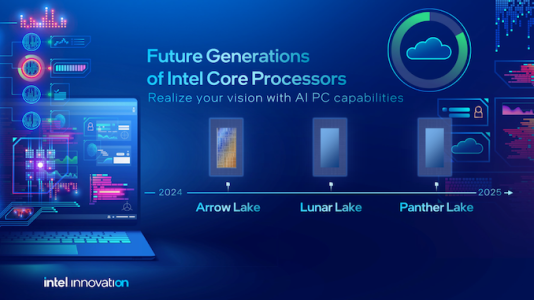
Wildcat Lake (WCL) Specs

Intel Wildcat Lake (WCL) is upcoming mobile SoC replacing Raptor Lake-U. WCL consists of 2 tiles: compute tile and PCD tile. It is true single die consists of CPU, GPU and NPU that is fabbed by 18-A process. Last time I checked, PCD tile is fabbed by TSMC N6 process. They are connected through UCIe, not D2D; a first from Intel. Expecting launching in Q1 2026.
Intel Raptor Lake UIntel Wildcat Lake 15WIntel Lunar LakeIntel Panther Lake 4+0+4
Launch DateQ1-2024Q2-2026Q3-2024Q1-2026
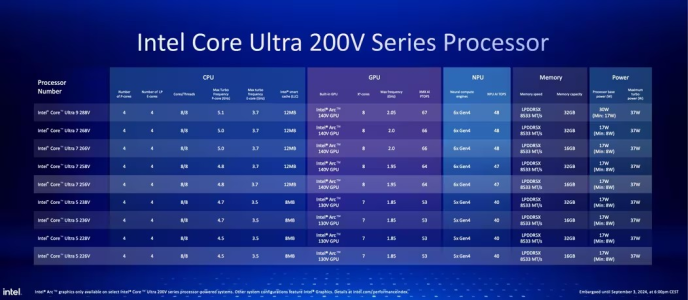
ModelIntel 150UIntel Core 7 360Core Ultra 7 268VCore Ultra 7 365
Dies2223
NodeIntel 7 + ?Intel 18-A + TSMC N6TSMC N3B + N6Intel 18-A + Intel 3 + TSMC N6
CPU2 P-core + 8 E-cores2 P-core + 4 LP E-cores4 P-core + 4 LP E-cores4 P-core + 4 LP E-cores
Threads12688
Max Clock5.4 GHz4.8 GHz5 GHz4.8 GHz
L3 Cache12 MB6 MB12 MB12 MB
TDP15 - 55 W15 - 35 W17 - 37 W25 - 55 W
Memory128-bit LPDDR5-520064-bit LPDDR5x-7467128-bit LPDDR5x-8533128-bit LPDDR5x-7467
Size96 GB48 GB32 GB128 GB
Bandwidth83 GB/s60 GB/s136 GB/s120 GB/s
GPUIntel GraphicsIntel GraphicsArc 140VIntel Graphics
RTNoNoYESYES
EU / Xe96 EU2 Xe8 Xe4 Xe
Max Clock1.3 GHz2.6 GHz2 GHz2.5 GHz
NPUGNA 3.017 TOPS48 TOPS49 TOPS


PPT1.jpg
PPT2.jpg
PPT3.jpg


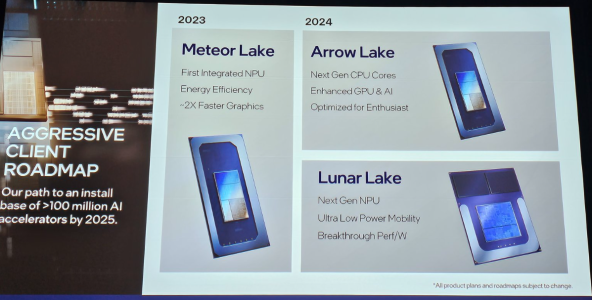
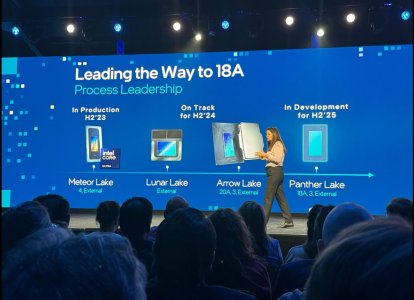
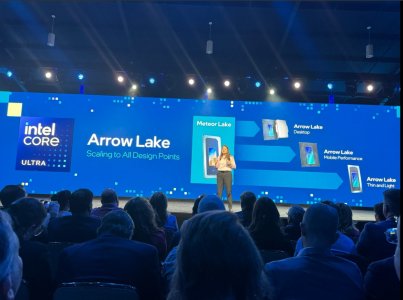
As Hot Chips 34 starting this week, Intel will unveil technical information of upcoming Meteor Lake (MTL) and Arrow Lake (ARL), new generation platform after Raptor Lake. Both MTL and ARL represent new direction which Intel will move to multiple chiplets and combine as one SoC platform.

MTL also represents new compute tile that based on Intel 4 process which is based on EUV lithography, a first from Intel. Intel expects to ship MTL mobile SoC in 2023.

ARL will come after MTL so Intel should be shipping it in 2024, that is what Intel roadmap is telling us. ARL compute tile will be manufactured by Intel 20A process, a first from Intel to use GAA transistors called RibbonFET.


LNL-MX.png
 

Attachments

  • PantherLake.png
    PantherLake.png
    283.5 KB · Views: 24,049
  • LNL.png
    LNL.png
    881.8 KB · Views: 25,534
  • INTEL-CORE-100-ULTRA-METEOR-LAKE-OFFCIAL-SLIDE-2.jpg
    INTEL-CORE-100-ULTRA-METEOR-LAKE-OFFCIAL-SLIDE-2.jpg
    181.4 KB · Views: 72,443
  • Clockspeed.png
    Clockspeed.png
    611.8 KB · Views: 72,329
Last edited:
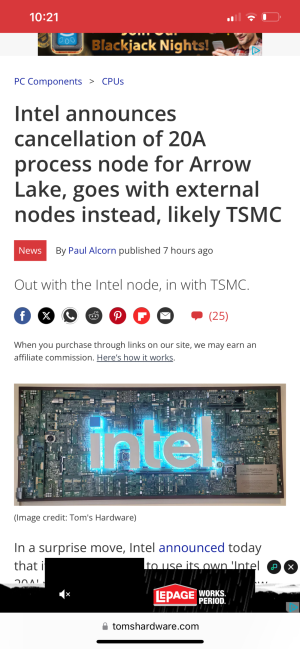
I had a feeling that Intel 20A would not see the daylight.
Their choice to focus on 18A instead of a internal node with no customers, saving 500mil is right by me.

The explanation that the low defect rates of 18A is leading the acceleration is also fine by me.

I can feel the pressure in this product, they need to bring it to the market no matter what, don't let perfect be the enemy of good enough or whatever the saying is.

Intel was telling anybody, who wanted to listen for the last 3.5 years that 18A will bring "unquestioned leadership".
So they themselves were setting the bar high.
There is indeed pressure there now to deliver.

Whether cancelling the 20A process with arguments, which enjoy the benefits of plausible deniability, I don't know.
No one forced Intel to introduce the 20A process, but they were more than happy to talk about it over the last years.
Now suddenly its a good idea to cancel it.
 
dude, we ain't getting ultra 3 chips with TSMC N3B, wake up 😁
Too expensive for intel. It's gonna be alder lake and raptor lake at the bottom (or bartlet lake 12+0, if it even comes out to regular people)

Also, ultra 3 was supposed to be 4+4. Because 6+4 is already ultra 5
Intel just said no 20a for ARL. U3 will be only use n3b Now.
 

Attachments

  • IMG_2999.png
    IMG_2999.png
    1.1 MB · Views: 76
I know, and I'm saying that there won't be ultra 3 chip on n3b. That means no ultra 3 chip, at all. In the lower end we're stuck with Alder, Raptor, and probably Bartlet.
There are recent rumors of Ultra 3 Arrow Lake chips: https://videocardz.com/newz/intel-r...ultra-3-205-215-arrow-lake-desktop-processors

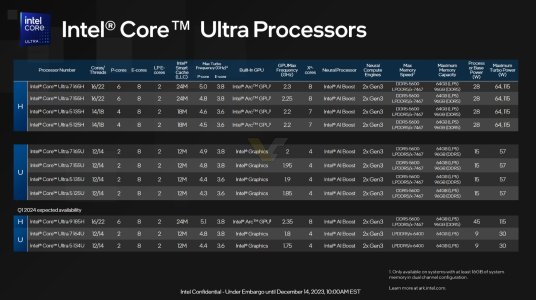
My personal bet is that the Ultra 3 Arrow Lake chips will be the 65 W Meteor Lake i5 chips rebranded (135H and 125H become the 215 and 205). All Intel would need to do is disable an E core cluster and use the power that would have gone to that cluster to bump up the clock speeds. If I am correct, then that puts the Ultra 3 chips on Intel 4.
 
Interesting how a year ago, this roadmap was leaked, and it seems like intel was already prepared to for 20A to not be available. Nothing here is reliant on Intel 20A. Purple is N3, Light blue is intel 4 + N6, and dark blue is intel 7.

The only product that was reliant on 20A was Non-K i3 and i5 on desktop if I recall.

edit: RPL-U and RPL-H is just ADL-U and ADL-H chips with no changes, so intel will be milking 2+8 snd 6+8 alder lake for 4 years straight (2022, 2023, 2024, 2025), if not more. Alder lake forever!
View attachment 106875
20A was never for Mobile. So it never interfered with Mobile ARL plans.
dude, we ain't getting ultra 3 chips with TSMC N3B, wake up 😁
Too expensive for intel. It's gonna be alder lake and raptor lake at the bottom (or bartlet lake 12+0, if it even comes out to regular people)

Also, ultra 3 was supposed to be 4+4. Because 6+4 is already ultra 5
Raichu said that there's a 4+4 Ultra 3. That should be a cutdown 6+8 die that will be fully fabbed on N3B now.
 
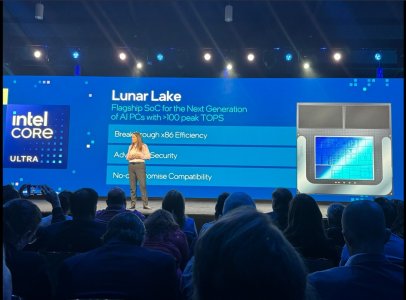
Lunar goodness
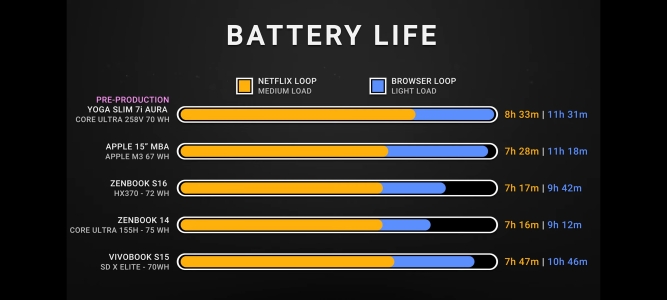
I wonder how much of the battery life advantage over the Zenbook S16 HX370 that is otherwise very similar is due to the LCD vs. OLED display? I can't wait for some near identical/like laptops so we can get a better idea exactly how the CPU's/platforms compare.
 
I wonder how much of the battery life advantage over the Zenbook S16 HX370 that is otherwise very similar is due to the LCD vs. OLED display? I can't wait for some near identical/like laptops so we can get a better idea exactly how the CPU's/platforms compare.
Yup zenbook uses oled but mac is mini led IPS
 
I wonder how much of the battery life advantage over the Zenbook S16 HX370 that is otherwise very similar is due to the LCD vs. OLED display? I can't wait for some near identical/like laptops so we can get a better idea exactly how the CPU's/platforms compare.

Yeah, LCD vs OLED actually makes it not that impressive of a battery life improvement. We'll see how other models turn out (hopefully better), but I'd say this is actually a disappointing result given that battery life was supposed to be one of the primary strengths for LNL.
 
Mac pros are mini LED IPS with high refresh rate ... Mac airs are just regular IPS panels at 60 Hz..
60hz is just cheating at this point lol iirc LNL strix have has 120hz display
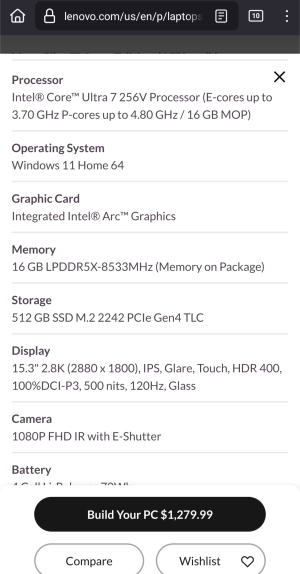
$1400 for 32GB 258V I don't know what to say tbh not that expensive but not cheap as well
 

Attachments

  • Screenshot_20240905-230655.png
    Screenshot_20240905-230655.png
    340 KB · Views: 41
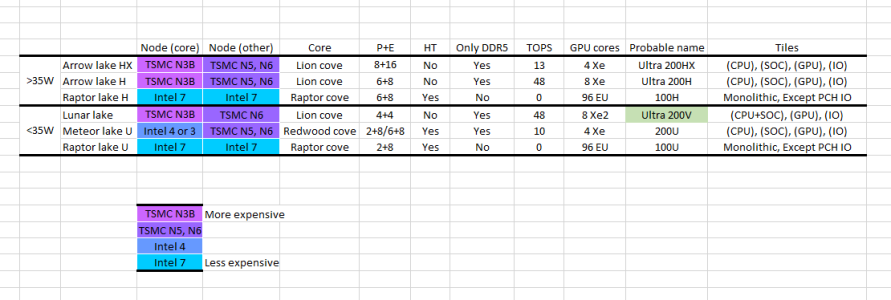
I was confused a bit about intel and their 2025 stuff, decided to make a table for myself, wanna shareView attachment 106884
Lunarlake has two tiles not three. Only IO is separated.
Lunar goodness
All garbage. Barely 10 hours with a 70WHr battery. Rarely any of them are using FHD displays so we're basically back to pre-Haswell level efficiency.

The gaming results are beating Strix at least, and the thermals/power is better.
 
Last edited:
Pre-Haswell would struggle a lot in a current test like this. Light load is high load for Pre-Haswell, no hardware decoding and light browsing is more likely heavy browsing on Haswell.
 
All garbage. Barely 10 hours with a 70WHr battery. Rarely any of them are using FHD displays so we're basically back to pre-Haswell level efficiency.
That test was ran with 30 W power average. The same chip could run that same system with about half that power--probably even less. Performance would be worse, but you'd get at least 20 hours.

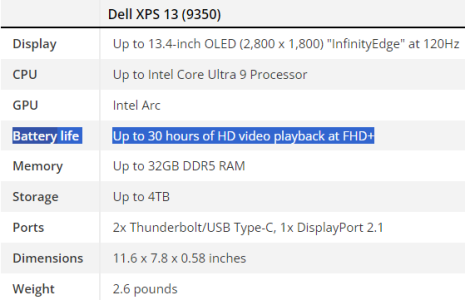
Dell XPS 13 is getting almost 30 hours FHD+ video playback with Lunar Lake with I think is a 55 Whr battery. https://www.tomsguide.com/computing...longest-laptop-battery-life-ever-what-we-know
1725562138085.png
 
Last edited:
Pre-Haswell would struggle a lot in a current test like this. Light load is high load for Pre-Haswell, no hardware decoding and light browsing is more likely heavy browsing on Haswell.
I'm not talking about specialized accelerators added in the later generations. They could have took Sandy Bridge and added those too, but that wouldn't have addressed the lack of fundamental efficiency gains.

The last big gain was with Haswell, and before that it was Pentium M when they brought idle down by introducing dynamic speedstep. Before that TDP was more correlated with battery life.

According to Dave's test he's talking about 10-20% gain over Meteorlake as some big deal. There's nothing to be excited about based on his tests. My 2017 Yoga does 7-8W too with heavy browsing.
That test was ran with 30 W power average. The same chip could run that same system with about half that power. Performance would be worse, but you'd get ~20 hours.
??!? Think about what you are saying. You can't get 10 hours on a 70WHr battery with 30W power average. It's 7W average.
 
Back
Top