• We’re currently investigating an issue related to the forum theme and styling that is impacting page layout and visual formatting. The problem has been identified, and we are actively working on a resolution. There is no impact to user data or functionality, this is strictly a front-end display issue. We’ll post an update once the fix has been deployed. Thanks for your patience while we get this sorted.

Discussion Intel Meteor, Arrow, Lunar & Panther Lakes + WCL Discussion Threads

Page 353 - Seeking answers? Join the AnandTech community: where nearly half-a-million members share solutions and discuss the latest tech.

Tigerick

Senior member
Wildcat Lake (WCL) Specs

Intel Wildcat Lake (WCL) is upcoming mobile SoC replacing Raptor Lake-U. WCL consists of 2 tiles: compute tile and PCD tile. It is true single die consists of CPU, GPU and NPU that is fabbed by 18-A process. Last time I checked, PCD tile is fabbed by TSMC N6 process. They are connected through UCIe, not D2D; a first from Intel. Expecting launching in Q1 2026.
Intel Raptor Lake UIntel Wildcat Lake 15WIntel Lunar LakeIntel Panther Lake 4+0+4
Launch DateQ1-2024Q2-2026Q3-2024Q1-2026
ModelIntel 150UIntel Core 7 360Core Ultra 7 268VCore Ultra 7 365
Dies2223
NodeIntel 7 + ?Intel 18-A + TSMC N6TSMC N3B + N6Intel 18-A + Intel 3 + TSMC N6
CPU2 P-core + 8 E-cores2 P-core + 4 LP E-cores4 P-core + 4 LP E-cores4 P-core + 4 LP E-cores
Threads12688
Max Clock5.4 GHz4.8 GHz5 GHz4.8 GHz
L3 Cache12 MB6 MB12 MB12 MB
TDP15 - 55 W15 - 35 W17 - 37 W25 - 55 W
Memory128-bit LPDDR5-520064-bit LPDDR5x-7467128-bit LPDDR5x-8533128-bit LPDDR5x-7467
Size96 GB48 GB32 GB128 GB
Bandwidth83 GB/s60 GB/s136 GB/s120 GB/s
GPUIntel GraphicsIntel GraphicsArc 140VIntel Graphics
RTNoNoYESYES
EU / Xe96 EU2 Xe8 Xe4 Xe
Max Clock1.3 GHz2.6 GHz2 GHz2.5 GHz
NPUGNA 3.017 TOPS48 TOPS49 TOPS


PPT1.jpg
PPT2.jpg
PPT3.jpg


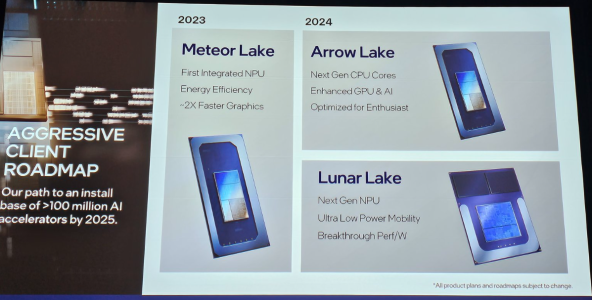
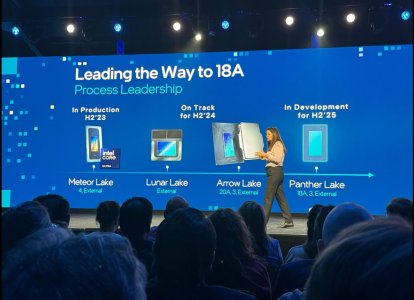
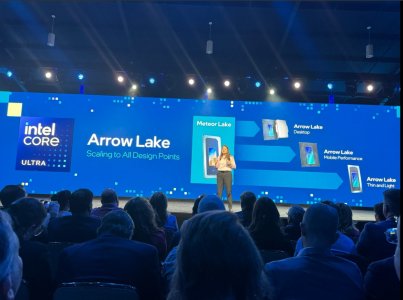
As Hot Chips 34 starting this week, Intel will unveil technical information of upcoming Meteor Lake (MTL) and Arrow Lake (ARL), new generation platform after Raptor Lake. Both MTL and ARL represent new direction which Intel will move to multiple chiplets and combine as one SoC platform.

MTL also represents new compute tile that based on Intel 4 process which is based on EUV lithography, a first from Intel. Intel expects to ship MTL mobile SoC in 2023.

ARL will come after MTL so Intel should be shipping it in 2024, that is what Intel roadmap is telling us. ARL compute tile will be manufactured by Intel 20A process, a first from Intel to use GAA transistors called RibbonFET.


LNL-MX.png
 

Attachments

  • PantherLake.png
    PantherLake.png
    283.5 KB · Views: 24,049
  • LNL.png
    LNL.png
    881.8 KB · Views: 25,534
  • INTEL-CORE-100-ULTRA-METEOR-LAKE-OFFCIAL-SLIDE-2.jpg
    INTEL-CORE-100-ULTRA-METEOR-LAKE-OFFCIAL-SLIDE-2.jpg
    181.4 KB · Views: 72,443
  • Clockspeed.png
    Clockspeed.png
    611.8 KB · Views: 72,329
Last edited:
From all the sources I have seen there is no HT on ARL-S. Every source says this and we got some from Intel too. It is very very unlikely. From what we know only some server variants might ship with HT enabled.
But then will Arrow be limited to only 8P+16E=>24 threads, when even the predecessor had 32?
Ok, Arrow should still be more performant, but even so It looks like a regression.

P.S. I hope there is no additional E cluster just for idle.
 
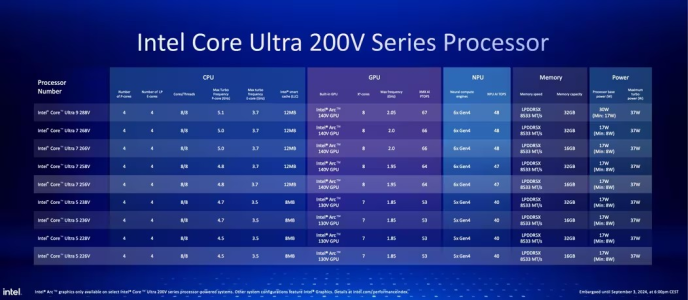
Lunar Lake can scale upto 30W TDP, but it's also supposed to be used in fanless laptops.

What's the maximum TDP a fanless laptop would support?
 
~10% die area is committed to HT? That's hard to believe. Also the extra power consumption only occurs when the HT core is forced to handle two threads, no?
All the structures required for HT don't disappear when HT isn't active. Even if they're clock gated to avoid all dynamic power they'll still use some amount of static power.

Regarding the 10% core die area to enable HT, keep in mind that also includes the many security structures which are only necessary for a HT enabled core.
 
Lunar Lake can scale upto 30W TDP, but it's also supposed to be used in fanless laptops.

What's the maximum TDP a fanless laptop would support?

Well, the best point of comparison would be an M3 Macbook Air. It seems to be able to sustain 10/11W of power with (very) short bursts at 20W. Notebookcheck.

The rumor from leaked slides was that Intel was targeting a 8W TDP PL1 for Lunar Lake's fanless mode which I could see be paired up with a 20W PL2. You could theoretically go higher on both counts by beefing up the passive cooling, but really you don't want a PL1 much higher than 10W if you're doing a fanless thin and light.

However considering they haven't said a word about fanless publicly so far I think it's fair to wonder if maybe that's no planned anymore. Could be they weren't able to reach their performance targets at 10-ish Watts of sustained power and scrapped it.
 
~10% die area is committed to HT? That's hard to believe. Also the extra power consumption only occurs when the HT core is forced to handle two threads, no?

Ht enlarge structures in cpu critical paths. Removing it is much like going one node forward with manufacturing process. And yes, when cpu critical path is made larger power use stay high even when those parts for two threads aren't used. Maybe that can work around by design that has lower frequencies for SMT. Intel designs have lacked that kind of design philosophy.
 
Last edited:
Also the extra power consumption only occurs when the HT core is forced to handle two threads, no?

Based on LNL's design philosophy, if there is busy Lion Cove frequently, that is no less than a waste of power consumption.
Intel dosen't aim at squeezing LNC performance from the start.
 

Attachments

  • Sky_pri.jpg
    Sky_pri.jpg
    111.4 KB · Views: 23
Lunar Lake can scale upto 30W TDP, but it's also supposed to be used in fanless laptops.

What's the maximum TDP a fanless laptop would support?

It depends on the design and how big it is, I would say between 4-10W on a laptop. On LNL there is a 8W fanless option for Lunar Lake which is optional and this includes the on package RAM. Most designs should use 17W.
 
The Intel rep that said it will said otherwise. I think he knows better than random internet guy #567,345,124.
And what exactly did he say? Arrow Lake's Lion Cove will have more L2 Cache than Lunar Lakes's (3MB instead of 2.5), that just about covers the extent of the "differentiation" between them...
 
~10% die area is committed to HT? That's hard to believe. Also the extra power consumption only occurs when the HT core is forced to handle two threads, no?
This is from the senior principal P core engineer and Intel slides.

HT adds 10% die area and additional power usage even when running ST.
 
And what exactly did he say? Arrow Lake's Lion Cove will have more L2 Cache than Lunar Lakes's (3MB instead of 2.5), that just about covers the extent of the "differentiation" between them...
To be honest, the language he used was very vague so we don't know if there are more differences between the two.
 
And what exactly did he say? Arrow Lake's Lion Cove will have more L2 Cache than Lunar Lakes's (3MB instead of 2.5), that just about covers the extent of the "differentiation" between them...
if i get bored i will dig up a video for part of it: according to Intel, Lion Cove is an "architecture" (not a "Core", an "architecture") that has "many" configurable options, including hyper-threading, that can be turned on and off as needed. Hyperthreading was turned off for Lunar Lake to save area and power. They said all of this on video, I'm sure you can find it.

For the more direct answer, it is coming soon. It wasn't communicated to me in any way I can show proof so you'll have to wait (or talk to an Intel rep).

Everything I've seen indicates Intel has actually done something few (any?) companies ever have, and I don't think they are being given enough credit. Based on their claims, they have made a silicon design that is highly configurable and easily portable between nodes/processes of multiple vendors. That is, Intel can quickly spin up a chip with Lion Cove cores in it on either TSMC or Intel processes, and on either N3/N5 or Intel 4/3/20A/18A with minimal effort. They can do this while also turning on/off or configuring major features.

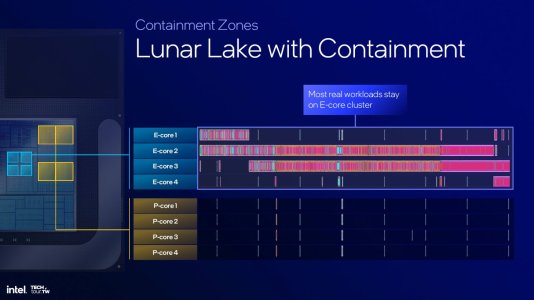
In lunar lake, for example, L2 cache was cut down and also L1->L2 bandwidth, hyper-threading removed, AVX--512 is "supposedly" not present, and more. Lion Cove server cores will have none of those limitations, and desktop will be optimized around whatever makes sense for Arrow Lake.
 
No, it won't.
We don’t know it won’t. It does seem unlikely, because Intel in Hulk’s linked presentation highlights HT benefits in thread-dense servers, but theoretically possible due to Lion Cove’s modularity. At Computex, Intel also said they would add HT where the performance benefits existed and power wasn’t as much of a concern.
 
Last edited:
~10% die area is committed to HT? That's hard to believe. Also the extra power consumption only occurs when the HT core is forced to handle two threads, no?

It’s 10% core area, probably not including L2 which means it ends up being like 0.3% of the compute die area for each of the four P-cores in LNL.
 
if i get bored i will dig up a video for part of it: according to Intel, Lion Cove is an "architecture" (not a "Core", an "architecture") that has "many" configurable options, including hyper-threading, that can be turned on and off as needed. Hyperthreading was turned off for Lunar Lake to save area and power. They said all of this on video, I'm sure you can find it.

For the more direct answer, it is coming soon. It wasn't communicated to me in any way I can show proof so you'll have to wait (or talk to an Intel rep).

Everything I've seen indicates Intel has actually done something few (any?) companies ever have, and I don't think they are being given enough credit. Based on their claims, they have made a silicon design that is highly configurable and easily portable between nodes/processes of multiple vendors. That is, Intel can quickly spin up a chip with Lion Cove cores in it on either TSMC or Intel processes, and on either N3/N5 or Intel 4/3/20A/18A with minimal effort. They can do this while also turning on/off or configuring major features.

In lunar lake, for example, L2 cache was cut down and also L1->L2 bandwidth, hyper-threading removed, AVX--512 is "supposedly" not present, and more. Lion Cove server cores will have none of those limitations, and desktop will be optimized around whatever makes sense for Arrow Lake.
Right, I think the encouraging thing is that if HT is not included on Arrow Lake it is likely because not including HT was the better option for whatever power envelope Intel was targeting, rather than because they took a guess at the implications early in development and by the point the discovered HT was net benefit, it was too late.

Or even worse, that they tried to make HT work and couldn't.
 
No Intel chip designers have explicitly stated that LNC in ARL will have HT. Some of the things they said kinda implies that ARL may get HT. Even I think it will. But Intel hasn't confirmed it yet.

And about HT, the P core designer said it in very high clarity the same thing I've been saying all along. HT kicks in and gives the performance increase only after all physical cores gets fully saturated during heavy multi-threaded workloads. And imho, this situation is not useful for most consumers and completely useless when there are plenty of E cores. HT is archaic and should just die.


4.6GHz is the best leak we've had till now.


In a month or two since they're targeting a sep launch.

Right, my 32 thread 5950x has 16 good threads, and 16 redacted ones that perform at best like 1/3rd the speed of the 16. This means that when making HPC apps, I have to be careful to design around that fact, or expect that things close to 16 cores not 32. Made worse by the fact that in some cases having HT enabled makes the 16 "good" threads individually slower. HT sucks and was a bandaid in the era when 32 cores on a die were unthinkable, never mind 144. We're past that, so HT needs to go away and Intel needs to drive core counts up by spamming Skymont.

I want to see a 64 core consumer part, with 8 lion cove for low-thread scenarios.

edit: Also, if Intel does ever get rentable units working, Chadmont will reach its final form, GigaChad.


No profanity in tech.


esquared
Anandtech Forum Director
 
Last edited by a moderator:
Back
Top