• We’re currently investigating an issue related to the forum theme and styling that is impacting page layout and visual formatting. The problem has been identified, and we are actively working on a resolution. There is no impact to user data or functionality, this is strictly a front-end display issue. We’ll post an update once the fix has been deployed. Thanks for your patience while we get this sorted.

Discussion Intel Meteor, Arrow, Lunar & Panther Lakes + WCL Discussion Threads

Page 474 - Seeking answers? Join the AnandTech community: where nearly half-a-million members share solutions and discuss the latest tech.

Tigerick

Senior member
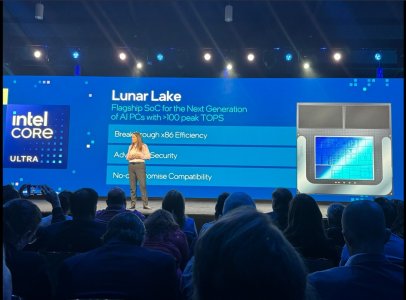
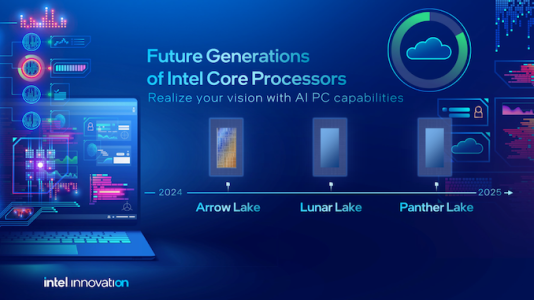
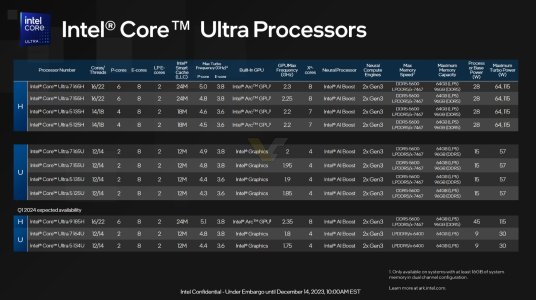
Wildcat Lake (WCL) Specs

Intel Wildcat Lake (WCL) is upcoming mobile SoC replacing Raptor Lake-U. WCL consists of 2 tiles: compute tile and PCD tile. It is true single die consists of CPU, GPU and NPU that is fabbed by 18-A process. Last time I checked, PCD tile is fabbed by TSMC N6 process. They are connected through UCIe, not D2D; a first from Intel. Expecting launching in Q1 2026.
Intel Raptor Lake UIntel Wildcat Lake 15WIntel Lunar LakeIntel Panther Lake 4+0+4
Launch DateQ1-2024Q2-2026Q3-2024Q1-2026
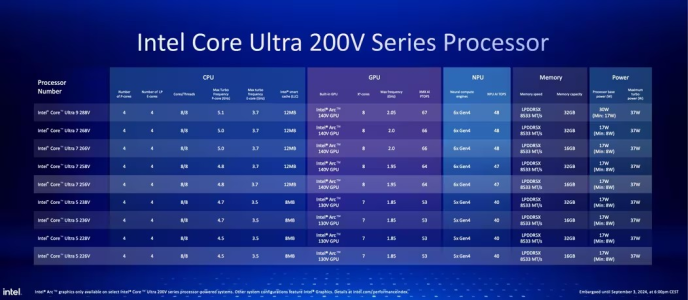
ModelIntel 150UIntel Core 7 360Core Ultra 7 268VCore Ultra 7 365
Dies2223
NodeIntel 7 + ?Intel 18-A + TSMC N6TSMC N3B + N6Intel 18-A + Intel 3 + TSMC N6
CPU2 P-core + 8 E-cores2 P-core + 4 LP E-cores4 P-core + 4 LP E-cores4 P-core + 4 LP E-cores
Threads12688
Max Clock5.4 GHz4.8 GHz5 GHz4.8 GHz
L3 Cache12 MB6 MB12 MB12 MB
TDP15 - 55 W15 - 35 W17 - 37 W25 - 55 W
Memory128-bit LPDDR5-520064-bit LPDDR5x-7467128-bit LPDDR5x-8533128-bit LPDDR5x-7467
Size96 GB48 GB32 GB128 GB
Bandwidth83 GB/s60 GB/s136 GB/s120 GB/s
GPUIntel GraphicsIntel GraphicsArc 140VIntel Graphics
RTNoNoYESYES
EU / Xe96 EU2 Xe8 Xe4 Xe
Max Clock1.3 GHz2.6 GHz2 GHz2.5 GHz
NPUGNA 3.017 TOPS48 TOPS49 TOPS


PPT1.jpg
PPT2.jpg
PPT3.jpg


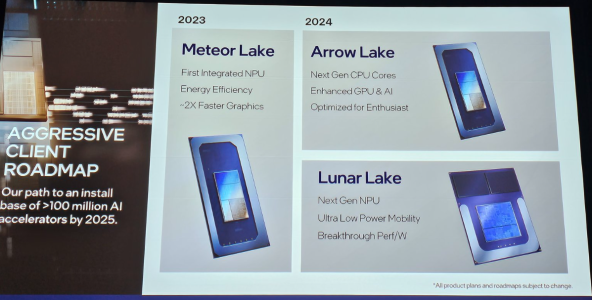
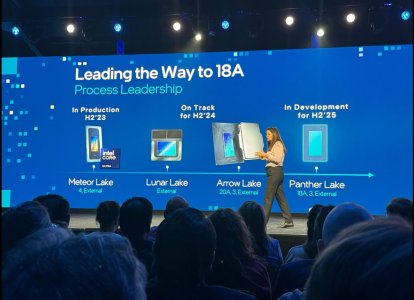
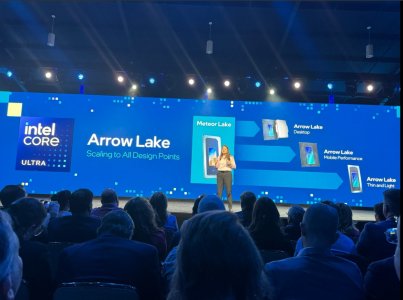
As Hot Chips 34 starting this week, Intel will unveil technical information of upcoming Meteor Lake (MTL) and Arrow Lake (ARL), new generation platform after Raptor Lake. Both MTL and ARL represent new direction which Intel will move to multiple chiplets and combine as one SoC platform.

MTL also represents new compute tile that based on Intel 4 process which is based on EUV lithography, a first from Intel. Intel expects to ship MTL mobile SoC in 2023.

ARL will come after MTL so Intel should be shipping it in 2024, that is what Intel roadmap is telling us. ARL compute tile will be manufactured by Intel 20A process, a first from Intel to use GAA transistors called RibbonFET.


LNL-MX.png
 

Attachments

  • PantherLake.png
    PantherLake.png
    283.5 KB · Views: 24,049
  • LNL.png
    LNL.png
    881.8 KB · Views: 25,534
  • INTEL-CORE-100-ULTRA-METEOR-LAKE-OFFCIAL-SLIDE-2.jpg
    INTEL-CORE-100-ULTRA-METEOR-LAKE-OFFCIAL-SLIDE-2.jpg
    181.4 KB · Views: 72,443
  • Clockspeed.png
    Clockspeed.png
    611.8 KB · Views: 72,329
Last edited:
There have been a lot of recent members using this same line. Curious coincidence I'm sure.

"Intel has nothing to worry about."
1725670835803.png

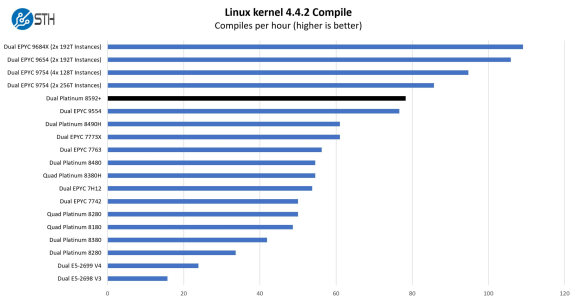
He calls this nothing to worry about. Its getting creamed. One of my 9554's almost is equal to TWO 8592+'s !!!

Quote from the article number 1 (I will look for more

"At this point, a few things are reasonably clear. Intel does not have the core count to go toe-to-toe with AMD in this generation."
 
Apple sells about 15-20% of worldwide unit sales. Profits are much higher. The opposite with Intel, server marketshare higher and profits lower when compared to the competition. Not great.
Apple sells less phones, well it’s still a lot but less then others at around 150-200 million iPhones sold every year.

But since most phones they are in the $700-$1200 range they make a lot of profit.


Intel also sells the same amount of products in client.
 
View attachment 107000

He calls this nothing to worry about. Its getting creamed.
Yea, because they have a core count deficit. That disappears with Granite Rapids. Even if I don't believe they won't take #1, they are probably going to be only about 10% or so away, the best position in servers since Skylake.

If you let your bias influence your decisions, you'll constantly be wrong.
 
Yea, because they have a core count deficit. That disappears with Granite Rapids. Even if I don't believe they won't take #1, they are probably going to be only about 10% or so away, the best position in servers since Skylake.

If you let your bias influence your decisions, you'll constantly be wrong.
And the 9554 equalling 2 8592's ???? Core count there ? And wattage ? I don't see any actual numbers there. But 2 8592s vs one 9554 ? I doubt they have less.
 
And the 9554 equalling 2 8592's ???? Core count there ? And wattage ? I don't see any actual numbers there. But 2 8592s vs one 9554 ? I doubt they have less.
According to that very chart, 60 core 8592 is beating 64 core 9554. EPYC 9554 is also 360W, similar to 8592. And they are both dual sockets.

Like I said, you let your bias influence your decisions, then you are going to be constantly wrong. You have to go solely by data.
 
View attachment 107000

He calls this nothing to worry about. Its getting creamed. One of my 9554's almost is equal to TWO 8592+'s !!!

Quote from the article number 1 (I will look for more

"At this point, a few things are reasonably clear. Intel does not have the core count to go toe-to-toe with AMD in this generation."
I think you may be misreading this.

It shows Dual 9554 EPYC (2x64C, 256 threads) vs Dual Platinum 8592+ (2x64C, 256 threads) being close in Linux compile times with the Xeon slightly edging ahead.

Unless you mistyped and meant 9654 EPYC but a single socket 9654 isn’t in this chart.

Edit: fixed core counts
 
I think you may be misreading this.

It shows Dual 9554 EPYC (2x64C, 256 threads) vs Dual Platinum 8592+ (2x60C, 240 threads) being close in Linux compile times with the Xeon slightly edging ahead.

Unless you mistyped and meant 9654 EPYC but a single socket 9654 isn’t in this chart.

8592+ is 64 cores.
 
8592+ is 64 cores.
I stand corrected.

It's still beating the 64 core EPYC. 128 core Granite Rapids will be very competitive.

Intel has good products coming, which markfw can't see. But that's not Intel's problem. The problem is they are basically a finance company and will fall flat in engineering again.
 
According to that very chart, 60 core 8592 is beating 64 core 9554. EPYC 9554 is also 360W, similar to 8592. And they are both dual sockets.

Like I said, you let your bias influence your decisions, then you are going to be constantly wrong. You have to go solely by data.
I think you may be misreading this.

It shows Dual 9554 EPYC (2x64C, 256 threads) vs Dual Platinum 8592+ (2x64C, 256 threads) being close in Linux compile times with the Xeon slightly edging ahead.

Unless you mistyped and meant 9654 EPYC but a single socket 9654 isn’t in this chart.

Edit: fixed core counts
You are right I did not see dual both places. But I would like to see actual wattages. My 9554 @%100% is running 282 watts. What is the 8592 REAL actual ?
 
According to that very chart, 60 core 8592 is beating 64 core 9554. EPYC 9554 is also 360W, similar to 8592. And they are both dual sockets.

Like I said, you let your bias influence your decisions, then you are going to be constantly wrong. You have to go solely by data.

Average power 2P 8592+ 556W.

Average power 2P 9554 377W.

And the 2P 9554 still 3.6% ahead in the perfs average, that s the data.

So that s RPL transfered to the server area.

Bias influence you said.?...


Last edited:
You are right I did not see dual both places. But I would like to see actual wattages. My 9554 @%100% is running 282 watts. What is the 8592 REAL actual ?

Phoronix reviewed the CPU as well, here was the min and avg power consumption measurements across the full test suite:

Min (W)Avg (W)
Dual Epyc 955425.64377.42
Dual Xeon 8592+100.34556.83

With GNR being on Intel 4, we should expect a significant drop in per core power consumption.
 
I let this speak for me..... But my point still stands. Intel DOES still have something to worry about. And Turin is not out yet......
No one said Intel will be a leader but it'll be much closer this time, within 10%. That's the whole point. SPR is their weakest point in servers.
 
No one said Intel will be a leader but it'll be much closer this time, within 10%. That's the whole point. SPR is their weakest point in servers.
Now THAT I agree with. If power was competitive, then AMD WOULD have to worry, due to Intels big installed base lead. Power is still a problem, and in the data center, 10 times more than desktop.
 
I wonder if in the next generation after LionCove we will see a 10-Wide, 8x ALU and 6x FP decoder, or maybe Intel will immediately switch to a 12-Wide, 10x ALU and 8x FP decoder.
 
GNR is on Intel 3.
Yes also Intel 7 -> 4 -> 3 is approx 1.20*1.18 = 40% PPW ON A best cae even with no ipc it should improve by 40% ppc best case btw redwood cove on Intel 4 has 20% PPW vs 13700H p core
 
Last edited:
People get real nervous when there are any chances of good competition between the two. I though that was good for consumers.
 
Let me try to explain again. After all the lithography steps are taken for a given EUV layer the wafer can be optically scanned for defects. The statement is that if 3 hours are spent performing that optical scan and no defects are found, that optical scan only provides confidence that there are no defects in 62-63% of the 1cm^2 die. If less time was spent on the optical scan the confidence rate would be lower. More time spent would give a higher confidence rate. It says nothing about actual Intel 3 defect density.
So then what was the value of this observation in the first place, that people would see fit to distribute the information? Do we have any reference data from other EUV nodes for comparison?

@Markfw

Phoronix has a pretty good review of Emerald Rapids you can use for reference if necessary:


Draw your own conclusions from that.

@Hitman928

Indeed those products weren't even listed for sale a few hours ago. At least now one outlet is selling Sierra Forest!
 
No one said Intel will be a leader but it'll be much closer this time, within 10%. That's the whole point.
Within 10% in AVX-512 workloads too?

I think Intel saw that threat incoming and embarked on the AMX bandwagon. At least on that front, they have nothing to worry about.
 
Back
Top