• We’re currently investigating an issue related to the forum theme and styling that is impacting page layout and visual formatting. The problem has been identified, and we are actively working on a resolution. There is no impact to user data or functionality, this is strictly a front-end display issue. We’ll post an update once the fix has been deployed. Thanks for your patience while we get this sorted.

Discussion Intel Meteor, Arrow, Lunar & Panther Lakes + WCL Discussion Threads

Page 460 - Seeking answers? Join the AnandTech community: where nearly half-a-million members share solutions and discuss the latest tech.

Tigerick

Senior member
Wildcat Lake (WCL) Specs

Intel Wildcat Lake (WCL) is upcoming mobile SoC replacing Raptor Lake-U. WCL consists of 2 tiles: compute tile and PCD tile. It is true single die consists of CPU, GPU and NPU that is fabbed by 18-A process. Last time I checked, PCD tile is fabbed by TSMC N6 process. They are connected through UCIe, not D2D; a first from Intel. Expecting launching in Q1 2026.
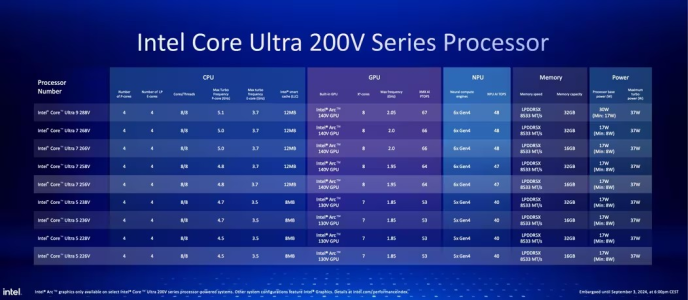
Intel Raptor Lake UIntel Wildcat Lake 15WIntel Lunar LakeIntel Panther Lake 4+0+4
Launch DateQ1-2024Q2-2026Q3-2024Q1-2026
ModelIntel 150UIntel Core 7 360Core Ultra 7 268VCore Ultra 7 365
Dies2223
NodeIntel 7 + ?Intel 18-A + TSMC N6TSMC N3B + N6Intel 18-A + Intel 3 + TSMC N6
CPU2 P-core + 8 E-cores2 P-core + 4 LP E-cores4 P-core + 4 LP E-cores4 P-core + 4 LP E-cores
Threads12688
Max Clock5.4 GHz4.8 GHz5 GHz4.8 GHz
L3 Cache12 MB6 MB12 MB12 MB
TDP15 - 55 W15 - 35 W17 - 37 W25 - 55 W
Memory128-bit LPDDR5-520064-bit LPDDR5x-7467128-bit LPDDR5x-8533128-bit LPDDR5x-7467
Size96 GB48 GB32 GB128 GB
Bandwidth83 GB/s60 GB/s136 GB/s120 GB/s
GPUIntel GraphicsIntel GraphicsArc 140VIntel Graphics
RTNoNoYESYES
EU / Xe96 EU2 Xe8 Xe4 Xe
Max Clock1.3 GHz2.6 GHz2 GHz2.5 GHz
NPUGNA 3.017 TOPS48 TOPS49 TOPS


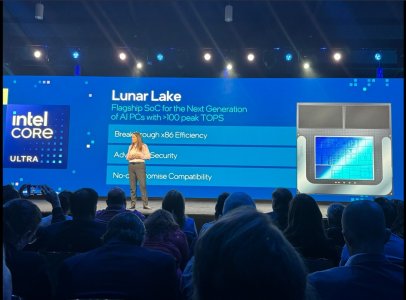
PPT1.jpg
PPT2.jpg
PPT3.jpg


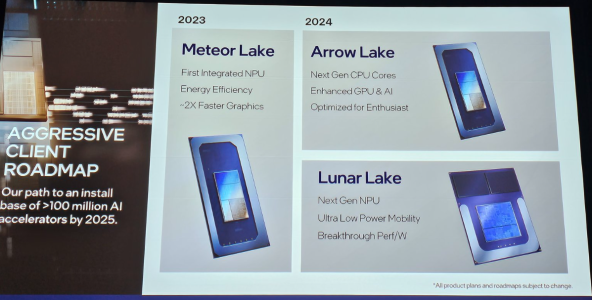
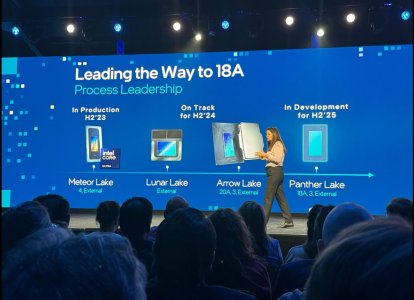
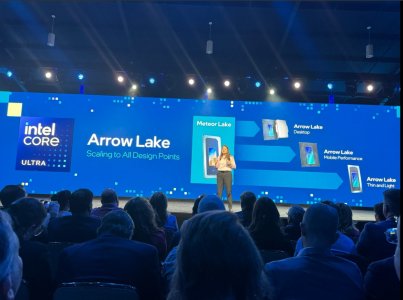
As Hot Chips 34 starting this week, Intel will unveil technical information of upcoming Meteor Lake (MTL) and Arrow Lake (ARL), new generation platform after Raptor Lake. Both MTL and ARL represent new direction which Intel will move to multiple chiplets and combine as one SoC platform.

MTL also represents new compute tile that based on Intel 4 process which is based on EUV lithography, a first from Intel. Intel expects to ship MTL mobile SoC in 2023.

ARL will come after MTL so Intel should be shipping it in 2024, that is what Intel roadmap is telling us. ARL compute tile will be manufactured by Intel 20A process, a first from Intel to use GAA transistors called RibbonFET.


LNL-MX.png
 

Attachments

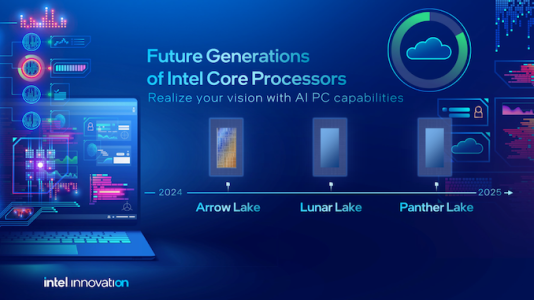
  • PantherLake.png
    PantherLake.png
    283.5 KB · Views: 24,049
  • LNL.png
    LNL.png
    881.8 KB · Views: 25,534
  • INTEL-CORE-100-ULTRA-METEOR-LAKE-OFFCIAL-SLIDE-2.jpg
    INTEL-CORE-100-ULTRA-METEOR-LAKE-OFFCIAL-SLIDE-2.jpg
    181.4 KB · Views: 72,443
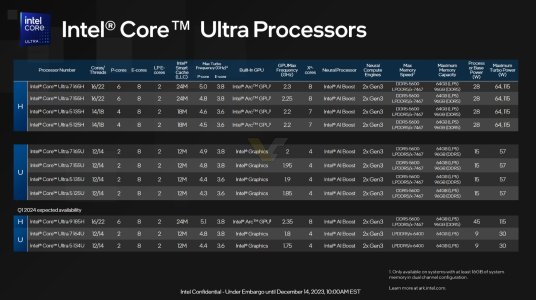
  • Clockspeed.png
    Clockspeed.png
    611.8 KB · Views: 72,329
Last edited:
Last edited:
Intel's last great CPU before their fabs were taken away from them.

"Bad, Bad Intel! You can't take good care of fabs so we can't let you have them anymore" <<< Press release from US Govt when they seize control of Intel fabs for national security reasons.
 
We will see. ARL is on arguably at least an equal node to Zen 5, even if Intel, "the supposed foundry company," didn't manufacture it themselves. Lets see how the power usage compares; I bet AMD will still be considerably more efficient. Of course the comparison will be complicated by the fact that ARL uses E cores and doesn't have HT.

You don't even need to bet, the PL1 is set to to be 250W right now for Core Ultra 7/9, and the current "leaked" 285K results are slower than a 9950X with PBO on.

Amd was significantly better in perf per watt even on old Global Foundry nodes when they had a node disadvantage compared to Intel on 10nm+++. Intel would need probably a 2-3 node lead over AMD just to match their current efficiency.
 
One thing I've seen that I don't think is right in Intel's comparison is that they list the Asus Zenbook S16 with the Ryzen HX 370 and the Asus Vivobook S15 with the X-Elite as having 1920x1080 screens but both have much higher res OLED screens.
They might have just set the screens as 1080p.
Indeed. Hopefully independent reviews match the advertising. If so, LNL seems like a big winner. It's the type of chip I want in a laptop. I don't need 24 threads and AAA gaming, give me good low threaded performance, long battery life, and the ability to play some light games and I'm happy.
Yup.

<2.5lbs, Convertible, great pen support. My dream laptop.

Also, the footnotes and the slides are basically saying:
-2880 resolution: 14 hours web browsing battery life
-1920 resolution: 20 hours of web browsing battery life

Guess what screen resolution I would be looking for?

Memory latency is 90ns according to Intel not 120.
 
The leak isn't wrong. LNL refresh for the current XPS 13 is indicated in September on the timeline.

What is coming in January 2026 is that they'll announce a brand new XPS 13, codenamed Divo, and that will still ship LNL alongside Oryon V2.
Go away Dell. On package memory with significant power savings, SoC with great battery life, and it's exactly the same chassis as Sandy Bridge XPS in 2011.
Am I reading it right?

16% faster than AMD HX 370 in CB2024 ST
6% faster in GB6 &
a whopping 28% faster in SPECint2017

Looks like Lunar Lake is gonna wipe the floor with AMD HX 370! :grimacing:
In single thread though.
 
Am I reading it right?

16% faster than AMD HX 370 in CB2024 ST
6% faster in GB6 &
a whopping 28% faster in SPECint2017

Looks like Lunar Lake is gonna wipe the floor with AMD HX 370! :grimacing:
You are reading it wrong.

CB2024 1T: Intel 1.2 x X1E-78-100, AMD 1.03 x X1E-78-100, thus Intel / AMD - 1 = 1.2 / 1.03 - 1 = 16.5% faster
Geekbench 6.3 1T: Intel 1.21 x X1E-78-100, AMD 1.15 x X1E-78-100, thus Intel / AMD - 1 = 1.21 / 1.15 - 1 = 5.2% faster
SPECrate Int 1T: Intel 1.61 x X1E-78-100, AMD 1.33 x X1E-78-100, thus Intel / AMD - 1 = 1.61 / 1.33 - 1 = 21.1% faster
 
It says 50% lower power for Lunarlake. They sandbagged that too, since they were saying 40%. Haha.


Maybe it was improved late in development with power managament optimizations. For PTL rumours say they claim 35% lower power and 2-3 hours more battery life, although it's unknown which generation this was compared with. Can be only MTL or ARL I guess.
 
It also claims that HX 370 is ~1.26x higher in SPECint than X1E-80 and we know that isn't true.
So maybe take it with a large helping of salt.
I've long stopped trusting any marketing slide. In particular Intel has been found to be cheating so often that it's not funny anymore. It's depressing to see people drink kool aid marketing from any company (and I know first hand how Intel cheated in the past; I explained here how they cheated on AnTuTu with ICC more than 10 years ago).

Let's wait and see what David Huang finds for SPEC.
 
Also, people who still think ARL-S is gonna deliver only <= 5% performance uplift over previous gen equivalent are gonna be very disappointed.
You are like the pre-Computex Zen 5 people.

Lunarlake doesn't suffer from clockspeed reduction, Arrowlake does. Meteorlake also sucked at low power, which Lunarlake addresses.
 
Even AMD did it. But the final results aren't usually that far off from reality for both of them. And also, most of the previous Lunar Lake leaks pretty much match up with today's presentation. So, I don't expect much cheating this time around.
I put the blame on all marketing slides, not only Intel. Some of the slides might be true or not. I just don't trust them without independent validation.

But as I said, I showed in this very forum how Intel cheated to show misleading AnTuTu results. Also hundreds of Intel results were removed from SPEC DB. So in my book, if I never trust marketing slides from any company, Intel is the worst.

That doesn't mean their latest chip isn't good or great. It just means I'll wait for reviews from sources I trust.
 
If they have a 61% advantage in SPECint while showing much less in GB6 and other benchmarks, my money is on "Intel's C compiler broke one of the SPECint tests" and one of those tests went up by 6x or something crazy. Even with geomean if you break one test badly enough you get a big bump.

So as always when the numbers are available I'll at what it scores on the gcc subtest, and use that to compare it with AMD, M4, etc. Because if Intel broke one of the tests in their compiler that's meaningless from a real world performance perspective. Just like people complaining about M4 benefiting from SME in GB 6.3 - just run it in GB 6.2 if you've got a problem with that (and to be equal you should also have a problem with AVX512 etc. optimizations on x86)
 
In Specint they used icc putting others at a disadvantage. Also the 50% power reduction is in one benchmark, most real workloads only got about 30% power savings. Seems like Teams is the best case with 41% but it's still 20% behind X elite. 4K AV1 streaming they're claiming 33%, which based on MTL's 17W number translates to ~11W. That's still 3X of what M3 based MB Air draws and double the amount of power X Elite elite uses in this workload
 
Back
Top