
Asterox
Golden Member
This is 12/24 Zen 3 vs 8/16 Rocket Lake CPU Geekbench comparison. From this we can easily estimate, that in "CPU Multithread 8/16 Zen 3 will be significantly faster vs 8/16 Rocket Lake".
Last edited:


There are some major changes in Rocket Lake. But, no matter what, Intel is still up against a power wall. At this point, even if it was 18% better in all uses (not just Spec2017), that will still leave a lot of people disappointed. 18% gain in ~18 months is okay, but nothing spectacular.I swear every time I visit this thread you guys substract a few 100Mhz and % IPC from Rocket Lake. Now it's just a refresh of Skylake?
Mebiuw still claims 18% IPC in Spec2017 over Comet Lake.
Which makes sense if the core is from Willow Cove bolted onto the Sunny Cove cache configuration.

Since when is 18% gain in 18 months not spectacular?There are some major changes in Rocket Lake. But, no matter what, Intel is still up against a power wall. At this point, even if it was 18% better in all uses (not just Spec2017), that will still leave a lot of people disappointed. 18% gain in ~18 months is okay, but nothing spectacular.

10 cores -> 8 is a requirement if you don't want these chips to fight nV's GA102 on power consumption, and the new Xe graphics, while much more capable and powerful, need a lot more area too.
This is 12/24 Zen 3 vs 8/16 Rocket Lake CPU Geekbench comparison. From this we can easily estimate, that in "CPU Multithread 8/16 Zen 3 will be significantly faster vs 8/16 Rocket Lake".
You are wrong on the graphics. Xe doesn't make more space than Gen 11, and in Rocketlake its cut down to 32EUs.
When you are more than 18% behind in many tests.Since when is 18% gain in 18 months not spectacular?

Well, Intel is not catching up anytime soon.When you are more than 18% behind in many tests.
You are welcome. Thanks for the constant reminder that you aren't here to provide unbiased information.And thanks for the down vote in another thread.... NOT
Yeah, I'd rather see the reviews. Just geekbench on and ES chip isn't telling me too much.Good to know! I stand corrected.
Despite being pessimistic over what RKL could be as an end product for a 2021 release, I'm eager to see it.
I do provide unbiased information. I go for the best at the time. Right now its AMD and 99% of this forum knows that, but YOU don't have a clue.You are welcome. Thanks for the constant reminder that you aren't here to provide unbiased information.
A comet lake refresh for the i3 and below could easily be done on a small 4c die. Leave L1 and L2 untouched, but include a large L3 (double the existing Comet Lake i3 L3 size) and let it clock to current Comet Lake i7/i9 levels and you'll have celerons, Pentiums and i3 chips worth an 11th gen name. It's ok to not enable PCIe 4.0 on lower SKUs for Intel.
I swear every time I visit this thread you guys substract a few 100Mhz and % IPC from Rocket Lake. Now it's just a refresh of Skylake?
Mebiuw still claims 18% IPC in Spec2017 over Comet Lake.
Which makes sense if the core is from Willow Cove bolted onto the Sunny Cove cache configuration.
 www.anandtech.com
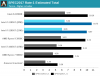
Despite being pessimistic over what RKL could be as an end product for a 2021 release, I'm eager to see it.
At this point I really wonder why they couldn't have used Tigerlake-H for just the K series SKUs. Just 3. I mean 11900K, 11700K, and 11600K. They really can't afford fab space? I call BS.

Yields obviously. Who knows how widespread the 8 core Tiger Lake-H will be. It's easier with Alder Lake because of chiplets but you have no such luck with Tiger Lake.
You are wrong on the graphics. Xe doesn't make more space than Gen 11, and in Rocketlake its cut down to 32EUs.
Rocketlake is terribly underperforming there, unless we're expecting slower performance in than 9900K.
9900K gets 9K in multi-thread or more.

There were also early Tiger Lake geekbench scores there that topped out at 4.4 Ghz and were slower than 1065G7. I would definitely not take these Rocket Lake scores as fact yet.@Asterox You can be stubborn as you want, but the reality is Geekbench is a user-submitted benchmark, which makes the results notoriously unreliable.
Based on Geekbench I can show you 1165G7 being slower than 1065G7, and Broadwell being faster than Zen 2.
By making use of the data cache for UBO pulls, there is generally up to another few percent improvements for various OpenGL and Vulkan games running on Linux -- either natively or through the likes of the DXVK layer.
There were also early Tiger Lake geekbench scores there that topped out at 4.4 Ghz and were slower than 1065G7. I would definitely not take these Rocket Lake scores as fact yet.
There is a new codename in the Windows graphics driver: Goldwater Lake (GWL).
Is this Intel accepting the golden shower AMD are giving them at the moment?


