
Markfw
Moderator Emeritus, Elite Member
Only one problem with the photoshopped picture, they recommend EPYC, and that Ryzen picture is too big anyway. Replace it with a 9654 or a Turin, and it makes more sense.Intel is saved then.

Only one problem with the photoshopped picture, they recommend EPYC, and that Ryzen picture is too big anyway. Replace it with a 9654 or a Turin, and it makes more sense.Intel is saved then.
Something something went very wrong after Alder Lake. Meteor Lake desktop was cancelled. Meteor Lake mobile P-core's IPC actually regressed. Then they went all in on the stupidity and actually tried to churn out more of these crap CPUs to "meet" demand on a very expensive low yielding Intel 4 process. What in the actual hell? It was like Pat was out basking in the sun and told his secretary to "use your common sense and don't bother me with unnecessary calls or issues". And she did the best she could 😀I also don't recall anyone predicting Intel would be in this position when they were raking in the money back in 2021.
Something something went very wrong after Alder Lake. Meteor Lake desktop was cancelled. Meteor Lake mobile P-core's IPC actually regressed. Then they went all in on the stupidity and actually tried to churn out more of these crap CPUs to "meet" demand on a very expensive low yielding Intel 4 process. What in the actual hell? It was like Pat was out basking in the sun and told his secretary to "use your common sense and don't bother me with unnecessary calls or issues". And she did the best she could 😀
That's funny!Edit: Pat was give the Titanic 30 seconds after the collision and it's trying to get the Californian to notice them. Maybe this time they do.
That's funny!
But TBH, things went downhill a LOT more after the Titanic was given to Pat. He may not have done something himself to make things worse but it's also the things he DIDN'T do (like more scrutiny on how much they were spending) that made a real mess of things.

Remember, by late 2021, Intel had scuffed their original Ponte Vecchio in favor of TSMC tiles and pushed back Aurora. There was also the Mizuho report, which at the time fueled speculation (which many doubted) that Intel wouldn't be able to maintain volume until rolling out High NA EUV nodes in 2025.Oh noes! there are rumors! start shorting that stock bois! GTFO. 🤣 I also don't recall anyone predicting Intel would be in this position when they were raking in the money back in 2021.

I would say the writing was on the wall starting in 2017 already, Intel's reaction was just all around terrible (stocks buyback instead investing in foundries and R&D!) for years to come still.If you had told me in mid 2021 that this would be something people are saying in late 2024 I'd have never believed it.
Intel's current profit margin certainly is doomed.
I think they genuinely thought AMD's resurgence was just a blip. Or...they just milked the finances for what they were.... Anyone there didn't want to be seen to tank margins and heavily invest...I would say the writing was on the wall starting in 2017 already, Intel's reaction was just all around terrible (stocks buyback instead investing in foundries and R&D!) for years to come still.
Raptor lake fiasco is 100% on top Intel management, because they decided to push frequencies insanely high.In my opinion Pat underestimated one thing, I think he believed Intel issues resided at the management level, bad strategy and bad decisions. But after the fiasco with SPR and RPL, there is clear a cultural issue within the company and that will take time to solve.
... Nobody knew that Raptor Lake/Raptor Lake Refresh would have major hardware flaws which are still unresolved (and may never be) ...
Seems like Alder Lake did a better job of holding up to vcore/vid than Raptor Lake. For whatever reason.There are no mysteries to be revealed here. Intel just fries their chips with too much voltage needed to reach high frequencies.
They are running substantially slower:Seems like Alder Lake did a better job of holding up to vcore/vid than Raptor Lake. For whatever reason.
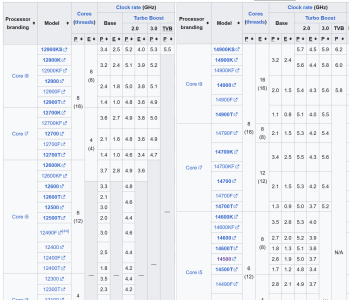
Alder Lake (12900ks) hit 5.5 GHz with TVB. Granted, the "normal" boost cap was 5.3 GHz, which just happens to be the magic number for (relative) stability for Raptor Lake, e.g. try to keep boost clocks at 5.3 GHz or lower. But if I recall correctly, Alder Lake took more voltage to get to 5.3 GHz (and 5.5 GHz).They are running substantially slower:
Reddit comment is saying the upper management including Pat underestimated the AI boom as well. Taking AADG(Royal Core team) employees to work on AI for GPUs caused outrage and had veteran employees leave.What hardware flaws (except that time limited oxidation problem in one manufacturing plant)? It is possible that Intel pushed the frequency about 1 GHz higher than what the chips can long term handle. You need about 0,25V more to reach those higher frequencies with massive increases in temperature and current density. ANY CPU would degrade and break when pushed so hard.
How do the shareholders feel now? I bet most of the wise ones who saw the writing on the wall have bailed out already.What should have been done if you look at it now is let AMD take the leadership while the company recovers. However, Alderlake was the season of inflated revenues due to unnecessary lockdowns, so shareholder revolt might have happened losing to AMD. 10-20% revenue reduction due to that wouldn't have looked good. Short term over Long term profits.
those "unnecessary lockdowns" helped save lifes.Reddit comment is saying the upper management including Pat underestimated the AI boom as well. Taking AADG(Royal Core team) employees to work on AI for GPUs caused outrage and had veteran employees leave.
The real issue stems from loss of the process lead, so they went to extreme measures to try to keep leadership. That's why the clocks are so high. Saying it requires a lot of voltage isn't the fundamental reason. Same with why Pentium III 1.13GHz had the issue. They were caught in a bad situation and clocked it higher than the CPU could handle.
I also keep saying the clocks are way too high. Netburst/Bulldozer comes to haunt them again.
What should have been done if you look at it now is let AMD take the leadership while the company recovers. However, Alderlake was the season of inflated revenues due to unnecessary lockdowns, so shareholder revolt might have happened losing to AMD. 10-20% revenue reduction due to that wouldn't have looked good. Short term over Long term profits.

The layoff plan was one source of tension between Tan and the board, according to sources. Tan wanted specific cuts, including middle managers who do not contribute to Intel's engineering efforts.
Tan has told people he believed Intel was overrun by bureaucratic layers of middle managers who impeded progress at Intel’s server and desktop chips divisions and the cuts should have focused on these people.
Tan grew frustrated as the board did not follow his recommendations over how to make the manufacturing business more customer-centric and to remove unnecessary bureaucracy, a person close to Tan said.
Isn't that wasting valuable money?Tan leaves as the company endures one of the bleakest periods in its five-decade history that has left it vulnerable to a potential activist shareholder attack, former executives said. Intel has hired investment bank Morgan Stanley to prepare a defense, according to sources familiar with the matter, confirming an earlier report.
Hey, maybe that's a good investment strategy. Anything Intel passes on, it's gonna be a hit! 😀Intel passed on an opportunity in 2018 to take as much as a 30% stake in ChatGPT-maker OpenAI, Reuters previously reported.
Open ai making money when?Hey, maybe that's a good investment strategy. Anything Intel passes on, it's gonna be a hit! 😀
Soon! 😛Open ai making money when?
Never, considering only the infra costs. And the fact that they don’t have any competitive advantage.Open ai making money when?
They’ve got a strong first mover advantage though, that counts for something (assuming they don’t squander it).Never, considering only the infra costs. And the fact that they don’t have any competitive advantage.
The sudden resignation of a high-profile Intel (INTC.O), opens new tab board member came after differences with CEO Pat Gelsinger and other directors over what the director considered the U.S. company’s bloated workforce, risk-averse culture and lagging artificial intelligence strategy, according to three sources familiar with the matter.
Lip-Bu Tan, a semiconductor industry veteran, had said he was leaving the board because of a personal decision to “reprioritize various commitments” and that he remained “supportive of the company and its important work,” in a regulatory filing on Thursday.
The former CEO of chip-software company Cadence Design joined Intel’s board two years ago as part of a plan to restore Intel’s place as the leading global chipmaker. The board expanded Tan’s responsibilities in October 2023, authorizing him to oversee manufacturing operations.
Over time, Tan grew frustrated by the company’s large workforce, its approach to contract manufacturing and Intel’s risk-averse and bureaucratic culture, according to the sources, who were not authorized to speak publicly.
To cut costs, Intel announced in August layoffs of more than 15% of its workforce, its second round of cuts in two years. Intel had nearly 125,300 employees globally according to its August financial results.
The layoff plan was one source of tension between Tan and the board, according to sources. Tan wanted specific cuts, including middle managers who do not contribute to Intel's engineering efforts.
Gelsinger, who took over in 2021 as part of a turnaround plan, added at least 20,000 employees to Intel's payroll by 2022.
To Tan and some former Intel executives, the workforce appeared bloated. Teams on some projects were as much as five times larger than others doing comparable work at rivals such as Advanced Micro Devices (AMD.O), opens new tab, according to two sources. One former executive said Intel should have cut double the number it announced in August years ago.
Tan has told people he believed Intel was overrun by bureaucratic layers of middle managers who impeded progress at Intel’s server and desktop chips divisions and the cuts should have focused on these people.
Intel's workforce, which is larger than those of Nvidia and Taiwan Semiconductor Manufacturing Co (2330.TW), opens new tab combined, has led to a complacent and uncompetitive culture, far from the “only-the-paranoid-survive” ethos of Intel co-founder Andy Grove, former Intel executives said.
Tan grew frustrated as the board did not follow his recommendations over how to make the manufacturing business more customer-centric and to remove unnecessary bureaucracy, a person close to Tan said.
Intel has continued to build new factories in Ohio, Arizona and across Europe without naming new customers.


