If the US govt paid off the debt tomorrow..

Page 2 - Seeking answers? Join the AnandTech community: where nearly half-a-million members share solutions and discuss the latest tech.

Atreus21

Lifer
Aug 21, 2007
12,001
571
126
It's mostly money we pay to ourselves, so getting rid of it isn't really that helpful. Also, government debt plays an important part in our financial system.

I think social security beneficiaries might be interested to hear that we don't care if the money raided from the trust fund ever gets paid back.
 

werepossum

Elite Member
Jul 10, 2006
29,873
463
126
As I stated nearly all U.S debt isn't callable. The government agreed it wouldn't pay the debt off early. The people have to be willing to sell it to the feds, and at the price they want. Even if they printed money they can't just pay the debt off, because the debt holders have rights.
Given that the majority of our debt is short term, you make a rather pointless point. Within five years, virtually all our external debt could be paid off - IF we had the money and the will. That is still short term enough to have a very significant effect.
 

Darwin333

Lifer
Dec 11, 2006
19,946
2,330
126
How much would it cost the taxpayers to balance the budget every year?

A hellofa lot since government spending, which includes deficit spending, is one of the main factors in calculating our GDP. We wouldn't even need to pay off the debt, if we simply stopped borrowing money our economy would tank per simple math.

But we are talking crazy hypothetical here so I was just playing along.
 

Darwin333

Lifer
Dec 11, 2006
19,946
2,330
126
It's mostly money we pay to ourselves, so getting rid of it isn't really that helpful. Also, government debt plays an important part in our financial system.

So taking money out of your right pocket and putting it in your left pocket, with interest paid out of the right pocket, adds some sort of value?
 

DCal430

Diamond Member
Feb 12, 2011
6,020
9
81
Given that the majority of our debt is short term, you make a rather pointless point. Within five years, virtually all our external debt could be paid off - IF we had the money and the will. That is still short term enough to have a very significant effect.

30% of our external debt exceeds 5 years to maturity, and this 30% represents over 80% of the interest due. So no we wouldn't be able to wipe out our debt in 5 years. Not issuing any new short term debts would put only the tiniest of dents in the interest due, since the majority of the interest we pay is from the longer term debts.
 
Last edited:

FerrelGeek

Diamond Member
Jan 22, 2009
4,669
266
126
Oops! Maybe you should ask your question again, I don't think anyone saw it;)

Agreed. This conversation is only relevant if a non democrat is president; just like homeless veterans or the killing fields of south Chicago.
 

ElFenix

Elite Member
Super Moderator
Mar 20, 2000
102,407
8,595
126
We wouldn't have to pay to service that debt anymore which currently is around $400B a year IIRC. That's $400B a year that we wouldn't have to extract from the taxpayers or could be used for other things.

My question to you, why is paying $400B a year to service our debt beneficial?

to the extent that $400B is deficit, that's not extracted from taxpayers. the US government doesn't hold money.
 

sm625

Diamond Member
May 6, 2011
8,172
137
106
Sadly the word "deflation" has not yet appeared in this thread. If the government were to pay off its debt you would have a deflationary event so massive it would cause an economic collapse. And what would the Federal Reserve do to stop it? No more debt means no more treasuries for them to buy. And their manipulation of interest rates wouldnt help too much either because you'd be taking the largest interest bearing instruments off the market. That's really the key issue. Treasury bonds generate interest, which constantly puts new money into the system. Erasing the debt means erasing the mechanism for new money creation.

If the government paid off the debt that means a whole bunch of creditors (holders of treasuries) would be left with a huge pile of cash in their hand that is no longer earning any interest at all. There would be some scramble to generate income off this, but overall it would be a terrible loss in monetary velocity and highly disruptive to the financial system. The end result would be a deflationary depression followed by a massive increase in new government spending and thus new debt to counter it.
 
Last edited:

glenn1

Lifer
Sep 6, 2000
25,383
1,013
126
Sadly the word "deflation" has not yet appeared in this thread. If the government were to pay off its debt you would have a deflationary event so massive it would cause an economic collapse. And what would the Federal Reserve do to stop it? No more debt means no more treasuries for them to buy. And their manipulation of interest rates wouldnt help too much either because you'd be taking the largest interest bearing instruments off the market. That's really the key issue. Treasury bonds generate interest, which constantly puts new money into the system. Erasing the debt means erasing the mechanism for new money creation.

If the government paid off the debt that means a whole bunch of creditors (holders of treasuries) would be left with a huge pile of cash in their hand that is no longer earning any interest at all. There would be some scramble to generate income off this, but overall it would be a terrible loss in monetary velocity and highly disruptive to the financial system. The end result would be a deflationary depression followed by a massive increase in new government spending and thus new debt to counter it.

The article below is highly relevant. And there are other assets the rich could invest in besides U.S. government debt, it's just viewed as the safest due to repayment history and the fallback ability for the government to print money to pay the debt (monetizing it).

Also, please explain the causal mechanism of how paying off debt and forcing the liquidity onto the former bondholders is somehow deflationary.

http://www.npr.org/sections/money/2...he-entire-national-debt-and-why-it-didnt-last

http://www.npr.org/sections/money/2...aid-off-the-debt-the-secret-government-report
 

werepossum

Elite Member
Jul 10, 2006
29,873
463
126
So taking money out of your right pocket and putting it in your left pocket, with interest paid out of the right pocket, adds some sort of value?
:D It does if the right pocket is the wrong pocket and the left pocket is the right pocket. As long as government adds enough magic smoke anyway.

30% of our external debt exceeds 5 years to maturity, and this 30% represents over 80% of the interest due. So no we wouldn't be able to wipe out our debt in 5 years. Not issuing any new short term debts would put only the tiniest of dents in the interest due, since the majority of the interest we pay is from the longer term debts.
Fine, figure it over ten years. That would be paying off $1.8 trillion per year plus interest - still a monumental accomplishment.

By printing money.
Do you really need to ask the effect of almost tripling our money supply in any reasonable time period?
 

sm625

Diamond Member
May 6, 2011
8,172
137
106
Also, please explain the causal mechanism of how paying off debt and forcing the liquidity onto the former bondholders is somehow deflationary.

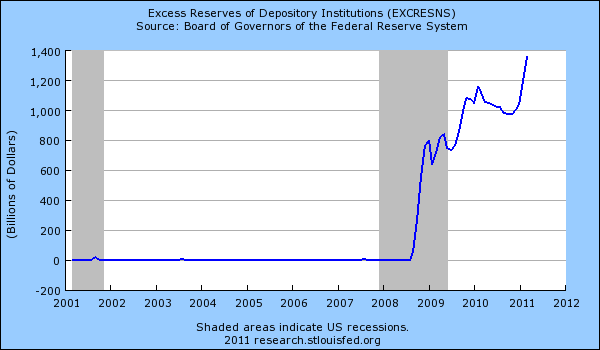
That is a very good question. The best way to answer it is to look at what happened with the primary dealers after the 2008 meltdown.

excess-reserves.png


This is basically what would happen to the money if the govt paid off its debt. It wouldnt end up as excess reserves, but the point is that it would end up doing exactly what this huge chunk of money did in 2008-2009: nothing. The national debt represents money in motion right now. It is liquid. It is cash flow. It is an income stream for millions of people. Paying it off means cutting all of its liquidity immediately and totally. Monetary velocity would drop to practically zero. The money would have to find a new place to go, and that process would take years. Until it does, it is highly deflationary. Sure, some of the money would immediately chase bubbles and push asset prices higher. But most would sit idle. Cash flow is everything in the market. Asset price levels mean nothing. Dumping a trillion dollars into stocks and real estate cannot, in itself, produce any cash flow.
 

Bird222

Diamond Member
Jun 7, 2004
3,641
132
106
:D It does if the right pocket is the wrong pocket and the left pocket is the right pocket. As long as government adds enough magic smoke anyway.


Fine, figure it over ten years. That would be paying off $1.8 trillion per year plus interest - still a monumental accomplishment.


Do you really need to ask the effect of almost tripling our money supply in any reasonable time period?

Yes because I want to learn. I know inflation would increase but if industries are going to collapse I would like to know what order and how? I would also like to know once the dust cleared what shape/improvements the country would have.
 

sm625

Diamond Member
May 6, 2011
8,172
137
106
Fine, figure it over ten years. That would be paying off $1.8 trillion per year plus interest - still a monumental accomplishment.

It's actually not that much. Half the debt is such short term debt that it is already essentially cash equivalent. Most of the long term bonds have already been traded for shorter term notes. This has been the primary economic driving force of the last 5 years (ie a bond bubble). This is also why growth is struggling to hit 2%. This was the purpose behind Operation Twist. Driving down long bond rates = driving up the price = more money for bondholders to (hopefully) stimulate the economy. That didnt happen, because all they did was buy shares of AMZN, which does absolutely nothing for the economy, unless the income stream from the AMZN stock exceeds the income stream from the long bonds before their yields were driven down. Of course this cant and wont happen. Trading a stable bond yield for an uncertain (or nonexistent!) dividend yield is not a wise choice for very large pools of money. The end game of all this is Japan, where pretty much every bond is a zero yielding bond or on a trajectory to be a zero yielding bond. At that point, all the debt is monetized, it doesnt even need to be converted to cash. It essentially already is cash. Cash is simply a zero yield note with infinite duration.

 

werepossum

Elite Member
Jul 10, 2006
29,873
463
126
It's actually not that much. Half the debt is such short term debt that it is already essentially cash equivalent. Most of the long term bonds have already been traded for shorter term notes. This has been the primary economic driving force of the last 5 years (ie a bond bubble). This is also why growth is struggling to hit 2%. This was the purpose behind Operation Twist. Driving down long bond rates = driving up the price = more money for bondholders to (hopefully) stimulate the economy. That didnt happen, because all they did was buy shares of AMZN, which does absolutely nothing for the economy, unless the income stream from the AMZN stock exceeds the income stream from the long bonds before their yields were driven down. Of course this cant and wont happen. Trading a stable bond yield for an uncertain (or nonexistent!) dividend yield is not a wise choice for very large pools of money. The end game of all this is Japan, where pretty much every bond is a zero yielding bond or on a trajectory to be a zero yielding bond. At that point, all the debt is monetized, it doesnt even need to be converted to cash. It essentially already is cash. Cash is simply a zero yield note with infinite duration.

Those are good points. Still, even increasing our monetary supply by an extra 50% would be wildly inflationary. I can see two points though that would mitigate that. First, the Fed can take money out of the economy, so in theory a lot of that could be taken away. And second, much if not most of that money wouldn't sit idle, it would leave our economy for new investment opportunities abroad. Just having a huge pile of cash looking for investments doesn't mean our nation suddenly becomes a much better place to invest. New piles of cash entering our stock market would drive up prices, so savvy investors would turn elsewhere rather than buy American stocks at already inflated prices. That would tend to spread the inflationary effect across the world, not just the American economy.
 

TheGardener

Golden Member
Jul 19, 2014
1,945
33
56
I think social security beneficiaries might be interested to hear that we don't care if the money raided from the trust fund ever gets paid back.
Shhhhhhhhh! We are not suppose to tell anyone that Social Security is 0% funded.