• We’re currently investigating an issue related to the forum theme and styling that is impacting page layout and visual formatting. The problem has been identified, and we are actively working on a resolution. There is no impact to user data or functionality, this is strictly a front-end display issue. We’ll post an update once the fix has been deployed. Thanks for your patience while we get this sorted.

I Would Like The Pyramids Alot More If They Were Tetrahedrons

Gizmo j

Platinum Member
I asked ChatGPT if any ancient cultures made a Tetrahedron pyramid and it said no.

The reason I like Tetrahedrons better is because it's made entirely of triangles.

Video games, CGI and 3D printer files are made with triangles.


Good thing ancient Egyptian didn't have you around to bitch about their shape of choice. You might have been buried in one of them.

PS the pyramids are not food safe
 
Ah, pyramids are a reminder that the history we know is generally a...history of the RICH and history of the LEARNED. But of course, humans, insecure with NOT KNOWING, conclude that what historians conclude is all that happened in history.
 
A REGULAR tetrahedron has a small limiting feature: ALL FOUR of its sides must be equilateral triangles. Of course, one could make an exception for one side, but that then forces at least one more to differ from the rest. For a Pyramid the base is usually square (that also could be changed, getting us to polyhedrons) and thus the easiest structure has the four top sides as identical triangles, either equilateral or isosceles. Again, exceptions exist.

Want all sides of a body identical? Ignore a point (zero-dimensional space?)and a straight line (one-dimensional) and any 2-dimensional drawing. We need three-dimensional bodies. After a cube (square faces) it gets tricky and only certain bodies can be made with identical flat faces. Example: a regular dodecahedron has twelve regular pentagons as faces. I don't think it can be done with hexagons. In fact, according to Wikipedia


bodies with all flat sides identical and "regular" (each face's edge length and all angles are the same) are called Platonic Solids, and there are only five of them, each made only with triangles (three such bodies), squares, or pentagons.

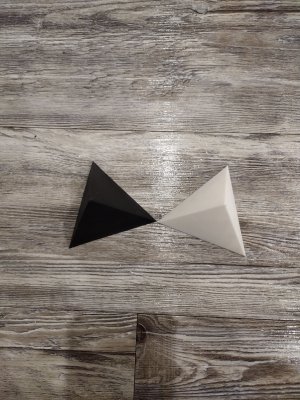
Actually, I disagree slightly with that Wikipedia article. One of their solids is the Octahedron. It is easily seen as two square pyramids stuck to each other bottom -to-bottom so it has eight triangular faces. Another name for that is a square bipyramid. But there is also the trigonal bipyramid that looks like two tetrahedrons stuck together similarly to yield a solid with six triangular faces. Is that a hexahedron?
 
Last edited:
Ah, pyramids are a reminder that the history we know is generally a...history of the RICH and history of the LEARNED. But of course, humans, insecure with NOT KNOWING, conclude that what historians conclude is all that happened in history.
This is... not true? There are all sorts of historical mysteries that historians say we'll likely never have answers for. On the thread topic, the mysteries of ancient Egypt have been studied so long that ancient Egyptology itself is ancient.
 
PS the pyramids are not food safe

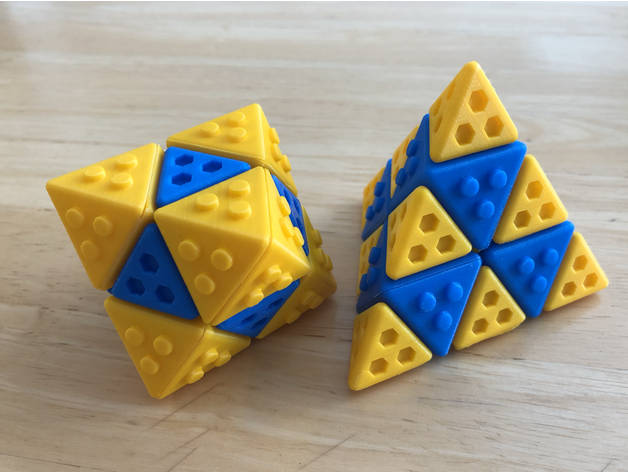
Well now he needs to 3D print a tetrahedron pyramid!


This is... not true? There are all sorts of historical mysteries that historians say we'll likely never have answers for. On the thread topic, the mysteries of ancient Egypt have been studied so long that ancient Egyptology itself is ancient.
Rarely is any history fully objective. An agenda leaks through even though the facts may be indisputable, by causing the reader to draw inferences and conclusions the author desires.
People who don't know any better when presented with a "history" wind up discounting the daily mundane experience of the subjects that lived in the time.

For Mozart biographies, the painting of Leopold Mozart as a paranoid and irrational person with conspiracies is more of a reflection of the biographer's easier academic environment than one who lived in the "music industry" of the day. It also discounts his education and experience; someone with practice in philosophy and jurisprudence is not making assertions willy nilly. That Marcia Davenport was willing to accept Leopold Mozart's suspicions and paint other nobles as capable of deceit and artifice in Mozart's life in her bio, even though she was 100 years past Mozart's time, indicates that even in the early 20th century, it was not unacceptable to believe there was deceitful stuff going on back then.
 
Rarely is any history fully objective. An agenda leaks through even though the facts may be indisputable, by causing the reader to draw inferences and conclusions the author desires.
People who don't know any better when presented with a "history" wind up discounting the daily mundane experience of the subjects that lived in the time.

For Mozart biographies, the painting of Leopold Mozart as a paranoid and irrational person with conspiracies is more of a reflection of the biographer's easier academic environment than one who lived in the "music industry" of the day. It also discounts his education and experience; someone with practice in philosophy and jurisprudence is not making assertions willy nilly. That Marcia Davenport was willing to accept Leopold Mozart's suspicions and paint other nobles as capable of deceit and artifice in Mozart's life in her bio, even though she was 100 years past Mozart's time, indicates that even in the early 20th century, it was not unacceptable to believe there was deceitful stuff going on back then.
That's a lovely story, but my point was that when you said: "[we] conclude that what historians conclude is all that happened in history", it was not a true or accurate statement. I said nothing of objectivity or agendas, but rather that historians in fact do conclude there are many things we will likely never know (in contrast to your claim that we've decided historians are the ultimate arbiters of the past).
 
historians in fact do conclude there are many things we will likely never know

That happened last year when they got the DNA results from Pompeii:


In short, “The scientific data we provide do not always align with common assumptions,” said co-author David Reich, a geneticist at Harvard University. “These findings challenge traditional gender and familial assumptions.”

Reich also cautioned against making similar mistakes with DNA analysis. "Instead of establishing new narratives that might also misrepresent these people's experiences, the genetic results encourage reflection on the dangers of making up stories about gender and family relationships in past societies based on present-day expectations," he said.

“Our findings have significant implications for the interpretation of archaeological data and the understanding of ancient societies,” said co-author Alissa Mittnik, also of Harvard University. “They highlight the importance of integrating genetic data with archaeological and historical information to avoid misinterpretations based on modern assumptions.
 
The pyramids were the optimal shape and location to harvest spiritual energy from the universe in order to power the Egyptian empire. Trust the science.
 
Years ago a guy I worked with lent me a book on pyramidology, and said he thought I'd like it. I've never read so much bullshit in my life. It was a struggle getting through the book. Even if you accepted the premise as fact, it was contradicted in other parts of the book. Probably popular with the room temp iq crowd :^S
 
Years ago a guy I worked with lent me a book on pyramidology, and said he thought I'd like it. I've never read so much bullshit in my life. It was a struggle getting through the book. Even if you accepted the premise as fact, it was contradicted in other parts of the book. Probably popular with the room temp iq crowd :^S
Igor would love it
 
If I could use one of the biggest 3D printers in the world like the one below, I would make a tetrahedron pyramid.


Here is ChatGPT making a tetrahedron in c++:


Code:
#include <iostream>
#include <array>

struct Vec3 {
    float x, y, z;
};

struct Tetrahedron {
    std::array<Vec3, 4> vertices;

    Tetrahedron() {
        vertices[0] = {1, 1, 1};
        vertices[1] = {-1, -1, 1};
        vertices[2] = {-1, 1, -1};
        vertices[3] = {1, -1, -1};
    }

    void printVertices() {
        for (int i = 0; i < 4; ++i) {
            std::cout << "Vertex " << i << ": (" << vertices[i].x
                      << ", " << vertices[i].y << ", " << vertices[i].z << ")\n";
        }
    }
};

int main() {
    Tetrahedron t;
    t.printVertices();
    return 0;
}
 
Code:
tuxj@debian:~/temp/ConvertedMusic$ cc triangle.c triangle
triangle.c:3:10: fatal error: iostream: No such file or directory
    3 | #include <iostream>
      |          ^~~~~~~~~~
compilation terminated.

I don't program. Fix it
 
Not nearly as big I wanted it to be, I think it'll be cool to make the world's largest tetrahedron and have it on the Guinness world record book.

The slicer software lets you print big stuff in small pieces!


If you're not into high-tech 3D printers and want a tetrahedral pyramid the old-fashioned way from carpentry, you cut four identical equilateral triangles from sheets of wood. Make each edge cut at a 60 degree angle. Glue edges together while using "Abracadabra" or your own favourite spell to ensure mystic properties.
 
Back
Top