I saw 2010 and other stuff. You send your probe, ship, whatever around a planet. It comes in at an orbit that brings it very close to the planet, but it does not crash, and shoots out on the other side, escaping orbit at a very fast speed. How fat depends on the trajectory it comes in at, and the mass of the objection you are banking against to pick up the speed. So take a voyager size probe, and using the sun, if we did the math perfect, and nailed said math perfect, how fast could we shoot that probe out into space? Like .95 speed of light or something like that? Anyone thought about this kind of stuff? We need to figure this kind of stuff out, no stagnate here until our destruction...

-
We’re currently investigating an issue related to the forum theme and styling that is impacting page layout and visual formatting. The problem has been identified, and we are actively working on a resolution. There is no impact to user data or functionality, this is strictly a front-end display issue. We’ll post an update once the fix has been deployed. Thanks for your patience while we get this sorted.
You are using an out of date browser. It may not display this or other websites correctly.
You should upgrade or use an alternative browser.
You should upgrade or use an alternative browser.
How fast can they sling-shot things around sun?
- Thread starter SaltyNuts
- Start date

[DHT]Osiris
Lifer
No, at that speed the sun wouldn't exert any meaningful amount of gravity on the object. It'd curve slightly off trajectory, but it wouldn't really 'slingshot'. That happens at lower speeds. I don't know the math, but someone else (orbital mechanics specialist) would.Like .95 speed of light or something like that?

ultimatebob
Lifer
I saw 2010 and other stuff. You send your probe, ship, whatever around a planet. It comes in at an orbit that brings it very close to the planet, but it does not crash, and shoots out on the other side, escaping orbit at a very fast speed. How fat depends on the trajectory it comes in at, and the mass of the objection you are banking against to pick up the speed. So take a voyager size probe, and using the sun, if we did the math perfect, and nailed said math perfect, how fast could we shoot that probe out into space? Like .95 speed of light or something like that? Anyone thought about this kind of stuff? We need to figure this kind of stuff out, no stagnate here until our destruction...
It wouldn't really work as well as you think it would. You would get a good rate of speed by slingshotting around the sun, but the pull of the Sun's gravity would eventually slow the craft down significantly by the time it got back to around to Earth orbit.

sdifox
No Lifer
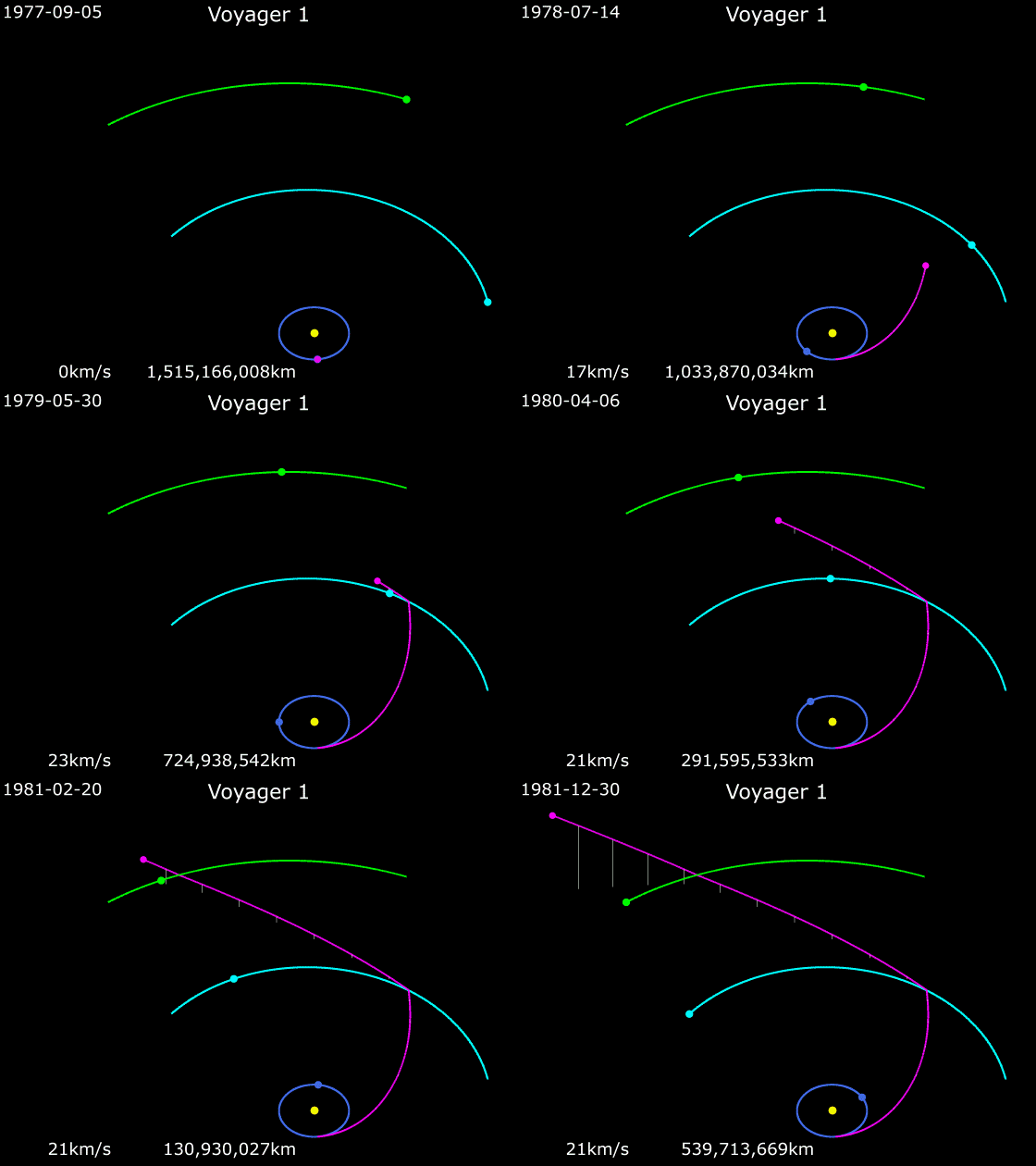
Gravity assist - Wikipedia
 en.m.wikipedia.org

K1052
Elite Member
You're not going to return to 1987 and save the Humpbacks. Now stop watching Star Trek IV. 😛
Not with these Klingon dilithium crystals!
I saw 2010 and other stuff. You send your probe, ship, whatever around a planet. It comes in at an orbit that brings it very close to the planet, but it does not crash, and shoots out on the other side, escaping orbit at a very fast speed. How fat depends on the trajectory it comes in at, and the mass of the objection you are banking against to pick up the speed. So take a voyager size probe, and using the sun, if we did the math perfect, and nailed said math perfect, how fast could we shoot that probe out into space? Like .95 speed of light or something like that? Anyone thought about this kind of stuff? We need to figure this kind of stuff out, no stagnate here until our destruction...
The only objects that have enough gravitational pull, to be used to sling shot and accelerate an object to near the speed of light, would be a Black Hole or a Neutron Star.No, at that speed the sun wouldn't exert any meaningful amount of gravity on the object. It'd curve slightly off trajectory, but it wouldn't really 'slingshot'. That happens at lower speeds. I don't know the math, but someone else (orbital mechanics specialist) would.

Pohemi
Lifer
And far as we are aware is physically possible, only subatomic particles are accelerated to those speeds by said cosmic bodies.The only objects that have enough gravitational pull, to be used to sling shot and accelerate an object to near the speed of light, would be a Black Hole or a Neutron Star.

Red Squirrel
No Lifer
I think 25 metric tons of potassium nitrate packed into a tube to make a solid rocket booster should get you there. You're going to need a lot of struts.

Scarpozzi
Lifer
Going the speed of light going towards the sun would cancel out the speed. To avoid that problem, I suggest going at night with photon torpedoes on standby.No, at that speed the sun wouldn't exert any meaningful amount of gravity on the object. It'd curve slightly off trajectory, but it wouldn't really 'slingshot'. That happens at lower speeds. I don't know the math, but someone else (orbital mechanics specialist) would.

shortylickens
No Lifer
I think Star Trek 4 is the biggest load of horse shit ever seen on the big theater screen.
ANYWAYS.....
If something goes too fast around a massive body it just keeps going. It doesnt orbit. It doesnt come back around.
Basic Newtonian physics.
If you want a demonstration, go purchase Kerbal Space Program on steam. Or watch some videos on youtube.
ANYWAYS.....
If something goes too fast around a massive body it just keeps going. It doesnt orbit. It doesnt come back around.
Basic Newtonian physics.
If you want a demonstration, go purchase Kerbal Space Program on steam. Or watch some videos on youtube.

IronWing
No Lifer
I figured Star Trek 4 was William Shatner's way of suggesting that it was time to stop milking a dead cow.I think Star Trek 4 is the biggest load of horse shit ever seen on the big theater screen.
shortylickens
No Lifer
Star Trek 4 made the most money. So, if that were his position, he was dead fuckin wrong. And he made two more movies after that, which also turned a profit.I figured Star Trek 4 was William Shatner's way of suggesting that it was time to stop milking a dead cow.


JEDI
Lifer
nope.I think 25 metric tons of potassium nitrate packed into a tube to make a solid rocket booster should get you there. You're going to need a lot of struts.
hydrogen is the best. (5 km/s )
your way will waste energy converting solid into gas.
and if you build your spaceship in space, a plasma ion drive is best. (15 km/s )
Last edited:
JEDI
Lifer
why does god need a spaceshipI liked Star Trek 4. It was entertaining and had some good memorable lines.
shortylickens
No Lifer
ummmmm.......why does god need a spaceship


HomerJS
Lifer
Oh please!. Kirk and crew had this nailed down in Star Trek TOS. They had to return Capt. Christopher back to his time and get back to theirs all in one shot.You're not going to return to 1987 and save the Humpbacks. Now stop watching Star Trek IV. 😛
TRENDING THREADS
-
 Discussion Zen 5 Speculation (EPYC Turin and Strix Point/Granite Ridge - Ryzen 9000)
- Started by DisEnchantment
- Replies: 25K
-
Discussion Intel Meteor, Arrow, Lunar & Panther Lakes + WCL Discussion Threads
- Started by Tigerick
- Replies: 25K
-

-

-
