• We’re currently investigating an issue related to the forum theme and styling that is impacting page layout and visual formatting. The problem has been identified, and we are actively working on a resolution. There is no impact to user data or functionality, this is strictly a front-end display issue. We’ll post an update once the fix has been deployed. Thanks for your patience while we get this sorted.

Help replacing a ballast...

mcvickj

Diamond Member
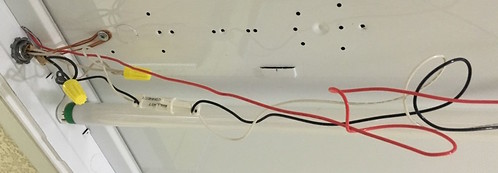
So I have a three bulb light fixture in my basement that is not lighting consistently. So I figured it is probably the ballast that is the cause of the problem.

My question is does it matter which blue wire on the new ballast goes to a particular bulb? Or can I just cut the three blue, red, white and black and just wire in the new one and attach with wire nuts?

The picture on the bottom is the new ballast.

27565860564_3d6cda88a4.jpg


27565860954_a8972f38f3.jpg


27566079833_0b9de07a5f.jpg


27566079933_c079531c77.jpg
 
I've never seen a new fixture that used the external ballast configuration rather than the newer bulbs with internal ballast. "New " as in the last ten years.
 
I've tried reseating the bulbs twice. Also swapped them between another light. I'm not sure how old the fixture is. It is just a drop ceiling with fluorescent lights.
 
I've never seen a new fixture that used the external ballast configuration rather than the newer bulbs with internal ballast. "New " as in the last ten years.

Standard 4' T8 fixtures sold today have the ballast in the fixture not the bulbs. A 3 tube fixture, that factor is a lot less common than 2 or 4 tubes.

Examples:
http://www.homedepot.com/p/Lithonia...ip-Fluorescent-Shop-Light-1242ZG-RE/202052422
http://www.homedepot.com/p/Lithonia...nt-Heavy-Duty-Shop-Light-1284GRD-RE/202968125

Tubes
http://www.homedepot.com/p/Philips-...uorescent-Light-Bulb-30-Pack-434530/205477883
 
Last edited:
Seems strange but, I've only dealt with industrial fixtures.
 
They've been this way for a long time, though towards the beginning they had less efficient line frequency transformers, 120Hz flicker and hum instead of multi-KHz frequency switching PSU ballasts which came out around the '80s, IIRC.

It's a better system for long life, getting a potted ballast heat away from the bulb heat and not having the size constraint of fitting in a bulb, though being potted, not much chance of repairing one at the discrete component level but replacements only cost about $10 dual tube or $17 quad tube, then approaching 3000 honest lumens from each 4' $2 tube.
 
Last edited:
Thanks for the info. Just curious how can you tell from the diagram?

Just reduce it logically. All the reds are parallel, you could literally wirenut all of them together in the same wire nut, so no difference there. Since all reds are electrically identical, it doesn't matter which set of blues are on the other side of the tube. Also, the blue leads aren't identified because bulb order makes no difference, so as long as you don't connect more than 1 bulb to one blue lead, you're golden.
 
Seems strange but, I've only dealt with industrial fixtures.
Huh?
Nearly all linear fluorescent T12, T10, T8, T5 etc fixtures use ballasts like the ones in the OP.

Where and what industrial fluorescent fixtures have you seen with integral ballasted lamps?
Only compact fluorescent (numerous styles and sizes) normally have an integral ballast.

OP, did you get it working?
Wire colors don't matter, just connect it like the wiring diagram shows (like stormkroe said).

I would also replace the lamps at the same time and you will be good for another 10 years.
 
Last edited:
Back
Top