• We’re currently investigating an issue related to the forum theme and styling that is impacting page layout and visual formatting. The problem has been identified, and we are actively working on a resolution. There is no impact to user data or functionality, this is strictly a front-end display issue. We’ll post an update once the fix has been deployed. Thanks for your patience while we get this sorted.

Government Data Show U.S. in Decade-Long Cooling

Page 6 - Seeking answers? Join the AnandTech community: where nearly half-a-million members share solutions and discuss the latest tech.
Surface temperatures have paused, which isn't consistent with global warming theory. However, deep ocean temperatures have risen. Therefore, the missing heat is in deep oceans.

There is a problem with accepting the above as proven fact - the scientific method isn't complete, because the hypothesis hasn't been tested. It isn't enough to observe increased ocean temperatures and declare, as fact, it was caused by global warming. You need to conduct tests to verify they are caused by man-made global warming.

This article - http://www.21stcenturysciencetech.com/articles/ocean.html - provides an alternative hypothesis, that warm water doesn't sink and changes in deep ocean temperatures are caused by normal fluctuations over long cycles. This hypothesis also needs more testing.

If we have two competing hypothesis, neither of which has been fully tested, we don't exactly have settled science.
 
I'll guarantee you every legitimate climate scientist has taken the temperatures from the OP into account. It's simply the incorrect assertion that it by itself shows global cooling that's being rejected.

I never made any such assertion, simply pointed out interesting data.

Other than all the other factors they've taken into account over the decades that led them to make the hypothesis it was man-mad and then supported the hypothesis into a theory. Many of which I linked above that you are curiously ignoring.

I have ignored nothing and read most if not all such links.

The Earth has warmed about .5C over the last 200 hundred years
Very magnanimous of you
Current climate models cannot remotely predict the future
A little hyperbolic here. Maybe that's why we continue to investigate and refine the models?

Not magnanimous at all. Simply factual and an acknowledgment of what is in the record.

Not hyperbolic [sic] but in fact you agree that the science is obviously not settled.

CO2 is not a pollutant.
Ok.... How about we call it exhaust. Since it's the low energy by product of combustion. Of course in high concentrations it will kill you. In low atmospheric concentrations we'll freeze to death.

You can call CO2 anything you want but it is a gas we need for our form of life. Classifying CO2 as a pollutant would allow the EPA to expand its oversight to our energy production infrastructure and essentially dictate what energy can be produced.

The climate is one of the most complex systems and we are barely scratching the surface of understanding it
Nice appeal to ignorance. I'm curious what first order or second order effects do you think are being neglected here?

Not an appeal at all to ignorance. Again, simply stating a fact that anyone should be able to understand. Climate modeling is complex. Our climate models today are not predicting the future with any reliability. Hence, much more research needs to be done so the science is not settled except for the Earth has warmed since the end of the Little Ice Age. How much humans contributed to that and how much are natural cycles is yet to be determined.
 
I have absolutely zero confidence in Ocean Heat Content prior to Argo.

Even then, observe what our best data can come up with. Ocean Heat Content contains cooling trends in the Northern Hemisphere, and warming trends in the Southern. Sort of destroys your theory once examined. This "energy imbalance" is selectively warming the deep ocean on one side of the planet, but not the other?

It gets worse if you mean to tell us that CO2 warmed the atmosphere, which then warmed the surface, which then warmed the deep ocean, all while leaving no trace in the former. You might call it a logical conclusion, I call it fraud.

Doesn't look like the IPCC agrees with your assessment:

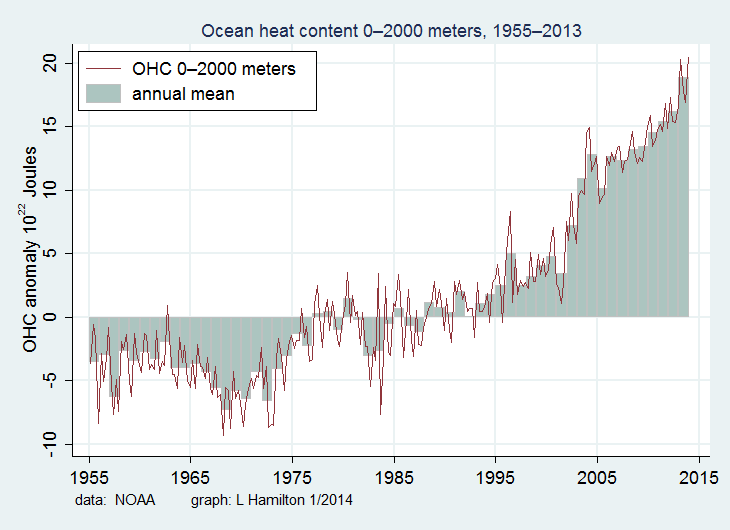
ocean_heat_chart.png

*The IPCC concludes that more than 90 percent of the heat trapped by greenhouse gases in the atmosphere have been absorbed by oceans. Figure Source: Nuccitelli et al., 2012 *

Even your chart shows overall warming during the "pause" which you said couldn't happen because it's a fraud for the ocean to warm while the air cools even though that's the basic definition of a heat exchanger.

But I get it, global conspiracy of fraud and incompetence. Only Judith Curry is brave enough to tell the "truth" (TM), on Fox and Friends, that 4 out 5 doctors prefer Marlboros, er I mean global climate is changing because man isn't causing it, or I mean it is but it's a good thing. Remember to visit her website, (no Adblock please) and don't forget to click like!

Seriously though, your hypothesis has ramifications. According to you everything, atmosphere and ocean temperatures are decreasing, ice is increasing. So where is the solar energy going? Energy has to balance or is that another global conspiracy?

I'm sure Judith has another chart somewhere showing energy balance. 😉
 
Last edited:
I have absolutely zero confidence in Ocean Heat Content prior to Argo.

Even then, observe what our best data can come up with. Ocean Heat Content contains cooling trends in the Northern Hemisphere, and warming trends in the Southern. Sort of destroys your theory once examined. This "energy imbalance" is selectively warming the deep ocean on one side of the planet, but not the other?

It gets worse if you mean to tell us that CO2 warmed the atmosphere, which then warmed the surface, which then warmed the deep ocean, all while leaving no trace in the former. You might call it a logical conclusion, I call it fraud.

It is perfectly reasonable that parts of the ocean are warming and others aren't. With a system like the ocean it would be strange if the entire thing was uniformly warming.

The deep ocean, surface, and atmosphere all heat and cool each other depending on relative temperature. You won't be able to have a warm atmosphere if the ocean surface is cool.
 
Surface temperatures have paused, which isn't consistent with global warming theory. However, deep ocean temperatures have risen. Therefore, the missing heat is in deep oceans.

There is a problem with accepting the above as proven fact - the scientific method isn't complete, because the hypothesis hasn't been tested. It isn't enough to observe increased ocean temperatures and declare, as fact, it was caused by global warming. You need to conduct tests to verify they are caused by man-made global warming.

This article - http://www.21stcenturysciencetech.com/articles/ocean.html - provides an alternative hypothesis, that warm water doesn't sink and changes in deep ocean temperatures are caused by normal fluctuations over long cycles. This hypothesis also needs more testing.

If we have two competing hypothesis, neither of which has been fully tested, we don't exactly have settled science.
Virtually nothing in climate science is settled science. However, we can make some reasonable statements.

1. The Earth is generally warming and will do so until the next Ice Age, albeit probably not without pauses and cooling dips.
2. CO2 traps reflected heat and thereby warms the planet, although it is one of the weaker warming gases, and will continue to do so until those particular frequencies have been mostly absorbed.
3. The Earth has magnificent feedback loops, both positive and negative, to regulate temperature. We do not understand the majority of these mechanisms, so we can't really predict how well or how quickly they will regulate temperature.
4. We're putting a significant amount of CO2 into the atmosphere that would not otherwise be there.
5. Excess CO2 always has some negative effects, even though it is a very necessary substance for life. Compare it to water, which is also necessary for life. We pipe water into our homes, but if we have, say, four feet of water in our homes, then we have a problem even though water is good and necessary for life.

Therefore it behooves us to identify and enact sane, responsible measures to reduce CO2 output and mitigate CO2 accumulation. I don't consider this to be an emergency, but the sooner a problem is addressed the sooner it is solved.
 
"Tobacco smoke does not cause CANCER!" Oh shit, channeling the Sixties, gotta get with the times, got new bosses putting $$ in the ol'pocket now.
"Man made CO2 does not cause GLOBAL WARMING!"

Ducked that one, just hope no one mentions the umbrella of particulate pollution shielding the Northern industrial zone from the same temperature increase as it has in the Arctic. 25% decrease measured in the strength of Sunlight hitting the ground between the Fifties and Seventies. No wonder they feared a coming Ice Age.

signed: Mouth piece of Corporate interests
 
Virtually nothing in climate science is settled science. However, we can make some reasonable statements.

1. The Earth is generally warming and will do so until the next Ice Age, albeit probably not without pauses and cooling dips.
2. CO2 traps reflected heat and thereby warms the planet, although it is one of the weaker warming gases, and will continue to do so until those particular frequencies have been mostly absorbed.
3. The Earth has magnificent feedback loops, both positive and negative, to regulate temperature. We do not understand the majority of these mechanisms, so we can't really predict how well or how quickly they will regulate temperature.
4. We're putting a significant amount of CO2 into the atmosphere that would not otherwise be there.
5. Excess CO2 always has some negative effects, even though it is a very necessary substance for life. Compare it to water, which is also necessary for life. We pipe water into our homes, but if we have, say, four feet of water in our homes, then we have a problem even though water is good and necessary for life.

Therefore it behooves us to identify and enact sane, responsible measures to reduce CO2 output and mitigate CO2 accumulation. I don't consider this to be an emergency, but the sooner a problem is addressed the sooner it is solved.

This is a very reasonable post. I'd nit pick a few of your points but on the whole: :thumbsup:
 
"Tobacco smoke does not cause CANCER!" Oh shit, channeling the Sixties, gotta get with the times, got new bosses putting $$ in the ol'pocket now.
"Man made CO2 does not cause GLOBAL WARMING!"

Ducked that one, just hope no one mentions the umbrella of particulate pollution shielding the Northern industrial zone from the same temperature increase as it has in the Arctic. 25% decrease measured in the strength of Sunlight hitting the ground between the Fifties and Seventies. No wonder they feared a coming Ice Age.

signed: Mouth piece of Corporate interests

No, that is not what I or some others are saying at all. There is no doubt the Earth is generally warming. There is no doubt additional CO2 is being dumped into the atmosphere by man's activities. The question really amounts to what extent is this increase in CO2 by man and related to an Earth that is still leaving an ice age and therefore has some built in warming trend already. That is the discussion today.
 
That caught me off guard. I had to go out searching my sources for the deep ocean heating faster, but I only found some spotty information from 2011. Then I stumbled upon a blog friendly to you and re-discovered the contradictory information.

What do you make of this?
It shows the 0-2000 warming faster than the 0-700.

Well what I take away is that your charts are using the same ocean data as the ones I linked from the IPCC.

I'd expect a swath of ocean 2000 ft deep to contain more energy than the same swath only 700ft deep.

However if you look at the plot I posted you can see that a little more than half is contained in the first 700ft. I'd kind of expect that as the heat has to be transferred from the atmosphere or direct solar irradiance to the upper ocean and then by convection to the deeper ocean.

If it seemed like I was saying the deeper ocean was increasing faster than the upper ocean that wasn't what I was going for. The upper ocean in general should heat faster than the lower ocean due to the latency of heat transfer.

My basic point was that atmospheric temperature is only one of many heat reservoirs that have to be measured to determine whether the Earth as a whole is balanced, increasing or decreasing.

From the chart I linked you can see that the ocean is many multiples the size heat sink the atmosphere is.

Edit. I also wonder if the wealth of data down to 2000 ft is because the Navy was interested in sonar performance. 2000ft covers the maximum depth of naval subs. At least that's what Tom Clancy led me to believe. 😉
 
Last edited:
No, that is not what I or some others are saying at all. There is no doubt the Earth is generally warming. There is no doubt additional CO2 is being dumped into the atmosphere by man's activities. The question really amounts to what extent is this increase in CO2 by man and related to an Earth that is still leaving an ice age and therefore has some built in warming trend already. That is the discussion today.

ocean_heat_chart.png

So if you look at the chart it shows roughly 20x10^22 joules of energy stored in the ocean over and above what was there in 1960.

Just for comparisons sake that is equal to:

  • ~5 times the energy in all fossil fuel reserves
  • ~48000 Gigatons of TNT
  • ~40% the estimated impact energy of the Chicxulub meteor
(Thanks Wolfram Alpha!)

It is a metric shit ton of energy and quite frankly the 800lb gorilla in the room. Any hypothesis as to what the climate is doing must explain this energy increase.

That increase in energy must have come from some where. There are really only 3 options:

  • Retained Solar Energy
  • Decay Heat from Radioactive Minerals
  • Latent Heat from the Formation of the Earth

Decay heat makes no sense as it's been slowly decreasing since the Earth was formed. Same with the latent heat of formation.

That leaves retained solar energy.

So as you said what's our contribution? And as you also rightly pointed out we were warming after the last ice age.

Let's look at some possible natural reasons why retained solar radiation is increasing.

- Orbital variation has moved the Earth closer to the sun. Nope our orbit and inclination to the sun hasn't changed appreciably in the last 100 years.

- Solar output has increased. Nope. I've posted this chart already in this thread and you can see a steady cyclic oscillation going back several decades with a small but meaningful decrease in the 00's

So if it's not solar input the issue must be with the Earth. For the atmosphere and oceans to increase their retention of energy there must be more energy incoming than leaving. We just showed it's not due to an increase in incoming energy so that leaves us with a decrease in outgoing energy.

And that brings us to greenhouse gases. So what's the makeup of the atmosphere?
TBL01_0T2.JPG


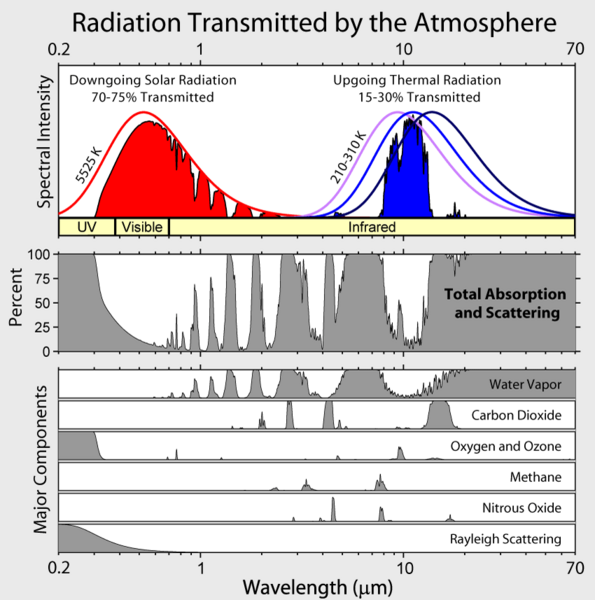
So which of these gases including H20 can trap heat?

595px-atmospheric_transmission.png


Methane, water vapor and CO2 are the heavy hitters.

methane-global-average-05-2006b.jpg

Methane seems to be leveling off.


Water Vapor has been increasing but it increases due to temperature increases as higher temperature means more evaporation and more ability for the air to hold water. So increasing water vapor is symptom not a primary cause of heating.

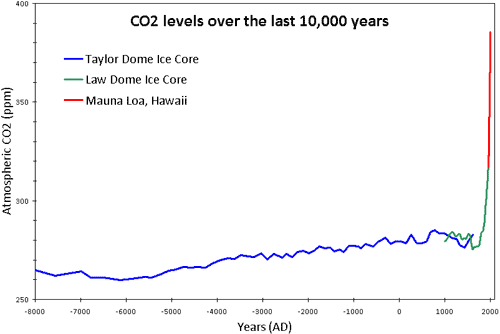
co2_10000_years.gif


So that leaves us with CO2 and the infamous hockey stick plot. We know exactly how much we've been putting into the air based on fossil fuels sold and burned.

While pre-industrial levels of CO2 already grabbed most of the energy the excess CO2 traps a few more percentages of energy leaving the earth. It also continues to block IR energy leaving at higher and higher altitudes as the concentration increases, driving higher temperatures if I understand correctly.

The imbalance ends up being a fraction of a percent of the energy that hits the earth, less than 1W/m^2 out of the approximately 1300W/m^2 that hit the earth. But the earth is a big place and that imbalance ends up being an extra dinosaur killer asteroid worth of energy siting in our ocean and air over time.

So that in a nut shell is how we know the earth is warming and man is the primary cause.

I hope some of this was useful.

 
Last edited:
Well what I take away is that your charts are using the same ocean data as the ones I linked from the IPCC.

I'd expect a swath of ocean 2000 ft deep to contain more energy than the same swath only 700ft deep.

The 2000 meter chart is steeper, shows faster warming, than the 700 meter chart. Thus the deep ocean is warming faster. Your IPCC chart shows the opposite. There is a serious fundamental error somewhere. Did they transpose the color key?

In addition, what do you think about Northern Hemisphere OHC not rising? The Argo era global OHC rise is entirely from the Southern Oceans. To trust in Ocean Heat Content as reliable data, I need to understand its quirks.
 
The 2000 meter chart is steeper, shows faster warming, than the 700 meter chart. Thus the deep ocean is warming faster. Your IPCC chart shows the opposite. There is a serious fundamental error somewhere. Did they transpose the color key?

In addition, what do you think about Northern Hemisphere OHC not rising? The Argo era global OHC rise is entirely from the Southern Oceans. To trust in Ocean Heat Content as reliable data, I need to understand its quirks.

Ok let me try and explain what I think the charts show and see if you agree with me.

We basically have 4 plots that show the quantity of energy contained in the ocean down to certain depths vs time.

Your first chart shows total energy content from 0 ft - 700ft. Let's say that for any given year that's X amount of energy.

My chart also has plot that shows total energy content of the upper ocean vs time. It too should show X amount of energy for the same year.

My next plot shows the amount of energy from the bottom of the upper ocean down to the lower ocean (700ft-2000ft). Let's call that quantity of energy Y for a given year.

Your second chart shows the total quantity if energy from 0ft - 2000ft, the combined energy stored in the upper and lower ocean. So for a given year that we could express that as X + Y.

So your second plot should always be higher than your first and equal to the sum of my two plots. Let's pick a year and see if I'm right.

In the last year of my plot which looks to be 2009 my 0 - 700ft plot shows roughly 19x10^22J at the top and around 6x10^22J at the bottom for a total magnitude of about 13x10^22J

Your plot for 0-700ft in 2009 shows about a magnitude of 11x10^22J.

My 700-2000ft plot shows a total magnitude of a little bit more than 4x10^22J

Total X + Y from my two graphs is around 17x10^22J

Your total plot from 0-2000ft in 2009 shows a total quantity of energy of around 14x10^22J.

So if we subtract your X from your X+Y we get a total energy content of around 3x10^22J, pretty close to the 4x10^22J from my chart.

So your plots and mine seem to be showing the same thing. (At least as close as I can tell from trying to read them on my iPhone)

So in short both of our plots show the upper ocean with most of the energy and increasing. While the lower ocean has less energy but is also increasing albeit at a slower rate. This makes sense from a heat mass transfer stand point to me.

I don't have an answer on your Argo question, I'll have to take a look at it.

Let me know if I wasn't clear with anything.
 
Last edited:
The 2000 meter chart is steeper, shows faster warming, than the 700 meter chart. Thus the deep ocean is warming faster. Your IPCC chart shows the opposite. There is a serious fundamental error somewhere. Did they transpose the color key?

In addition, what do you think about Northern Hemisphere OHC not rising? The Argo era global OHC rise is entirely from the Southern Oceans. To trust in Ocean Heat Content as reliable data, I need to understand its quirks.

In order to get the 700-2000m warming you would have to subtract 0-700m from the 0-2000m graph.
 
So in short both of our plots show the upper ocean with most of the energy and increasing. While the lower ocean has less energy but is also increasing albeit at a slower rate. This makes sense from a heat mass transfer stand point to me.

The IPCC chart shows lower ocean increasing at a slower rate, but the actual data shows lower ocean increasing at a faster rate. That is the difference I'm focused on. I understand the baseline difference by using 0-2000 instead of 700-2000, but if the upper ocean was warming faster then the addition of the lower ocean would not increase the trend. It appears that the IPCC chart is not correct.

Maybe that's a red herring at this point, as you are adequately suggesting to me that the upper ocean has so much more energy, that an increase in it could bleed over a greater amount to the lower ocean. You are essentially explaining what I'm seeing.

Skeptical arguments I've heard suggest that this energy imbalance would first need to be increasing faster in the atmosphere and upper ocean, before increasing faster in the lower ocean. It appears to be a misguided notion, for if both upper reservoirs are already imbalanced, who are they to tell us what the rate of transfer should be to the lower ocean?

In fact, given the truth of Polar Amplification, it's precisely the lower energy portions of our thermal system which should warm the fastest. OHC is entering into evidence that this holds true for the lower ocean.

Given this, my earlier argument (re which layer should warm fastest) is invalidated. Regardless of the error in the IPCC chart. I will retract the statement which called it a fraud on that basis.

However, I would like to put a point to rest. Given what the most recent decade of data says, it is obvious that the lower ocean has recently warmed faster than the upper ocean. Do you also read it that way, and agree?
 
Last edited:
The IPCC chart shows lower ocean increasing at a slower rate, but the actual data shows lower ocean increasing at a faster rate. That is the difference I'm focused on. I understand the baseline difference by using 0-2000 instead of 700-2000, but if the upper ocean was warming faster then the addition of the lower ocean would not increase the trend. It appears that the IPCC chart is not correct.

Yes it would, that isn't temperature it's OHC in joules through those depths. So obviously unless 700-2000m is actually cooling 0-2000m will increase faster than 0-700m.

So the actual data shows 0-2000m is gaining more energy than 0-700m alone. So both 0-700m and 700-2000m are both gaining energy. You will have to subtract one from the other to get how much 700-2000m are gaining

Edit: from your own link you can see that actual overall temperature change of 0-700m is higher than 0-2000m. Which also supports what we have said.
 
Last edited:

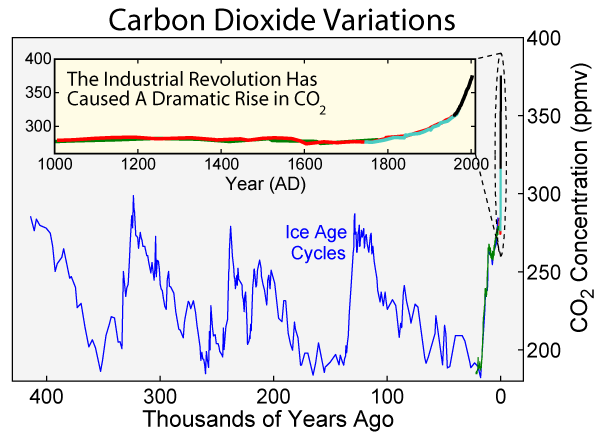
Personally I find the Vostok CO2 levels combined with the most recent CO2 levels far more dramatic and telling to the story:
Carbon_Dioxide_400kyr.png

That's always been a very impressive and sobering result. We're falling into uncharted places with the current atmospheric/landmass variables.
 
Personally I find the Vostok CO2 levels combined with the most recent CO2 levels far more dramatic and telling to the story:
Carbon_Dioxide_400kyr.png

That's always been a very impressive and sobering result. We're falling into uncharted places with the current atmospheric/landmass variables.

I agree. Now realize that every oil, coal, and gas company intends to sell and burn their entire reserves over the coming decades.

Since energy usage is tied with quality of living, preventing the use of carbon fuels means more people suffering in poverty, if they can't be replaced by greener energy.

Not a good situation.
 
Good to see people are making progress learning things here. It's nice to see the incoherent arguments going away.
 
Back
Top