• We’re currently investigating an issue related to the forum theme and styling that is impacting page layout and visual formatting. The problem has been identified, and we are actively working on a resolution. There is no impact to user data or functionality, this is strictly a front-end display issue. We’ll post an update once the fix has been deployed. Thanks for your patience while we get this sorted.

News Global Foundries Expansion (Anandtech)

Ugh, made this a 'question' instead of 'news' 🙄

I changed it for you if thats OK, back to news. If you want it back to question, let me know.
Markfw
Anandtech Moderator
 
I imagine that there is currently allot of IoT, automotive, etc. that can be done on current and near term node. Not sure what the breakdown is for GloFo sales by node. Is Singapore 12FD? Seems like the new NY Fab would be a generation after that.
 
Their current, most advanced, finger node is 12lp+, which incorporates some of their IP developed for their 7nm node. It's a non-trivial improvement, but isn't in the same class as N7 or i10,sf,esf. GF are seeing substantial revenue from all of their fans currently, and are essentially investing what they are making in expanding their capabilities with their current nodes.

In the future, they will likely partner with another foundary to purchase trailing node IP and equipment and update their offerings with newer model capacity, but are so far removed from leading edge development that they would likely never get back into leading edge development.
 
They'll not move to sub 7nm node where EUVs dominate. You can't really buy only 1 or 2 EUV scanners(~10% of their annual revenue) to set up a new process. Setting up a new process requires a new methodology, PDK, ecosystem support, and factory. There will be massive losses if one EUV scanner stops (-50% throughput).
Still, DUV-based processes are good and have a strong demand so GloFo is doing what they can.
 
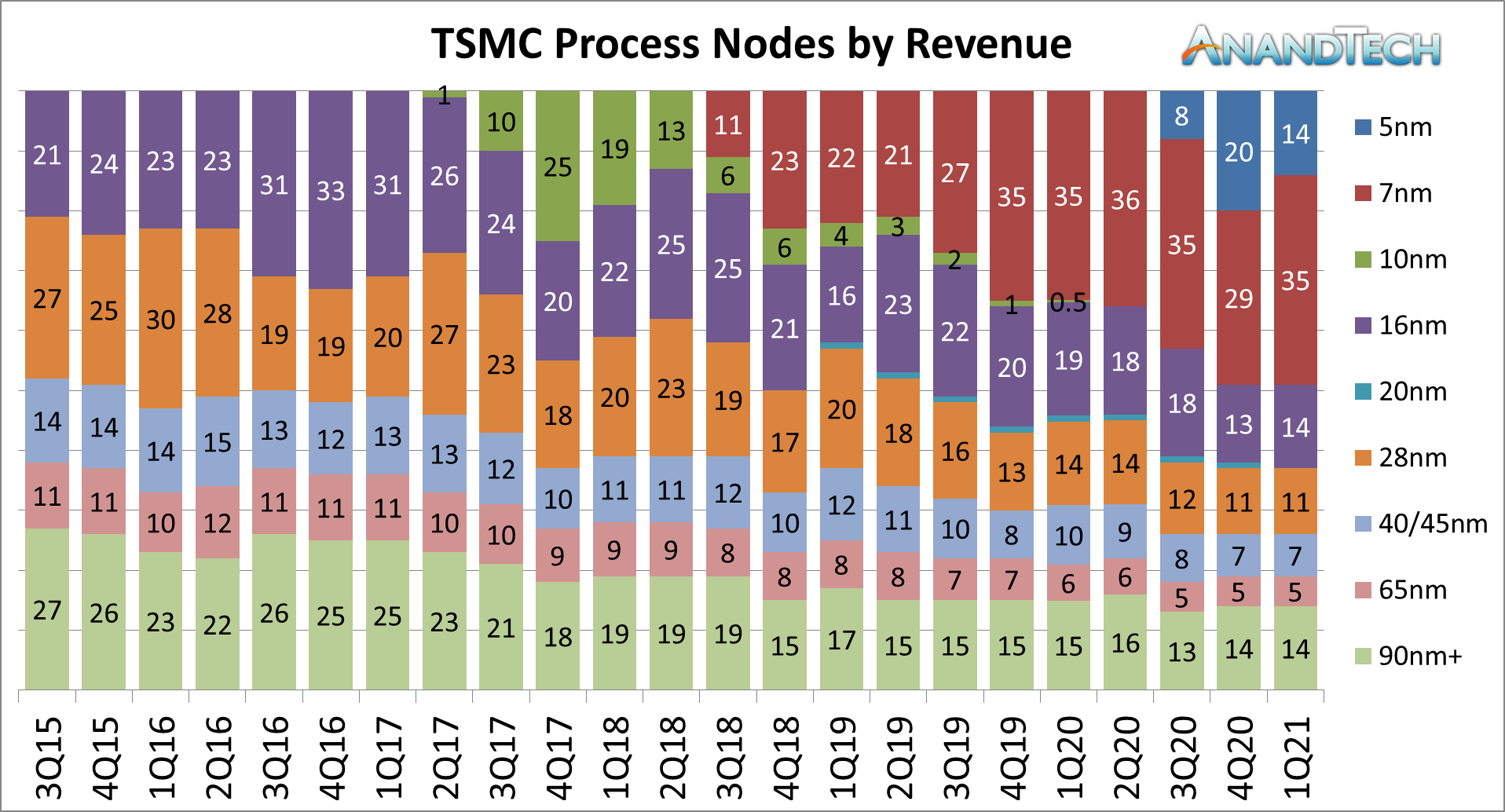
I don't think Global Foundries needs to be on the bleeding edge to compete. Here's a graph from an AT article earlier this year that shows TSMC's revenue breakdowns per node:

RevenueSplit.png


Even with 5nm ramping up, half of their revenue is still using nodes that are effectively older than the best node that Global Foundries has. For all the fuss about the latest and greatest process nodes, a lot of people are still paying for wafers on a process that's over a decade old. Looking at the historical trend it doesn't appear that the bleeding edge node ever accounts for much more than a third of the revenue, or at least not in the time scale for this data.

There's no sense in Global Foundries trying to run a race that they can't hope to win. Imagine if every creature in the sea were desperately trying to occupy the ecological of the shark. It just wouldn't work.
 
I don't think Global Foundries needs to be on the bleeding edge to compete. Here's a graph from an AT article earlier this year that shows TSMC's revenue breakdowns per node:

RevenueSplit.png


Even with 5nm ramping up, half of their revenue is still using nodes that are effectively older than the best node that Global Foundries has. For all the fuss about the latest and greatest process nodes, a lot of people are still paying for wafers on a process that's over a decade old. Looking at the historical trend it doesn't appear that the bleeding edge node ever accounts for much more than a third of the revenue, or at least not in the time scale for this data.

There's no sense in Global Foundries trying to run a race that they can't hope to win. Imagine if every creature in the sea were desperately trying to occupy the ecological of the shark. It just wouldn't work.

Damn. Someone explain the 90nm trend please? Especially cost-effective node?
 
Damn. Someone explain the 90nm trend please? Especially cost-effective node?

What is it about the 90nm trend that has you confused? As more nodes are added below it, 90nm becomes a smaller percentage of TSMC's overall revenue but the 90nm+ revenue in absolute terms is likely unchanged as there will always be customers for those nodes.
 
What is it about the 90nm trend that has you confused? As more nodes are added below it, 90nm becomes a smaller percentage of TSMC's overall revenue but the 90nm+ revenue in absolute terms is likely unchanged as there will always be customers for those nodes.

I dont know what to say, for its age it looks to have a disproportionate big slice of the pie.
 
7nm only needs DUV.

Yes but multi-patterning isn't ideal since you need to use a lot of masks so EUVL looks to be a promising proposal to lower the entry cost to manufacturing 7nm process in the future if we can improve the throughput of these systems ...

In the not far future, we can expect to see the introduction of anamorphic high-NA EUVL systems in a couple of years which will help even further in the reduction of mask count ...
 
I don't think Global Foundries needs to be on the bleeding edge to compete. Here's a graph from an AT article earlier this year that shows TSMC's revenue breakdowns per node:

RevenueSplit.png


Even with 5nm ramping up, half of their revenue is still using nodes that are effectively older than the best node that Global Foundries has. For all the fuss about the latest and greatest process nodes, a lot of people are still paying for wafers on a process that's over a decade old. Looking at the historical trend it doesn't appear that the bleeding edge node ever accounts for much more than a third of the revenue, or at least not in the time scale for this data.

There's no sense in Global Foundries trying to run a race that they can't hope to win. Imagine if every creature in the sea were desperately trying to occupy the ecological of the shark. It just wouldn't work.

Thank you for this.

It's super easy for enthusiasts to focus only on the latest processes and x86/arm products, but the semiconductor world is SO much bigger than that, and the vast majority of devices needing silicon don't need the latest and greatest by any stretch. Capacity is a real issue globally at present, so expansion eases some of the supply pressure.
 
Back
Top