Germany's new boom: making money by making stuff

Page 2 - Seeking answers? Join the AnandTech community: where nearly half-a-million members share solutions and discuss the latest tech.

amyklai

Senior member
Nov 11, 2008
262
8
81
Why would they even need it when it's law that you have worker representation on the boards. $7 per hour (or whatever min. wage) is far below the equilibrium wage for the overwhelming majority of jobs anyway and it's FAR less than what Germans are paid, so min. wage doesn't even matter.

Actually there are low-paying jobs and there has been a minimum wage debate in the last years. Postmen, security guards, cleaning personnel, hair stylists and similar low qualification jobs get pretty low pay and for some for those jobs, a minimum wage IS relevant.
 

ShawnD1

Lifer
May 24, 2003
15,987
2
81
And in cities, there's often a city-owned public housing association.
So basically Germany is like USA but it doesn't have retards who break the windows and break the elevator then complain about the government having broken windows and a broken elevator and "dey left us in da projeks"


Obvious article is obviously obvious. Value added = good? No shit. Next you'll tell us that having a job is a great way to make money.


Germany has no minimum wage either :O
When the country isn't a piece of shit, minimum wage is not required. Minimum wage in my city or region or something is like $8.50 per hour, but even McDonalds pays $10/h. Nobody will work for $8.50 because there isn't that much of a job shortage in this particular city.

If you're talking about minimum wage being too low, then you're missing the point entirely. Having a bunch of jobs that actually pay minimum wage to people who are fully grown adults means your economy is fucked beyond believe and needs to be fixed.
 

amyklai

Senior member
Nov 11, 2008
262
8
81
Also, worker representation on boards only exists in larger companies. Basically, the smaller the company, the more limited the worker's rights.
 

alphatarget1

Diamond Member
Dec 9, 2001
5,710
0
76
Why would they even need it when it's law that you have worker representation on the boards. $7 per hour (or whatever min. wage) is far below the equilibrium wage for the overwhelming majority of jobs anyway and it's FAR less than what Germans are paid, so min. wage doesn't even matter.

Not everybody makes $48 an hour in Germany. You could say that Germans in manufacturing makes more money than their US counterparts, but wages in general are lower in Germany compared to the US, at least from what I've heard from friends.

Let me take that back- I think wages of college graduates/higher educated people are probably lower than in the US. German doctors don't make 200k a year AFAIK.
 

Phokus

Lifer
Nov 20, 1999
22,994
779
126
Actually there are low-paying jobs and there has been a minimum wage debate in the last years. Postmen, security guards, cleaning personnel, hair stylists and similar low qualification jobs get pretty low pay and for some for those jobs, a minimum wage IS relevant.

Well this thread is about manufacturing and why it fled. And OUR minimum wage is lower than the equilibrium for those jobs you're talking about (except maybe 'cleaning personnel' that's done by illegal labor).
 

Phokus

Lifer
Nov 20, 1999
22,994
779
126
Also, worker representation on boards only exists in larger companies. Basically, the smaller the company, the more limited the worker's rights.

This is what i found:

It applies to public and private companies, so long as there are over 2000 employees. For companies with 500-2000 employees, one third of the supervisory board must be elected.

Not exactly 'large' companies only. But if all those companies have worker representation and they raise wages, that would raise the equilibrium wages of those companies that don't have it.
 

amyklai

Senior member
Nov 11, 2008
262
8
81
Another interesting and somewhat funny tidbit:
unsurprisingly, a lot of companies in the low-paying sectors used to oppose minimum wages in recent years.

Now things have changed: pretty soon, workers from Eastern Europe will be allowed to work in the whole EU without any restriction.

Now these same companies are calling for minimum wages, because they fear to be overrun by competitors from Poland, Czech Republic etc, who do the cleaning job for a fraction of the money. By calling for the minimum wage, they're trying to force these foreign service companies to play on a level field. We'll see how that goes.
 

ShawnD1

Lifer
May 24, 2003
15,987
2
81
Also, worker representation on boards only exists in larger companies. Basically, the smaller the company, the more limited the worker's rights.

It's like that everywhere. Bigger company = better compensation. Even for doing stuff like engineering field work, a lot of the smaller companies in my area don't have any benefits at all. They pay a remarkably good wage and that's where it ends. No pension, no insurance, no group rates on things (I get 20% off food items at the bar downstairs).
 

amyklai

Senior member
Nov 11, 2008
262
8
81
Not exactly 'large' companies only. But if all those companies have worker representation and they raise wages, that would raise the equilibrium wages of those companies that don't have it.

Oh, then we have different scales in mind. A lot of the German industry is comprised of smaller companies with 50 - 2000 employees (the so-called Mittelstand).
These small - medium companies are the ones that have been creating jobs in the last decades, the larger companies tend to have less employees in Germany than they had 20 or 30 years ago (and instead more employees in other countries).

The Mittelstand is regulated less by employee representation but more by the fact that these are usually family companies and the owners live in the same (often small) town where the company is located. They have a reputation to lose and treating your employees badly or paying low isn't the best way to improve your standing in your hometown.
Of course, two generations later, when there's often less connection between the owner familiy, the company and the community, there will be different forces at play and that's where board representation of employees becomes important (and the German tax law, which gives the heirs rather big tax discounts if the amount of employees stays at least the same for a minimum number of years).

 

Phokus

Lifer
Nov 20, 1999
22,994
779
126
Oh, then we have different scales in mind. A lot of the German industry is comprised of smaller companies with 50 - 2000 employees (the so-called Mittelstand).
These small - medium companies are the ones that have been creating jobs in the last decades, the larger companies tend to have less employees in Germany than they had 20 or 30 years ago (and instead more employees in other countries).

The Mittelstand is regulated less by employee representation but more by the fact that these are usually family companies and the owners live in the same (often small) town where the company is located. They have a reputation to lose and treating your employees badly or paying low isn't the best way to improve your standing in your hometown.
Of course, two generations later, when there's often less connection between the owner familiy, the company and the community, there will be different forces at play and that's where board representation of employees becomes important (and the German tax law, which gives the heirs rather big tax discounts if the amount of employees stays at least the same for a minimum number of years).


I guess in that case, banking laws/regulating capital flight is more important in the long run then. But still, higher wages from employee representation should lead to higher equilibrium wages for those smaller companies that don't have representation.
 

amyklai

Senior member
Nov 11, 2008
262
8
81
But still, higher wages from employee representation should lead to higher equilibrium wages for those smaller companies that don't have representation.
Yes, they do in a way. But the wages are usually not negotiated within a single company, they're negotiated between union representatives and owner representatives for a whole area of Germany ("Flächentarifvertrag"). Such a master contract will set the wages for lots of companies.

Board representation is probably more important for influencing strategic company decision (like when a car company has to decide where a new model will be built, Germany or Hungary etc.).
 

Lotheron

Platinum Member
Oct 21, 2002
2,188
4
71
If you're talking about minimum wage being too low, then you're missing the point entirely. Having a bunch of jobs that actually pay minimum wage to people who are fully grown adults means your economy is fucked beyond believe and needs to be fixed.

Actually, it's called supply and demand. If there is a demand for jobs that pay $x rate, then there will be supply for jobs that pay $x rate. There's nothing messed up about it and it's simple economics.
 

Jhhnn

IN MEMORIAM
Nov 11, 1999
62,365
14,686
136
Looks like it's downsizing and VAT taxes that have helped Germany.

Hogwash. It's the fact that their structure of corporate governance grants workers a stake and a say in how things are done. Employers recognize that they have obligations to the communities that have provided them with the means to do well, rather than the leveraged buyout lootocracy and Wall St flimflam artists of America.
 

charrison

Lifer
Oct 13, 1999
17,033
1
81
Just remember when moron conservatives say American workers in manufacturing are 'too expensive':

Germany is anything but a low-wage country: The average hourly compensation -- wages plus benefits -- of German manufacturing workers is $48, well above the $32 hourly average for their American counterparts. Yet Germany is an export giant while the U.S. is the colossus of imports.

(from the other thread)

http://mjperry.blogspot.com/2011/01/we-should-take-more-pride-in-our-global.html

Yup, we dont make anything.
 

charrison

Lifer
Oct 13, 1999
17,033
1
81
The UK suffered the same fate as the US in terms of unions thanks to Thatcher. Rather than work to make unions and corporations work harmoniously together to find solutions to long term growth, they followed more capitalist policies that allowed corporations to destroy unions, drive wages down, and move capital oversees.

Germany's laws include having worker representation on the board of directors of companies so companies and unions/workers work together for long term growth rather than the Reagan/Thatcher style of short term growth/slash and burn type capitalism encouraged by wall street (notice that London is also one of the great financial cities in the world). Don't meet expected quarterly earnings? We're going to whack your stock and (and your bonus as a result). Whelp, time to start outsourcing everyone. They also have policies that keep capital from fleeing the country and now they're prospering.

Another interesting thing about Germany is they are basically a right to work state. They have unions, but they are not a condition of employment. This probably keeps the unions from getting stupid over there.
 

SparkyJJO

Lifer
May 16, 2002
13,357
7
81
Republicans are still telling us that.

Not this one. We need to make more stuff here, and I buy stuff made here over china-made crap as much as reasonably possible. That's one reason I drive a GM vehicle that was built right here in Ohio.
 

Infohawk

Lifer
Jan 12, 2002
17,844
1
0
But by the early 2000s, the evidence of slow growth and high levels of unemployment was too powerful to ignore, so Gerhard Schröder introduced the Agenda 2010 reforms which cut business taxes, slashed the top rate of income tax, made pensions less generous, cut unemployment pay and allowed the shops to stay open later.

"Schröder didn't get the full credit for what he did," Mayer said. "He attacked all the sacred cows and paid the price by losing the election to Merkel. Industry embarked on a ruthless cost-cutting programme, they exploited new production techniques and IT to make their operations leaner and more profitable. Some parts of manufacturing were moved overseas but not all of it.

"It is an amazing comeback. The country seems to be a lot more dynamic."

This thread is a circle jerk of planned-economy supporters acting like this somehow vindicates their outdated preferences. Not sure why they feel vindicated when they fight tooth and nail against the type of measures Schroder implemented over there.
 
Apr 17, 2005
13,465
3
81
So we're making a few expensive things, with far fewer workers than necessary to maintain a robust middle class....

yes, our manufacturing sector is the most efficient and productive in the world. we should be focusing on creating more jobs 'up the ladder'. instead our productivity increases are lost because those laid off workers just end up on unemployment.
 

Phokus

Lifer
Nov 20, 1999
22,994
779
126

That's not really a 'fact', i was talking about manufacturing LABOR. Obviously we leave lots of stuff here that can be made via automated processes and little need for labor. The stuff that's more manual labor intensive? We ship that to low wage countries. Germany is bucking that trend. That's the whole point. Also, they have twice the union membership that the US has as a percentile of the workforce.

From your same blogger:

http://mjperry.blogspot.com/2009/04/manufacturing-jobs-as-percent-of-total.html

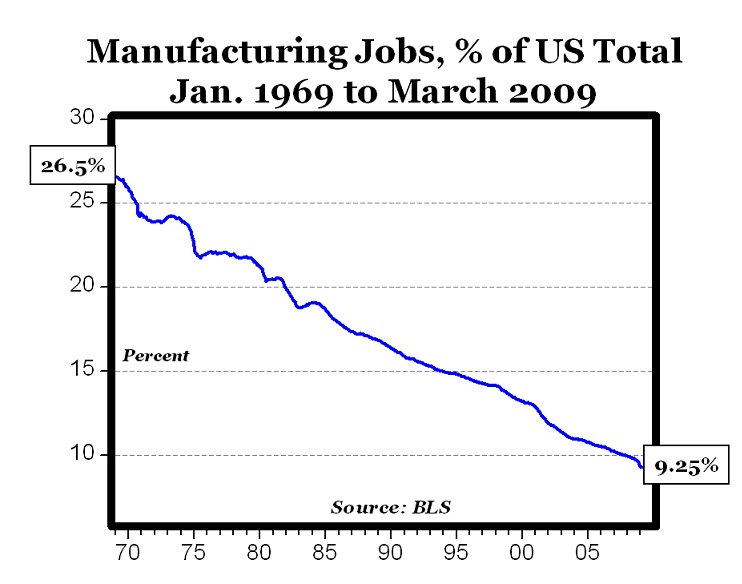
mfgjobsbls.bmp


Probably not, since industrial production is a measure of manufacturing output and manufacturing jobs as a percent of total payroll employment have declined significantly from 26.5% in 1969 (more than 1 out of every 4 jobs was in manufacturing) to the lowest-ever level of only 9.25% (about 1 in 11 jobs is in manufacturing) in March 2009 (see chart above, data are from the BLS via Economagic).

Also how much of that is related to manufacturing of military equipment that's not allowed to be offshored?

Another interesting thing about Germany is they are basically a right to work state. They have unions, but they are not a condition of employment. This probably keeps the unions from getting stupid over there.

I'd gladly trade that for the ability to get employee representation on the board of directors. Note: This would only be possible if the federal government made that law. And since that's apparently communism, it'll never happen.
 
Last edited:

charrison

Lifer
Oct 13, 1999
17,033
1
81
That's not really a 'fact', i was talking about manufacturing LABOR. Obviously we leave lots of stuff here that can be made via automated processes and little need for labor. The stuff that's more manual labor intensive? We ship that to low wage countries. Germany is bucking that trend. That's the whole point. Also, they have twice the union membership that the US has as a percentile of the workforce.

From your same blogger:

http://mjperry.blogspot.com/2009/04/manufacturing-jobs-as-percent-of-total.html

mfgjobsbls.bmp
Guess what, we all used to be farmers a 100 years ago too, things change. Manufacturing as percentage of the workforce is in decline worldwide, even in low wage countries. Productivity is moving people out of factories worldwide and we are all better off for it. You do realize on average service sector jobs pay more than manufacturing jobs?
 

Phokus

Lifer
Nov 20, 1999
22,994
779
126
This thread is a circle jerk of planned-economy supporters acting like this somehow vindicates their outdated preferences. Not sure why they feel vindicated when they fight tooth and nail against the type of measures Schroder implemented over there.

Yet their taxes are STILL higher than ours are and they have a very high VAT tax to boot:

http://en.wikipedia.org/wiki/File:Income_Tax_Germany_2010.png

The rate of value-added tax rate generally in force in Germany is 19%. A reduced tax rate of 7% applies e.g. on sales of certain foods, books and magazines, flowers and transports.

And they have something called a 'trade tax' which i've never even heard of here:

Entrepreneurs engaging in business operations are subject to trade tax as well as income tax/corporation tax. In contrast to the latter, trade tax is charged by the local authorities, who are entitled to the entire amount. The rate levied is fixed by each local authority separately within the range of rates prescribed by the central government. As from 1 January 2008, the rate averages 14% of profits subject to trade tax.

Their taxes are still really frigging high compared to ours AND they pay a HELLUVA lot more for their manufacturing workers than we do.

In fact, taxes are 40% of their GDP, while only 28% of GDP in America:

http://en.wikipedia.org/wiki/List_of_countries_by_tax_revenue_as_percentage_of_GDP

Now explain to me why, even though many/most of our corporations dodge the responsibility of paying taxes via loopholes and we've cut the personal income tax to ludicrously low levels that our manufacturing jobs haven't come back since we're doing 'much' better taxwise?
 
Last edited: