Geforce GTX 1080 is the best selling high end card in history (Fudzilla)

Page 2 - Seeking answers? Join the AnandTech community: where nearly half-a-million members share solutions and discuss the latest tech.

showb1z

Senior member
Dec 30, 2010
462
53
91
That actually appears correct using techpowerup's performance summary numbers. 980 -> 980 ti, 780 ti -> 980 and 390x->fury x all were smaller jumps. You can argue overclocking and such but it's not unfounded to say.

Yeah, I'm sure there are reviews out there to support that. In the real world we all know the gap between 980Ti and 980 is bigger than 1080 to 980Ti.
But it's not important, silly "article".
 

antihelten

Golden Member
Feb 2, 2012
1,764
274
126
That actually appears correct using techpowerup's performance summary numbers. 980 -> 980 ti, 780 ti -> 980 and 390x->fury x all were smaller jumps. You can argue overclocking and such but it's not unfounded to say.

It kinda depends upon whether or not you count the various titan cards (and it is of course much lower than the 680 -> 780 Ti jump which was just 2.5 years ago).

980 Ti -> 1080 = 31.8%
980 -> 980 Ti = 25.3%
980 -> Titan X = 31.2%
680 -> 780 Ti ≈ 50.3%
680 -> Titan ≈ 36%
 
Last edited:

trane

Member
May 26, 2016
92
1
11
It kinda depends upon whether or not you count the various titan cards (and it is of course much lower than the 680 -> 780 Ti jump which was just 2.5 years ago).

980 Ti -> 1080 = 31.8%
980 -> 980 Ti = 25.3%
980 -> Titan X = 31.2%
680 -> 780 Ti ≈ 50.3%
680 -> Titan ≈ 36%

This launch should be compared to the 580 > 680, 780 Ti > 980.
 

antihelten

Golden Member
Feb 2, 2012
1,764
274
126
This launch should be compared to the 580 > 680, 780 Ti > 980.

This isn't about what the 980 Ti -> 1080 jump should or shouldn't be compared to, it's about Fudzilla's claim that said jump is the highest in years which it isn't (unless you artificially limit yourself to only going back 2 years and no Titan cards).
 

selni

Senior member
Oct 24, 2013
249
0
41
It kinda depends upon whether or not you count the various titan cards (and it is of course much lower than the 680 -> 780 Ti jump which was just 2.5 years ago).

980 Ti -> 1080 = 31.8%
980 -> 980 Ti = 25.3%
980 -> Titan X = 31.2%
680 -> 780 Ti ≈ 50.3%
680 -> Titan ≈ 36%

Agree with the titans even if the pricing was hilarious, but there was a 780 release in between the 680 and 780 ti.
 

Qwertilot

Golden Member
Nov 28, 2013
1,604
257
126
I dunno about Titans - the pricing is so premium that I'm really not sure they should qualify for these sorts of comparisons.

The thing to track is 680 to 780 to 980. The 780ti was effectively the titan being pushed down to the 'normal' track due to competitive pressure.

Basically the 1080 is a bang on average/expected increase in nearly every way :) Timing, %age increase over the 980ti, power consumption etc etc.

Slightly silly to call it otherwise I think.
 

showb1z

Senior member
Dec 30, 2010
462
53
91
Those are reference card numbers. If you'd compare aftermarket cards, the ones people actually buy, that would shift the numbers in favor of the 980Ti.
 

antihelten

Golden Member
Feb 2, 2012
1,764
274
126
Agree with the titans even if the pricing was hilarious, but there was a 780 release in between the 680 and 780 ti.

True but then you would be comparing the 680 to a cut down chip. The equivalent to that would be comparing the 980 Ti to the 1070.

Unless of course you want to compare cards based purely on the chronological release order and not looking at the underlying chip being used and whether it is fully enabled. But then you get a lot of noise imho, including rebrands like the 680 to 770.
 

antihelten

Golden Member
Feb 2, 2012
1,764
274
126
I dunno about Titans - the pricing is so premium that I'm really not sure they should qualify for these sorts of comparisons.

The thing to track is 680 to 780 to 980. The 780ti was effectively the titan being pushed down to the 'normal' track due to competitive pressure.

Basically the 1080 is a bang on average/expected increase in nearly every way :) Timing, %age increase over the 980ti, power consumption etc etc.

Slightly silly to call it otherwise I think.

I agree that 680 -> 780 -> 980 -> 1080 would make sense (although the prices have varied quite significantly here, from $500 to $650), but my post was mainly in relation to Fudzilla's claim of the 980 Ti to 1080 jump being the biggest in years, which I don't really agree with. If on the other hand they had said that it was the biggest X80 (non-Ti) jump in years then I would agree.

980 -> 1080 = 66.7%
780 -> 980 = 29.4%
680 -> 780 = 26.6
580 -> 680 = 31.3%
 

selni

Senior member
Oct 24, 2013
249
0
41
True but then you would be comparing the 680 to a cut down chip. The equivalent to that would be comparing the 980 Ti to the 1070.

Unless of course you want to compare cards based purely on the chronological release order and not looking at the underlying chip being used and whether it is fully enabled. But then you get a lot of noise imho, including rebrands like the 680 to 770.

Shrug, the 980 ti is cut down too. Either way I think we're saying the same thing - you can probably truthfully say it's the largest jump in a while depending on what you're looking at, but it's not going to be by a huge margin.
 

antihelten

Golden Member
Feb 2, 2012
1,764
274
126
Shrug, the 980 ti is cut down too.

Yes but that would artificially favor the 1080 making the jump bigger than the real difference between GM200 and GP104, whereas in the 680 to 780 jump it's the other way around with the 780 (GK110) being artificially hampered, thus making the jump smaller than the real difference between GK104 and GK110.

Comparing the 980 Ti -> 1080 jump with the 680 -> 780 Ti jump would still favor the 1080, since the 780 Ti isn't being compared to a cut down chip, but it would provide a more informative view of the GM200 -> GP104 jump versus the GK104 -> GK110 jump (and other previous jumps), than using the 780 would.

But either way this is now just sophistry based on a throw away remark from Fudzilla, so who cares really.
 
Last edited:

Qwertilot

Golden Member
Nov 28, 2013
1,604
257
126
Definitely!

I was actually mostly going on something else :) Namely, what gets released on the annual Spring 'schedule' - ok, the 980 was Autumn but otherwise they all came out then.

One other rational thing would be to hold TDP ~constant instead - people will obviously tend to upgrade that way in practice. Then you get 680 to 980 vs 980 to 1080. Or 780(ti?) to 980ti to 1080ti.
 

littleg

Senior member
Jul 9, 2015
355
38
91
1080 sold more than 980ti then? More NV sponsored forum marketing.


Insulting others is not allowed here. This is a technical forum
The OP simply quoted, and linked to fudzilla, no forum marketing
This could also be considered trolling
Markfw900
 
Last edited by a moderator:

sm625

Diamond Member
May 6, 2011
8,172
137
106
Nvidia should have just outright set the MSRP to $999? Why not? There would still be plenty willing to pay it.
 

Head1985

Golden Member
Jul 8, 2014
1,867
699
136
5000 will be better still buying by nv sheeps.


Threadcrapping and trolling are not allowed
Markfw900
 
Last edited by a moderator:

tential

Diamond Member
May 13, 2008
7,348
642
121
Nvidia should have just outright set the MSRP to $999? Why not? There would still be plenty willing to pay it.
I've said numerous times that the msrp of the founders edition for the 1080 should have been a minimum of $800 preferably $1000+.

But I also believe nvidia should start doing a prerelease ultra founders edition with 100-1000 cards being ebayed in a staggered fashion a month before release. many vendors use eBay to sell their products and nvidia is leaving money on the table not letting their enthusiasts bid for early access to these cards.

Purely from a business perspective not from a personal obviously
 

digitaldurandal

Golden Member
Dec 3, 2009
1,828
0
76
I've said numerous times that the msrp of the founders edition for the 1080 should have been a minimum of $800 preferably $1000+.

But I also believe nvidia should start doing a prerelease ultra founders edition with 100-1000 cards being ebayed in a staggered fashion a month before release. many vendors use eBay to sell their products and nvidia is leaving money on the table not letting their enthusiasts bid for early access to these cards.

Purely from a business perspective not from a personal obviously

Nvidia likely has contracts with their AIB partners and they may be limited in their ability to do this. The AIB partners would have to do it but the thing is if one AIB partner just posts it as buy it now at a reasonable price they will gain customers over the others which could mean future sales.

They also might invite an investigation into price fixing if they all did it which could carry its own problems.
 

sxr7171

Diamond Member
Jun 21, 2002
5,079
40
91
It kinda depends upon whether or not you count the various titan cards (and it is of course much lower than the 680 -> 780 Ti jump which was just 2.5 years ago).

980 Ti -> 1080 = 31.8%
980 -> 980 Ti = 25.3%
980 -> Titan X = 31.2%
680 -> 780 Ti ≈ 50.3%
680 -> Titan ≈ 36%

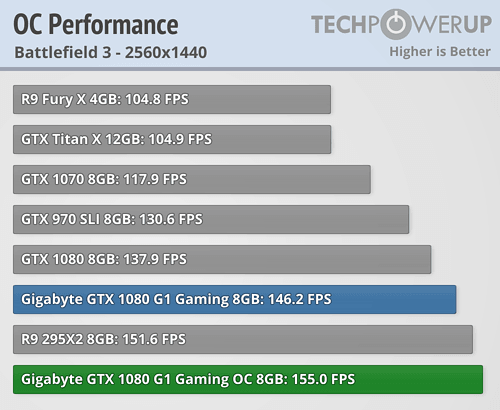
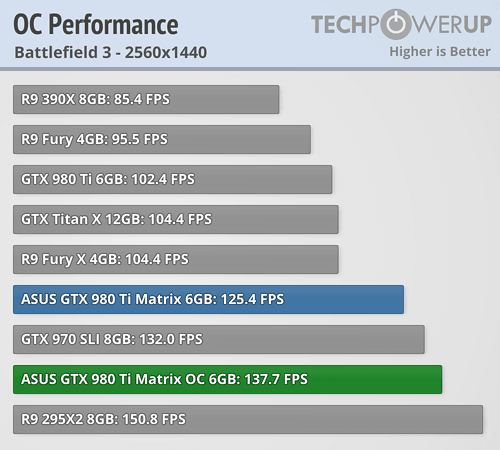
980ti at 1550MHz to a 1080 at 2060Mhz I wonder why nobody has done that comparison. I'll bet the improvement is 5% maybe 7%.
 

IllogicalGlory

Senior member
Mar 8, 2013
934
346
136
The 1080 is a cut down chip. The comparison is completely valid with a 780.
No it isn't. It's fully enabled GP104. 780 is GK110 with 576 cores disabled. It's more appropriate to compare to the the 680 and 980 which are also full 04 chips. Or you could compare the 780 to the 980 Ti, although the 980 Ti is probably more comparable to the OG Titan.

However, I'm guessing you already know that. How are they the same?
980ti at 1550MHz to a 1080 at 2060Mhz I wonder why nobody has done that comparison. I'll bet the improvement is 5% maybe 7%.
perf_oc.png
perf_oc.png


2050MHz vs 1517MHz 1080 wins by 12.5%. I'd guess the advantage would be about 10-10.5% in your scenario.
 
Last edited:

sxr7171

Diamond Member
Jun 21, 2002
5,079
40
91
No it isn't. It's fully enabled GP104. 780 is GK110 with 576 cores disabled. It's more appropriate to compare to the the 680 and 980 which are also full 04 chips. Or you could compare the 780 to the 980 Ti, although the 980 Ti is probably more comparable to the OG Titan.

However, I'm guessing you already know that. How are they the same?
perf_oc.png
perf_oc.png


2050MHz vs 1517MHz 1080 wins by 12.5%. I'd guess the advantage would be about 10-10.5% in your scenario.

Finally thank you. I've got a Titan X at 1500Mhz so I don't really see the point of upgrading. But even for a 980ti owner 10% is hard to justify a new card.

I suppose the "cut down" I meant is that the card is an 04 card. I'm done buying those and trust me I have bought the last few.

The 780ti was weird in that the Titan of that generation was a fused off product while the 780ti was the real deal. I suppose they didn't know what the heck they were doing with Titan branding. I'm pretty sure going forward the full chips will be Titan like the Titan X. Also having the future ti products be very close to the Titan is very helpful to all of us. I hope we never see anything like the 780 again which I guess they put out because the 680 aged so poorly.
 
Last edited: