[DHT]Osiris
Lifer
Putting feelers out for a question I've got that I'm a little concerned I won't get a good answer for.
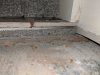
I've got a solarium-style room in my place that we're looking at adding a hot tub into. The paperwork specifically cites the full weight of the tub + water at 2500lbs, and the base is 80"x70". We just moved into this place and I haven't tracked down any blueprints yet (gonna try to from whatever local zoning authorities might have that) but the room itself is tiled, with what looks to be a thinset layer, a ~1/2"-3/4" cement layer for our radiant heating system (I know that's in the room), followed by about a 1/8" layer of what I suspect is some kind of concrete backerboard, followed by another ~1/2"-3/4" of some kind of plywood or particle board. I'm able to determine these numbers based on a cutout in the flooring in a closet that let me take a snapshot of the layers.
I cannot confirm what's under these layers, but I can definitely say that there's a rather unsettling 'hollow' sound if I stomp on the tile, compared to other sections of the house, which leads me to believe there's probably a void underneath it, I'd assume with joists to support the weight. Would that be reasonable? Nowhere else in the house does it sound like that. As a side note, the room appears to be roughly 4-6" off what I believe to be the slab when looking from the outside. There's no step up into the room from within the home, which I suppose means the rest of the house (or at least the section of the house that room comes off from - it was built in two parts) has a void as well.
Actual question, would it be likely that this flooring, consisting of tile, some thinset, concrete containing some radiant heating pipies, probably backerboard, and particle board, would be able to support 2500lbs (+500 for 2-3 adults?) over a ~38 sq ft area. My math brings that out to ~80lbs per sqft. If I'm standing within a single sq ft section of the tile, I'm over double that. Am I correct in that I should not be worrying?
I've got a solarium-style room in my place that we're looking at adding a hot tub into. The paperwork specifically cites the full weight of the tub + water at 2500lbs, and the base is 80"x70". We just moved into this place and I haven't tracked down any blueprints yet (gonna try to from whatever local zoning authorities might have that) but the room itself is tiled, with what looks to be a thinset layer, a ~1/2"-3/4" cement layer for our radiant heating system (I know that's in the room), followed by about a 1/8" layer of what I suspect is some kind of concrete backerboard, followed by another ~1/2"-3/4" of some kind of plywood or particle board. I'm able to determine these numbers based on a cutout in the flooring in a closet that let me take a snapshot of the layers.
I cannot confirm what's under these layers, but I can definitely say that there's a rather unsettling 'hollow' sound if I stomp on the tile, compared to other sections of the house, which leads me to believe there's probably a void underneath it, I'd assume with joists to support the weight. Would that be reasonable? Nowhere else in the house does it sound like that. As a side note, the room appears to be roughly 4-6" off what I believe to be the slab when looking from the outside. There's no step up into the room from within the home, which I suppose means the rest of the house (or at least the section of the house that room comes off from - it was built in two parts) has a void as well.
Actual question, would it be likely that this flooring, consisting of tile, some thinset, concrete containing some radiant heating pipies, probably backerboard, and particle board, would be able to support 2500lbs (+500 for 2-3 adults?) over a ~38 sq ft area. My math brings that out to ~80lbs per sqft. If I'm standing within a single sq ft section of the tile, I'm over double that. Am I correct in that I should not be worrying?