• We’re currently investigating an issue related to the forum theme and styling that is impacting page layout and visual formatting. The problem has been identified, and we are actively working on a resolution. There is no impact to user data or functionality, this is strictly a front-end display issue. We’ll post an update once the fix has been deployed. Thanks for your patience while we get this sorted.

Question Finally got back to the Lenovo P520 and now getting the "Error 1962 no operating system found".

jamesdsimone

Golden Member
Finally worked out all the various issues with my other 3 projects and finally got the time and energy to finish up the P520 which is going to be my new primary computer. I booted and got into BIOS and checked some of the settings including the boot order. I disabled the network boot option and put the 2 NVMe drives as boot option 1 and 2. Disabled secure boot and PXE. I shut down and installed a 4 TB hard drive and connected the optical drive and hard drive hot swap rack(left it empty though). I'm all set or at least I think I am. Boot up and I get the no OS found error. I tried going to the boot menu and booting from each NVMe drive and got the same error. I changed the CMOS battery. I reloaded default factory BIOS setting. I can see all the drives in BIOS just fine. I booted from the install USB and Windows sees the OS install since gave me an option to update/repair the existing OS. I have an SSD with Ubuntu on it. I plugged that in and was able to boot from that. The NVMe drive was there and Windows is on the drive. Went back into BIOS set the boot order to the 2 NMVe drive then the Ubuntu drive below them. Rebooted and the 2 NVMe drives are bypassed and the system boots to Ubuntu. I can reinstall Windows but that would be a lot of work and not convinced that would solved the problem.
 
Then a good place to start troubleshooting would be with only the drive you want to boot from connected. Might even remove the hot swap to help rule out gremlins.
 
Then a good place to start troubleshooting would be with only the drive you want to boot from connected. Might even remove the hot swap to help rule out gremlins.
The hot swap does not have a drive in it but I can disconnect the SATA cable. The system was sitting for a couple weeks not even plugged in and it had booted fine last time I booted it. The only thing I changed was the boot order as far as I remember.
 
Sometimes it is as simple as opening a command prompt on the USB windows stick and using the old school =
  1. bootrec /fixmbr
  2. bootrec /fixboot
  3. bootrec /RebuildBcd
 
Sometimes it is as simple as opening a command prompt on the USB windows stick and using the old school =
  1. bootrec /fixmbr
  2. bootrec /fixboot
  3. bootrec /RebuildBcd
This hasn't worked for anything I've worked on for about the last 2 years. Always fails on #3 with "access denied". However, assigning a drive letter to the EFI partition and using the bcdboot command instead has worked every time.
 
just install the OS drive by itself and confirm that the BIOS settings for that drive are correct.

EDIT: you can do a repair install of win 10/11 from the install USB using recovery options.
 
just install the OS drive by itself and confirm that the BIOS settings for that drive are correct.

EDIT: you can do a repair install of win 10/11 from the install USB using recovery options
I tried that but when I rebooted I got the same error which is why I think I did something to the BIOS boot setting.
 
I tried that but when I rebooted I got the same error which is why I think I did something to the BIOS boot setting.
Boot from the Windows USB drive, hit shift-F10 at the first install screen. Run diskpart and type "list disk". Is there an * in the GPT column? Also type "list volume". Post the results here.
 
Boot from the Windows USB drive, hit shift-F10 at the first install screen. Run diskpart and type "list disk". Is there an * in the GPT column? Also type "list volume". Post the results here.
I am so irritated with this thing. I booted it up this morning and looked at the boot menu the 2 NVMe drives show legacy boot, the SSD with ubuntu on it shows both UEFI and legacy option. The optical drives shows up on the menu too. I disconnected the SATA hard drive. Booting off the Ubuntu drive worked with either option. I assume the Windows install is on NVMe dive one. Booting off either just ended up booting to Ubuntu. The boot order is set to the 2 NVMe drive with the SSD the 3rd option. I decided I would look at the boot order again. It is set to CSM with auto/legacy first. I decided to try UEFI only just for completeness. Again it booted to Ubuntu. I unplugged the Ubuntu drive. I rebooted so I could reenable CSM and all I get is a blank screen. The Lenovo logo never came up. Pressing F12 doesn't get me into BIOS just nothing. The monitor light is yellow which I think means it is not getting a signal. I tried switching from DVI to VGA still nothing. Cleared the CMOS still nothing. Now for the stupid part. I plugged the Ubuntu drive back in and rebooted. Hit F12 repeatedly and got the blank screen. A few minutes later with none of the usual pre booting text appearing on screen Ubuntu started up and seems to be running fine. So I'm at a loss. The video card can't be bad right? Bad motherboard? Any Suggestion? Is there anything I can do from Ubuntu to trouble shoot it?
 
If you can, do what I asked in post #12 above, please.
I swapped out the video card and pulled the CMOS battery for 15 minutes. The CMOS battery seemed a little loose. I tried booting from the USB drive and it did not post. Since I reset the CMOS I assume that the USB drive is in the boot order but have no way of checking since I can't get into BIOS. I installed Hardinfo in Ubuntu and everything showed up ok. Ran a couple benchmarks and they all ran ok. The boot time for Ubuntu seems sluggish and it restarts before booting to desktop.
 
Last gasp idea. Instead of just pulling the CMOS battery, find the clear CMOS jumper and clear it this way. Unplug the PC first.
 
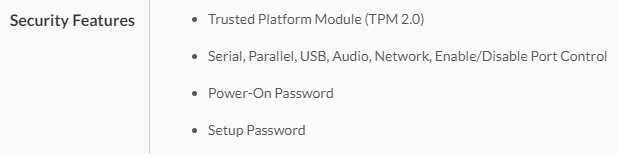
Is this some kind of TPM 2.0 problem? Are certain ports blocked from being able to boot?

P520.png

Maybe clone one of the NVME drives to another drive, then wipe the NVME and see if the system will let you install Windows with that drive only installed?
 
Is this some kind of TPM 2.0 problem? Are certain ports blocked from being able to boot?

Maybe clone one of the NVME drives to another drive, then wipe the NVME and see if the system will let you install Windows with that drive only installed
I'm sure I installed Windows in Legacy mode and CSM was enabled and secure boot disabled.
 
Back
Top