[extremetech] AMD talks with private equity firm Silver Lake fell through: Report

Page 3 - Seeking answers? Join the AnandTech community: where nearly half-a-million members share solutions and discuss the latest tech.

MiddleOfTheRoad

Golden Member
Aug 6, 2014
1,123
5
0
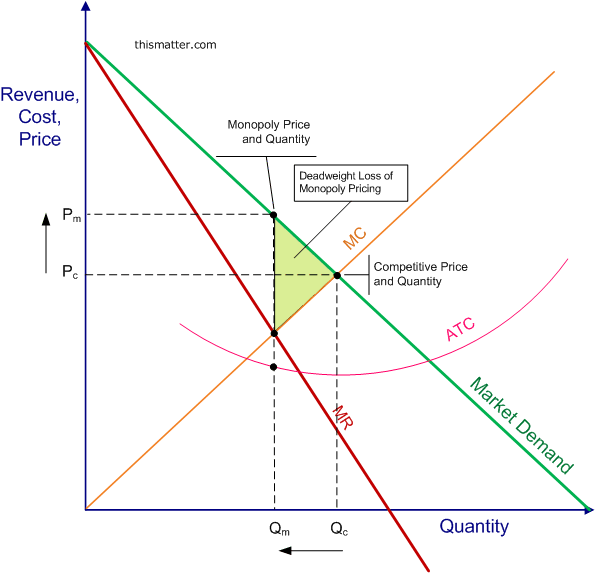
Optimal price/profit ratio on the volume.

Its no secret Intel priced CPUs that way for a long time.

Simplified:

main-qimg-90d17ed64536aff8295f95834d57fba2

Spoken like someone who hasn't got a clue about how capitalism actually works.

 

ShintaiDK

Lifer
Apr 22, 2012
20,378
146
106
Care to clarify that?

From what I can tell the graph only shows how Intel will price its products to maximize revenue.

But how would a monopoly on CPUs lower the price for the consumer?

I said prices would be the same or lower. Since AMD sells chips with much less margins in inbetween segments. To keep up the volume a slight price adjustment is needed. Else volume would decrease slightly. But as AMDs share keep declining, then you end up with the same pricing.

pricing-ppt-8-728.jpg
 
Last edited:

Fjodor2001

Diamond Member
Feb 6, 2010
4,581
731
126
Those graphs basically show the same as the previous one, so they do not add anything.

It's obvious you're completely missing the forces resulting from competition in a market economy, and how they drive innovation and prices down for the consumer.

If we are to believe you, there should not be anti-trust laws but pro-monopoly laws. And there should only be one company producing each type of product. All resources should be owned by the government, and they should decide who produces what. In theory that's all great and highly efficient. But in practice it has been shown over and over to not work at all. It's a pipe dream.
 

ShintaiDK

Lifer
Apr 22, 2012
20,378
146
106
Intel have been competing with itself for a small decade now.

If competition drives down prices. Why does an iPhone cost so much?

Static demand market isn't the same as dynamic demand. Also semiconductor companies requires huge cash flow.

Also you need to read up what antitrust laws are.
 

Fjodor2001

Diamond Member
Feb 6, 2010
4,581
731
126
Intel have been competing with itself for a small decade now.

I'm of course talking about a general situation where there is competition vs a monopoly. So in the case for x86 CPUs, that would require AMD to be more competitive than they are now to have a great impact. But assuming AMD would be more competitive, are you still suggesting an Intel monopoly would be better to drive CPU innovation forward and prices down for the consumers?
 

ShintaiDK

Lifer
Apr 22, 2012
20,378
146
106
I'm of course talking about a general situation where there is competition vs a monopoly. So in the case for x86 CPUs, that would require AMD to be more competitive than they are now to have a great impact. But assuming AMD would be more competitive, are you still suggesting an Intel monopoly would be better to drive CPU innovation forward and prices down for the consumers?

You are not going to get anymore competition. No matter how many Intels or AMDs there is.

Because you lack complete understanding of the market volume, cost and cash flow.

In short words. The market is too small. And the costs keep spiraling up.

Sooner or later you pretty much gonna end up with 1 company making all (important) CPUs. Then you can argue who it will be. Qualcomm, Apple, Intel or someone else. But there will only be 1.
 
Last edited:

Maxima1

Diamond Member
Jan 15, 2013
3,549
761
146
If competition drives down prices. Why does an iPhone cost so much?

A perfectly competitive market results in a market of homogeneous products. An iPhone costs so much because Apple has successfully raised the perceived value of the brand. This is similar to Beats earphones. Cheap components with huge markup, but low operating profit due to spending on marketing to increase brand value.
 

dark zero

Platinum Member
Jun 2, 2015
2,655
140
106
Intel have been competing with itself for a small decade now.

If competition drives down prices. Why does an iPhone cost so much?

Static demand market isn't the same as dynamic demand. Also semiconductor companies requires huge cash flow.

Also you need to read up what antitrust laws are.
Iphone cost so much since their SW is really optimized.
Only that. Intel depends on MS and viceversa.
 

Qwertilot

Golden Member
Nov 28, 2013
1,604
257
126
Sooner or later you pretty much gonna end up with 1 company making all (important) CPUs.

Not quite sure about that - if something like the current ARM survives, then it'll keep the costs to come into the market on some level rather low, so you'll likely retain some diversity.

Also, of course, the sort of area that's always likely to attract non trivial politics :)
 

Snafuh

Member
Mar 16, 2015
115
0
16
You are not going to get anymore competition. No matter how many Intels or AMDs there is.

If Intel raises the price of their low end CPUs (up to i3) OEMs will buy more AMD CPUs. There is competition. Only in the "high end" segment AMD has no comparable products.

Why does an iPhone cost so much?
Because Apple isn't fighting for more volume. They sell enough phones despite the high price. And other flagship phones are not much cheaper.

Why does Intel use contra revenue for their tablet chips? Because competitors can sell their chips cheaper.

monopoly-pricing-deadweight-loss.png
 

ShintaiDK

Lifer
Apr 22, 2012
20,378
146
106
The contra revenue is direct example that the traditional x86 volume is getting too small.

If Intel raised prices without competition. Volume would decrease.
 
Last edited:

ShintaiDK

Lifer
Apr 22, 2012
20,378
146
106
Not quite sure about that - if something like the current ARM survives, then it'll keep the costs to come into the market on some level rather low, so you'll likely retain some diversity.

Also, of course, the sort of area that's always likely to attract non trivial politics :)

More and more higher end ARM companies are giving up. So you got less and less companies making these ARM chips. Its exactly the same. Its no different than in the past when we had 20+ x86 manufactors.
 

Sonikku

Lifer
Jun 23, 2005
15,914
4,956
136
Care to clarify that?

From what I can tell the graph only shows how Intel will price its products to maximize revenue.

But how would a monopoly on CPUs lower the price for the consumer?

Intel will be so grateful to be the sole proprietor of CPU's that they will pass the profits onto their consumers. And on that day, Rush Limbaugh will smooch Obama on the lips.
 

Fjodor2001

Diamond Member
Feb 6, 2010
4,581
731
126
If competition drives down prices. Why does an iPhone cost so much?

Because competition has made Apple develop a very good phone, with very good CPU, so they can charge more than some of the competition for it (e.g. Samsung S6 is in the same price range). Thanks to competition there are still other cheaper alternatives around too though. And we can choose between e.g. Android, iOS and Windows Phone. And we've seen a very rapid improvement in the mobile phone and tablet space over the years. All thanks to competition. Not monopoly.

If we were to have it your way, there'd not even be an iPhone. We'd all still be using feature phones with polyphonic ring signals as the coolest new feature. Maybe next year we would get 4 extra ring signals. Just enough to optimize the profit for Nokia.
 
Last edited:

VirtualLarry

No Lifer
Aug 25, 2001
56,587
10,227
126
More and more higher end ARM companies are giving up. So you got less and less companies making these ARM chips. Its exactly the same. Its no different than in the past when we had 20+ x86 manufactors.

I don't recall a past in which we ever had 20+ x86 mfgs. Care to share?
 

VirtualLarry

No Lifer
Aug 25, 2001
56,587
10,227
126
Because competition has made Apple develop a very good phone, with very good CPU, so they can charge more than some of the competition for it (e.g. Samsung S6 is in the same price range). Thanks to competition there are still other cheaper alternatives around too though. And we can choose between e.g. Android, iOS and Windows Phone. And we've seen a very rapid improvement in the mobile phone and tablet space over the years. All thanks to competition. Not monopoly.

If we were to have it your way, there'd not even be an iPhone. We'd all still be using feature phones with polyphonic ring signals as the coolest new feature. Maybe next year we would get 4 extra ring signals. Just enough to optimize the profit for Nokia.

Give this man a medal. Because, he gets it.
 

Qwertilot

Golden Member
Nov 28, 2013
1,604
257
126
More and more higher end ARM companies are giving up. So you got less and less companies making these ARM chips. Its exactly the same. Its no different than in the past when we had 20+ x86 manufactors.

Not quite I'd think? Much lower barrier for entry with ARM doing the reference designs than there ever was for x86. So, if the market did contract hugely you'd imagine there'd be scope for people to come in.

And those reference cores are going to get there of course. The people doing really fancy custom cores etc is a bit different of course.
 

StrangerGuy

Diamond Member
May 9, 2004
8,443
124
106
Apple can charge sky high prices on iPhones solely because people are willing to pay for the iOS ecosystem exclusivity; a purely software advantage. Their custom SoCs are just icing on the cake, made possible by not playing the myopic and unsustainable razor thin margins for marketshare war that the PC and Android vendors engage in.
 

ShintaiDK

Lifer
Apr 22, 2012
20,378
146
106
Not quite I'd think? Much lower barrier for entry with ARM doing the reference designs than there ever was for x86. So, if the market did contract hugely you'd imagine there'd be scope for people to come in.

And those reference cores are going to get there of course. The people doing really fancy custom cores etc is a bit different of course.

Sooner or later a custom ARM design will be the entry point.

But the list of ARM companies keep shrinking. NXP and Freescale merged this year. And so did Avago and Broadcom. TI basically gave up as we know.

bulletin20150805Fig02.png
 
Last edited: