• We’re currently investigating an issue related to the forum theme and styling that is impacting page layout and visual formatting. The problem has been identified, and we are actively working on a resolution. There is no impact to user data or functionality, this is strictly a front-end display issue. We’ll post an update once the fix has been deployed. Thanks for your patience while we get this sorted.

[Extech]Intel's 14nm milkshake

Haserath

Senior member
http://www.extremetech.com/computing/171477-intels-14nm-milkshake-its-better-than-yours
14nm-1.png

14nm-2.png


It tastes like victory.

But it also looks like switching speed is only marginally improved if at all on the top end.

With that sort of advantage, Intel's IGP should also gain a lot of ground on any other GPU.
 
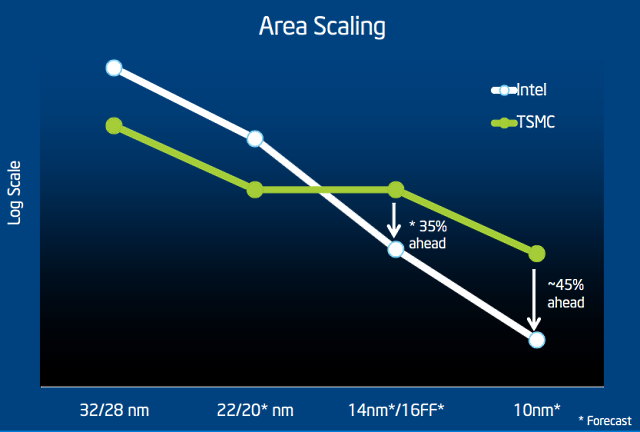
It also shows in area scaling what TSMCs 16nm and Glofos 14nm-XM really is.

And Intels 14nm is healthy with high yields.
 
Last edited:
My take is this is about the fab business, and how Intel is planning to AMD their competition by forcing them to use slower, hotter, more power hungry designs with cheaper prices.

The other thing I took from it was Haswell is the norm, Sandy Bridge was the exception. Because of the way tech has gone, and Intels strong desire to win it all.
 
my only issue with the analyst day was intel opening its fabs up for other competitors. Id rather not have them enable nvdia/qcom. Apple i guess is fine since they dont really compete head to head. But giving qcom access to INTEL's best assets seems awful awful awful strategy
 
but shouldn't 14nm be smaller than 16nm by ~12.5% (2/16), so the gap is only 20% or so it would be according to their claims. I am not sure if a few nm will have huge effects on power but i guess we will see.
 
my only issue with the analyst day was intel opening its fabs up for other competitors. Id rather not have them enable nvdia/qcom. Apple i guess is fine since they dont really compete head to head. But giving qcom access to INTEL's best assets seems awful awful awful strategy

Eh, depends entirely upon the margins that they're talking about - at 65% margins or higher why wouldn't they exactly? Sure it would remove a competitive advantage for Intel SoCs, but by the time such would come to fruition I expect the landscape will look quite a bit different from right now. (Remember, even if Qualcomm committed to using Intel's process in say the middle of this year the first product likely wouldn't come out 'til sometime in 2016 most likely.)

Another way to look at it is that Intel has their choice of competition - the IP designers or the foundries. If they 'beat' either one then the other suffers as well... and it's going to be an awful lot easier for them to 'beat' the foundries. Because as I've said many times, if the foundries don't make enough money then they can't maintain the capital expenditures necessary to keep up. And soon as they fall further behind Intel is free to charge more per wafer or delay the leading edge introduction to the competition for a year.

So yeah, there is a very effective long-term strategy possibly behind this move. It's definitely good for Intel to keep its options open.

Oh, and one interesting tidbit from Holt's presentation - Intel hadn't been scaling density as aggressively as they could through 22nm since the processes were tuned for performance. Definitely makes sense when you look at the characteristics.
 
Intel better do something, because qualcomm is devouring them. Its only going to be a couple more years before millions are using their smartphone as their only computing device. Hell millions are already doign that. But I guess what I mean is, over the next couple years, millions of people are going to go from being intel / intel + qualcomm users to strictly being qualcomm users. It's not just qualcomm of course. Apple and even nvidia are a part of it.
 
the thing is, the 805 isn't coming til Q2 2014, so what happens to the release date of the next gen snapdragon (20nm A57). back half 2014? and what will be the gfx improvement?, if there is one. so i guess we'll see what happens, but i think intel has the right strategy going forward, they know they need to catch up. cherry trail is that catch up on gfx. broxton will be the chip to look for in regards to cpu/gpu leadership. it sure will be interesting though.

i think intel opening their fabs is a good thing and i'm sure they'll make the right deals. i do wish we got a bit more on broadwell, oh well ces isn't that far away.
 
Apple would be the best company to open up their fabs to, especially if they can make an agreement for x86 only in Macs for awhile. And the fact that the Android market is where the competition is.

If they could make a deal for Google's Nexus device, they might get somewhere with Atom.

I think they'll make more deals with companies like Altera before they get anything like major consumer chip volume.
 
The question might be, who is willing to pay more than they even do at TSMC. Apple is certainly one of them. And Apple, while competition, is not in a direct competition.
 
agreed. apple is the company that has the resources to pay top-dollar for the capacity that intel can provide, whether at 22nm or at 14nm. the thing is i don't really ever seeing on the current trajectory a-series competing with core, unless apple branches out to compete with core. then that's different, i don't see x86 on macs going away anytime soon. especially as the core series is improving at 14/10..nm.

then again, cherry trail and broxton are going to be the milestones in which to compare. like i said in the other thread though, broxton according to geekbench would be on a core i3 level now/sandy-ivy core i5.
 
indeed that is what Krzanich said. 2x, but its over 2x right now, its like 2.5x-3x right now, so there will be some catch up. i think a lot of that will be by broxton.
 
Granted Intel has been the premier fab for eons in tech years, I'll believe these sorts of claims when we have silicon in our hands from both companies.
 
ahh wvu, i went there my freshman year. good times.

I think one of the other important takeaways from yesterday was the even though there were yield issues for 14nm, it didn't push out 10nm at all.

Unfortunately, there we no materials changes mention as Holt pretty much was ambiguous and didn't clarify if there were or weren't. Also FinFet is here til 10nm, which makes sense and backs up everything I have seen. 7nm is where we will see a transistor design change (gate-all-around, tfet).

A materials change (germanium, SiGe InGaAs/GaSb/etc.) will be needed either at 10nm or 7nm. I think once that occurs we will see a solid jump in performance, as those materials will be of higher electron mobility. Hopefully the IEDM conference will shed a little more light on these factors along with transistor design.
 
Last edited:
i don't see x86 on macs going away anytime soon.

Expect Apple to go 100% ARM once OS X and iOS are fully merged. Which may not be too far off; Apple is rumored to release a 12" iPad next year. What Apple really needs to complete things is GPU tech, and I'm sure buying ATI off the scrap heap once AMD goes bankrupt will fit the bill.
 
Expect Apple to go 100% ARM once OS X and iOS are fully merged. Which may not be too far off; Apple is rumored to release a 12" iPad next year. What Apple really needs to complete things is GPU tech, and I'm sure buying ATI off the scrap heap once AMD goes bankrupt will fit the bill.

i don't think that will be the case. professionals use the mac line and they need the extra performance over the low wattage chips. apple already has crazy battery life and solid margins on their macs, so the need for them to switch i think is rather low, unless they are developing a high performance competitor to core. samsung could do the same thing with exynos. by the end of 2015, i think the strategies of each company will be played out. but i expect intel to have the edge in mobility.
 
Intel better do something, because qualcomm is devouring them. Its only going to be a couple more years before millions are using their smartphone as their only computing device. Hell millions are already doign that. But I guess what I mean is, over the next couple years, millions of people are going to go from being intel / intel + qualcomm users to strictly being qualcomm users. It's not just qualcomm of course. Apple and even nvidia are a part of it.

Oh yeah, let's just go overboard with the hyperbole here.
 
@jpiniero - if none is buying it, why would they introduce retina display, bring in crystall well, tout about improved battery life. up until two years back, they held the highest market share in laptops sold above $1000. why would they jeopardize that
 
Back
Top