• We’re currently investigating an issue related to the forum theme and styling that is impacting page layout and visual formatting. The problem has been identified, and we are actively working on a resolution. There is no impact to user data or functionality, this is strictly a front-end display issue. We’ll post an update once the fix has been deployed. Thanks for your patience while we get this sorted.

Ever gotten a shock from standard US house voltage, 120V? How bad?

Page 4 - Seeking answers? Join the AnandTech community: where nearly half-a-million members share solutions and discuss the latest tech.
Status
Not open for further replies.
Interesting topic. I work in an industrial environment where we use some extremely serious power (we have 2 substations on the property, and they both have redundant feeds from 2 different electricity suppliers with automatic fail-over).

If you aren't scared of electricity, you should be.

http://www.youtube.com/watch?v=W6Im7PLduwc


In this one:
http://www.youtube.com/watch?v=dPJtknGmsys&feature=related

What they DON'T tell you is that the man crawled inside the bottom of the unit wearing standard clothing. Clothing is plastic. When an arc flash occurs, your plastic clothing melts into your skin. Then your skin melts.

Don't fuck with electricity.
 
Interesting topic. I work in an industrial environment where we use some extremely serious power (we have 2 substations on the property, and they both have redundant feeds from 2 different electricity suppliers with automatic fail-over).

If you aren't scared of electricity, you should be.

http://www.youtube.com/watch?v=W6Im7PLduwc


In this one:
http://www.youtube.com/watch?v=dPJtknGmsys&feature=related

What they DON'T tell you is that the man crawled inside the bottom of the unit wearing standard clothing. Clothing is plastic. When an arc flash occurs, your plastic clothing melts into your skin. Then your skin melts.

Don't fuck with electricity.

Wow no one died in either case! 😱 Lucky lucky lucky!
 
I got a poke of 440 once, through the wet cotton gloves I was wearing. First idiot installed the switch for an industrial fan on the back of column that you had to reach around sight unseen to turn it off and on. Second idiot removed the cover to work on it and never replaced it. Squisher reached around the column to turn the fan off, my entire arm went numb and it hurt like hell all at the same time.
I called over the electrician bitching like hell. He walked up to me a few minutes later to ask if I was sure I was alright, because that fan was 440v. I'm sure I didn't get the full on 440v through those gloves.
 
i was splicing .750 coax and i left 90VAC on it, because i was in a hurry. the battery in my cordless died, so i dug out my hand corer. with 1 bare hand on the outer conductor and the other holding a non-insulated coring tool, i felt it go up 1 arm, across my heart and lungs and down the other arm. not cool.
 
When I was 13 I pulled the spark plug wire off of a 12-horse Kohler while it was running...

-and could not let go until the engine quit turning.
 
Felt 110 several times, 220 once (dryer line). I was damn lucky in the 220 case as I was cleaning up dirty standing water in my laundry room. 15 minutes later I was shocked by the line. If the standing water was still there I am sure I would be much worse off.

Worst 110 was when I was fixing my dad's pinball machine. I didn't have a flashlight and I was replacing a fuse in the machine. In my infinite wisdom I thought, why not do it with the machine on so I have some light. I pulled the fuse, my arm thrashed around for a bit and got cut up nicely on all the sharp connections.

Best was my awesome EE father... I was helping him wire his newly finished basement. While I was putting in a light switch, I asked him if the breaker was off. He said of course it was. 10 seconds later, my hand jerked and the screwdriver that WAS in my hand ended up embedded in the freshly painted drywall behind me. I said "Are you sure it's off?"
 
When I was a kid the "Nintendo TV" was this old wood paneled piece of crap that had analog dials and no remote obviously. Eventually the power button broke but it did so in the "On" position so we merely started unplugging it to turn it off. All of the use of the plug caused the wire to fray badly and one day I grabbed it touching exposed wires. It hurt like a bastard and left a black burned spot on the palm of my hand but no lasting damage.
 
Not sure if serious particularly the bolded part!

At 12V the skin offers such a high resistance that so little current flows that a person won't feel it. As the voltage increases this changes. This is precisely why you don't use toasters while bathing. 😉


At 40kV 99% of the available current will flow through your body. Ignition systems have currents much lower than a household outlet - in the milliamp range. This just proves how LITTLE current is actually required.

Touch the secondary of an angry MOT (Microwave Oven Transformer) - and it WILL kill you. Despite it being a relatively puny 2kV its 1/2 AMP current will put 1000W through your body and you will flop around like a catfish in a canoe, lose control of bladder and bowel functions and stop breathing.

You're saying it wouldn't hurt to grab both contacts of a car battery?
 
Interesting topic. I work in an industrial environment where we use some extremely serious power (we have 2 substations on the property, and they both have redundant feeds from 2 different electricity suppliers with automatic fail-over).

If you aren't scared of electricity, you should be.

http://www.youtube.com/watch?v=W6Im7PLduwc


In this one:
http://www.youtube.com/watch?v=dPJtknGmsys&feature=related

What they DON'T tell you is that the man crawled inside the bottom of the unit wearing standard clothing. Clothing is plastic. When an arc flash occurs, your plastic clothing melts into your skin. Then your skin melts.

Don't fuck with electricity.

What gets me is how workplaces are so tight asses about downtime that the workers have to do this live. It just comes to show how companies don't care about safety, it's all about the mighty dollar. Racking breakers can be really risky when it's live as if you don't get it in properly the first time it could arc right at the buss bar. Of course an arc flash suit could help. Though, depending on how much voltage/amps you're dealing with, the arc flash suit's purpose may simply be to ensure there is still a body left to put in the casket. 😛
 
You're saying it wouldn't hurt to grab both contacts of a car battery?

Skin that is dry has a fairly high resistance to current flow. For example I just measured my skin resistance on a finger with a very high quality meter, one inch apart, and it was 4.9 million ohms. Using ohms law, current = voltage / resistance . If my finger crossed the terminals on a battery the current flow would be :

I = V/R
I = 13.8VDC / 4.9M ohms
current = .000006 amps

However , I handled a banana skin with that same hand and rubbed it slightly across the same finger which changed the resistance to .4 M ohms
I= 13.8VDC / .4M ohms
current = .0000345 amps

I increased the current 57 times by handling a banana skin and rubbing off the minerals and salts it contained.

Now imagine a hand with salt on the skin dampened but now dry, like when you might be working, resistance drops to 6K ohms
I= 13.8VDC / 6k ohms
I = .0023 amps
I = .0023 amps or 2.3ma <---- enough to stop a heart

As the voltage goes up so does the risk, with 120VAC the above works out
Dry skin = .0000245 amps
Banana = .0003 amps < -- again enough to kill
hand with salts = .02 amps or 20ma

Also keep in mind that this was with the probes laying on the skin , not pointed against the skin. Something like a wire poking you would be much lower resistance.
 
Last edited:
Hell after reading this thread you guys got me scared to install another ceiling fan. 🙂 Is it good enough to test the wires with a MM before you proceed?
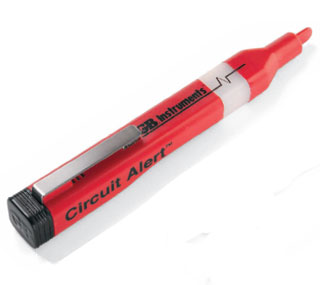
I use one of these (similar) or a mm.

http://www.circuitalert.com/circuit...sensor/CAM-10_electrician_voltage_sensor.html

Actual one I use:
2010-04-15_142838_Electrical_Tester.jpg
 
Last edited:
DrP just reminded me of this one time at band camp...

I was on a roof working on an AC unit. The contactor was bad. My boss shut off the power and then came up. He was kneeling behind me looking over my shoulder as I replaced the contactor. As I was taking off one of the terminals my screwdriver hit the side of the contactor and it arced. It surprised me and I jumped backwards. I hit him and if we had been closer to the edge of the roof (1 story) he would have been knocked off.

The contactor was on a 2 pole breaker and it wasn't banded. My boss had only shut off one leg. I was 18 and learned that you always, always, shut off the power yourself.

I will admit, I often changed out plugs and switches with them live so I didn't have to re-set clocks and such.
 
Skin that is dry has a fairly high resistance to current flow. For example I just measured my skin resistance on a finger with a very high quality meter, one inch apart, and it was 4.9 million ohms. Using ohms law, current = voltage / resistance . If my finger crossed the terminals on a battery the current flow would be :

I = V/R
I = 13.8VDC / 4.9M ohms
current = .000006 amps

However , I handled a banana skin with that same hand and rubbed it slightly across the same finger which changed the resistance to .4 M ohms
I= 13.8VDC / .4M ohms
current = .0000345 amps

I increased the current 57 times by handling a banana skin and rubbing off the minerals and salts it contained.

Now imagine a hand with salt on the skin dampened but now dry, like when you might be working, resistance drops to 6K ohms
I= 13.8VDC / 6k ohms
I = .0023 amps
I = .0023 amps or 2.3ma <---- enough to stop a heart

As the voltage goes up so does the risk, with 120VAC the above works out
Dry skin = .0000245 amps
Banana = .0003 amps < -- again enough to kill
hand with salts = .02 amps or 20ma

Also keep in mind that this was with the probes laying on the skin , not pointed against the skin. Something like a wire poking you would be much lower resistance.

Very nice, thanks for that.
 
I have done tons of household wiring. I have replaced all of the remaining knob and tube wiring in my house, which is probably 10 circuits.
I did quite a bit of electrical work on my old house too (new circuits, replaced all switches/outlets, all new fixtures and fans).

I have been hit ~10 times in my life, usually because I was swapping an outlet and was too lazy to go shut off the breaker.
As others have said, if you have rough/tough/dry hands, the shock isn't too bad.
If you are wearing boots or are standing on an insulated ladder or wood floors and are using 1 hand, it lessens the shock quite a bit too. If you are barefoot, standing in your basement and you touch a live wire, you could easily die.

I have had a few shocks where the screwdriver or pliers slip and hit something else, or I and stripping a live wire and my hand slips up to the uninsulated metal on the tool.

In almost all cases, I knew the risks, but proceeded anyway. The risk in all cases were a slight shock or a blast of molten metal in the face.
 
Last edited:
Knew a couple of old school electritians that would spit on thier fingers and touch the 120v sockete to see if it was live.
 
I got hit by 220V once.

I was replacing a broken lightbulb, forgot to turn it off first, and somehow managed to get shocked.

Anyway, didn't really do a whole lot. My finger was numb for a few minutes, but that was about it. Not much in the way of pain.
 
My science teacher used to let us play with these things:

http://en.wikipedia.org/wiki/Leyden_jar

He claimed hundreds of thousands of volts, and would have the class hold hands in a circle and conduct the shock all around. Actually I'm really surprised there were no heart attacks...
Maybe like a static shock - high voltage, but very low current.
So you've got some very motivated electrons that really want to move. But there are very few of them, so the total energy delivered remains quite low.


Skin that is dry has a fairly high resistance to current flow. For example I just measured my skin resistance on a finger with a very high quality meter, one inch apart, and it was 4.9 million ohms.
...
...The hell is with me? I held one lead in each hand, between index finger and thumb, and the resistance through my arms from one hand to the other was about 285k.
(Extech Multilog 720. ~$300.)
The back of my hand has much higher resistance though.

Maybe it's my superconducting nervous system that's doing it. Yeah, that's it.😵
 
Last edited:
I watched some guy working on a LIVE 440VAC panel when it arc-flashed.
All that was left of his multimeter was some copper strands left from the test leads.

He was pretty fucked up but lived.
 
I watched some guy working on a LIVE 440VAC panel when it arc-flashed.
All that was left of his multimeter was some copper strands left from the test leads.

He was pretty fucked up but lived.

My dad experienced 440VAC once. He fried his multimeter and melted his shoes. Also he flew back ~20 feet. But he was one lucky SOB, just picked himself up and went back to work... no issues at all.
 
110 is child's play. I've never felt anything else, though.

Oh and, obligatory, it's the amps that matter.

110voltsx20amp = 2200watts = tingle
12voltsx660amp = 7920watts = you can weld shit with this (car battery)

Are you thick? You know it only take about 5-6mA across your heart to stop it, right?

Also, I've been shocked by a flyback transformer a few times while taking apart some old CRT monitors. (About 10-20KV)
 
Last edited:
Status
Not open for further replies.
Back
Top
