• We’re currently investigating an issue related to the forum theme and styling that is impacting page layout and visual formatting. The problem has been identified, and we are actively working on a resolution. There is no impact to user data or functionality, this is strictly a front-end display issue. We’ll post an update once the fix has been deployed. Thanks for your patience while we get this sorted.

Estimated time SSDs will replace current drives

hackmole

Senior member
Now that they have developed 2 gig and larger SSD drives, it seems like it just comes down to economizing the drives and then mass producing them to bring the price down to our current platter drives.

At some point that will happen. Can anyone estimate when that will be. Seems like it might be about 2 years.

Of course, I've heard there is other technology even better but that could be 5 to 10 years away.
 
I used to watch Star Trek so I want biodrives based upon the biopacks on Voyager. Yeah living storage that can grow and adapt to my needs. Seriously though looking at how quickly this technology has come to market and the short time it's taken for the prices to come down to current levels far surpasses hd's which have been out for decades. I hope that in the next 5 years that I can build a multiterabyte system with all ssd's.

I'd really love to see standard storage change from difficult to reach bays to hot swappable bays mounted in the front or side that we can just plug in and out without having to disassemble the case to get to them.
 
I'd really love to see standard storage change from difficult to reach bays to hot swappable bays mounted in the front or side that we can just plug in and out without having to disassemble the case to get to them.

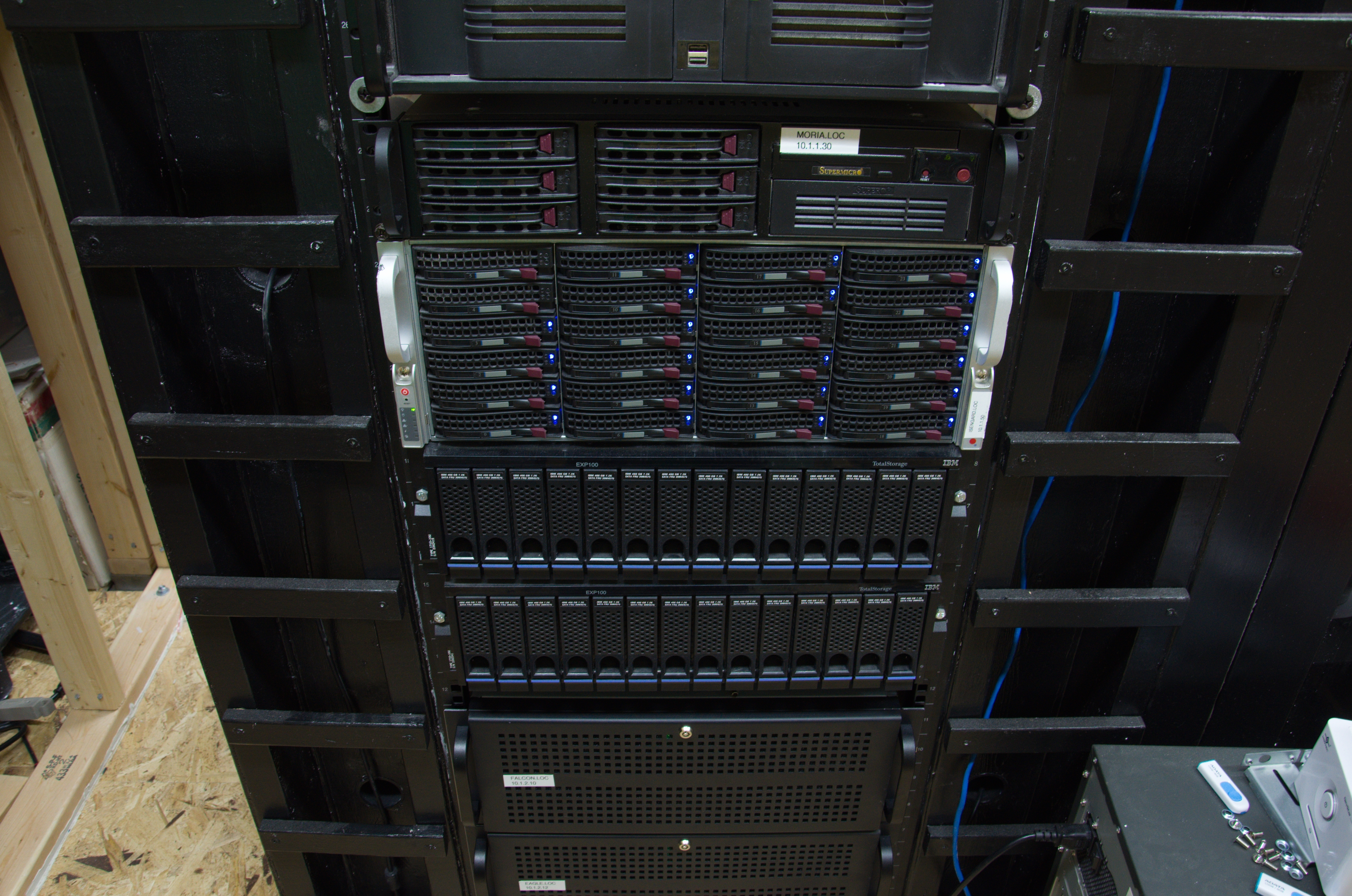
That's all I do now, only internal drives are SSD for OS, the rest are spindle drives in raid with hot swap. The 4U server serves pretty much all of my data:


The biggest draw back of SSDs in mass data systems is their IO limitations, I'm hoping that by the time multi TB SSDs become common that they will find a way to remove that limit. "but a regular user will never hit that limit" do I look like a regular user? 😛 I also don't want to be forced to pay 5x the price for "enterprise" drives either. For now SSD for OS and spindle drives in software raid (or similar redundant system) is the best solution for me.
 
My first SSD only lasted me 2 1/2 years. This was back in 2011 when a 64GB SSD cost about $130. I didn't feel like I got a good deal at all. I'm not sure what average life is for an SSD, but 2 1/2 years is too short for a storage device. I'd like to get at least 5 years minimum.
 
My first SSD only lasted me 2 1/2 years. This was back in 2011 when a 64GB SSD cost about $130. I didn't feel like I got a good deal at all. I'm not sure what average life is for an SSD, but 2 1/2 years is too short for a storage device. I'd like to get at least 5 years minimum.

Agreed, and from what I've read they usually fail catastrophically with no warning. I believe that suggests a controller failure, which I would probably blame on heat. Many cases mount these drives out of the airflow, which is a bad idea.
 
Yeah, I don't really like the way they fail suddenly. I've never had it happen to me but there are plenty of horror stories. Spinners will usually at least give you some warning. Right now I don't think I would want my file server full of ssd's. Spinners are plenty good enough for streaming movies over a 1GbE network. Once 10GbE networks and 4k video starts becoming popular I might could see a server full of ssd's, and then maybe a 8+ core cpu to be able to transcode 4k down to be able to play on a phone or tablet.
 
That's all I do now, only internal drives are SSD for OS, the rest are spindle drives in raid with hot swap. The 4U server serves pretty much all of my data:


The biggest draw back of SSDs in mass data systems is their IO limitations, I'm hoping that by the time multi TB SSDs become common that they will find a way to remove that limit. "but a regular user will never hit that limit" do I look like a regular user? 😛 I also don't want to be forced to pay 5x the price for "enterprise" drives either. For now SSD for OS and spindle drives in software raid (or similar redundant system) is the best solution for me.

Nice rack.
 
My first SSD only lasted me 2 1/2 years. This was back in 2011 when a 64GB SSD cost about $130. I didn't feel like I got a good deal at all. I'm not sure what average life is for an SSD, but 2 1/2 years is too short for a storage device. I'd like to get at least 5 years minimum.


I have a used 60 GB G.Skill Sniper in this laptop that has over 5 TBs written to it and its health just went down to 98%. Don't think the temp is being reported right with Crystaldiskinfo as it says 33 F. LOL

Got my first SSD in the desktop that's about 4 years old now. It's an Adata using a Sandforce chipset.
 
My first SSD only lasted me 2 1/2 years. This was back in 2011 when a 64GB SSD cost about $130. I didn't feel like I got a good deal at all. I'm not sure what average life is for an SSD, but 2 1/2 years is too short for a storage device. I'd like to get at least 5 years minimum.

My first ssd, an adata 128gb, lasted me exactly two months before it failed. The replacement lasted until earlier this year when a failing power supply contributed to its failure. My second, an ocz vertex 2 128gb, lasted 6 months before it failed. The replacement is still working fine in my sons desktop. My third, a Samsung 840 pro 256, lasted exactly 2 years before it locked up on me which sent me to Intel for a 520 120gb which I have for sale. The replacement 840 pro is chugging along in my laptop and is doing fine. My latest purchase is another Samsung except this time its a 850 pro 256 which is my current desktop boot drive. I had issues with Samsung and getting a rma for the 840 but after trying to talk to Intel customer support which is obviously based in India I've gone back to Samsung.

As prices come down and the technology becomes more reliable I hope to replace all of my spinners with ssd's for the speed, low heat and power consumption as well as being quiet. I long for the day when I don't have to hear the platters and heads making noise or wait for access to information.
 
Last edited:
Now that they have developed 2 gig and larger SSD drives, it seems like it just comes down to economizing the drives and then mass producing them to bring the price down to our current platter drives.
That time again, is it? We've seen these same predictions when we hit $1/GB, 50c/GB, 1TB, 3D NAND, and now 2TB.

Meanwhile I can buy a 2TB HDD for ~$50 while a 2TB SSD costs $800. That's about 16x cost difference per GB, and you want to talk about HDDs being replaced?

LOL.

At some point that will happen. Can anyone estimate when that will be. Seems like it might be about 2 years.
Probably around the same time tape drives are replaced by HDDs, which doesn't look like will ever happen.
 
I had issues with Samsung and getting a rma for the 840 but after trying to talk to Intel customer support which is obviously based in India I've gone back to Samsung.

Jeepers... is Intel CS THAT bad??? D: ...and I thought Samsung's was abysmal.

As much as I love my SSDs, I don't see a real benefit in data storage solutions, particularly in the cost/GB analysis. The fact that SSDs usually (absolutely, in my experience...) fail without warning is another no-go.
 
Got my first SSD in the desktop that's about 4 years old now. It's an Adata using a Sandforce chipset.

My first SSD was an OCZ Vertex 3 120GB with Sandforce. Still runs just fine. I have an OCZ Arc 100 480GB in our laptop that is awesome for its uses and I absolutely adore my PCIe Kingston Predator in my main rig. 1400MB/s is bliss.
 
Yeah, I don't really like the way they fail suddenly. I've never had it happen to me but there are plenty of horror stories. Spinners will usually at least give you some warning. Right now I don't think I would want my file server full of ssd's. Spinners are plenty good enough for streaming movies over a 1GbE network. Once 10GbE networks and 4k video starts becoming popular I might could see a server full of ssd's, and then maybe a 8+ core cpu to be able to transcode 4k down to be able to play on a phone or tablet.

It's all about using the right tool for the job. Tape drives are still 100% viable for long term backup solutions, and spinning disks aren't going to disappear anytime soon. Unless you absolutely need the higher throughput from SSDs in a server/datacenter, ol' spinny still gets the job done cheaper and easier and he probably will for a long time coming.

Every technology has its strengths and its weaknesses, and every install needs to weigh those against how they meet the project's needs.

What I want to know is when the PC OEMs are going to start putting SSDs in their systems without having to call and argue with a corporate sales rep and pay a crazy markup. I'd love to start pushing them out to our users, they'd be a major benefit but it's difficult to justify the cost because the OEMs suck.
 
Why would I ever replace my 3TB media drive with an SSD?

The hard disk is cheaper, there would be no difference in performance, and the hard drive retains data for a long, long time.
 
NAND has probably already overtaken HDD as the worlds most prolific storage, mainly due to mobile devices. I dont have the raw numbers, but I suspect the total amounts are really close. There is something like 5,000 exabytes of total global digital storage capacity. We are running roughly 1000 exabytes per year in global HDD sales, much of that capacity going towards replacement of existing capacity rather than new capacity. It is really tough to say exactly what percentage of global storage is NAND and what is HDD, but NAND has either already overtaken, or will in the very near future, within 2 years at most. That marks the tipping point. After that tipping point, it will take no more than 5 years for NAND to become cheaper per GB. So, 2022 at the very latest. My best guess is in the year 2019 you will be able to buy a 8-16TB SSD on newegg for cheaper than a 8-16TB HDD.
 
Why would I ever replace my 3TB media drive with an SSD?

The hard disk is cheaper, there would be no difference in performance, and the hard drive retains data for a long, long time.

Noise, heat and energy. Plus the speed helps if you are iterating through large number of files when doing searches.
 
They both have their uses.

Personally, I see no reason to replace HDD's for general storage of course, but SSD's have come down enough in price that I use them on almost everything for OS's

Of course my computers aren't running in a lab at a university or something along those lines.
 
Last edited:
We have nearly all SSD in our analytic platforms at work and the mechanical drives have much more of an IO limitation than the SSD's.

I'm talking about them wearing out. They're only good for so many writes then they die. Of course enterprise grade ones will probably be designed for more writes and companies replace everything every 3 years anyway but you'll also pay an arm and a leg for that. For at home I like to keep stuff for as long as I can without having to worry how hard I push it.
 
Noise, heat and energy. Plus the speed helps if you are iterating through large number of files when doing searches.

I can see the noise being an issue. I hate the spinning sound. But the energy/heat is pretty insignificant. Of course it all comes down to what is important to you. For me $100 for 3TB of media storage makes more sense than $1000+ for 3TB of SSD storage. But I can concede that we're all individuals and have different priorities.

I'm just saying for me to move to all SSD storage I'd need to see about 10 cents/GB cost for SSD storage. I don't see that happening even in the next 5 years. But I hope I'm wrong😉
 
Yeah prices will need to come way down before it can be used for mass storage. I have 19TB worth of spindle drives (mostly raid 10) can't imagine the cost of SSDs to get that amount of usable redundant storage.
 
Back
Top