DT: Next-generation 28nm GPUs Could Be 45 Percent Faster

Page 2 - Seeking answers? Join the AnandTech community: where nearly half-a-million members share solutions and discuss the latest tech.

TemjinGold

Diamond Member
Dec 16, 2006
3,050
65
91
^ This is highly unlikely because there is 0 chance that Kepler is only 26% faster than a GTX580. AMD can't be naive to think that being just 45% faster for their high-end HD7970 card is sufficient enough to compete with Kepler.


I don't disagree with your point but this part is irrelevant. Whether or not AMD thinks they can compete has no bearing on how the product will turn out. Just look at BD...
 

boxleitnerb

Platinum Member
Nov 1, 2011
2,605
6
81
But the situation in the GPU market is totally different. They have been able to compete since HD4000 and both use the same manufacturing process, so no big surprises there. So it is relevant - both chips will probably be close in performance as it has been for the past couple of years.
 

BD231

Lifer
Feb 26, 2001
10,568
138
106
Good, I can finally dump this 460 for something twice as fast that isn't rediculessly overpriced or a dual card solution.
 
Feb 19, 2009
10,457
10
76
You guys have terrible reading comprehension. :p

28nm HKMG has the potential to run at 45% faster clock speeds with identical gate leakage. It means they can go all balls to the walls and push clock speed and we will have high TDP like we currently do, or they can take it easy and lower TDP.

The shrink itself, 40nm -> 28nm is already a doubling of transistor density. That in theory is already 100% perf increase, but often in practice 60-80%. However, coupled with the huge clock speed increase possible, we may be looking at a GPU that's doubled Cayman transistors running at 1.4ghz. (That is a huge leap)
 

boxleitnerb

Platinum Member
Nov 1, 2011
2,605
6
81
Double transistor density, yes. But those additional transistors sip power, too. So you can either clock the transistors you have higher OR use the additional power budget to add more transistors OR do a combination of the two (to a lesser extent, then).

Btw, why are they not saying anything about dynamic power? Gate leakage is static power, but your chip has to do something, right?
 

Concillian

Diamond Member
May 26, 2004
3,751
8
81
The article implies 45% more clockspeed. It talks about the transistors being 45% faster, not the final product.

This, coupled with doubling the number of transistors, should make these monster GPUs for performance.

I predict 75%-125%+ over the current fastest single GPU.


It is deeper than this.

This speed improvement is based on the same leakage per gate

With the same design scaled down to 28nm, and the same leakage, you would have a device functionally equivalent to the original device in power consumption, but higher speed.

However, devices will have more transistors, so they won't run them 45% higher clockspeed, because cards like that would have even higher TDP than current cards, and they're already approaching a practical limit of TDP per card.
 
Feb 19, 2009
10,457
10
76
The assumption you are making here is the 28nm shrink of transistors themselves do not reduce power requirements per transistor. All the article refers to is that HKMG is very tolerant of running at high clock speeds.
 

toyota

Lifer
Apr 15, 2001
12,957
1
0
Why is everyone complaining, its not like we really even have games that can really test current GPU's. I mean I'm playing BF3 with most of the eye candy on ultra and I'm using a OC'ed 4890, so 45% from the shrink alone and then perhaps another 10-20% with changes to the arch's is not only to be expected, but more than needed at the moment.
why do people say this nonsense every time we talk about new cards? there are plenty of games where I cannot max settings and get enough framerates to even consider using vsync. hell crank Metro 2033 and especially Clear Sky up and enjoy a slideshow at times. even in BF 3, many people want way more performance so just because you are happy does not mean everyone else is. and that just at 1920x1080. so open your mind up a bit and think about people trying to run even higher resolutions. we ALWAYS can find a use for more gpu power.
 
Last edited:

Idontcare

Elite Member
Oct 10, 1999
21,110
64
91
Good, I can finally dump this 460 for something twice as fast that isn't rediculessly overpriced or a dual card solution.
BD231's sig said:
GTX 460 @ 850mhz/1.75v
^ surely the 1.75V is in error? Maybe 1.05V?

The assumption you are making here is the 28nm shrink of transistors themselves do not reduce power requirements per transistor. All the article refers to is that HKMG is very tolerant of running at high clock speeds.

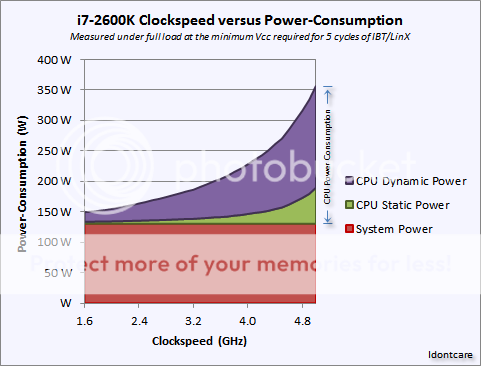
This is where you REALLY have to watch the EXACT words used in the marketing-speak. They cited "gate leakage"...neither the gate leakage (no mention of the leakage from all the other contributing sources) nor leakage in general (adding in all other contributors) say much of anything about the dynamic power consumption of an IC under load.

From here, dynamic power dominates leakage (static) power by nearly a ratio of 6:1.

Intel&


PtotalVccTGHzAreaGraph.png


DynamictoStaticGraph.png


Saying the leakage power is the same when the clockspeeds are 45% higher is literally speaking to power-consumption at idle clockspeeds when static leakage power dominates.

That 300W GTX580 is 300W because 225W is dynamic power and 75W is static power, raising clocks 45% just because the static power will remain 75W says nothing about what happens to the 225W of dynamic power when you raise those clocks.

IMO the entire basis of the OP is a red herring.
 

Chinoman

Senior member
Jan 17, 2005
336
0
76
I'm more excited to see how phone SoC's will take advantage of the 28nm process. GPUs will be faster no doubt but it's a pattern we've seen a million times at node jumps. Smartphones could really benefit from this process. Maybe we'll see battery life double.
 

boxleitnerb

Platinum Member
Nov 1, 2011
2,605
6
81
Dynamic power should decrease too, because capacitances get smaller and less current flows when switching occurs.
 

tigersty1e

Golden Member
Dec 13, 2004
1,963
0
76
You guys are forgetting about power consumption.

The 4870 to 5870 jump and all previous jumps also had a nice jump in tdp. Currently, we are already almost to that tdp max. Especially for AMD.

This coming 7970 card will probably come in with the same tdp as the 6970, give or take some watts with a new revised powertune. Given that, a 45% jump is probably more certain. Anything more than 45% will probably be due to giving the new card more juice.
 

3DVagabond

Lifer
Aug 10, 2009
11,951
204
106
You guys are forgetting about power consumption.

The 4870 to 5870 jump and all previous jumps also had a nice jump in tdp. Currently, we are already almost to that tdp max. Especially for AMD.

This coming 7970 card will probably come in with the same tdp as the 6970, give or take some watts with a new revised powertune. Given that, a 45% jump is probably more certain. Anything more than 45% will probably be due to giving the new card more juice.

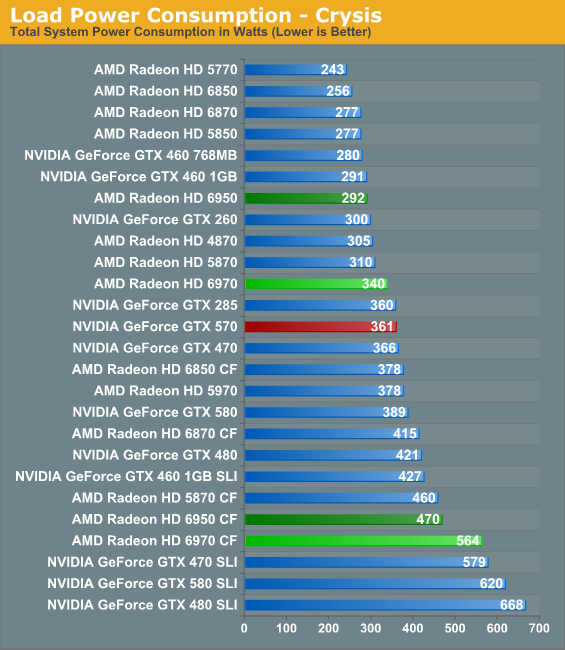
This is the most recent reviews I could get on the two top GPU's from AMD and nVidia. I'm not sure why you believe that power limits are a problem "especially for AMD"?

power-consumption4.png
power-consumption.png
 

RussianSensation

Elite Member
Sep 5, 2003
19,458
765
126
You guys are forgetting about power consumption.

The 4870 to 5870 jump and all previous jumps also had a nice jump in tdp. Currently, we are already almost to that tdp max. Especially for AMD.

This coming 7970 card will probably come in with the same tdp as the 6970, give or take some watts with a new revised powertune. Given that, a 45% jump is probably more certain. Anything more than 45% will probably be due to giving the new card more juice.

That's a good point. AMD's GPU division has been very focused on performance/watt/transistor. I still think, they can extract 45% more performance from faster transistors at the same power envelope using 28nm. And on top of that, I am sure they'll find another 10-15% increase resulting from a brand new architecture (and especially more geometry performance) and more memory bandwidth.

You are right though, AMD may choose to ship cards with lower TDP and only a 45% increase in performance over the 6970. They could price those cards lower to achieve higher volumes. They could just leave the top performance for their dual-GPU card as they usually do. With new management, it's too difficult to predict if AMD will continue to focus on the high end $400 GPU performance in the first place. But since HD7970 was designed before Read arrived, I think it was given the proper investment and performance focus it deserved.
 
Last edited:

bryanW1995

Lifer
May 22, 2007
11,144
32
91
The 45% could just be clock speeds.

45% higher clocks + Double the transistors in the same die area could mean a 7970 being near 6990 performance at the 200W level. If that makes sense.

I read that to be 45% higher clocks, not 45% higher performance. With 45% higher clocks and, say 2 x the transistors, it could actually be possible to see a true + 100% performance boost. I'm not holding my breath, however. I'd still go with the top single gpu being ~ 10-20% slower than 6990.
 

bryanW1995

Lifer
May 22, 2007
11,144
32
91
"According to sources within TSMC, the 28HP HKMG process is doing very well. So well, in fact, that it supports up to a 45 percent speed improvement over the firm's own 40G process"

^ The sentence is comparing manufacturing processes not GPUs. This reads that 28nm transistors at TSMC can work at 45% faster frequencies as their 40nm predecessors. That doesn't take into account any architectural improvements that AMD will bring.

I would say this time, HD7970 should be faster by a lot more than 45%:

1) Brand new architecture from scratch --> far better DX11 performance, esp. under killer DX11 features such as Tessellation, bokeh DOF. On top of that, scalar architecture makes it far better at geometry computation than the fixed Tessellation engines.

2) Let's say a GTX580 is 15% faster on average than the HD6970. If HD7970 is only 45% faster than HD6970, that would make it only 26% faster than a GTX580 (HD6970 = 100, GTX580 = 115, HD7970 = 145, then 145/115 = 26%).

^ This is highly unlikely because there is 0 chance that Kepler is only 26% faster than a GTX580. AMD can't be naive to think that being just 45% faster for their high-end HD7970 card is sufficient enough to compete with Kepler.

3) 28nm process will allow AMD to add more transistors and increase frequencies. They added 12-15% more performance on top of the 5870 in 6970 by simply doing minor tweaks on the same 40nm process (VLIW-5 --> VLIW-4), added barely any more memory bandwidth and barely added clocks. They were still able to improve Tessellation performance improved significantly. Imagine what can be done on a far more complex architecture that can work on more things simultaneously. Also, I am pretty sure this time they'll add a lot more memory bandwidth.

As rumors point to performance approaching an HD6990, I am guessing HD7970 is 60-80% faster than HD6970 not 45%.


Keep in mind that one of their big targets this go-round is GPGPU. Remember that gtx 280 was a bit of a letdown b/c they had so much real estate devoted to something that we gamers don't care about.

45 percent faster ? Wtf is that, soo if in a area in BF3 you get 52fps youll get 85fps with the new 6xx series ?

Math fail. 52*1.45 = 75.4
 
Last edited:

Skurge

Diamond Member
Aug 17, 2009
5,195
1
71
You guys are forgetting about power consumption.

The 4870 to 5870 jump and all previous jumps also had a nice jump in tdp. Currently, we are already almost to that tdp max. Especially for AMD.

This coming 7970 card will probably come in with the same tdp as the 6970, give or take some watts with a new revised powertune. Given that, a 45% jump is probably more certain. Anything more than 45% will probably be due to giving the new card more juice.

The 5870 had a much higher TDP than 4870, but despite being 60-70% faster used only a few watts more.

34663.png


The 6950 being even faster uses less power than the 4870. So they can get a lot more than 45% for same power use.
 

PlasmaBomb

Lifer
Nov 19, 2004
11,636
2
81
45 percent faster ? Wtf is that, soo if in a area in BF3 you get 52fps youll get 85fps with the new 6xx series ?

No, as others have said the 45% refers to the transistors, and your math is off.

I'm sure IDC will chime in about the importance of dynamic power consumption vs idle power consumption/leakage (which is what they are likely referring to when they state a 45% improvement based on the same leakage per gate).
 

LiuKangBakinPie

Diamond Member
Jan 31, 2011
3,903
0
0
You can have the lowest power usage, the fastest ram in the world, clock speeds higher than superman on crack it still wont improve your gpu when the design only manage it to work at 1 triangle per clock cycle.

You can have a huge bus 23 percent effeciency with your cores but it still wont improve your performance if your connection to the ram looks like a endless maze of scruffy connections
 

LiuKangBakinPie

Diamond Member
Jan 31, 2011
3,903
0
0
The 5870 had a much higher TDP than 4870, but despite being 60-70% faster used only a few watts more.

34663.png


The 6950 being even faster uses less power than the 4870. So they can get a lot more than 45% for same power use.

Because the 4870 has a bandwidth disadvantage and still uses the vertex shaders for Tessellation. Thats why the bandwidth is there. For dx 11. On Dx 9 and then the performance difference ain't that huge. it still uses the same L2 cache as the previous lot.
 

tigersty1e

Golden Member
Dec 13, 2004
1,963
0
76
The 5870 had a much higher TDP than 4870, but despite being 60-70% faster used only a few watts more.


The 6950 being even faster uses less power than the 4870. So they can get a lot more than 45% for same power use.

That is 1 benchmark. If you were to take averages of more games with dx11, dx9, and dx10, you would see the 5870 pull away from the 4870. And these are presumably peak power numbers and not average power numbers.

The 6950 is also 2 generations above the 4870. So yeah, they can get a lot more than 45% improvement over the 5870 with the 7970.
 
Feb 19, 2009
10,457
10
76
Essentially, they can aim for the same die space, meaning double the transistors and they can also run them faster and be within a similar TDP. That is already a lot of opportunities for performance improvements, regardless of architecture changes. So unless they pull a BD debacle.. I'm expecting the 7970 to be extremely fast and power hungry (~250W or greater).

It's time they aim for the crown and get a premium on their cards. As its been stated many times, they've gained a lot of market share going for mid-range perf/$ dominance, but that strategy haven't made them rich.
 

Dadofamunky

Platinum Member
Jan 4, 2005
2,184
0
0
You guys are forgetting about power consumption.

Ah, the unsexy side. Of course, that question has been in my mind since I started reading this thread. These cards now eat up massive amounts of power when you push them. Dare we hope we can realize significant real-world performance gains in both frame rates and in power consumption?
 

Arkadrel

Diamond Member
Oct 19, 2010
3,681
2
0
45% faster chips....

does that mean we ll have GPU's with cores running 1500 mhz instead of like 900-1000 max?

:) sign me up.