
-
We’re currently investigating an issue related to the forum theme and styling that is impacting page layout and visual formatting. The problem has been identified, and we are actively working on a resolution. There is no impact to user data or functionality, this is strictly a front-end display issue. We’ll post an update once the fix has been deployed. Thanks for your patience while we get this sorted.
You are using an out of date browser. It may not display this or other websites correctly.
You should upgrade or use an alternative browser.
You should upgrade or use an alternative browser.
Does anyone know how NAND dies are binned at the various manufacturers?
- Thread starter cbn
- Start date

cbn
Lifer
Here is an article on ADATA describing the company doing its own binning after buying the wafers:
http://www.tomshardware.com/news/kevin-chen-adata-ssd-industry,32050.html
Apparently other companies like Kingston also buy wafers and do own their packaging and binning:
http://www.anandtech.com/show/7763/an-update-to-kingston-ssdnow-v300-a-switch-to-slower-micron-nand
http://www.tomshardware.com/news/kevin-chen-adata-ssd-industry,32050.html
Adata is one of the few third-party SSD vendors that purchases NAND in wafer form; most simply procure the finished packages. Adata processes the wafers itself, which allows it to bin the flash die and assure that it adheres to its rigorous quality standards. The company indicated that the wafer processing and binning capability provides it with cost and quality benefits, and Chen noted that 2 to 5 percent of the die that are sold as "SSD grade" do not meet Adata's SSD requirements. Chen feels that the ability to control the NAND binning process provides Adata with an advantage over competitors, particularly when it comes to TLC NAND, which encounters more reliability challenges.
Apparently other companies like Kingston also buy wafers and do own their packaging and binning:
http://www.anandtech.com/show/7763/an-update-to-kingston-ssdnow-v300-a-switch-to-slower-micron-nand
Like many SSD OEMs, Kingston buys its NAND in wafers and does its own validation and packaging. As a result figuring out the original manufacturer is not possible without the help of Kingston because there are no public data sheets or part number decoders to be found. I've never been a big fan of OEM-packaged NAND because OEMs tend to be more tight-lipped about the specifics of the NAND and it's easier to silently switch suppliers, although I do see the economical reasons (NAND is cheaper to buy in wafers).
cbn
Lifer
Here is a shot of the Corsair Neutron XT SSD (2014 SSD which uses the Phison S10 reference design. Notice the packages are labeled "Toshiba"):
http://www.anandtech.com/show/8689/corsair-neutron-xt-ssd-review

However, notice newer Phison reference designs have packages not labeled "Toshiba" but still have the 15 character code with a T at beginning:
http://www.tomshardware.com/reviews/corsair-force-le-200-ssd,4949.html

https://www.servethehome.com/testing-phison-s10-dc-data-center-ssds/
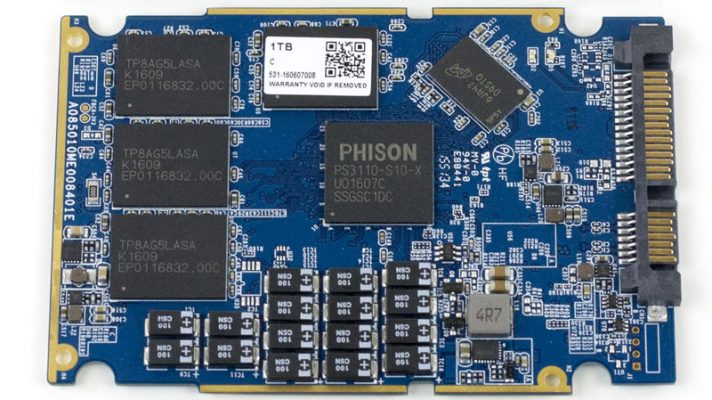
http://www.anandtech.com/show/10234/the-pny-cs1311-and-cs2211-ssd-review-mlc-vs-tlc-at-15nm

Looking at the the current OCZ SSDs (OCZ owned by Toshiba) I do notice they still have packages labeled "Toshiba" (examples below):
OCZ VX500:
http://www.cdrlabs.com/reviews/tosh...drive/box-contents-and-physical-features.html
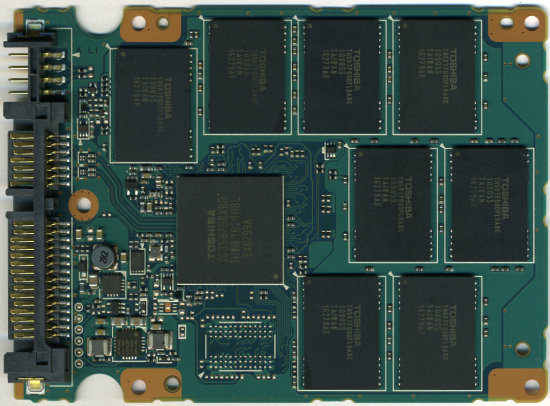
OCZ Trion 150:
http://www.anandtech.com/show/10189/the-ocz-trion-150-ssd-review

OCZ TL100:
http://aphnetworks.com/reviews/toshiba-ocz-tl100-240gb/2

I wonder what is going on here? (The Non Toshiba labelled packages still have a 15 character code beginning with T like the Toshiba packages do...but why would they not be labelled Toshiba? These are packages made and binned by Phison?)
http://www.anandtech.com/show/8689/corsair-neutron-xt-ssd-review
However, notice newer Phison reference designs have packages not labeled "Toshiba" but still have the 15 character code with a T at beginning:
http://www.tomshardware.com/reviews/corsair-force-le-200-ssd,4949.html
https://www.servethehome.com/testing-phison-s10-dc-data-center-ssds/
http://www.anandtech.com/show/10234/the-pny-cs1311-and-cs2211-ssd-review-mlc-vs-tlc-at-15nm
Looking at the the current OCZ SSDs (OCZ owned by Toshiba) I do notice they still have packages labeled "Toshiba" (examples below):
OCZ VX500:
http://www.cdrlabs.com/reviews/tosh...drive/box-contents-and-physical-features.html
OCZ Trion 150:
http://www.anandtech.com/show/10189/the-ocz-trion-150-ssd-review
OCZ TL100:
http://aphnetworks.com/reviews/toshiba-ocz-tl100-240gb/2
I wonder what is going on here? (The Non Toshiba labelled packages still have a 15 character code beginning with T like the Toshiba packages do...but why would they not be labelled Toshiba? These are packages made and binned by Phison?)
Last edited:
cbn
Lifer
Here is a shot of the Kingston Hyper X Savage SSD PCB:
https://www.pcper.com/reviews/Stora...ge-vs-Patriot-Ignite-vs-Corsair-Neutron-XT/In

This looks like one of the Phison S10 reference platforms (including the Nanya DRAM) but with Kingston's NAND packages.
https://www.pcper.com/reviews/Stora...ge-vs-Patriot-Ignite-vs-Corsair-Neutron-XT/In
This looks like one of the Phison S10 reference platforms (including the Nanya DRAM) but with Kingston's NAND packages.
Last edited:
cbn
Lifer
Here is the PCB shot of the Patriot Blast, another Phison S10 SSD (but one that uses Micron NAND rather than the Toshiba NAND commonly found in Phison reference SSDs):
https://www.islabit.com/61287/ssd-patriot-blast-240gb-sata-3-6gbps-review.html/3
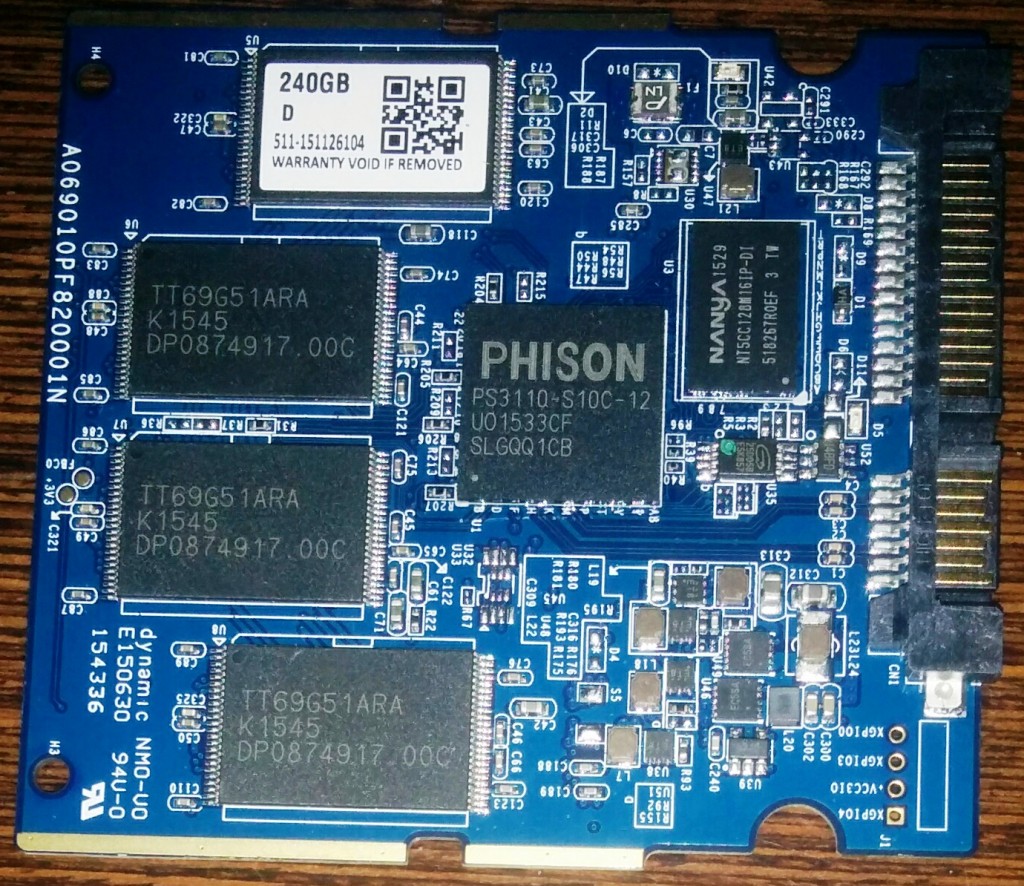
Notice the Packages (with Micron NAND inside) obviously don't say Toshiba, but have the same 15 character code as the packages of other Phison reference design SSDs with Toshiba NAND.
OK, so at this point I feel confident that these Phison reference SSDs are using NAND binned by someone else besides Toshiba even when Toshiba NAND is inside.
https://www.islabit.com/61287/ssd-patriot-blast-240gb-sata-3-6gbps-review.html/3
Notice the Packages (with Micron NAND inside) obviously don't say Toshiba, but have the same 15 character code as the packages of other Phison reference design SSDs with Toshiba NAND.
OK, so at this point I feel confident that these Phison reference SSDs are using NAND binned by someone else besides Toshiba even when Toshiba NAND is inside.
Glaring_Mistake
Senior member
I'm specifically thinking of the NAND (from Samsung, Toshiba, WD, Intel, Micron, SK Hynix) that goes into consumer SSDs. Do any of the manufacturers use more than one tier, two tiers, three tiers for consumer SSDs?
Also how does this NAND compare to the NAND used in other devices?
Don't really know how that works, sorry.
Or quite how it is divided into different tiers though that is something that they do.
Do know of some reasons as to why the quality of the NAND can vary:
1. The NAND manufacturers reserve the best binned NAND from themselves.
2. Companies that do not manufacture NAND but want to sell SSDs can buy it directly, the quality depending on for example what they're willing to pay and the closeness of their relationship.
The latter being why Adata is pretty much the only third party using IMFT 3D NAND.
3. And there is always subsidiaries and the open market but you may get NAND of even lower quality than usual.
OCZ blamed their drives dying on their not having a good source of quality NAND (whether that is true or not the stability of their drives improved a lot after their being acquired by Toshiba).
Also here is the little I can find on binning and how NAND quality can vary: http://www.samsung.com/global/busin...te/SSD/M2M/html/ssd845dcevo/MlcNandFlash.html
http://www.gamersnexus.net/guides/1140-silicon-die-bin-out-process-explained
http://www.anandtech.com/show/8880/discussion-with-ocz-ceo-ralph-schmitt
http://www.tomshardware.com/reviews/transcend-ssd370,4239.html#p1
Here is a shot of the Corsair Neutron XT SSD (2014 SSD which uses the Phison S10 reference design. Notice the packages are labeled "Toshiba"):
I wonder what is going on here? (The Non Toshiba labelled packages still have a 15 character code beginning with T like the Toshiba packages do...but why would they not be labelled Toshiba? These are packages made and binned by Phison?)
Here is the PCB shot of the Patriot Blast, another Phison S10 SSD (but one that uses Micron NAND rather than the Toshiba NAND commonly found in Phison reference SSDs):
https://www.islabit.com/61287/ssd-patriot-blast-240gb-sata-3-6gbps-review.html/3
Notice the Packages (with Micron NAND inside) obviously don't say Toshiba, but have the same 15 character code as the packages of other Phison reference design SSDs with Toshiba NAND.
OK, so at this point I feel confident that these Phison reference SSDs are using NAND binned by someone else besides Toshiba even when Toshiba NAND is inside.
Look at this test of S10 drives too: http://www.tomshardware.com/reviews/toshiba-tlc-mlc-micron-mlc-phison-s10,4190.html
And this review: https://translate.google.com/transl....html&edit-text=&search_plus_one=form&act=url
cbn
Lifer
Also here is the little I can find on binning and how NAND quality can vary: http://www.samsung.com/global/busin...te/SSD/M2M/html/ssd845dcevo/MlcNandFlash.html
http://www.gamersnexus.net/guides/1140-silicon-die-bin-out-process-explained
http://www.anandtech.com/show/8880/discussion-with-ocz-ceo-ralph-schmitt
http://www.tomshardware.com/reviews/transcend-ssd370,4239.html#p1
Samsung link said:Some vendors conclude the validation process at the wafer-level rather
than revalidating at the chip-level. Chips that do not pass this second-level validation at Samsung are
reserved for secondary, non-SSD applications.
^^^^ So binning can actually take place on the wafer level. That is Interesting as I thought binning only happened on the die level or module level as mentioned below in the quote from gamernexus:
Gamernexus said:Toward the final steps of silicon fabrication, individual dies and NAND Flash modules are tested for frequency and voltage tolerance, among other things; the stability (or volatility) of the silicon chip is gauged within a spec range, then the factory bins-out the chip for use in specific product lines.
Some great info the Anandtech and Tom's hardware links as well:
Anandtech said:Another crucial element that Toshiba provides is the access to its NAND supply. In the past OCZ had to source NAND from the open market, which resulted in varying quality NAND being used. Like many components (and goods/stocks in general), NAND is sold on spot market where anyone can sell or buy NAND. In case a NAND manufacturer (or any company) has excess stock, they can dump a portion of that into the spot market and sell it at the day's price. It is possible to buy NAND straight from the manufacturer, but the required volume tends to be fairly high and in turn you don't get the benefits of the dynamic spot market (predicting supply/demand and the associated price changes can be very profitable, if successful).
Anandtech said:Since OCZ sourced most of its NAND from the spot market, the quality wasn't always top notch. Especially during times of low supply, OCZ basically had to use any and all NAND it got its hands into. As NAND is such a vital element of an SSD, the lower quality NAND also had an impact on overall quality and in worst cases on customer satisfaction as well.
Anandtech said:Now that OCZ has access to Toshiba's NAND, that is no longer a concern. Not only is OCZ getting a steady supply of NAND from Toshiba, it also has access to the latest and highest quality chips. It is not a secret that all NAND manufacturers cherry-pick NAND and use the best dies for their own drives, which is why the best quality chips don't even end up on the open market.
Tom's hardware said:The NAND flash used in it is not as cut and dry. All but one unit shipped for review previously used genuine Micron Grade A flash. One reviewer in Russia received a drive with SpecTek flash, as we did on our 512GB sample. The SpecTek -AL flash is the Micron subsidiary's best NAND flash part, but it's not considered the same 20-nm 128-gigabit Tier 1 Grade A flash that Micron sells to customers or uses in-house. SpecTek sells Micron flash that often doesn't pass full performance or quality-control tests. At one time, OCZ Technology (prior to the Toshiba acquisition) shipped products with SpecTek flash, and other SSD vendors spoke up:
Tom's hardware said:"When we took the cover off of this third, direct from OCZ SSD, we found a 'S' stamped over Micron logo on all the flash devices (see the image to the left). This indicates the device is 'off spec' product because it failed some parameter of Micron's full performance and/or quality specification testing. 'Off spec' memory is typically used in low-level applications such as toys, offering considerable cost savings over Tier 1 level to an SSD manufacturer." - Grant Dahlke, formally of Other World Computing (OWC)
Tom's hardware said:The SpecTek 20-nm 128-gigabit part number we found in our SSD370 512GB sample is SpecTek's highest-grade offering. We still don't like seeing this flash used in products like SSDs where reliability trumps low cost. . Most users will not have an issue with it, but we were told by engineers in the industry that any part using this flash will have higher return merchandise authorization (RMA) rates than parts using Tier 1 Grade A flash. One SSD retailer we spoke with noted an increase in RMAs on products using less than Grade A flash. The difference is 1 in 300 products returned with Tier 1 Grade A flash, compared with 9 in 300 products returned using the lower-grade flash.
Tom's hardware said:Our 256GB SSD370 sample did ship with genuine Micron 20-nm MLC flash. Given that nearly all of the reviewers have received Micron flash but products shipping in the wild are mixed, we can't say what flash you may receive in your retail product. Transcend never discloses which type of flash is guaranteed. This topic has come up with other low-cost SSDs from other manufactures in years past. The backlash from end users has never been positive, even when those users never experienced a single problem.
Tom's hardware said:The NAND flash used in it is not as cut and dry. All but one unit shipped for review previously used genuine Micron Grade A flash. One reviewer in Russia received a drive with SpecTek flash, as we did on our 512GB sample. The SpecTek -AL flash is the Micron subsidiary's best NAND flash part, but it's not considered the same 20-nm 128-gigabit Tier 1 Grade A flash that Micron sells to customers or uses in-house. SpecTek sells Micron flash that often doesn't pass full performance or quality-control tests. At one time, OCZ Technology (prior to the Toshiba acquisition) shipped products with SpecTek flash, and other SSD vendors spoke up: "When we took the cover off of this third, direct from OCZ SSD, we found a 'S' stamped over Micron logo on all the flash devices (see the image to the left). This indicates the device is 'off spec' product because it failed some parameter of Micron's full performance and/or quality specification testing. 'Off spec' memory is typically used in low-level applications such as toys, offering considerable cost savings over Tier 1 level to an SSD manufacturer." - Grant Dahlke, formally of Other World Computing (OWC) The SpecTek 20-nm 128-gigabit part number we found in our SSD370 512GB sample is SpecTek's highest-grade offering. We still don't like seeing this flash used in products like SSDs where reliability trumps low cost. . Most users will not have an issue with it, but we were told by engineers in the industry that any part using this flash will have higher return merchandise authorization (RMA) rates than parts using Tier 1 Grade A flash. One SSD retailer we spoke with noted an increase in RMAs on products using less than Grade A flash. The difference is 1 in 300 products returned with Tier 1 Grade A flash, compared with 9 in 300 products returned using the lower-grade flash. Our 256GB SSD370 sample did ship with genuine Micron 20-nm MLC flash. Given that nearly all of the reviewers have received Micron flash but products shipping in the wild are mixed, we can't say what flash you may receive in your retail product. Transcend never discloses which type of flash is guaranteed. This topic has come up with other low-cost SSDs from other manufactures in years past. The backlash from end users has never been positive, even when those users never experienced a single problem.
Last edited:

Elixer
Lifer
I was curious on how they tested all this at the factory, but, didn't get very far. Seems to be a pretty big secret on how each company does it.
I would think that they would have to test at least 1 full write to the NAND chip, though, not sure if there is some way to test each cell in a row, or maybe have some special write pattern that will show the NAND chip should be binned lower.
Perhaps they can use 3D Xrays to determine something... *shrug*
I would think that they would have to test at least 1 full write to the NAND chip, though, not sure if there is some way to test each cell in a row, or maybe have some special write pattern that will show the NAND chip should be binned lower.
Perhaps they can use 3D Xrays to determine something... *shrug*
cbn
Lifer
One thing that is very interesting about the Micron 3D NAND Gen 1 dies is they can either be used as TLC (384Gb/48GB) or MLC (256Gb/32GB). Gen 2 doubles the capacity to 768Gb/96GB (TLC) and 512Gb/64GB (MLC).
So I wonder if this is allowing certain companies to actually still use some Micron 3D TLC NAND that fails "SSD grade" in SSDs if they use it as 3D MLC instead? (re: MLC has much better endurance than TLC)
EDIT: The more I think about this....the more I am convinced this is probably happening. The downside, of course, to having one "big" NAND die (configured as either 384Gb TLC or 256 Gb MLC) serving all needs rather than a "big" (256 Gb MLC) die and a "small" (256 Gb TLC) die is that for certain classic capacities an odd number of dies would be needed if the NAND was configured as TLC. This or the NAND channels on a quad channel SSD controller would be unequally populated.
So I wonder if this is allowing certain companies to actually still use some Micron 3D TLC NAND that fails "SSD grade" in SSDs if they use it as 3D MLC instead? (re: MLC has much better endurance than TLC)
EDIT: The more I think about this....the more I am convinced this is probably happening. The downside, of course, to having one "big" NAND die (configured as either 384Gb TLC or 256 Gb MLC) serving all needs rather than a "big" (256 Gb MLC) die and a "small" (256 Gb TLC) die is that for certain classic capacities an odd number of dies would be needed if the NAND was configured as TLC. This or the NAND channels on a quad channel SSD controller would be unequally populated.
Last edited:
Glaring_Mistake
Senior member
One thing that is very interesting about the Micron 3D NAND Gen 1 dies is they can either be used as TLC (384Gb/48GB) or MLC (256Gb/32GB). Gen 2 doubles the capacity to 768Gb/96GB (TLC) and 512Gb/64GB (MLC).
So I wonder if this is allowing certain companies to actually still use some Micron 3D TLC NAND that fails "SSD grade" in SSDs if they use it as 3D MLC instead? (re: MLC has much better endurance than TLC)
EDIT: The more I think about this....the more I am convinced this is probably happening. The downside, of course, to having one "big" NAND die (configured as either 384Gb TLC or 256 Gb MLC) serving all needs rather than a "big" (256 Gb MLC) die and a "small" (256 Gb TLC) die is that for certain classic capacities an odd number of dies would be needed if the NAND was configured as TLC. This or the NAND channels on a quad channel SSD controller would be unequally populated.
Few use Micron 3D MLC NAND however so even if so I'm not sure that would be that common.
Adata has the SU900 and the SX8000 and Mushkin and Transcend might each have a drive with it too but aside from those I don't know of any.
Though Mushkin and Transcend just specify that they use 3D MLC NAND, not Micron 3D MLC NAND but given that Intel/Micron is the only one shipping it (for SSDs) it seems a reasonable guess.
Aside from Samsung that is but they tend to prefer keeping the NAND to themselves.
Of course there's at least one drive using Samsung 16nm TLC NAND so it could technically be possible that they also sell their 3D NAND to others.
cbn
Lifer
Few use Micron 3D MLC NAND however so even if so I'm not sure that would be that common.
Adata has the SU900 and the SX8000 and Mushkin and Transcend might each have a drive with it too but aside from those I don't know of any.
Though Mushkin and Transcend just specify that they use 3D MLC NAND, not Micron 3D MLC NAND but given that Intel/Micron is the only one shipping it (for SSDs) it seems a reasonable guess.
Aside from Samsung that is but they tend to prefer keeping the NAND to themselves.
Of course there's at least one drive using Samsung 16nm TLC NAND so it could technically be possible that they also sell their 3D NAND to others.
ADATA also has the XPG SX950.
So with this drive having a better warranty than the SU 900 Ultimate the Micon 3D MLC NAND must be better. However, the Warranty in the SU900 Ultimate (also uses Micron 3D MLC NAND) is still very good at 5 years.....better than the 3 year warranty of Micron 3D TLC of the SU 800 Ultimate.
I guess a question I have then is how much boost in endurance does a Micron 3D NAND die get when it is used as 256Gb MLC rather than 384Gb TLC?
Looking at this old comparison of planar MLC vs. planar TLC the gain was 4x greater endurance for MLC (over TLC) at the same node:
http://www.anandtech.com/show/5067/understanding-tlc-nand/2
So if 3D NAND used as MLC has a similar gain? then I would imagine Micron 3D NAND dies not making the cut for 3 year warranty as TLC could still be used for 5 year warranty MLC. SSDs made with such dies (converted from 384Gb TLC to 256Gb MLC) would also have the benefit of populating the channels of quad channel SSD controller equally if the target was the classic capacities. (Eg, three dies of 384 Gb TLC vs. four dies 256 Gb MLC or six dies of 384 Gb TLC vs. eight dies of 256 Gb MLC)
Glaring_Mistake
Senior member
ADATA also has the XPG SX950.
Ah, forgot about that one.
So with this drive having a better warranty than the SU 900 Ultimate the Micon 3D MLC NAND must be better. However, the Warranty in the SU900 Ultimate (also uses Micron 3D MLC NAND) is still very good at 5 years.....better than the 3 year warranty of Micron 3D TLC of the SU 800 Ultimate.
I'd think it may have more to do with market segmentation than endurance but even if it were related to endurance it might be that it has more OP (since it uses smaller capacities than the others) rather than the NAND being better binned.
Whichever one it is it is difficult to tell however so it's just speculation either way.
I guess a question I have then is how much boost in endurance does a Micron 3D NAND die get when it is used as 256Gb MLC rather than 384Gb TLC?
Looking at this old comparison of planar MLC vs. planar TLC the gain was 4x greater endurance for MLC (over TLC) at the same node:
http://www.anandtech.com/show/5067/understanding-tlc-nand/2
So if 3D NAND used as MLC has a similar gain? then I would imagine Micron 3D NAND dies not making the cut for 3 year warranty as TLC could still be used for 5 year warranty MLC.
I think it has a bit to do with how good the construction of the NAND is and what kind of endurance they deem acceptable, which means you may get various amounts of P/E from the NAND depending on where the cutoff is for the particular manufacturer.
Regarding the difference between Intel/Micron's MLC NAND and their TLC NAND (Gen 1) it looks like it may be that the MLC NAND has a 6x greater endurance than the TLC NAND (when both use BCH ECC), see:
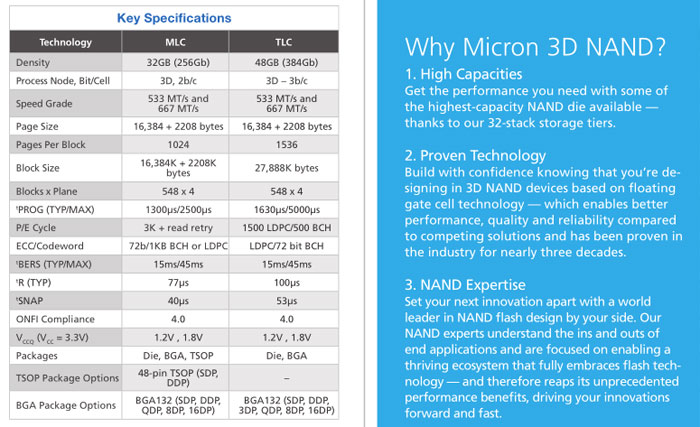
The MX300 uses LDPC ECC and is rated at 1500 P/E so this seems fairly credible.
A friend and I have speculated that the reason for the fairly low raw endurance of their 3D TLC NAND may be that they're not using a very large lithography for their 3D TLC NAND.
At least they've gone with small lithographies for their 3D MLC NAND, their 3D MLC NAND (Gen 1) seems to use both 20nm and 16nm lithographies, see:

and: https://www.intel.com/content/www/u...-series/dc-s3520-480gb-2-5inch-6gbps-3d1.html
That doesn't necessarily mean that their 3D TLC NAND has to use one of those lithographies but may use one a lot larger but those are the ones we know about.
Though even if they've gone with a small lithography with their 3D TLC NAND they may find that a bit harder to pull off with QLC NAND since they also have plans for that just like Toshiba/WD.
Last edited:
cbn
Lifer
A friend and I have speculated that the reason for the fairly low raw endurance of their 3D TLC NAND may be that they're not using a very large lithography for their 3D TLC NAND.
At least they've gone with small lithographies for their 3D MLC NAND, their 3D MLC NAND (Gen 1) seems to use both 20nm and 16nm lithographies, see:
and: https://www.intel.com/content/www/u...-series/dc-s3520-480gb-2-5inch-6gbps-3d1.html
Wow, I didn't know that Intel used such a small lithography..... but that image does say 20nm (and in the Intel link you also provided it does say 16nm for 3D NAND).
Interestingly, (although not apples to oranges) Micron mentions their 3D MLC NAND (which uses floating gate) has the same endurance as their 20nm NAND in this link.
Micron said:This vertical approach lets us expand the size of each 3D NAND cell—the lithography is actually larger than our latest planar NAND. The larger NAND cells improve both performance and endurance to the point where our MLC 3D NAND parts will meet the endurance rates of our 20nm NAND.
That doesn't necessarily mean that their 3D TLC NAND has to use one of those lithographies but may use one a lot larger but those are the ones we know about. Though even if they've gone with a small lithography with their 3D TLC NAND they may find that a bit harder to pull off with QLC NAND since they also have plans for that just like Toshiba/WD.
According to the following article TLC and MLC use the same die:
http://www.anandtech.com/show/9116/estimating-intelmicron-32layer-256gbit-3d-nand-die-size
With that noted, I do agree that if Intel-Micron wants QLC (with small lithography) then yes that might be pretty tough!
cbn
Lifer
Now that I think about it more....
Intel-Micron 3D NAND having such small lithography might be one reason why their Vertical NAND came to market so fast relative to Toshiba and SK Hynix.
Whereas, perhaps, with Toshiba the 3D NAND lithography being larger means that the company needs QLC more than Intel-Micron does in order to be competitive to with its own planar NAND?
Intel-Micron 3D NAND having such small lithography might be one reason why their Vertical NAND came to market so fast relative to Toshiba and SK Hynix.
Whereas, perhaps, with Toshiba the 3D NAND lithography being larger means that the company needs QLC more than Intel-Micron does in order to be competitive to with its own planar NAND?
Glaring_Mistake
Senior member
Wow, I didn't know that Intel used such a small lithography..... but that image does say 20nm (and in the Intel link you also provided it does say 16nm for 3D NAND).
Considering one of the advantages with going from 2D to 3D NAND was that it allowed for a lot larger lithographies than previous it was easy to assume that Intel/Micron would also go with like 40nm.
Thought so too before I saw otherwise.
Also the decision to go with such a small lithography seems odd but that they decided to use two different (small) lithographies within the same generation makes it even more odd.
Interestingly, (although not apples to oranges) Micron mentions their 3D MLC NAND (which uses floating gate) has the same endurance as their 20nm NAND in this link.
Yes, have noticed that they have compared it to their 20nm MLC NAND more than once.
Found amusing that they write: "This vertical approach lets us expand the size of each 3D NAND cell—the lithography is actually larger than our latest planar NAND."
Like, yeah - you went from 16nm to 20nm, what a jump!
According to the following article TLC and MLC use the same die:
http://www.anandtech.com/show/9116/estimating-intelmicron-32layer-256gbit-3d-nand-die-size
That seems to make it even more likely that a small lithography is used for both their 3D MLC and TLC NAND, yes.
With that noted, I do agree that if Intel-Micron wants QLC (with small lithography) then yes that might be pretty tough!
Yeah, their 16nm TLC NAND could already develop issues and QLC NAND of a similar lithography should add quite a bit of complexity.
Now that I think about it more....
Intel-Micron 3D NAND having such small lithography might be one reason why their Vertical NAND came to market so fast relative to Toshiba and SK Hynix.
Partly the reason I think.
But likely what delayed 3D NAND so long for other manufacturers was the use of a Charge Trap which has been trouble to implement for a long time.
Some test results I've seen may indicate that even the construction of a Charge Trap considered good enough to use may have its issues (in one drive at least) (though it may not necessarily be due to the Charge Trap since there are a number of factors playing a part, just seems likely).
Whereas, perhaps, with Toshiba the 3D NAND lithography being larger means that the company needs QLC more than Intel-Micron does in order to be competitive to with its own planar NAND?
Maybe, but Samsung uses a large lithography too and have said that they do not intend to make QLC NAND.
We'll see if that changes though.
cbn
Lifer
That seems to make it even more likely that a small lithography is used for both their 3D MLC and TLC NAND, yes.
.....And it would seem to me Gen 2 TLC (768 Gb)/MLC (512 Gb) (EDIT 3: mentioned in the last paragraph of this article) is probably also on 20nm since it doubles capacity of the Gen 1 TLC 9384 Gb)/MLC (256 Gb) with a doubling a layers (64 layer vs. 32 layers).
EDIT 2: More info to support that in the last paragraph of this article....although I have seen mentioned in newer articles like the one below (and in this one) about a Gen 2 512 Gb TLC die?
With that noted, I do wonder what lithography is being used for Intel-Micron Gen 2 256 Gbit TLC?
http://www.anandtech.com/show/11100...ce-roadmap-updates-forecasts-and-ceo-retiring
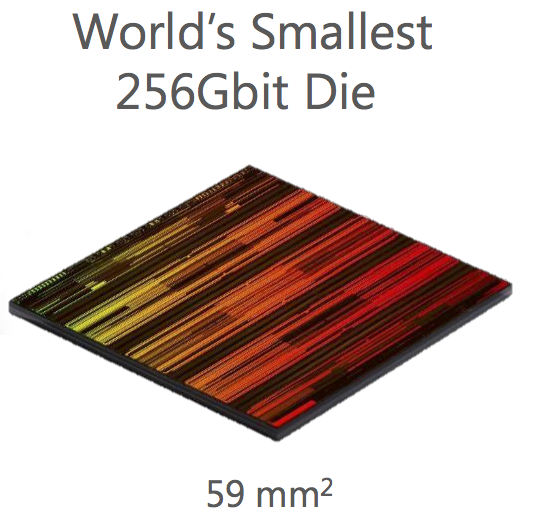
EDIT: The article I linked in post #14 had the Intel-Micron 32 layer 384 Gbit TLC die etimated at 175mm2 (and this source lists it at 168mm2)....so maybe this 64 layer 256 Gbit TLC die at 59mm is 16nm?
P.S. This Gen 2 256 Gbit TLC is being used in the Intel 545s SSD---> http://www.anandtech.com/show/11571/the-intel-ssd-545s-512gb-review-64layer-3d-tlc-nand-hits-retail
Last edited:
Glaring_Mistake
Senior member
.....And it would seem to me Gen 2 TLC (768 Gb)/MLC (512 Gb) is probably also on 20nm since it doubles capacity of the Gen 1 TLC 9384 Gb)/MLC (256 Gb) with a doubling a layers (64 layer vs. 32 layers).
Seems logical.
EDIT2: More info to support that in the last paragraph of this article....although I have seen mentioned in newer articles about a Gen 2 512 Gb TLC die?
What I find interesting in that article is this:

See the arrow going from 20nm to 3D?
Doesn't it look like they mean both that they use a 20nm lithography for their 3D NAND and that it has about as many electrons as 2D 50nm NAND?
Like, how exactly would they manage that?
With that noted, I do wonder what lithography is being used for Intel-Micron Gen 2 256 Gbit TLC?
http://www.anandtech.com/show/11100...ce-roadmap-updates-forecasts-and-ceo-retiring
EDIT: The article I linked in post #14 had the Intel-Micron 32 layer 384 Gbit TLC die etimated at 175mm2 (and this source lists it at 168mm2)....so maybe this 64 layer 256 Gbit TLC die at 59mm is 16nm?
Might well be the case.
P.S. This Gen 2 256 Gbit TLC is being used in the Intel 545s SSD---> http://www.anandtech.com/show/11571/the-intel-ssd-545s-512gb-review-64layer-3d-tlc-nand-hits-retail
I plan to purchase an Intel 545s and put it through a kind of gauntlet like I've done with a number of drives to see how it performs.
It's not like that is likely to tell us what the lithography of the NAND is, since the controller will probably have a bigger impact than the NAND.
Still, it means that we'll get to see how it handles voltage drift.
cbn
Lifer
Yeah, that article (quote below) implies the 168mm2 Intel-Micron Gen 1 (32L) 256 Gb MLC/384 Gb TLC die has a larger geometry than 20nm:
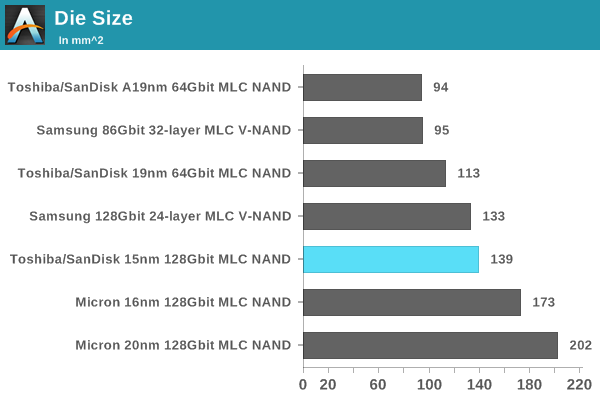
And if I compare that Micron Gen 1 3D NAND 256 Gb MLC/384 Gb TLC with die size of 168mm2 to the the Micron 16nm 128 Gb MLC (equivalent to 192 Gb if used as TLC) with die size of 173mm2 or Micron 20nm 128 Gb MLC (equivalent to 192 Gb if used as TLC) with die size of 202mm2 then maybe it is effectively a larger lithography even though they call it "20nm"? (reason: With 32 layers a wouldn't a 3D NAND die of the same lithography as a planar NAND die be a lot smaller (1/16 the size?) even if it has double the number of bits)
http://www.anandtech.com/show/8415/measuring-toshibas-15nm-128gbit-mlc-nand-die-size
The larger size of the cell improves the performance since it has a higher cell capacitance – more electrons can be stored, and a better natural Vt distribution (~50%) is achieved. (Note that at 20-nm planar, less than 10 electrons gave 100mv Vt shift!)
Number of electrons/100mV Vt shift (left), and Vt distribution vs 20-nm planar flash (Source: Intel/Micron/IEDM)
The cell geometry also means that the cell/cell interference is reduced – again, comparing to the 20-nm planar chip;
Cell/cell interference of 3D-NAND vs planar NAND (Source: Intel/Micron/IEDM)
We will see what the commercial part looks like when we get our hands on one, likely in the first few months of next year. Unfortunately there are no scale bars on any of the images, so we have no feel for what the actual dimensions are; though probably not too different from the Samsung, which is classed as a 40-nm device.


And if I compare that Micron Gen 1 3D NAND 256 Gb MLC/384 Gb TLC with die size of 168mm2 to the the Micron 16nm 128 Gb MLC (equivalent to 192 Gb if used as TLC) with die size of 173mm2 or Micron 20nm 128 Gb MLC (equivalent to 192 Gb if used as TLC) with die size of 202mm2 then maybe it is effectively a larger lithography even though they call it "20nm"? (reason: With 32 layers a wouldn't a 3D NAND die of the same lithography as a planar NAND die be a lot smaller (1/16 the size?) even if it has double the number of bits)
http://www.anandtech.com/show/8415/measuring-toshibas-15nm-128gbit-mlc-nand-die-size
Last edited:
cbn
Lifer
P.S. This Gen 2 256 Gbit TLC is being used in the Intel 545s SSD---> http://www.anandtech.com/show/11571/the-intel-ssd-545s-512gb-review-64layer-3d-tlc-nand-hits-retail
I plan to purchase an Intel 545s and put it through a kind of gauntlet like I've done with a number of drives to see how it performs.
It's not like that is likely to tell us what the lithography of the NAND is, since the controller will probably have a bigger impact than the NAND.
Still, it means that we'll get to see how it handles voltage drift.
Looking forward to hearing about that. (I am hoping the SATA 6 Gbps SSDs have a stronger than expected finish considering that last major wave as mostly all planar TLC)
Last edited:
Glaring_Mistake
Senior member
Yeah, that article (quote below) implies the 168mm2 Intel-Micron Gen 1 (32L) 256 Gb MLC/384 Gb TLC die has a larger geometry than 20nm:
True, but the image should be from Micron while the one writing the article seems to be assuming that they will use a large lithography (since that was considered one of the benefits of going over to 3D NAND).
And if I compare that Micron Gen 1 3D NAND 256 Gb MLC/384 Gb TLC with die size of 168mm2 to the the Micron 16nm 128 Gb MLC (equivalent to 192 Gb if used as TLC) with die size of 173mm2 or Micron 20nm 128 Gb MLC (equivalent to 192 Gb if used as TLC) with die size of 202mm2 then maybe it is effectively a larger lithography even though they call it "20nm"? (reason: With 32 layers a wouldn't a 3D NAND die of the same lithography as a planar NAND die be a lot smaller (1/16 the size?) even if it has double the number of bits)
I don't know really.
But I have seen Micron claim that it would be about equivalent to a 50nm lithography which has made me wonder if that they do use 20nm but also at the same time (somehow) have managed to make it match a much larger lithography.
Looking forward to hearing about that. (I am hoping the SATA 6 Gbps SSDs have a stronger than expected finish considering that last major wave as mostly all planar TLC)
It will take a long time for the tests to complete though, long enough that many of the drives have become outdated.
For example, the SP550 and BX200 are still being tested despite the fact that I created threads about those more than a year ago.
Most of the important tests for them have been completed though, so I may actually write something (relatively) soon (as in just a few months).
And they're also partly responsible for my not writing anything about several other drives since they are going to be referenced a bit (well, the BX200 is going to be).
But if you're interested I can give you a preview on the Intel 545s when I get some results of some relevance on how it performs even if just that is still going to take months.
I don't really know why but apparently some of what I wrote became quoted and I can't do anything about it.
Last edited:
cbn
Lifer
But if you're interested I can give you a preview on the Intel 545s when I get some results of some relevance on how it performs even if just that is still going to take months.
That would be great, but if you are concerned it would affect your final results I can wait. Whatever works best for you.
Glaring_Mistake
Senior member
That would be great, but if you are concerned it would affect your final results I can wait. Whatever works best for you.
No, not really concerned about that.
If it is prone to slowing down (relatively quickly) it should soon be noticed and if it is not - well, then we know that it is not. Or at least not under those circumstances.
So even if the tests are incomplete we can kind of see how it behaves though there still may be some odd behavior, for example that it slows down faster when powered on (something that may actually happen).
Which is something that we don't really see until that part of the tests have been completed and it is given time to recover.
What I see as something that could be a problem is the controller, all of the drives using the SM2256 have had read speeds drop in my tests (though how much has varied quite a bit).
Even if the NAND can also be a factor the controller may have a bigger impact on how it manages to withstand voltage drift (with little wear).
Still I think that they may have improved that since the SM2256 - and if not then we may get to see that once I've tested the Intel 545s.
Glaring_Mistake
Senior member
Unfortunately I have not yet gotten to test how the Intel 545s handles voltage drift since there is still not a 128GB in stock anywhere around here.
But I found that a few stores reported it as using 16nm 3D TLC NAND supporting that it is likely that Intel/Micron use fairly small lithographies for their 3D TLC NAND too.
Example: https://www.pbtech.co.nz/product/HDDINT3702310/Intel-SSD-545s-256GB-25in-SATA-6GBS-16NM-TLC-3D-Re
Even with a lithography around that size however voltage drift can be kept under control better than you'd expect.
Tested an SSD of a similar lithography after significant wear (like 92% P/E cycles used) a while ago and read speeds did not drop a lot.
In fact a drive using 30-40nm NAND had read speeds drop more with less wear (like 77% P/E cycles used).
They are rated at different P/E cycles however so the second drive had seen around four times the number of P/E cycles as the first even if the first drive had seen more wear percentually.
But I found that a few stores reported it as using 16nm 3D TLC NAND supporting that it is likely that Intel/Micron use fairly small lithographies for their 3D TLC NAND too.
Example: https://www.pbtech.co.nz/product/HDDINT3702310/Intel-SSD-545s-256GB-25in-SATA-6GBS-16NM-TLC-3D-Re
Even with a lithography around that size however voltage drift can be kept under control better than you'd expect.
Tested an SSD of a similar lithography after significant wear (like 92% P/E cycles used) a while ago and read speeds did not drop a lot.
In fact a drive using 30-40nm NAND had read speeds drop more with less wear (like 77% P/E cycles used).
They are rated at different P/E cycles however so the second drive had seen around four times the number of P/E cycles as the first even if the first drive had seen more wear percentually.
TRENDING THREADS
-
 Discussion Zen 5 Speculation (EPYC Turin and Strix Point/Granite Ridge - Ryzen 9000)
- Started by DisEnchantment
- Replies: 25K
-
Discussion Intel Meteor, Arrow, Lunar & Panther Lakes + WCL Discussion Threads
- Started by Tigerick
- Replies: 25K
-
 Discussion Intel current and future Lakes & Rapids thread
- Started by TheF34RChannel
- Replies: 24K
-

-
