Does AMD have any hope against Intel?

Page 8 - Seeking answers? Join the AnandTech community: where nearly half-a-million members share solutions and discuss the latest tech.
Mar 9, 2013
134
0
76
Intel can squash AMD anytime they want. Unfortunately, for all consumers Intel don't even consider them a big enough competition to bother taking them down.

I really don't like AMD to be in such a big mess on the processor front. The only thing that seems to work for them is the APU. But, there too they are too conservative. They haven't have really shown the potential that they have.

AMD needs to really shift to a smaller node process to be relevant in the game. Problem is, the more time they take to actually reach there. The more hard it would become for them to come out of the quick sand.
 

AnandThenMan

Diamond Member
Nov 11, 2004
3,991
627
126
Intel can squash AMD anytime they want. Unfortunately, for all consumers Intel don't even consider them a big enough competition to bother taking them down.
Why squash AMD just buy them out. I think at this point getting past regulators would not be an issue.
Innovating in multicore is great, but when IPC languishes too much relative to the competition it just ends up looking like an expedient or an apology, like, "here are your free cores, sorry about that poor per-core performance."
Nah, if Intel was the one pushing weaker cores but more of them suddenly single core performance would be yesterdays news. AMD simply doesn't have the influence.
 

crashtech

Lifer
Jan 4, 2013
10,695
2,294
146
Nah, if Intel was the one pushing weaker cores but more of them suddenly single core performance would be yesterdays news. AMD simply doesn't have the influence.
Not. It's all about performance metrics in the end. During Netburst Intel didn't control the narrative, and if AMD became the performance leader, no amount of spin would help Intel.
 

AnandThenMan

Diamond Member
Nov 11, 2004
3,991
627
126
Performance metrics in what? I can write software that runs like a raped ape on a certain architecture but runs like a 286 on another.
 

2is

Diamond Member
Apr 8, 2012
4,281
131
106
Nah, if Intel was the one pushing weaker cores but more of them suddenly single core performance would be yesterdays news. AMD simply doesn't have the influence.

I don't agree. When AMD held the performance crown with the A64 and A65 x2 for a short while, they received a lot of praise while intel received a lot of criticism. Obviously there were the Intel fans that still defended them, but that applies to any vendor.

I myself was an AMD user during that era, and stuck with them for a while even after they lost the performance crown. When it became clear the performance gap was only widening, and the argument that we just need to wait until software is "optimized" for AMD was nothing more than wishful thinking, I made the switch to Intel.
 

monstercameron

Diamond Member
Feb 12, 2013
3,818
1
0
Not. It's all about performance metrics in the end. During Netburst Intel didn't control the narrative, and if AMD became the performance leader, no amount of spin would help Intel.


Where relatively cheap spin doesn't work there is always cash...and Intel has plenty of it. If per core performance is such a big thing then why does Intel get a pass with less than stellar atoms vs AMDs small core apu.
 

mrmt

Diamond Member
Aug 18, 2012
3,974
0
76
Where relatively cheap spin doesn't work there is always cash...and Intel has plenty of it. If per core performance is such a big thing then why does Intel get a pass with less than stellar atoms vs AMDs small core apu.

Because of a significantly better cost structure, the same reason on why OEMs went for bobcat over Celeron/Pentium?
 

monstercameron

Diamond Member
Feb 12, 2013
3,818
1
0
Because of a significantly better cost structure, the same reason on why OEMs went for bobcat over Celeron/Pentium?


Share your source on this alleged cost structure issue else your posts are as useful as nosta's -no offense nosta, you know I lub yah.
 

Abwx

Lifer
Apr 2, 2011
12,035
5,005
136
Share your source on this alleged cost structure issue else your posts are as useful as nosta's -no offense nosta, you know I lub yah.

Ironicaly, like Nosta, he can be right sometimes, Intel drasticaly improved the cost structure of their low cost, or rather high losses, chips, one chip + 70$ and that s it, you ll get tremendous growth in chip deliveries...
 

BSim500

Golden Member
Jun 5, 2013
1,480
216
106
Not. It's all about performance metrics in the end. During Netburst Intel didn't control the narrative, and if AMD became the performance leader, no amount of spin would help Intel.
Precisely. When the A64 /X2 was beating the P4, only a few die-hard "sour grapes" Intel fanboys were whinging and sulking about the "wrong" kind of benchmarks or the "wrong" compiler used like a worn-out broken record. Most people simply accepted AMD had the faster & more efficient cores at the time. That's why as others have said, AMD were also selling more server chips at the time (where arguing over $20-$50 CPU price tag differences is utterly insignificant compared to the TCO of running a server). Now the role's are reversed, we're seeing inverted "the reason AMD cores are slow is absolutely everyone else's fault except AMD and all we have to do is wait for x universal magic coding bullet (which is always just around the corner every year since 2006)" style fanboyism... :whiste:

I hope AMD do come back to compete with Intel core vs core, clock vs clock, but they aren't going to do it by piling on more cores, then sitting there 'demanding' games devs write consistently theoretically perfectly threaded code as a magic alternative to AMD not improving efficiency (IPC) of the CPU itself anywhere near the level of competitors. Some code (video encoding) is inherently more naturally threadable and easier to "parallel" across cores than other code (gaming). And even if gaming code were perfectly threadable, you only have to look at the half-broken state many modern games get released in to see optimization is way down on their list of priorities (if they even budgeted it in at all that is...)

Some people just can't seem to handle "MOAR CORES" is not some magic performance enhancing panacea even for supposed 2014 "next-gen" multi-threaded games:-
http://gamegpu.ru/images/remote/htt...Action-Assassins_Creed_Unity-test-ac_proz.jpg
http://gamegpu.ru/images/remote/htt...lefield_4_Dragons_Teeth-test-bf4_proz_amd.jpg
http://gamegpu.ru/images/remote/htt...ion-The_Evil_Within_-test-evilwithin_proz.jpg
http://gamegpu.ru/images/remote/htt...hadow_of_Mordor-test-ShadowOfMordor_proze.jpg
http://gamegpu.ru/images/remote/htt...f_Duty_Advanced_Warfare-test-cod_proz_amd.jpg

AAA games devs not spending an extra $2-3m delaying their game another 3 months so they can hand tweak every single line of code for the 2.0% of gamers with 6-8 CPU cores might not be how some want reality to be - but it simply is how it is. 3.19% of Steam users have 1 core, 48.3% have 2 cores, 2.7% have 3 cores and 43.6% have 4 cores. That's a combined 97.8% of the market with 1-4 cores. And being a Steam survey, this is if anything biased towards gamers with better hardware and excludes the plethora of cheap sub-2.5GHz dual-core non-gaming office boxes, netboxes, laptops, netbooks, etc, with no Steam client or games beyond Freecell, Solitare & Minesweeper installed at all.
 

Abwx

Lifer
Apr 2, 2011
12,035
5,005
136
Precisely. When the A64 /X2 was beating the P4, only a few die-hard "sour grapes" Intel fanboys were whinging and sulking about the "wrong" kind of benchmarks or the "wrong" compiler used like a worn-out broken record. Most people simply accepted AMD had the faster & more efficient cores at the time.

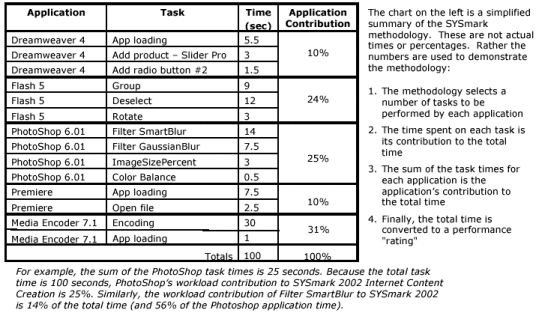
In the corporate market people use, or used, things like Sysmark to check what was adequate to buy, we re not talking of amateurs building their PCs and who are not the majority of the market.

mail.jpg


method.gif


photoshop.gif


Flash.gif


Access.gif


sort.gif


http://www.vanshardware.com/reviews/2002/08/020822_AthlonXP2600/020822_AthlonXP2600.htm

Cheating with the benchmarks seems to be an old industry at Intel.
 

BSim500

Golden Member
Jun 5, 2013
1,480
216
106
In the corporate market people use, or used, things like Sysmark to check what was adequate to buy, we re not talking of amateurs building their PCs and who are not the majority of the market.
I know exactly how the "corporate market" works as I've done a great deal of network installations with companies of all sizes from small businesses to one UK high grade data security corporation built inside an underground WW2 bunker with about 9 layers of security access, server room retinal scanners, multiple redundant Argon fire suppression systems, half the security staff were former Royal Marines, the works. I can 100% assure you, most of them tend to base their hardware purchases on more than just Sysmark (or any single benchmark in general). Even for Windows based server's, Java, virtualization, requests per second, latency, throughput, etc, are all commonly researched. You are chronically naive if all you think IT heads at corporations do is lookup the results page on "bapco.com" for expensive multi-million server acquisitions.

Cheating with the benchmarks seems to be an old industry at Intel.
Translation : "It's still always everyone else's fault, and Intel control the result of every single benchmark everywhere on the planet..." Seriously, it's as "old" now as it was 10 years ago... :rolleyes:
 

Abwx

Lifer
Apr 2, 2011
12,035
5,005
136
As always, consider the source

Not only there could be some bias but the article itself suggest that the author does not know a lot about the industries numbers when stating the the die cost of a BT is 5$.

Selling 40 millions chips at 0% gross margin would bring 400 millions revenues, down from 1.-1.2bn that can be expected from normal pricings wich would be in the 25-30$ range.

Yet giving those 40m chips cant cost more than 400m $, and even less if we are to use Ashraf s cost estimation, how ironic, but let s stick to 400m $.

Surprisingly it cost 4bn $ to give thoses 40m chips, that is, 100$/chip, or a chip + 90$.

We can assume that there s a part of RD but BT is not a that big project, AMD did a much better chip with few means, yet we have people that try to sustain that Intel need 3.5bn/year to devellop this chip, that is where AMD whole RD budget is 1bn for both CPUs and GPUs, actualy most of this money is given to OEMs as a mean to keep the competition, AMD, from entailing a market that has strategical importance for the years to come.