[Digitimes] Xeon Roadmap, Skylake launches in Q3'15

Page 3 - Seeking answers? Join the AnandTech community: where nearly half-a-million members share solutions and discuss the latest tech.

SAAA

Senior member
May 14, 2014
542
129
116
I agree. The skylake wiki page previously had doubled cache with lower latency.

Yep saw that but I'm still uncertain if it's true or not: same thing happened to the Haswell page but in the end no doubling so the only chance for big changes is now or until Icelake? Meh that's far...

Anyway there wasn't here a rumor about Skylake mobile parts with 3-4MB caches? If that's true the doubling seems even more suspicious.
But hey they can still improve the front end, or the usual better branch prediction line! ;)

BTW about IPC what happened with division? I mean there was a slide saying 3 vs 5 cycles for Broadwell, that's 66% better in one tick! Just how much standard code will benefit in real world scenarios?
 

witeken

Diamond Member
Dec 25, 2013
3,899
193
106
BTW about IPC what happened with division? I mean there was a slide saying 3 vs 5 cycles for Broadwell, that's 66% better in one tick! Just how much standard code will benefit in real world scenarios?
">5%" IPC increase.
 

jpiniero

Lifer
Oct 1, 2010
17,231
7,597
136
The delay isn't really in Intel's favour - the slower they move forward the slower we upgrade. They only make money when we upgrade. Personally I still have a i2500K, I would have built a new machine this year (well new MB, CPU, memory) but what's the point. In that way Intel are loosing out on money I would spend on them but instead I am spending on something else.

Do you really need to? Are games running slow for you with an overclocked 2500K?

I am expecting overclocks in the range of 5-5.2GHz. I am also expecting IPC improvement around 5-10% for legacy apps, over Broadwell.

I think you are going to be super disappointed.
 

III-V

Senior member
Oct 12, 2014
678
1
41
I think you are going to be super disappointed.
In regards to the clock speed thing? I don't think I will. The only time frequency hasn't scaled was with 22nm. Broadwell-Y is on its own process, which should help Broadwell-K reach higher clock speeds. Also, the fin shape is rectangular, which has a ~12% higher on-current than triangular fins at comparable or better electrostatic integrity.

I'm very confident that 14nm will overclock better. My estimations may end up being a bit too optimistic, but time will tell.

As far as Skylake's performance per clock improvement goes, for legacy applications... well, it's hard to say. I am just basing this on a general trend. If Intel managed to get 5% or so out of Broadwell, which is a tick... an additional 1.05x-1.1x over that is not unquestionable.
 

Ajay

Lifer
Jan 8, 2001
16,094
8,116
136
In regards to the clock speed thing? I don't think I will. The only time frequency hasn't scaled was with 22nm. Broadwell-Y is on its own process, which should help Broadwell-K reach higher clock speeds. Also, the fin shape is rectangular, which has a ~12% higher on-current than triangular fins at comparable or better electrostatic integrity.

I'm very confident that 14nm will overclock better. My estimations may end up being a bit too optimistic, but time will tell.

Well, that info is based on simulations of variable fin shapes from one TEM image of 22nm FinFETs. So, this is kind of like a second cousin once removed thing. Once obvious difference is that Intel when from three down to two fins - I would expect that Ion grew by more than 12% per fin as a function of Idrive or I don't see how they could have pulled that off.

I recall an older thread where Homeles brought up an issue with frequency scaling in FinFETs (I think it was based on slides from a presentation by K. Kuhn). Maybe I'll try and dig it up tomorrow - I know that I have the presentation and I'll see how search does in finding his post.
 

III-V

Senior member
Oct 12, 2014
678
1
41
Well, that info is based on simulations of variable fin shapes from one TEM image of 22nm FinFETs. So, this is kind of like a second cousin once removed thing.
Sure, but it's basically universally accepted that rectangular fins have higher Idsats.
Once obvious difference is that Intel when from three down to two fins - I would expect that Ion grew by more than 12% per fin as a function of Idrive or I don't see how they could have pulled that off.
Right, and that's where the taller fins come into play (42nm vs 34nm tall, for 14nm and 22nm respectively). Do keep in mind, they went from 3 → 2 on Core M's process... not necessarily on the HP process. Also, it was an example of what they could do -- the number of fins they use is going to vary from circuit to circuit.
I recall an older thread where Homeles brought up an issue with frequency scaling in FinFETs (I think it was based on slides from a presentation by K. Kuhn). Maybe I'll try and dig it up tomorrow - I know that I have the presentation and I'll see how search does in finding his post.
This one?
http://download.intel.com/pressroom/pdf/kkuhn/Kuhn_22nm_Device.pdf
 
Last edited:

Ajay

Lifer
Jan 8, 2001
16,094
8,116
136
Right, and that's where the taller fins come into play (42nm vs 34nm tall, for 14nm and 22nm respectively). Do keep in mind, they went from 3 → 2 on Core M's process... not necessarily on the HP process. Also, it was an example of what they could do -- the number of fins they use is going to vary from circuit to circuit.

Two excellent points! The number of fins varied in Haswell as it was anyway.


Yes, pp. 13-15. This is an excellent paper - it's been 6 years, wish we'd get an updated version at this year's IEDM (hopefully Intel will cover it's 14nm Rect Fin in some detail).

I guess what I can't figure right out now, is if the taller fins and higher Idsat will result in an improvement in switching speed. Will Ion be achieved faster and/or with less parasitic capacitance than 22nm fins and give a net decrease to switching speed? Does the new process improve sensitivity to VT improving frequency scaling or not? There is some info out there already, but, for example, I haven't dived into this thread yet: http://www.realworldtech.com/forum/?threadid=144618&curpostid=144618
 
Mar 10, 2006
11,715
2,012
126
I really wish Intel would bring out 14nm LGA 2011-3 parts sooner than 2016. I would love to have 14nm goodness in my main machine.
 

III-V

Senior member
Oct 12, 2014
678
1
41
I really just can't get excited for Broadwell-E, with core counts not moving anywhere. I mean, I guess it'll have significantly higher clocks, but I'd really like an affordable 6 or 8 core.
 

RussianSensation

Elite Member
Sep 5, 2003
19,458
765
126
5820K is very affordable. It's $299 at MC which is dirt cheap. Even at regular stores it's barely more expensive than a 4790K. A lot of users are getting 4.2-4.4Ghz overclocks. A 6-core BW-E at 4.5Ghz is going to be as fast as a 4.7Ghz 4790K and with 6 cores such a beastly CPU will last 5 years. The cost of ownership is ludicrously low for CPUs now. I mean in 5 years you can easily sell this CPU for $125. Never in the history of CPU has it been this cheap to own such fast near flagship CPUs.

It is 100% guaranteed that you will lose more money in SSDs and GPUs than Intel CPU. Can you imagine how large of an SSD you'll be able to buy for $400 in 5 years or how fast of a GPU? Probably at least 2.5x faster than a 980. There will not be a CPU 2-2.5X faster than a 4.5Ghz 6-core BW-E in 5 years at $400.
 
Last edited:

III-V

Senior member
Oct 12, 2014
678
1
41
A new motherboard and RAM are not cheap, though. But I guess you have a point. I'd forgotten they were that low.
 

Phynaz

Lifer
Mar 13, 2006
10,140
819
126
There is also business logic in saving money by using child labor, or not taking care of toxic waste thereby polluting the environment. If done in certain countries it's still legal. It doesn't mean I approve of that or like it either.

How you got from Intel not releasing a product to child labor abuse is beyond me.
 
Mar 10, 2006
11,715
2,012
126
I really just can't get excited for Broadwell-E, with core counts not moving anywhere. I mean, I guess it'll have significantly higher clocks, but I'd really like an affordable 6 or 8 core.

IMO, the purpose of Broadwell-E is not performance improvement so much as cost reduction. The die size of an 8 core BDW-E will be approximately half that of a comparable HSW-E, but Intel will sell it at the same price as the HSW-E.

Good economics for Intel, but obviously not much incentive for people on HSW-E to upgrade. Although I'd bet you that SNB-E and maybe even IVB-E owners might find a BDW-E compelling.
 

Fjodor2001

Diamond Member
Feb 6, 2010
4,696
765
126
How you got from Intel not releasing a product to child labor abuse is beyond me.

The principle is the same, the severity of course not at all - and that goes without saying.

Everything that is business logic because the company makes more money short term is not always appreciated or seen well upon by the customers. It can eat into the company's goodwill. And eventually it can come back and bite you in the ass, because people buy products from other companies. Especially if it's a close call between products from two different companies that the customer is choosing between.
 
Mar 10, 2006
11,715
2,012
126
The principle is the same, the severity of course not at all - and that goes without saying.

Everything that is business logic because the company makes more money short term is not always appreciated or seen well upon by the customers. It can eat into the company's goodwill. And eventually it can come back and bite you in the ass, because people buy products from other companies. Especially if it's a close call between products from two different companies that the customer is choosing between.

That may be the case for a small fraction of hardcore enthusiasts, but you need to see the bigger picture.

John Doe walking into Best Buy does not care about whether Intel delayed Skylake for "business reasons." He usually goes in to the store to buy a computer because his current one is too old, his daughter/son needs a machine for college, or whatever reasons normal, non-enthusiasts buy computers for.

He usually has a budget in mind, and based on that budget he'll buy the system that he thinks will suit his needs best. Since system vendors put i7s in the "best" systems, i5s in "better" systems, and i3/Pentium/Celeron in the "good" systems, his choice of processor will really be more or less made for him based on his total system budget. Then he will use it until it no longer does what he needs it to do and the cycle continues.
 
Last edited:

jpiniero

Lifer
Oct 1, 2010
17,231
7,597
136
In regards to the clock speed thing? I don't think I will. The only time frequency hasn't scaled was with 22nm.

Except you are now hitting heat density limits when the transistors get this small and at high enough clock speed. And Intel is still focusing the 'normal' process on maximizing clock speed at lower voltages to help keep the clock speeds up at low TDP... they just needed an entirely new process just to get Core down to something that could theoretically be sold in a tablet.
 

jpiniero

Lifer
Oct 1, 2010
17,231
7,597
136
Seems strange that E3-12xx v4 and E3-12xx v5 will be released simultaneously.

It's the same as Broadwell-K vs the locked Skylake quads except the Broadwell Xeon is locked of course but still has the GT3e graphics.
 

III-V

Senior member
Oct 12, 2014
678
1
41
Except you are now hitting heat density limits when the transistors get this small and at high enough clock speed. And Intel is still focusing the 'normal' process on maximizing clock speed at lower voltages to help keep the clock speeds up at low TDP... they just needed an entirely new process just to get Core down to something that could theoretically be sold in a tablet.
Heat density only increased with 22nm because there wasn't the usual reduction in leakage at the voltage range used for overclocking. As far as your second statement goes... that remains to be seen.
 

Ajay

Lifer
Jan 8, 2001
16,094
8,116
136
Except you are now hitting heat density limits when the transistors get this small and at high enough clock speed. And Intel is still focusing the 'normal' process on maximizing clock speed at lower voltages to help keep the clock speeds up at low TDP... they just needed an entirely new process just to get Core down to something that could theoretically be sold in a tablet.

Well, Intel still had different process for 22nm and I expect they will with 14nn: http://www.chipworks.com/en/technic...tel-details-22nm-trigate-soc-process-at-iedm/

Interesting thing is that there is a clear physical distinction between the HP and LP/ULP nodes. We will see more info soon at IEDM.
 

Ajay

Lifer
Jan 8, 2001
16,094
8,116
136
IMO, the purpose of Broadwell-E is not performance improvement so much as cost reduction. The die size of an 8 core BDW-E will be approximately half that of a comparable HSW-E, but Intel will sell it at the same price as the HSW-E.

And create a substantial improvement in perf/watt - which will be huge in data centers (BW-EP).
 

Lepton87

Platinum Member
Jul 28, 2009
2,544
9
81
5820K is very affordable. It's $299 at MC which is dirt cheap. Even at regular stores it's barely more expensive than a 4790K. A lot of users are getting 4.2-4.4Ghz overclocks. A 6-core BW-E at 4.5Ghz is going to be as fast as a 4.7Ghz 4790K and with 6 cores such a beastly CPU will last 5 years. The cost of ownership is ludicrously low for CPUs now. I mean in 5 years you can easily sell this CPU for $125. Never in the history of CPU has it been this cheap to own such fast near flagship CPUs.

It is 100% guaranteed that you will lose more money in SSDs and GPUs than Intel CPU. Can you imagine how large of an SSD you'll be able to buy for $400 in 5 years or how fast of a GPU? Probably at least 2.5x faster than a 980. There will not be a CPU 2-2.5X faster than a 4.5Ghz 6-core BW-E in 5 years at $400.

It doesn't matter that 5820K is cheap because the entry cost for the enthusiast platform is about the same owing to DDR4 prices, I payed more for mobo and about the same for RAM and in the end I ended up paying about the same I would have payed for IVY-E at launch with a 4930K CPU.
 

Ajay

Lifer
Jan 8, 2001
16,094
8,116
136
It doesn't matter that 5820K is cheap because the entry cost for the enthusiast platform is about the same owing to DDR4 prices, I payed more for mobo and about the same for RAM and in the end I ended up paying about the same I would have payed for IVY-E at launch with a 4930K CPU.

Sadly, with LGA Skylake coming out late, DDR4 may not drop in price as quickly in 2015. OEM SKL quads will be BGA, of course, and probably use LPDDR3 to keep costs down (at least, I think SKL will support LPDDR3).
 

Idontcare

Elite Member
Oct 10, 1999
21,110
64
91
Heat density only increased with 22nm because there wasn't the usual reduction in leakage at the voltage range used for overclocking.

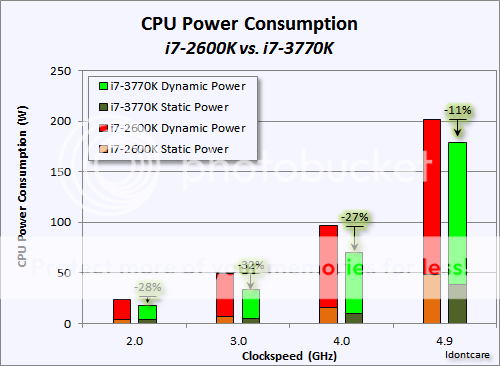
Not trying to be argumentative, but I found the advancements in leakage reduction with 22nm over 32nm to be impressive considering that all the insulating materials are that much thinner and yet the leakage was reduced.

i7-3770K vs. i7-2600K: Temperature, Voltage, GHz and Power-Consumption Analysis

DynamicvsStaticPowerConsumption.png


CPUPowerConsumption.png


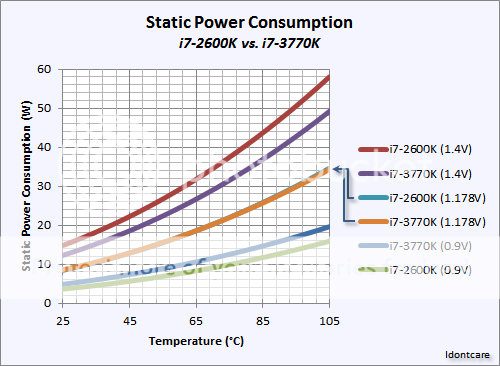
That thread itself is a bit lengthy and may be too boring to deep dive, so for this particular discussion (32nm vs 22nm leakage) I recommend drilling down to post #20, titled: Deeper Analysis of Static Power Consumption (Leakage)

StaticPowerConsumptionTempversusPower.png

^ note the leakage at higher voltages is lower for 22nm than it is for 32nm :eek:

That post concludes with:
What amazes me, and this is the message I hope people absorb in reading this, what amazes me is that Intel was able to shrink the physical geometry of the the circuits themselves in going from 32nm to 22nm (xtor density goes up) and yet they managed to essentially keep the static leakage the same (roughly) at any given temperature and/or voltage as the much less dense (and less likely to leak) 32nm circuits.

I think most people in the industry expect static leakage to increase at every node (holding Vcc constant) simply for the sake that the electrical insulation between conductors is getting thinning in the process of shrinking the circuits.

Yet we see here that Intel managed to stave off that static leakage hit in nearly a one-to-one fashion with the 32nm->22nm shrink as far as I can tell.
 
Last edited: