[Digital Trends] The end of the battle between AMD and Nvidia won’t be great for PC

5150Joker

Diamond Member
Feb 6, 2002
5,549
0
71
www.techinferno.com
Digital Trends just wrote an article discussing how alive the PC market was at the turn of the century with ATi/NVIDIA emerging victors along with DirectX with both rapidly innovating and leap frogging one another until recently. In their opening paragraph they write:

Over the last decade these companies, often known as the red team and the green team, have been locked in a seemingly eternal conflict. Whenever one side gained an edge, the other swiftly responded. No video card remained the obvious king for more than a few months. Gamers had plenty of choice, and could always count on the constant advancement of GPU performance.
It seems the conflict has reached its end.
Nvidia has gained a lasting upper hand on AMD, and gamers have taken notice: In 2014 the former gained 11 percent market share, taken entirely from the red team. Is this really the end of the war — and if so, what will it mean for gamers?

They then list reasons why they think NVIDIA has pulled ahead such as better software suite/ecosystem to frequently updated hardware with power efficiency. There's also discussion of AMD's financial woes and being spread too thin while NVIDIA is "grazing on high end video cards that provide a nutritious profit".

The conclusion is that AMD's decline is bad for PC gamers everywhere and we should hope that they somehow get back in the game. None of these reasons are new to those of us that keep up with this sort of news on a daily basis but websites like DT are more mainstream, kinda like Engadget, and it's why I found it interesting that they chose to write an article like this.


Source: http://www.digitaltrends.com/computing/is-the-eternal-pc-graphics-war-coming-to-an-end/
 

desprado

Golden Member
Jul 16, 2013
1,645
0
0
This..........AMD is the Reason why Nvidia is better.If AMD is gone than Nvidia wont care about there product or their drivers.
 

wand3r3r

Diamond Member
May 16, 2008
3,180
0
0
There are no shortage of rumors.

Now with the 390x about to stomp on the titan x, followed by a samsung purchase of AMD, it might be NV that is in trouble. ;)

/rumor sarcasm

The irony is that amd has been pretty competitive in their gpus. The situation is pretty dire, AMD needs to get marketing to the sheeple who aren't even aware how competitive they are.
 

ShintaiDK

Lifer
Apr 22, 2012
20,378
146
106
The notion that competition is the saviour of everything is wrong.

No innovation, no buy, too high prices, no buy. The industry is based on high cashflow and high R&D requiring high volume sales. So the companies would simply go bankrupt even as a monopoly if they changed.

However it would be bad as such for potential diversity. But that itself can be both good and bad.
 
Last edited:

nurturedhate

Golden Member
Aug 27, 2011
1,767
774
136
The notion that competition is the saviour of everything is wrong.

No innovation, no buy, too high prices, no buy. The industry is based on high cashflow and high R&D requiring high volume sales. So the companies would simply go bankrupt even as a monopoly if they changed.

However it would be bad as such for potential diversity. But that itself can be both good and bad.

Provide an example where complete lack of competition was good for a market then.
 

ShintaiDK

Lifer
Apr 22, 2012
20,378
146
106
Provide an example where complete lack of competition was good for a market then.

Volume is shrinking or stagnant. Prices can only be inflation adjusted more or less. R&D+Design cost spirals up each year.

Is competition good? Or would you just be worse of with multiple starved companies.

Its no different than farming and hunger. If the field can only feed 10 people, then you only gonna make everything worse trying to feed 20.

Plus see my signature. Competition is bad at generating innovation. Why take a risk when you can have staus quo. And we certainly dont lack examples there.
 

tviceman

Diamond Member
Mar 25, 2008
6,734
514
126
www.facebook.com
AMD marketing and decision makers (i.e. suites) are god awful. They waste time and money on ridiculously cheesy videos which convey no other message other than they're too cheap to create a real marketing campaign. They piggy backed on Nvidia's big gaming event last year, trying to get people to wear AMD shirts to an Nvidia party (dumb and potentially dangerous).

They released the 7970, 7970 GE, and R9 290X with horrible stock coolers which lead to mediocre reviews.

They released Tonga which.... was as big as the chip it was replacing, cost the same amount of money to consumers, came with less memory, and was not any faster.

The only thing they've gotten right from a marketing point of view is advertising that "4gb means 4gb," but even that was such a small blip. They didn't push the issue, they just left it in a tweet and in interviews. They should have used that on advertising banners and on newegg, amazon, etc. But nope.

I hope Fiji outright beats GM200 without breaking the power bank. I hope Fiji OC'd beats GM200 overclocked without breaking the power bank. I hope Fiji is priced better than GM200, and I hope it outsells GM200. That is all probably too much to hope for, but I'm still hoping.
 

Genx87

Lifer
Apr 8, 2002
41,091
513
126
This..........AMD is the Reason why Nvidia is better.If AMD is gone than Nvidia wont care about there product or their drivers.

This is really not founded in reality. Intel still releases wonderful designs despite the fact AMD hasn't been competitive in nearly a decade in the x86 CPU market. Nvidia, like Intel, needs to build better designs to entice consumers to purchase their product regardless of outside competition.

Anyways Nvidias ecosystem is such they utilize the same designs from the low end to Quadro and Tesla. Nvidia is fighting for market share in HPC. Those designs would filter down to the desktop GPU business.

Also remember Intel is the 800lb gorilla in the graphics market. They hold 70% of the market now. Over that time PC gaming has expanded greatly.
 
Last edited:

Erenhardt

Diamond Member
Dec 1, 2012
3,251
105
101
Volume is shrinking or stagnant. Prices can only be inflation adjusted more or less. R&D+Design cost spirals up each year.

Is competition good? Or would you just be worse of with multiple starved companies.

Its no different than farming and hunger. If the field can only feed 10 people, then you only gonna make everything worse trying to feed 20.

Plus see my signature. Competition is bad at generating innovation. Why take a risk when you can have staus quo. And we certainly dont lack examples there.

Everyone knows that when there is only 1 athlete in a race, he gives 110% of him to secure the lead and goes full steam ahead all the way from start to finish...

More competition, more innovation. Not only in the technology terms, but also a business model innovation, market segment innovation, channel innovation, etc.
 

destrekor

Lifer
Nov 18, 2005
28,799
359
126
Volume is shrinking or stagnant. Prices can only be inflation adjusted more or less. R&D+Design cost spirals up each year.

Is competition good? Or would you just be worse of with multiple starved companies.

Its no different than farming and hunger. If the field can only feed 10 people, then you only gonna make everything worse trying to feed 20.

Plus see my signature. Competition is bad at generating innovation. Why take a risk when you can have staus quo. And we certainly dont lack examples there.

You don't understand the quote in your signature.

Competition may not be what spurs each individual step of innovation, but competition is precisely what encourages corporations to gamble upon further innovation, because increased competition begets a faster rate of innovation. i.e. with more competition, there are more instances of innovation.

Which, as it is reasoned out, I don't actually think the quote makes any sense, or is at best too few in words and thus easily misconstrued, my apologies to Idontcare, especially if he had more to say that you chose to not include. If competition increases the pace of innovation (which is does), then that means more innovation is happening, which means it is driving the companies to innovate. If there is less competition, they are driven to innovate at a slower pace, and thus fewer innovations over a given time period.

The innovations are going to happen, and this is fueled ultimately by cash reserves and revenue and a desire to stay relevant and encourage the steady customer base to upgrade so that they can continue to sell product. However, with less or nonexistent competition, they can innovate at a comfortable pace without potentially hurting their quarterly and annual revenues. If they have competition, that means there is now more than one company choosing to innovate at any potential point in time, and the other company, whether they desire to or not, must risk net revenue in order to keep up with the competition and out-innovate to stay relevant.

Competition thus spurs innovation, which is not to say it would not happen at all, but competition induces it to happen at a faster pace, which means that given any time frame, we'll see more innovation in that span of time when the competition is greater.


Now, with AMD so hurt for cash, they are rarely capable of pushing the innovation with each generation, of which either makes it easier for the competition to coast, or to out-innovate for far less money with far less effort, which is preferable to the bottom line, always. These companies make progress with integrated circuits not for the benefit of mankind, but in order to encourage you to upgrade, or most importantly, encourage system builders to make new versions which are enough of an upgrade for consumers to be interested in buying. It's in their interest to innovate, but without competition, they can do so at a far more laggardly pace.
 

Subyman

Moderator <br> VC&G Forum
Mar 18, 2005
7,876
32
86
Without AMD there will still be progress, but it will be a scheduled performance increase using economically optimized metrics and timelines. In other words, it will be X% of performance increase every year and Y price for each bracket. The pricing will be less volatile than it is now, to our detriment. There will still be innovation, because nvidia wants people to buy the next card, but it will be just enough innovation to move that needle instead of having to leap frog another company competing for those same sales.

It is kind of like where intel is now. Tick tock, boring performance increases.
 

exar333

Diamond Member
Feb 7, 2004
8,518
8
91
You don't understand the quote in your signature.

Competition may not be what spurs each individual step of innovation, but competition is precisely what encourages corporations to gamble upon further innovation, because increased competition begets a faster rate of innovation. i.e. with more competition, there are more instances of innovation.

Which, as it is reasoned out, I don't actually think the quote makes any sense, or is at best too few in words and thus easily misconstrued, my apologies to Idontcare, especially if he had more to say that you chose to not include. If competition increases the pace of innovation (which is does), then that means more innovation is happening, which means it is driving the companies to innovate. If there is less competition, they are driven to innovate at a slower pace, and thus fewer innovations over a given time period.

The innovations are going to happen, and this is fueled ultimately by cash reserves and revenue and a desire to stay relevant and encourage the steady customer base to upgrade so that they can continue to sell product. However, with less or nonexistent competition, they can innovate at a comfortable pace without potentially hurting their quarterly and annual revenues. If they have competition, that means there is now more than one company choosing to innovate at any potential point in time, and the other company, whether they desire to or not, must risk net revenue in order to keep up with the competition and out-innovate to stay relevant.

Competition thus spurs innovation, which is not to say it would not happen at all, but competition induces it to happen at a faster pace, which means that given any time frame, we'll see more innovation in that span of time when the competition is greater.


Now, with AMD so hurt for cash, they are rarely capable of pushing the innovation with each generation, of which either makes it easier for the competition to coast, or to out-innovate for far less money with far less effort, which is preferable to the bottom line, always. These companies make progress with integrated circuits not for the benefit of mankind, but in order to encourage you to upgrade, or most importantly, encourage system builders to make new versions which are enough of an upgrade for consumers to be interested in buying. It's in their interest to innovate, but without competition, they can do so at a far more laggardly pace.

This is a great explanation.

In my mind, the whole Gsync/Freesync fits this idea very well. Competition is driving the innovation, but the fact that 2 different companies are pursuing a similar innovation separately, in somewhat mutually-exclusive means, is by it's very nature inefficient. Effective, yes. Efficient? No...

How often though do competing companies hold-hands and work together on a spec? Not often...and usually only when neither holds enough patents themselves to make it happen, or it is just too expensive to go it alone.
 

Head1985

Golden Member
Jul 8, 2014
1,867
699
136
AMD marketing and decision makers (i.e. suites) are god awful. They waste time and money on ridiculously cheesy videos which convey no other message other than they're too cheap to create a real marketing campaign. They piggy backed on Nvidia's big gaming event last year, trying to get people to wear AMD shirts to an Nvidia party (dumb and potentially dangerous).

They released the 7970, 7970 GE, and R9 290X with horrible stock coolers which lead to mediocre reviews.

They released Tonga which.... was as big as the chip it was replacing, cost the same amount of money to consumers, came with less memory, and was not any faster.

The only thing they've gotten right from a marketing point of view is advertising that "4gb means 4gb," but even that was such a small blip. They didn't push the issue, they just left it in a tweet and in interviews. They should have used that on advertising banners and on newegg, amazon, etc. But nope.

I hope Fiji outright beats GM200 without breaking the power bank. I hope Fiji OC'd beats GM200 overclocked without breaking the power bank. I hope Fiji is priced better than GM200, and I hope it outsells GM200. That is all probably too much to hope for, but I'm still hoping.
this is so true
 

Spanners

Senior member
Mar 16, 2014
325
1
0
Volume is shrinking or stagnant. Prices can only be inflation adjusted more or less. R&D+Design cost spirals up each year.

Is competition good? Or would you just be worse of with multiple starved companies.

Its no different than farming and hunger. If the field can only feed 10 people, then you only gonna make everything worse trying to feed 20.

Plus see my signature. Competition is bad at generating innovation. Why take a risk when you can have staus quo. And we certainly dont lack examples there.

He asked for a market example not a hypothetical scenario. I'm also struggling with that analogy and how it relates to competition in the GPU sector.


Isn't something like HBM memory innovation driven by competition? Do you think AMD would have taken the risk of implementing it at this stage if they had a comfortable lead in market share or they were the only game in town?
 

ShintaiDK

Lifer
Apr 22, 2012
20,378
146
106
He asked for a market example not a hypothetical scenario. I'm also struggling with that analogy and how it relates to competition in the GPU sector.


Isn't something like HBM memory innovation driven by competition? Do you think AMD would have taken the risk of implementing it at this stage if they had a comfortable lead in market share or they were the only game in town?

HBM is nothing more than an evolution. Whoever implements it first doesnt matter. It would come anyway.

GDDR5 is now 7 years old and we are still to see a new product. Not to mention its 5 years since GDDR5 hit 7Ghz. And thats with Samsung, Micron, Hynix etc. How is that competition working for you?

Do you think we wouldnt see products like HBM if there wasnt any competition?
 

AtenRa

Lifer
Feb 2, 2009
14,003
3,362
136
They piggy backed on Nvidia's big gaming event last year, trying to get people to wear AMD shirts to an Nvidia party (dumb and potentially dangerous).

Worst think they could ever do

They released the 7970, 7970 GE, and R9 290X with horrible stock coolers which lead to mediocre reviews.

I will agree for R9 290/X but HD7970 stock cooler was more than fine.

http://www.anandtech.com/show/5261/amd-radeon-hd-7970-review/27
43140.png


They released Tonga which.... was as big as the chip it was replacing, cost the same amount of money to consumers, came with less memory, and was not any faster.

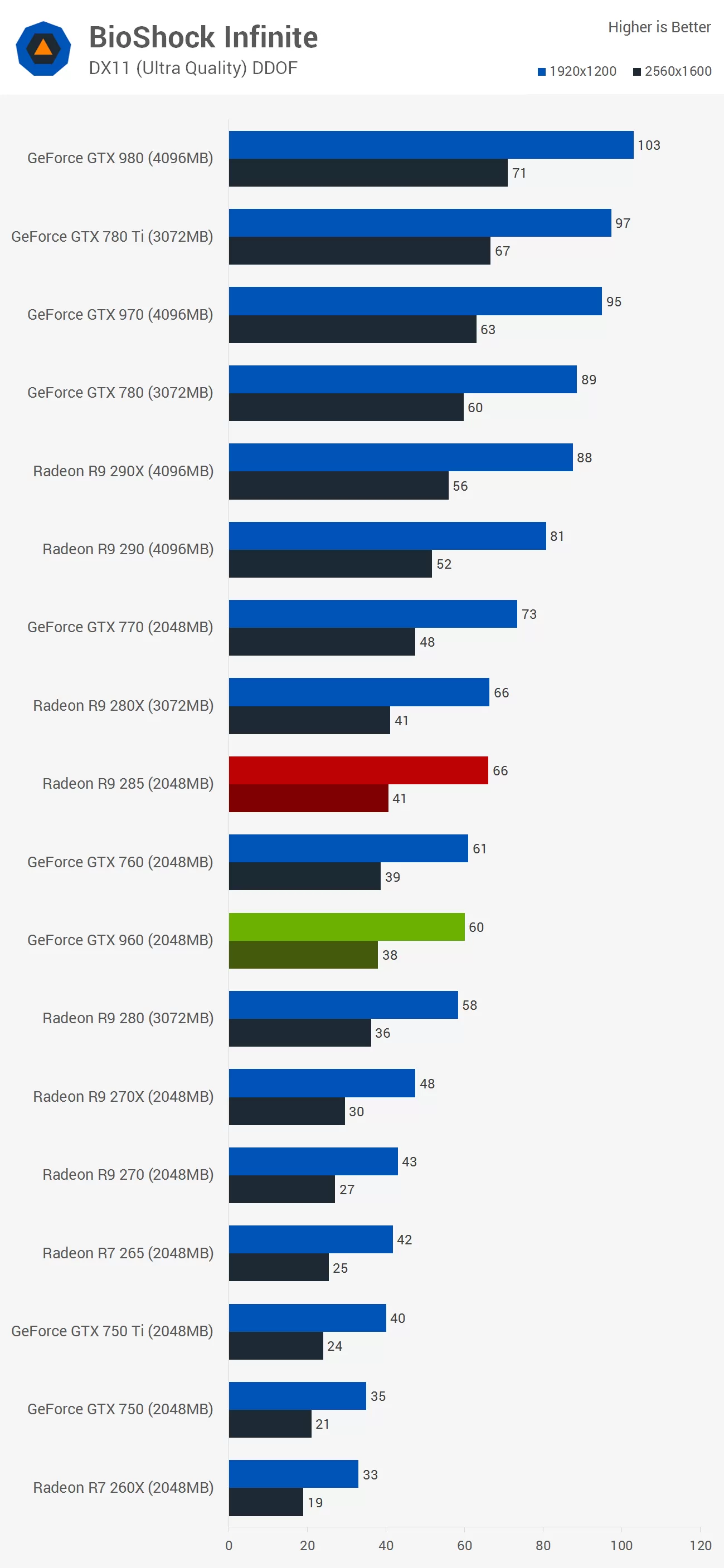
Tonga is faster than R9 280, uses less power, has more features like True Audio, Freesync and CF XDMA. In some games it is equal or faster than HD7970/280X with lower power consumption.

civbe_1920_1080.gif


watchdogs_1920_1080.gif


index.php


BioShock.png


I hope Fiji outright beats GM200 without breaking the power bank. I hope Fiji OC'd beats GM200 overclocked without breaking the power bank. I hope Fiji is priced better than GM200, and I hope it outsells GM200. That is all probably too much to hope for, but I'm still hoping.

Except of the price, you will not see anything else from those things you are hopping for.
 

monstercameron

Diamond Member
Feb 12, 2013
3,818
1
0
This is a great explanation.


In my mind, the whole Gsync/Freesync fits this idea very well. Competition is driving the innovation, but the fact that 2 different companies are pursuing a similar innovation separately, in somewhat mutually-exclusive means, is by it's very nature inefficient. Effective, yes. Efficient? No...


How often though do competing companies hold-hands and work together on a spec? Not often...and usually only when neither holds enough patents themselves to make it happen, or it is just too expensive to go it alone.


Micro 4/3s camera system...
 

GodisanAtheist

Diamond Member
Nov 16, 2006
8,533
9,969
136
We are already living in a post AMD GPU market where driver support for previous gen series is non-existant, developer relations teams push features coded to dramatically increase the disparity between the prior series and the current one, and the shift from "performance first" marketing to anything else (Software, dev relations, efficiency etc.) is in full swing.

We're essentially at a level of market lopsidedness (75%/25% in favor of NV) at this point that NVIDIA is really only competing with themselves without much worry or regard for what AMD may or may not do. As many posters in this forum have commented, the 390x could be faster, cooler and more efficient than the Titan X and no one would buy it because it isn't Nvidia.

I think even AMD may see the writing on the wall with their pivot to embedded and custom solutions. I say "I Think" because I've learned to never give AMD's executive team the benefit of the doubt.
 

Elfear

Diamond Member
May 30, 2004
7,169
829
126
This is really not founded in reality. Intel still releases wonderful designs despite the fact AMD hasn't been competitive in nearly a decade in the x86 CPU market. Nvidia, like Intel, needs to build better designs to entice consumers to purchase their product regardless of outside competition.

IMO, the CPU market has been pretty boring ever since AMD became uncompetitive. Sandy Bridge was great in 2011 but then we waited over a year for Ivy Bridge with a paltry 5-7% IPC increase and then another year+ for Haswell with a 5-6% IPC increase. Intel introduces new features and adds some efficiency each gen but for enthusiasts it's been very boring with no hope on the horizon for Broadwell and Skylake (in regards to IPC performance).

I see the same thing happening if AMD gives up the ghost and Nvidia is all alone in the dGPU market. Release new cards with a small performance increase and another feature or two each year. They'd still sell because who else would consumers buy from?

it's almost like we need a Doom and Gloom sub forum....

Agreed. News is good to stay informed but constantly reading about AMD's demise gets old. If it happens, it happens but I'd rather concentrate on less depressing aspects of the GPU world.
 

Headfoot

Diamond Member
Feb 28, 2008
4,444
641
126
Plus see my signature. Competition is bad at generating innovation. Why take a risk when you can have staus quo. And we certainly dont lack examples there.

Conclusory, and contrary to well established economic theory. If there's a workable macroeconomic system more efficient than capitalism, we haven't seen it yet.
 

ShintaiDK

Lifer
Apr 22, 2012
20,378
146
106
Conclusory, and contrary to well established economic theory. If there's a workable macroeconomic system more efficient than capitalism, we haven't seen it yet.

Its the best we currently have. But how many tax dollar/euro/yuan isnt used to workaround some of these issues associated. Also why space race and wars is some of the biggest innovation generators.
 

GodisanAtheist

Diamond Member
Nov 16, 2006
8,533
9,969
136
how is this even remotely true?

i think you mean nvidia driver support for previous gen is non-existent.

... well of course I'm talking about Nvidia; why would I be referencing AMD drivers in a post about already being in the "post AMD GPU market".

The point of my post is that Nvida, much like Intel, has already started to behave like AMD doesn't exist because they know AMD is in a bad state and no longer poses any real threat to them.