Did Bush tax cuts create the housing bubble?

Page 2 - Seeking answers? Join the AnandTech community: where nearly half-a-million members share solutions and discuss the latest tech.

BansheeX

Senior member
Sep 10, 2007
348
0
0
The central bank price fixed interest rates to absurdly low levels for too long, thereby flooding the banks with cheap money with which to speculate. This came just after the repeal of restrictions on FDIC-insured deposits. Homes above a certain value sold at a certain point were taxed less than other sales. Fannie and Freddie bought a lot of the crappy loans from lenders once they were made and stood behind the loans implicitly, again fueling their creation.

So yeah, basically a lot of social engineering from braindead socialists who always accomplish the opposite of their intentions. Home ownership became a government protocol to lift up the poor. If you were renting, you were being scammed, nevermind the cost of maintaining a structure.

There pretty much needs to be an amendment that prohibits the government from incentivizing one legal behavior over another. That would put a huge dent in the government's ability to do this stuff. They can't exactly illegalize renting or gasoline just because they're stupid enough to believe there's something better for us all that we don't know about.
 

halik

Lifer
Oct 10, 2000
25,696
1
81
I believe Canadian banks were appropriately regulated and maintained traditional underwriting standards (25% down payment, etc.) and that's why they didn't have the same crash we did:

Agreed
 

theeedude

Lifer
Feb 5, 2006
35,787
6,198
126
So then the issue in not tax cuts... but not allowing these companies to fail when they make stupid decisions. this is what a lot of people have been saying here for a long time. No one should be to big to fail. And judging by your perception... if they did fail.. they would lose their own money... so one wonders why people were chastised for saying these companies should go under.

The same Bush that gave the wealthy those tax cuts is the guy who bailed out AIG, which insured the bets those wealthy made with those tax cuts. So he gave them the tax cuts, and when they blew those on bad bets, he made them whole with taxpayer money.
 

NesuD

Diamond Member
Oct 9, 1999
4,999
106
106
Did Bush tax cuts create the housing bubble?

NO! Congress's failure to properly regulate and rein in the questionable lending practices of the mortgage industry created the housing bubble.
 

BansheeX

Senior member
Sep 10, 2007
348
0
0
lack of regulation on greedy banksters, blah blah blah

That's a rather simplistic way of putting it. Glass-Steagall was created because FDR, despite being a flaming socialist, knew that blanket insurance on deposits eliminated the fear of loss on the part of the depositor that would otherwise cause him to shun banks doing risky things with his money. Once his potential loss is shifted onto an unrelated party (in effect, future taxpayers), his behavior has changed. He no longer fears what the banks might do with his hard-earned money, so the ones doing the riskiest things and offering the highest interest win out. That's why it became necessary to regulate what banks did with deposits, they were no longer operating under a free market model that could self-regulate due to fear of loss on the part of both parties.
 
Last edited:

halik

Lifer
Oct 10, 2000
25,696
1
81
The central bank price fixed interest rates to absurdly low levels for too long, thereby flooding the banks with cheap money with which to speculate. This came just after the repeal of restrictions on FDIC-insured deposits. Homes above a certain value sold at a certain point were taxed less than other sales. Fannie and Freddie bought a lot of the crappy loans from lenders once they were made and stood behind the loans implicitly, again fueling their creation.

So yeah, basically a lot of social engineering from braindead socialists who always accomplish the opposite of their intentions. Home ownership became a government protocol to lift up the poor. If you were renting, you were being scammed, nevermind the cost of maintaining a structure.

There pretty much needs to be an amendment that prohibits the government from incentivizing one legal behavior over another. That would put a huge dent in the government's ability to do this stuff. They can't exactly illegalize renting or gasoline just because they're stupid enough to believe there's something better for us all that we don't know about.

Another empirically wrong Mises conjecture. If U.S. monetary policy was the driver of the speculative excess, you'd see the same run up and collapse in Canada (lockstep monetary policy), Panama etc.

http://www.clevelandfed.org/research/commentary/2009/0909.cfm
 

mshan

Diamond Member
Nov 16, 2004
7,868
0
71
AIG's London office was the problem:

"The unit's small group of traders risked nearly half a trillion dollars to insure U.S. mortgages and other debt using complex financial products called credit default swaps, according to recent congressional testimony.

"AIG financial products was the core, the hottest point of the global financial crisis," freelance investigative reporter Peter Koenig told "Good Morning America" today. "It was the epicenter."

The group's traders "found a crack in the system that was unregulated," Koenig told "GMA."

http://abcnews.go.com/Business/story?id=7045889&page=1

http://davisfunds.com/downloads/manager_commentary_-_semiannual_review_-_nyvf.pdf (page 8 Christopher Davis of Selected American Funds discusses their mistake of buying into AIG; I think they were looking at assets, earning power, and solvency, but sounds like temporary lack of liquidity is what brought that company down).
 
Last edited:

Munky

Diamond Member
Feb 5, 2005
9,372
0
76
NO, Bush's tax cuts were at best a sideshow compared to all the factors that fueled the housing bubble, like the lack of regulation, ZIRP, and nonexistent lending standards.
 

BansheeX

Senior member
Sep 10, 2007
348
0
0
You cannot honestly believe that if interest rates were set to 15% after the internet bubble collapsed that these loans and debt instruments would have been popularized. Many things had to happen simultaneously to cause the housing bubble. One of them was having interest rates far below where they were supposed to be. Savings plays a vital function in capital creation and allocation and the central bank seems to have forgotten that.

After all, would you rather make loans to a wealth-producing factory or an individual who just wants to spend it on a depreciating object like a home? Who are you more likely to make a return on? Naturally, you'd want to make more loans to producers. Unless, of course, the government gaurantees your home loans against losses and interest rates are a measly 2%, and the resulting price spikes from all these loans makes you think your collateral is more wealth-producing than a factory. How many businesses were denied loans in that environment? How many jobs were misallocated to the housing sector? And once the crap hit the fan, how many people fought tooth and nail to get the government to save their pointless fantasy job or home at the expense of a real recovery?

These are powerful levers getting pulled.
 
Last edited:

Fern

Elite Member
Sep 30, 2003
26,907
174
106
If you give more money to the middle class, it will spend it on what it needs to buy. The government can spend it on infrastructure. It is going to create demand for goods that are actually needed.
But if you give more money to the wealthy, they aren't going to spend it, they are going to "invest it" which means give it to some financial advisor to gamble with on Wall Street. And if those bets go south, they'll use their political power to get themselves a bailout from the taxpayer. Giving the wealthy tax cuts is just giving them more money to gamble with, and putting the rest of us on the hook for even bigger bailouts.

The middle class were refinancing their home mortgages and using the proceeds to purchase all kinds of consumer products etc. It's what kept our economy going because, well, we don't have much of an economy. Kept it going it going until that bubble burst anyway.

Fern
 

Matt1970

Lifer
Mar 19, 2007
12,320
3
0
If you give more money to the middle class, it will spend it on what it needs to buy. The government can spend it on infrastructure. It is going to create demand for goods that are actually needed.
But if you give more money to the wealthy, they aren't going to spend it, they are going to "invest it" which means give it to some financial advisor to gamble with on Wall Street. And if those bets go south, they'll use their political power to get themselves a bailout from the taxpayer. Giving the wealthy tax cuts is just giving them more money to gamble with, and putting the rest of us on the hook for even bigger bailouts.

I am still waiting to run into some of thses Rich people who never spend money. All the ones I know about spend money on:

Big Houses - Carpenters, Plumbers, Electricians, Painters all make Money.
Cars - Auto Wokers make Money.
Electronics - People in Japan make Money :)
Clothes, Food, Etc..

Even if they did invest it in the stock market, those companies he invested it in now has more capital to hire more people. That's how the market works.
 

halik

Lifer
Oct 10, 2000
25,696
1
81
You cannot honestly believe that if interest rates were set to 15% after the internet bubble collapsed that these loans and debt instruments would have been popularized. Many things had to happen simultaneously to cause the housing bubble. One of them was having interest rates far below where they were supposed to be. Savings plays a vital function in capital creation and allocation and the central bank seems to have forgotten that.

After all, would you rather make loans to a wealth-producing factory or an individual who just wants to spend it on a depreciating object like a home? Who are you more likely to make a return on? Naturally, you'd want to make more loans to producers. Unless, of course, the government gaurantees your home loans against losses and interest rates are a measly 2%, and the resulting price spikes from all these loans makes you think your collateral is more wealth-producing than a factory. How many businesses were denied loans in that environment? How many jobs were misallocated to the housing sector? And once the crap hit the fan, how many people fought tooth and nail to get the government to save their pointless fantasy job or home at the expense of a real recovery?

These are powerful levers getting pulled.

If FOMC set the target 15%, our whole economy would've collapsed. Your argument amounts to using an ICMB to end famine in africa.

Low interest rates were crowding out savings in Canada and Panama as well, yet the outcome is completely different. By the virte of the scientific method, your conjecture is void, as it is at odds with empirical data... regardless of whatever simplistic hypos you can come up with.

Incidentally this is also why Mises institute stuff has been discredited over and over - they always play the same tune, regardless of what happens in reality.

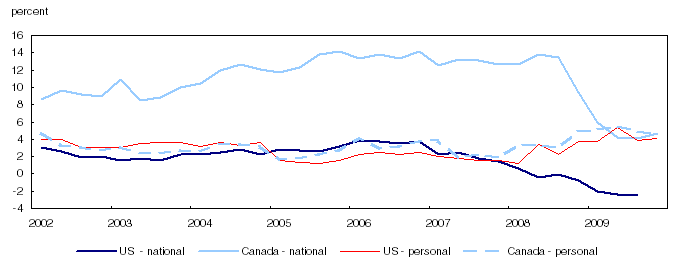
Personal savings rates in the US and Canada are nearly identical
ct090_en.gif

http://www.statcan.gc.ca/pub/11-010-x/2010004/ct090-eng.htm
 
Last edited:

dank69

Lifer
Oct 6, 2009
37,617
33,336
136
I am still waiting to run into some of thses Rich people who never spend money. All the ones I know about spend money on:

Big Houses - Carpenters, Plumbers, Electricians, Painters all make Money.
Cars - Auto Wokers make Money.
Electronics - People in Japan make Money :)
Clothes, Food, Etc..

Even if they did invest it in the stock market, those companies he invested it in now has more capital to hire more people in India/China. That's how the market works.
ftfy
 

theeedude

Lifer
Feb 5, 2006
35,787
6,198
126
I am still waiting to run into some of thses Rich people who never spend money. All the ones I know about spend money on:

Big Houses - Carpenters, Plumbers, Electricians, Painters all make Money.
Cars - Auto Wokers make Money.
Electronics - People in Japan make Money :)
Clothes, Food, Etc..

Even if they did invest it in the stock market, those companies he invested it in now has more capital to hire more people. That's how the market works.

Collateralized mortgages sure hired a lot of people building houses.
 

Ausm

Lifer
Oct 9, 1999
25,213
14
81
That's a rather simplistic way of putting it. Glass-Steagall was created because FDR, despite being a flaming socialist, knew that blanket insurance on deposits eliminated the fear of loss on the part of the depositor that would otherwise cause him to shun banks doing risky things with his money. Once his potential loss is shifted onto an unrelated party (in effect, future taxpayers), his behavior has changed. He no longer fears what the banks might do with his hard-earned money, so the ones doing the riskiest things and offering the highest interest win out. That's why it became necessary to regulate what banks did with deposits, they were no longer operating under a free market model that could self-regulate due to fear of loss on the part of both parties.

People back then must have not been afraid of Socialism like they today since FDR almost complete 4 terms in office and in poll after poll he is ranked in the top five Presidents of all time.
 
Last edited:

Ausm

Lifer
Oct 9, 1999
25,213
14
81
The middle class were refinancing their home mortgages and using the proceeds to purchase all kinds of consumer products etc. It's what kept our economy going because, well, we don't have much of an economy. Kept it going it going until that bubble burst anyway.

Fern

That is directly linked to predatory lending which I also forgot to address above.
 

dmcowen674

No Lifer
Oct 13, 1999
54,889
47
91
www.alienbabeltech.com
Did Bush tax cuts create the housing bubble?

Where did those tax cuts for the wealthy, and other trickle down money, go?

They got invested, all right. In things like collateralized debt obligations which fueled the housing bubble. So not only did those "job creators" got to "keep more of their money" but when they gambled and lost it, they were bailed out and got to keep more of your money too.

So when you hear that tax cuts will spur investments, don't automatically assume they'll spur investment in job creation, and that "investment" may end up costing you more money than you think.

Most of the things Bush & the GOP put into place during his reign of false wars has caused the destruction of the U.S. we are now witnessing.

All kinds of deregulations such as Bank deregulation, Eminent Domain, Check 21 just to name a few.
 

Fern

Elite Member
Sep 30, 2003
26,907
174
106
Collateralized mortgages sure hired a lot of people building houses.

Yes, it did. It fueled a housing boom and a number of other 'booms'. Independent mortgage refinance firms sprang up everywhere, and they were making good money. Realtors were making out big time. Nurseries, landscapers, lawyers who do real estate closings, title insurance companies, the list of those benefiting directly is really quite long.

Without the housing boom I often wonder what our economy would've looked like once the tech/dot.com bubble ended in early 2000. Before the tech/dot.com bubble we had Intel/Windows/PC boom to drive productivity and our economy.

It's been one boom/bubble after the next for quite some time now, at least since the early-to-mid 80's. All masking our economic weakness.

ATM I'm rather depressed and frustrated. I disagree with almost everyone. I disagree with both parties in Washington. My sig seems more appropriate than ever.

Despite claims to the contrary, our economic problems are not caused by a few 100 ultra high income earners. Despite claims by the Left/Dems/Progressives, these people aren't stealing everyones' "piece of the pie". Hell, they're making the damned pie. Gates, Jobs, Whitman, Bezos, Grove, Spielberg, Katzenberg, Geffen et al made pie everyone got to enjoy. Yeah, they made a billion $'s, but so what? Even if they didn't pay themselves so well you wouldn't have noticed any more money in your bank account, nor would there have been fewer low income people.

Nor is there a lack of mobility as claimed. Many of the richest were NOT born that way.

Wall Street is not our problem either. Yeah, some make big bucks too. They're responsible for billions of $'s. It's no small responsibility either. They've got to earn trust. They've got to be trusted not to steal it like Madoff, not lose it with poor trading positions/bets, not get client money ripped off by others etc. I've got some as clients, they work hard. It's a stressful job. It's not like some TV commercial where they sit around in a fancy restaurant eating a big pile of lobsters. I've had personal friends who couldn't take it, had a severe breakdown and became unhinged from reality. Extremely unhinged. Suicide was the final destination. I bet a lot of people here think they could do it. That it's just not fair because then they could earn that kind of money too if they had the chance. But I bet you couldn't. I bet 99.9999% couldn't.

So they scrape a small percentage off the top of the billions they handle daily. What if they didn't? You'd never notice. You'd have no more money in the bank. There wouldn't be any few low income people either.

They're not the problem.

------------------

IMO, our problem is that businesses don't find the US an attractive place to do business. Oh, we look good as a spot to have corp HQ's. Execs like being here, working here. So we have the top execs here making big bucks in stock options and the like. This pisses people off too. But even those execs in the world-wide HQ's located here making big bucks aren't the problem. We should be glad they're here. They spend an invest a lot of money here.

The problem is the bulk of business, the manufacturing, the tech, engineering and even service jobs, has left. We either chased them away, or allowed them to be lured away. We've got to figure it out. Why/how it happened and fix it. I see very little hope here because everybody's blaming the wrong stuff. You cannot fix the problem if you don't understand it.

It's not a simple answer. Many say 'labor', but it's not that simple. E.g., most manufacturing has little labor costs. So it cannot be explained away so easily.

And be careful who you turn to to fix it. They may be ones who caused the problem in the 1st place.

Fern

 

cubby1223

Lifer
May 24, 2004
13,518
42
86
Where did those tax cuts for the wealthy, and other trickle down money, go? They got invested, all right. In things like collateralized debt obligations which fueled the housing bubble. So not only did those "job creators" got to "keep more of their money" but when they gambled and lost it, they were bailed out and got to keep more of your money too. So when you hear that tax cuts will spur investments, don't automatically assume they'll spur investment in job creation, and that "investment" may end up costing you more money than you think.

You just guessing there, boy?
 

mshan

Diamond Member
Nov 16, 2004
7,868
0
71
Steve Jobs apparently said he has 700,000 jobs overseas and one of the reasons he can't have those jobs in U. S. is because he would need 30,000 factory engineers to support those jobs (found this with google search: http://markgritter.livejournal.com/670534.html)
"Jobs went on to urge that a way be found to train more American engineers. Apple had 700,000 factory workers employed in China, he said, and that was because it needed 30,000 engineers on-site to support those workers. "You can’t find that many in America to hire", he said. These factory engineers did not have to be PhDs or geniuses; they simply needed to have basic engineering skills for manufacturing. Tech schools, community colleges, or trade schools could train them. "If you could educate these engineers," he said, "we could move more manufacturing plants here." The argument made a strong impression on the president. Two or three times over the next month he told his aides, "We’ve got to find ways to train those 30,000 manufacturing engineers that Jobs told us about."
U. S. education system is not producing those engineers, and probably a reason administration and others are trying to promote visas for well trained foreign entrepreneurs who will hopefully build their empires in U. S., rather than abroad.
 
Last edited:

Fern

Elite Member
Sep 30, 2003
26,907
174
106
Steve Jobs apparently said he has 700,000 jobs overseas and one of the reasons he can't have those jobs in U. S. is because he would need 30,000 factory engineers to support those jobs (found this with google search: http://markgritter.livejournal.com/670534.html)
U. S. education system is not producing those engineers, and probably a reason administration and others are trying to promote visas for well trained foreign entrepreneurs who will hopefully build their empires in U. S., rather than abroad.

Education is certainly part of the problem. We're "average" at best.

http://www.huffingtonpost.com/2010/12/07/us-falls-in-world-education-rankings_n_793185.html

Fern