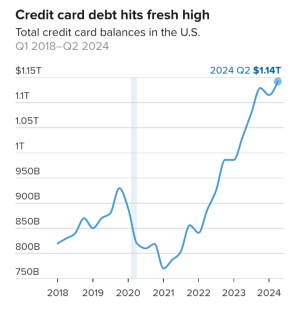
Credit card debt in the US is getting out of hand

Page 7 - Seeking answers? Join the AnandTech community: where nearly half-a-million members share solutions and discuss the latest tech.

Red Squirrel

No Lifer
May 24, 2003
70,912
13,922
126
www.anyf.ca
The state won't let me charge my customers the fee so when I started taking debit cards, I raised the interest rate by 2% on every loan.

I recall hearing something that they were going to change that rule where businesses can actually charge the fee, but not sure what came of it. I think no business wants to be the first one to do that so nobody is really doing it. As is we're basically paying 2% or so more for everything just to make up for those fees.
 
  • Like
Reactions: highland145

repoman0

Diamond Member
Jun 17, 2010
5,191
4,574
136
Businesses don’t give cash discounts though so of course customers are going to use a credit card to gather points or 2% cash back or whatever.
 

sdifox

No Lifer
Sep 30, 2005
100,871
18,078
126
I recall hearing something that they were going to change that rule where businesses can actually charge the fee, but not sure what came of it. I think no business wants to be the first one to do that so nobody is really doing it. As is we're basically paying 2% or so more for everything just to make up for those fees.
They are allowed to charge service fee for using credit card
 
Nov 17, 2019
13,375
7,896
136
Businesses don’t give cash discounts though so of course customers are going to use a credit card to gather points or 2% cash back or whatever.
That isn't true everywhere. I have several places I go that have one price for cash and another for cards. They pass on the 3% card fee if you use a card, but you pay less with cash or a check.
 
  • Like
Reactions: [DHT]Osiris

Fenixgoon

Lifer
Jun 30, 2003
33,446
13,066
136
That isn't true everywhere. I have several places I go that have one price for cash and another for cards. They pass on the 3% card fee if you use a card, but you pay less with cash or a check.
I thought you couldn't charge a fee for a credit card, but you could give a cash discount.
Which is the same as charging a fee for a credit card.
I've mostly seen it at gas stations
 
  • Like
Reactions: nakedfrog

dullard

Elite Member
May 21, 2001
26,185
4,842
126
Those costs are borne by the consumers in higher prices anyway; no business owner is eating 2% of gross margin just to be nice.
That is a bit of an overly simplistic viewpoint.

There is a price point where the business makes maximum profit. Too low of a price and they don't profit as much as they could per sale. Too high of a price and they lose sales and thus profit less. It is every business's (very difficult) job to find that optimum price point for their products. There are formulas and experiments that help (run a sale properly and you should get enough data to determine the mathematical optimum price point), but even those are time consuming and somewhat inexact since it is hard to experiment on your customers. Those formulas are taught in Microeconomics 101.

That optimum price is unaffected by costs. Meaning if they pay 2% or 0% for transaction fees, the optimum price point for maximum profit is unchanged. Thus, if the business wants to have maximum profits, the business should not pass on the fee.

The only time the costs matter is if the optimum price point is lower than the costs*. At which point, the business should not be selling that item/service at all (unless as an intentional loss leader).

* Or, possibly just too little of profit to bother with.

 

manly

Lifer
Jan 25, 2000
13,445
4,161
136
That is a bit of an overly simplistic viewpoint.

There is a price point where the business makes maximum profit. Too low of a price and they don't profit as much as they could per sale. Too high of a price and they lose sales and thus profit less. It is every business's (very difficult) job to find that optimum price point for their products. There are formulas and experiments that help (run a sale properly and you should get enough data to determine the mathematical optimum price point), but even those are time consuming and somewhat inexact since it is hard to experiment on your customers. Those formulas are taught in Microeconomics 101.

That optimum price is unaffected by costs. Meaning if they pay 2% or 0% for transaction fees, the optimum price point for maximum profit is unchanged. Thus, if the business wants to have maximum profits, the business should not pass on the fee.

The only time the costs matter is if the optimum price point is lower than the costs*. At which point, the business should not be selling that item/service at all (unless as an intentional loss leader).

* Or, possibly just too little of profit to bother with.
It's been a long time since I studied Econ 101, so I had to review a bit. I believe what you described is standard theory, and applicable for short term profit maximization. Input costs are certainly a factor for long term profit maximization and pricing strategy.

FWIW California recently raised the minimum wage for fast food workers to $20/hr. Prior to the change, a consensus view was that prices to the consumer would rise by about 5%. I don't buy a lot of fast food, but this appears to have happened within days of the wage increase at many places.
 

MrSquished

Lifer
Jan 14, 2013
26,067
24,397
136
You know. Now that I've had Time to really think about this topic, I just feel bad for the credit card companies. They're just trying to make a living and this big bad Biden government is coming after them. Poor souls. The world is just horrible to them credit card corporations.
 
  • Haha
Reactions: igor_kavinski

highland145

Lifer
Oct 12, 2009
43,973
6,338
136
Culumative inflation since 2020 is 21.4%
FWIW $825M in 2018 numbers is $1.05T in 2024 dollars so it's about an 8.5% increase over 2018. Certainly still not great but inflation does play a role here
Start at Q1 2020, 880B, 21.4% cumulative inflation which puts it at about the current owed, 1.1T

Q1 2021, 770B, 15.9% cumulative inflation... should be about 892B. 1.1T is some serious +133B drunk sailor spending.

edit: Guess if you divide it among 200m credit cards, it's not so bad.
 
Last edited:
  • Like
Reactions: Red Squirrel
Dec 10, 2005
29,303
14,740
136
FWIW $825M in 2018 numbers is $1.05T in 2024 dollars so it's about an 8.5% increase over 2018. Certainly still not great but inflation does play a role here
Love when people graph financial numbers in an extremely misleading way, like not adjusting for inflation and not using per capita amounts.