Climate Change: Water shortages out west

Page 2 - Seeking answers? Join the AnandTech community: where nearly half-a-million members share solutions and discuss the latest tech.

Dave_5k

Platinum Member
May 23, 2017
2,007
3,820
136
but somehow no one can figure out how to transport water from the the places that have excess to those that don't have enough, oh wait someone has but as usual we have to be dying of thirst before we move on it.

Average price for water in US is about 0.15-0.2 cents per gallon. Long distance, large scale transport by pipeline would run somewhere around 6 cents per gallon, or an increase in water costs by a factor of 30x-40x as most efficient long distance transport option.

If you simply priced all usage of water in dry areas like California, Nevada, Arizona at ~$0.05/gallon, including allowing those with water rights the option to sell at that price rather than use the water, I'd speculate that you would entirely fix the shortage issues - cheaper than transporting the water, and without having to have government build or mandate anything at all.
 
  • Like
Reactions: dank69

herm0016

Diamond Member
Feb 26, 2005
8,524
1,132
126
Average price for water in US is about 0.15-0.2 cents per gallon. Long distance, large scale transport by pipeline would run somewhere around 6 cents per gallon, or an increase in water costs by a factor of 30x-40x as most efficient long distance transport option.

If you simply priced all usage of water in dry areas like California, Nevada, Arizona at ~$0.05/gallon, including allowing those with water rights the option to sell at that price rather than use the water, I'd speculate that you would entirely fix the shortage issues - cheaper than transporting the water, and without having to have government build or mandate anything at all.

wait, you are saying that a system based on actual costs would be better than some government subsidized system? :eek:
 
  • Like
Reactions: UNCjigga

dank69

Lifer
Oct 6, 2009
37,612
33,330
136
wait, you are saying that a system based on actual costs would be better than some government subsidized system? :eek:
Yes, as it turns out, some things benefit from government intervention and some things do not. However, that example still seems to have some government intervention to enforce water prices.
 

brycejones

Lifer
Oct 18, 2005
30,261
31,298
136
oh hell no.

there are already too many restrictions on my water, that comes out of my well, and falls on my roof and runs down the ditch on my property.

areas of great influence will end up telling us further what we are allowed to grow/do. It's already a grey area weather we are allowed to grow any of our own food on our own property when you really get down in the water rights hole., how wells are classified, etc.
Does the water in your well magically only come from the confines of your property line?
 
  • Haha
Reactions: pcgeek11

MtnMan

Diamond Member
Jul 27, 2004
9,453
8,863
136
You’re being to pessimistic about fusion being 50 years out. Thanks to recent advances it’s now always 10 years out.
Local brewery had this sign in the restroom. I went day after day.... ;)
free beer - Copy (Phone).jpg
 
  • Like
Reactions: Ajay

Paratus

Lifer
Jun 4, 2004
17,752
16,084
146
I assume you're being sarcastic with "always?"
Yes sir. :D

Although there actually is a lot work being done on fusion at the moment both large and small scale, private and government. Maybe something will payoff but I’m not holding my breath.
 

woolfe9998

Lifer
Apr 8, 2013
16,242
14,245
136
Yes sir. :D

Although there actually is a lot work being done on fusion at the moment both large and small scale, private and government. Maybe something will payoff but I’m not holding my breath.

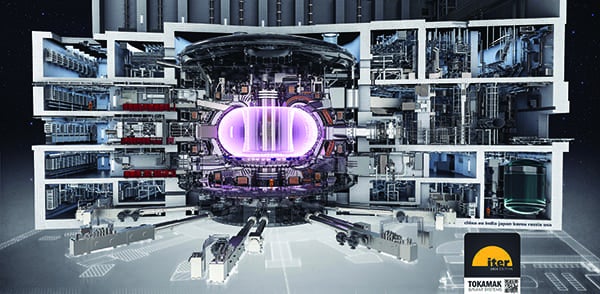
If you just look at ITER which some people think is the leading edge, it's own timeline puts commercialization somewhere in the mid to late 2040's. And that's about as rosy a projection as there is. So I figure 50 more years is a reasonable assumption.

Too bad it isn't coming sooner as it would help us greatly with climate change, but unfortunately it is not.
 

herm0016

Diamond Member
Feb 26, 2005
8,524
1,132
126
Does the water in your well magically only come from the confines of your property line?

i'm not allowed to store more than 110 gallons of rain water, which is about enough to do absolutely nothing consequential.
every drop that does not evaporate is going back into the ground on my property, and many steps are taken to reduce evaporative losses.

I think rain qualifies as within the confines of my property, not that it rains all that much anyway.

I get restricting commercial use, but where the density is probably less than 50 per sq mile, I really cant see rain water harvesting for personal use being that detrimental to downstream flow.
we should be "by right" to water our land for personal, non commercial use.
How about the water bottling plant that trucks water all day every day from a spring in Eldorado canyon to a bottling plant 25 miles away? why not restrict that kind of rampant disregard for climate or water security instead of constantly picking on the people who try to grow their own food.

I know the answer to that question. but you will just keep flaming in support of the governments who are much better at making decisions than any of us ever could be.
 
  • Like
Reactions: pcgeek11

IronWing

No Lifer
Jul 20, 2001
73,589
35,320
136
i'm not allowed to store more than 110 gallons of rain water, which is about enough to do absolutely nothing consequential.
every drop that does not evaporate is going back into the ground on my property, and many steps are taken to reduce evaporative losses.

I think rain qualifies as within the confines of my property, not that it rains all that much anyway.

I get restricting commercial use, but where the density is probably less than 50 per sq mile, I really cant see rain water harvesting for personal use being that detrimental to downstream flow.
we should be "by right" to water our land for personal, non commercial use.
How about the water bottling plant that trucks water all day every day from a spring in Eldorado canyon to a bottling plant 25 miles away? why not restrict that kind of rampant disregard for climate or water security instead of constantly picking on the people who try to grow their own food.

I know the answer to that question. but you will just keep flaming in support of the governments who are much better at making decisions than any of us ever could be.
Government ain't the problem; it is the low economic value prior right holders that are the problem. Senior rights holders spray irrigate low value crops while more productive water users get nothing.
 

brycejones

Lifer
Oct 18, 2005
30,261
31,298
136
i'm not allowed to store more than 110 gallons of rain water, which is about enough to do absolutely nothing consequential.
every drop that does not evaporate is going back into the ground on my property, and many steps are taken to reduce evaporative losses.

I think rain qualifies as within the confines of my property, not that it rains all that much anyway.

I get restricting commercial use, but where the density is probably less than 50 per sq mile, I really cant see rain water harvesting for personal use being that detrimental to downstream flow.
we should be "by right" to water our land for personal, non commercial use.
How about the water bottling plant that trucks water all day every day from a spring in Eldorado canyon to a bottling plant 25 miles away? why not restrict that kind of rampant disregard for climate or water security instead of constantly picking on the people who try to grow their own food.

I know the answer to that question. but you will just keep flaming in support of the governments who are much better at making decisions than any of us ever could be.
You’re in Colorado right? I generally agree with you that water is a huge problem in Colorado and under current water law the rain that falls on your property doesn’t belong to you. It’s bizarre in my mind but that is the result of 150 years of litigation over water rights in the west.

We also can’t continue to make up for a short fall of surface water by constantly extracting from the ground (looking at the Central Valley in CA and the western Great Plains)

My parents lived in Highlands Ranch for several years and saw one horrible drought yet the HOAs were still enforcing green lawn requirements (having your lawn painted wasn’t an option). We have to get much smarter about how we use the water we have. And that is going to require some form of public taking that is going to lead to an absolute shit show with the private property absolutists.
 

vi edit

Elite Member
Super Moderator
Oct 28, 1999
62,484
8,345
126
Residential use is still a uh...literal drop in the bucket for use. Yes we should be harder in enforcing climate appropriate landscaping (hardscaping, drought tolerant plants, ect). But the reality is that Agriculture use requiring a gallon of water per almond is just literally draining things dry. Corporate farms have greatly manipulated policy.
 

shortylickens

No Lifer
Jul 15, 2003
80,287
17,082
136
Residential use is still a uh...literal drop in the bucket for use. Yes we should be harder in enforcing climate appropriate landscaping (hardscaping, drought tolerant plants, ect). But the reality is that Agriculture use requiring a gallon of water per almond is just literally draining things dry. Corporate farms have greatly manipulated policy.
Yeah I had no idea about the almonds until I saw that Bill Maher report. My attitude is we need to stop subsidizing agricultural water. They need it? They can pay for it.
Also we need to charge extra for Nestle and all the water they steal just to put in bottles and charge money for.
 
  • Like
Reactions: herm0016

Ajay

Lifer
Jan 8, 2001
16,094
8,115
136
If you just look at ITER which some people think is the leading edge, it's own timeline puts commercialization somewhere in the mid to late 2040's. And that's about as rosy a projection as there is. So I figure 50 more years is a reasonable assumption.

Too bad it isn't coming sooner as it would help us greatly with climate change, but unfortunately it is not.

People have to understand that ITER is really a science experiment at this stage. Several countries have come together to place a $25B+ (US) bet that it will be successful. Part of it's increasing cost isn't technological, it's logistical - there are often factories in 3 different countries making the same component. That's very inefficient, but everyone want a hand in learning how to manufacture many of the important modules used in the reactor. If the experiment is a success, commercial plants will be less expensive, but hardly cheap. That they'll be more expensive than Fission plants seems to be a forgone conclusion. I suspect, commercially, it will be a failure. By then multiple varieties of solar, wind, tidal and other 'green' energy sources will have come down in cost and ramped up to even larger scale production; at which point, there will be no market niche for fusion power. I'm sure all the principle understand this and are likely hoping to take advantage of secondary technological and manufacturing developments that will contribute to their economies in the future.
 

hal2kilo

Lifer
Feb 24, 2009
26,506
12,619
136
People have to understand that ITER is really a science experiment at this stage. Several countries have come together to place a $25B+ (US) bet that it will be successful. Part of it's increasing cost isn't technological, it's logistical - there are often factories in 3 different countries making the same component. That's very inefficient, but everyone want a hand in learning how to manufacture many of the important modules used in the reactor. If the experiment is a success, commercial plants will be less expensive, but hardly cheap. That they'll be more expensive than Fission plants seems to be a forgone conclusion. I suspect, commercially, it will be a failure. By then multiple varieties of solar, wind, tidal and other 'green' energy sources will have come down in cost and ramped up to even larger scale production; at which point, there will be no market niche for fusion power. I'm sure all the principle understand this and are likely hoping to take advantage of secondary technological and manufacturing developments that will contribute to their economies in the future.
Magnetic confinement fusion is a dead end. There are other ways to fusion that are rapidly being developed. You can't put the sun in a bottle, and it's not really the way nature works.
 

Paratus

Lifer
Jun 4, 2004
17,752
16,084
146
If you just look at ITER which some people think is the leading edge, it's own timeline puts commercialization somewhere in the mid to late 2040's. And that's about as rosy a projection as there is. So I figure 50 more years is a reasonable assumption.

Too bad it isn't coming sooner as it would help us greatly with climate change, but unfortunately it is not.

Here’s a decent overview article. There’s a lot of private companies pursuing fusion now with smaller more esoteric designs that lend themselves to quicker turnarounds than ITER as they experiment. Maybe one will get lucky.


Private Fusion Companies
Since all of these companies are privately held, full details are not available on their technologies and financing, but it is estimated that at least $1 billion in investment funding has flowed into private fusion. Short summaries of some of the efforts are given below.
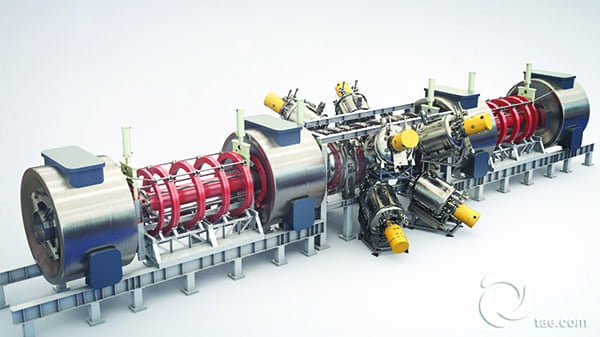
fig6-tae-technologies-fusion.jpg
6. A schematic of TAE Technologies’ field-reversed configuration (FRC) fusion device. Courtesy: TAE Technologies
TAE Technologies. TAE has been working for about 20 years on an approach known as field-reversed configuration (FRC). TAE’s technology, rather than relying on deuterium-tritium (DT) fusion, instead seeks to fuse hydrogen and boron. Though this is a more difficult reaction to achieve—requiring temperatures at least an order of magnitude higher—it has the advantage of not producing the highly energetic neutrons that complicate DT fusion. FRC is a magnetic confinement method forming a toroidal plasma, but without a toroidal magnetic field (Figure 6).
TAE is based in Irvine, California. Its publicly announced funding totals $700 million, and known investors include Google.
Commonwealth Fusion Systems (CFS). A spin-off from the Massachusetts Institute of Technology’s (MIT’s) Plasma Science and Fusion Center, CFS is pursuing a fairly conventional tokamak approach, but leveraging high-technology advances that came too recently to be incorporated into ITER. Foremost among these is the use of rare earth barium copper oxide (REBCO) superconductor (ITER employs niobium-tin). It is hoped this will allow for smaller, more efficient, and less expensive magnets. CFS is continuing a collaboration with MIT to develop a design for a compact high-field tokamak, called SPARC, that would produce 50 MW to 100 MW of fusion power at a Q value of 3. Construction of SPARC is slated to begin soon. MIT is one of the investors in CFS; others include several venture capital funds.
General Fusion. This Vancouver, British Columbia–based company is pursuing one of the more revolutionary approaches, which it calls magnetized target fusion (MTS). The MTS concept uses a sphere filled with molten lead-lithium, which is then pumped to form a vortex. A pulse of magnetically confined plasma fuel is injected into the vortex, and an array of pistons creates a shock wave in the liquid metal to compress the plasma to fusion conditions. Heat from the liquid metal will then be captured and used to generate electricity. The company is supported by Amazon CEO Jeff Bezos, Microsoft, and venture capital.
Tokamak Energy. A UK company, Tokamak Energy is working on magnetic confinement fusion, but employing a tokamak with a more spherical shape, based on a concept developed in the U.S. and the UK. This device, called ST40, has been commissioned and research on it is currently ongoing. Tokamak Energy claims to have achieved plasma temperatures of up to 15 million degrees Celsius. It most recently raised about $86 million in a January 2020 funding round.
 

hal2kilo

Lifer
Feb 24, 2009
26,506
12,619
136

Here’s a decent overview article. There’s a lot of private companies pursuing fusion now with smaller more esoteric designs that lend themselves to quicker turnarounds than ITER as they experiment. Maybe one will get lucky.


Private Fusion Companies
Since all of these companies are privately held, full details are not available on their technologies and financing, but it is estimated that at least $1 billion in investment funding has flowed into private fusion. Short summaries of some of the efforts are given below.
fig6-tae-technologies-fusion.jpg
6. A schematic of TAE Technologies’ field-reversed configuration (FRC) fusion device. Courtesy: TAE Technologies
TAE Technologies. TAE has been working for about 20 years on an approach known as field-reversed configuration (FRC). TAE’s technology, rather than relying on deuterium-tritium (DT) fusion, instead seeks to fuse hydrogen and boron. Though this is a more difficult reaction to achieve—requiring temperatures at least an order of magnitude higher—it has the advantage of not producing the highly energetic neutrons that complicate DT fusion. FRC is a magnetic confinement method forming a toroidal plasma, but without a toroidal magnetic field (Figure 6).
TAE is based in Irvine, California. Its publicly announced funding totals $700 million, and known investors include Google.
Commonwealth Fusion Systems (CFS). A spin-off from the Massachusetts Institute of Technology’s (MIT’s) Plasma Science and Fusion Center, CFS is pursuing a fairly conventional tokamak approach, but leveraging high-technology advances that came too recently to be incorporated into ITER. Foremost among these is the use of rare earth barium copper oxide (REBCO) superconductor (ITER employs niobium-tin). It is hoped this will allow for smaller, more efficient, and less expensive magnets. CFS is continuing a collaboration with MIT to develop a design for a compact high-field tokamak, called SPARC, that would produce 50 MW to 100 MW of fusion power at a Q value of 3. Construction of SPARC is slated to begin soon. MIT is one of the investors in CFS; others include several venture capital funds.
General Fusion. This Vancouver, British Columbia–based company is pursuing one of the more revolutionary approaches, which it calls magnetized target fusion (MTS). The MTS concept uses a sphere filled with molten lead-lithium, which is then pumped to form a vortex. A pulse of magnetically confined plasma fuel is injected into the vortex, and an array of pistons creates a shock wave in the liquid metal to compress the plasma to fusion conditions. Heat from the liquid metal will then be captured and used to generate electricity. The company is supported by Amazon CEO Jeff Bezos, Microsoft, and venture capital.
Tokamak Energy. A UK company, Tokamak Energy is working on magnetic confinement fusion, but employing a tokamak with a more spherical shape, based on a concept developed in the U.S. and the UK. This device, called ST40, has been commissioned and research on it is currently ongoing. Tokamak Energy claims to have achieved plasma temperatures of up to 15 million degrees Celsius. It most recently raised about $86 million in a January 2020 funding round.
Too many to link here. Safire, Brillion, NASA.

Examples of things that sound promising but have no answers as to how to extract the energy and repeat the process.
Giant laser reaches key milestone for fusion | New Scientist
 

woolfe9998

Lifer
Apr 8, 2013
16,242
14,245
136

Here’s a decent overview article. There’s a lot of private companies pursuing fusion now with smaller more esoteric designs that lend themselves to quicker turnarounds than ITER as they experiment. Maybe one will get lucky.


Private Fusion Companies
Since all of these companies are privately held, full details are not available on their technologies and financing, but it is estimated that at least $1 billion in investment funding has flowed into private fusion. Short summaries of some of the efforts are given below.
fig6-tae-technologies-fusion.jpg
6. A schematic of TAE Technologies’ field-reversed configuration (FRC) fusion device. Courtesy: TAE Technologies
TAE Technologies. TAE has been working for about 20 years on an approach known as field-reversed configuration (FRC). TAE’s technology, rather than relying on deuterium-tritium (DT) fusion, instead seeks to fuse hydrogen and boron. Though this is a more difficult reaction to achieve—requiring temperatures at least an order of magnitude higher—it has the advantage of not producing the highly energetic neutrons that complicate DT fusion. FRC is a magnetic confinement method forming a toroidal plasma, but without a toroidal magnetic field (Figure 6).
TAE is based in Irvine, California. Its publicly announced funding totals $700 million, and known investors include Google.
Commonwealth Fusion Systems (CFS). A spin-off from the Massachusetts Institute of Technology’s (MIT’s) Plasma Science and Fusion Center, CFS is pursuing a fairly conventional tokamak approach, but leveraging high-technology advances that came too recently to be incorporated into ITER. Foremost among these is the use of rare earth barium copper oxide (REBCO) superconductor (ITER employs niobium-tin). It is hoped this will allow for smaller, more efficient, and less expensive magnets. CFS is continuing a collaboration with MIT to develop a design for a compact high-field tokamak, called SPARC, that would produce 50 MW to 100 MW of fusion power at a Q value of 3. Construction of SPARC is slated to begin soon. MIT is one of the investors in CFS; others include several venture capital funds.
General Fusion. This Vancouver, British Columbia–based company is pursuing one of the more revolutionary approaches, which it calls magnetized target fusion (MTS). The MTS concept uses a sphere filled with molten lead-lithium, which is then pumped to form a vortex. A pulse of magnetically confined plasma fuel is injected into the vortex, and an array of pistons creates a shock wave in the liquid metal to compress the plasma to fusion conditions. Heat from the liquid metal will then be captured and used to generate electricity. The company is supported by Amazon CEO Jeff Bezos, Microsoft, and venture capital.
Tokamak Energy. A UK company, Tokamak Energy is working on magnetic confinement fusion, but employing a tokamak with a more spherical shape, based on a concept developed in the U.S. and the UK. This device, called ST40, has been commissioned and research on it is currently ongoing. Tokamak Energy claims to have achieved plasma temperatures of up to 15 million degrees Celsius. It most recently raised about $86 million in a January 2020 funding round.

Good info. Hopefully one will pan out. However, I remain pessimistic that we'll see commercialized fusion reactors any time before mid century. They've been researching this at least since the 1980's. If it was easy, they'd have accomplished it already.
 

hal2kilo

Lifer
Feb 24, 2009
26,506
12,619
136
Good info. Hopefully one will pan out. However, I remain pessimistic that we'll see commercialized fusion reactors any time before mid century. They've been researching this at least since the 1980's. If it was easy, they'd have accomplished it already.
Some old Nobel winning physicists need to get out of the way.
 

Stokely

Platinum Member
Jun 5, 2017
2,281
3,085
136
Depending on magic future tech to solve climate change seems about as far from "conservative" as you can get. It *could* happen--but planning on it to happen is quite the gamble.

I think we are seeing from the covid mask tantrums just how far gone the American public is when it comes to thinking beyond themselves for more than a minute. If there's one good thing about how bad things are going to get with climate change, it sure gets rid of any depression over covid pretty damn fast....