• We’re currently investigating an issue related to the forum theme and styling that is impacting page layout and visual formatting. The problem has been identified, and we are actively working on a resolution. There is no impact to user data or functionality, this is strictly a front-end display issue. We’ll post an update once the fix has been deployed. Thanks for your patience while we get this sorted.

Can a concrete pump truck pump sand?

Without going into detail, I have a hole to fill that no truck can get to for a straight dump. They'd have to dump no closer than 20-25' and I'd have to move the load with a 4' FEL bucket on a SCUT.

A pump truck could get close enough to use the hose, but I don't know if they can pump dry material, or what it might cost.
 
Do you have any fracking in your area? Sand pumpers are essential to fracking.

former oilfield engineer for 15 years.

moving sand on a frac site uses conveyor belts to the "blender" where water, chemicals and sand are mixed together to form the fluid which is usually something like a chia pudding consistency.

Sand can be moved via compressed air and large hoses. many bulk trucks use this for all sorts of granular material like sand, grain, fertilizer, mulch etc.

if its just for fill, you can order a truck of flowable fill from most concrete suppliers, this material will be kind of like a very soft cement with no aggregate. it will set up fairly quickly and you can dig it very easily with a rotohammer/ hammer drill with a shovel or pick attachment. flowable fill can be pumped easily and usually is of required density for structural fill spec.

you may also be able to find a "gravel slinger" truck that has a high speed conveyer belt on the back, these trucks can usually sling it off the end of the belt a good 20 feet, very cool to watch.

 
Last edited:
I ran s MUCH smaller version of this in the 70s at Hanford:


It was basically a small-ish hydraulic crane with a conveyor belt on the top of the boom. IIRC, it would reach about 100’.
 
Last edited:
get a bark blowing truck to do it with pea gravel.
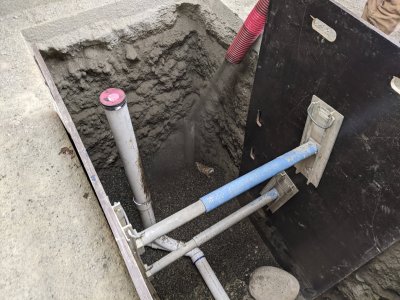
I had that done on a job inside a building.
PXL_20220316_151446849.jpg

They needed to turn a main line and bring it through a row of offices so they could demo the sewer main for an addition, and keep it all live.
Saw Cut room by room and retain the demizing walls, excavate with vac trucks to the tune of 20K, and then I and the bark truck placed 72 tons of pea gravel in 6 hours.
I had pre-positioned the 120 excavator there. He got a big (overweight) load on, I got one, and then I dipped it out of my truck and loaded his with the 120. He stayed and I ran for 12 tons at a time.
They could probably blow sand too.
 
Without going into detail, I have a hole to fill that no truck can get to for a straight dump. They'd have to dump no closer than 20-25' and I'd have to move the load with a 4' FEL bucket on a SCUT.

A pump truck could get close enough to use the hose, but I don't know if they can pump dry material, or what it might cost.
How many yards of material do you have to move?
 
Damn…pi*R2*16/27 equals almost 30 cubic yards.
For the life of me I couldn't remember that formula, and I've used it a thousand times.

Just for fun I priced out 30 yards of sand from the local home depot. Just under $43,000. Seems just a bit high to me.
 
Last edited:
I was told more like 5-6 cubic yards of dry material, but it was just an estimate. And I really don't know if it's 8 feet in diameter since there's no way to measure it. It may only be 6 or even a bit less. The opening is less then 30" and it bells out like a bottle.

Used to hold about 1,100 gallons of water.
 
my bark truck outfit would bid that at ~$500 or so. Done. Pea gravel falls at 95% and that is what I would recommend. Sand does not.
 
For the life of me I couldn't remember that formula, and I've used it a thousand times.

Just for fun I priced out 30 yards of sand from the local home depot. Just under $43,000. Seems just a bit high to me.
Most sand and gravel bulk here is about $45/yard plus delivery.
 
That's super cheap.
I had to pick up some CSBC (1.25") at the concrete plant yesterday. 11.5 tons and It was $335 in MY truck, $27 a ton.
They have extra haul units getting it there.
At the pit near my house same rock is $18 in my truck.
I can't go there until I get a site specific safety training.
Back to the topic, not every bark truck can blow pea gravel. The ones that do, will haul all you need for that hole in one go. They would be in and out in an hour and that is where the ~$500 bid number comes from.
 
I'll have to ask around at the materials companies to see what they know. The gravel haulers here just that. They own trucks and haul gravel, then dump or spread it. They don't have any special equipment.

I've got at least two large companies, one that does the ready mix and another that does paving and excavating. That one has the special stuff like dirt pans.

My thing is getting the chute over some shrubs, under a 7' over hang and between two posts. I can get in there with my SCUT if there is no other choice, but that puts a lot of wear and tear on the small tires and FWD system. And I'd still have to build a small sluce/chute to dump the FEL into that would guide the material into the hole.

.
 
Flowable fill and a 4" tow-behind pumper, he can pump 100' easily on the ground and then just needs a place to rinse (flush out) his hoses.
All I've ever had worked on an hourly rate or by the cu. yard, price negotiable based on how busy they are.
Skip the yellow pages, ask a local concrete contractor which pumper to use, they know who is best.
 
IMHO you need something that flows better than sand if you're trying to fill the cistern 100% full. Otherwise you're just going to create a pyramid below the opening that sounds difficult to access to spread around.
 
exactly. That is why us professionals use pea gravel to abandon septic tanks and structures, unless CDF is required. CDF is Controlled Density Fill, a lean mix of sand and Portland cement that flows in nicely, cures in a few days, and you can dig back through it with excavators etc.
It is used all over the industry. We set piling in it for basement excavation, for example. you scrape it out behind the flange of the I-beam and then drop 4x12 boards behind that flange, called lagging. Keep going down and tying that I beam back and lagging between beams and then gunite the wall. Last time I was 34' below street level below the Seattle monorail, and up against the battery street tunnel on old 99 that got filled in and abandoned later on.
CDF is nice because it fills all the voids in a complicated trench with pipe going this way and that way.
 
exactly. That is why us professionals use pea gravel to abandon septic tanks and structures, unless CDF is required. CDF is Controlled Density Fill, a lean mix of sand and Portland cement that flows in nicely, cures in a few days, and you can dig back through it with excavators etc.
It is used all over the industry. We set piling in it for basement excavation, for example. you scrape it out behind the flange of the I-beam and then drop 4x12 boards behind that flange, called lagging. Keep going down and tying that I beam back and lagging between beams and then gunite the wall. Last time I was 34' below street level below the Seattle monorail, and up against the battery street tunnel on old 99 that got filled in and abandoned later on.
CDF is nice because it fills all the voids in a complicated trench with pipe going this way and that way.

I worked for a contractor in San Jose doing soldier beams and lagging. The wood they used was green as hell…and soaked with CCA.


Nasty shit.
 
Back
Top