
-
We’re currently investigating an issue related to the forum theme and styling that is impacting page layout and visual formatting. The problem has been identified, and we are actively working on a resolution. There is no impact to user data or functionality, this is strictly a front-end display issue. We’ll post an update once the fix has been deployed. Thanks for your patience while we get this sorted.
You are using an out of date browser. It may not display this or other websites correctly.
You should upgrade or use an alternative browser.
You should upgrade or use an alternative browser.
Buying a GTX 670 vs 7950
Page 3 - Seeking answers? Join the AnandTech community: where nearly half-a-million members share solutions and discuss the latest tech.
I agree with what you said, but my point is that, and I think you support it, is what does "all the chips" mean? Does AMD use every single chip that is produced, even if it is, say, 5% ASIC quality?
I think it's a pretty predictable relationship between what voltages are required and what quality the ASIC is, or however you want to evaluate the purity/perfection of a silicon crystal and all the other factors that make it work.
Because of that hard-wired law of physics type of relationship, it seems plausible that when you see smoke, perhaps there is fire? When you see raised voltages hard-coded into BIOS, perhaps that enables use of lower quality of ASICS that will run fine at that higher voltage?
Put another way, is it possible that AMD has some flexibility on what ASIC quality is the cutoff point? Maybe with the higher voltage in BIOS, they can relax the quality requirement just a bit?
I'd love it if that were true, because more supply means lower prices for all. And I have AMD and NVidia video cards both, I'm not an anti-AMD (or anti-NVidia) fanboi.
I would say there is a high probability that your on to something, Its kinda the way i feel. It seems that there has to be a large range with the 7950 silicon. We know that the 7950 consist of chips that couldnt make the 7970 cut. There seems to be large discrepancies in the voltage as well, Perhaps AMD has had modest clocks because they wanted to use almost every chip. This would explain a lot.
The custom solutions could from chips that dont need a lot of voltage. There is a big difference in the voltage they use and the one for the 7950b. There is absolutely a reason for this.
All in all, i dont think the higher voltage 7950b would be bad. I bet they have a lot of overclocking room left, just as much or more as the vendor overclocked cards. I would recommend getting a 7950 with a great cooler. It is a gem, even the higher volt chips dont change that. I dont think its a fail on AMDs side, i just think AMD isnt into the same level of salvaging Nvidia is. They do things very differently. Not that either is wrong.

cmdrdredd
Lifer
I've bought plenty of things that were expensive, but it was generally an easy buy. To some people simply buying whatever is the highest overclocker determines their buy. Anyways, I wasn't actually planning on buying a GPU until I looked over the price drops and felt that I would like to play with higher than low/medium settings in some of the newer games. I bought this card for 100 dollars last year around February to replace a faulty 9800gtx+ after 2.5 years and saw that deal. $300-$400 isn't cheap, so I just figured I'd like to see which is the best for that price point in regards to more than just overclocking performance.
I was just making a joke. You can go back and forth all day between a 670 and 7950 and debate everything until you turn blue. In the end you just gotta pick one and go with it.
Honestly for a single card you won't be disappointed either way.

KingFatty
Diamond Member
If you get the less expensive card, you can put the remaining money you saved into an interest-bearing account (like a CD) where you can't touch it and it draws interest. So you look for a CD that locks up your money for when the next round of cards are due to be released and it's like your past self giving your future self a huge discount on the next card, a way to be a bit happier and willing to accept slightly less performance to save money and have an easier path when it's time to upgrade again.
If you get the less expensive card, you can put the remaining money you saved into an interest-bearing account (like a CD) where you can't touch it and it draws interest. So you look for a CD that locks up your money for when the next round of cards are due to be released and it's like your past self giving your future self a huge discount on the next card, a way to be a bit happier and willing to accept slightly less performance to save money and have an easier path when it's time to upgrade again.
are you being serious?
this plan will never work cause the way the US is printing money, hyperinflation will ruin the CD amounts purchasing power. He then will be so sad. Not only did he suffer with less performance for 2 years now that its time to upgrade he has lost so much that he has to pay someone to take his CD. If only he bought a 670for just a few bucks more it wouldve lasted him a lifetime.
by the way, i am not serious

RussianSensation
Elite Member
Sarasvati,
I just noticed that Newegg has the Sapphire Dual-X HD7950 950mhz for $318 after rebate and s&h. It also comes with Sleeping Dogs. That's even even better value than the $337 Sapphire Vapor-X vs. the $400 GTX670.
The 7950 Dual-X is made on the HD7970 PCB and uses the 6+8 pin power connectors, much like the MSI TwinFrozr 3. That means 1050-1150mhz overclocks easy.

It uses identical cooler to my 7970 card and here are my GPU temperatures at 99% load @1150mhz. Keep in mind your gaming temperatures should be lower than that:

Even at 1150mhz on a 7970, my card is veeeeeeeery quiet. You can save another $20 from not getting the Vapor-X. The Sapphire Dual-X cards are awesome.
I just noticed that Newegg has the Sapphire Dual-X HD7950 950mhz for $318 after rebate and s&h. It also comes with Sleeping Dogs. That's even even better value than the $337 Sapphire Vapor-X vs. the $400 GTX670.
The 7950 Dual-X is made on the HD7970 PCB and uses the 6+8 pin power connectors, much like the MSI TwinFrozr 3. That means 1050-1150mhz overclocks easy.
It uses identical cooler to my 7970 card and here are my GPU temperatures at 99% load @1150mhz. Keep in mind your gaming temperatures should be lower than that:
Even at 1150mhz on a 7970, my card is veeeeeeeery quiet. You can save another $20 from not getting the Vapor-X. The Sapphire Dual-X cards are awesome.
Last edited:

Sarasvati
Junior Member
Well, I'm purchasing two of these cards, and I'm pretty sure it's one rebate per household, so one would end up being the same as the vapor-x anyways.
Edit: Nice to see temps are so good on an oc'ed 7970 at full load. You're one of the few that posted more than just benchmarks, so thanks for that.
Edit: Nice to see temps are so good on an oc'ed 7970 at full load. You're one of the few that posted more than just benchmarks, so thanks for that.
RussianSensation
Elite Member
Ya, np. Keep in mind, while I recommend a single 7950 OC vs. 670 for price/performance, if you are going with 2x 7950 for the same system, I would probably recommend 670 SLI over 7950 OC CF. If you are putting 2 7950 cards into 2 separate systems, that's a non-issue then.
Sorry, this is completely wrong. The current batch of 7950 after-market cards from MSI TF3 7950, Sapphire Dual-X 7950 don't need 1.275V to hit 1150mhz. We have a thread for MSI TF3 for example where nearly everyone is hitting 1100-1150mhz under 1.175V. The only card that will ship with 1.21V or so is the Sapphire Vapor-X but it uses black diamond chokes from the TOXIC which reduces the power consumption over standard VRM setup. Plus, you don't even need to OC the 7950 to 1200mhz to beat a 1300mhz 670. 1125-1150mhz on 1.175V or below, pocket $70-80 savings.
That is if you'll be able to reach 400mhz OC on top of 800m. By doing that u'll probably need a serious volts - up to 1.275v or more.
Sorry, this is completely wrong. The current batch of 7950 after-market cards from MSI TF3 7950, Sapphire Dual-X 7950 don't need 1.275V to hit 1150mhz. We have a thread for MSI TF3 for example where nearly everyone is hitting 1100-1150mhz under 1.175V. The only card that will ship with 1.21V or so is the Sapphire Vapor-X but it uses black diamond chokes from the TOXIC which reduces the power consumption over standard VRM setup. Plus, you don't even need to OC the 7950 to 1200mhz to beat a 1300mhz 670. 1125-1150mhz on 1.175V or below, pocket $70-80 savings.
Last edited:
Sarasvati
Junior Member
Ya, np. Keep in mind, while I recommend a single 7950 OC vs. 670 for price/performance, if you are going with 2x 7950 for the same system, I would probably recommend 670 SLI over 7950 OC CF. If you are putting 2 7950 cards into 2 separate systems, that's a non-issue then.
Sorry, this is completely wrong. The current batch of 7950 after-market cards from MSI TF3 7950, Sapphire Dual-X 7950 don't need 1.275V to hit 1150mhz. We have a thread for MSI TF3 for example where nearly everyone is hitting 1100-1150mhz under 1.175V. The only card that will ship with 1.21V or so is the Sapphire Vapor-X but it uses black diamond chokes from the TOXIC which reduces the power consumption over standard VRM setup. Plus, you don't even need to OC the 7950 to 1200mhz to beat a 1300mhz 670. 1125-1150mhz on 1.175V or below, pocket $70-80 savings.
Sorry, I actually meant my brother was getting the other. I've heard enough bad things with CF though.
Nice to know it has quality components that are used in the TOXIC models. I'll pull the trigger on that one. Thanks for everything. :thumbsup:
RussianSensation
Elite Member
You are welcome. I hope you get killer cards. If you have 5 min or so, can you maybe create a separate thread or update this thread with your experience on the Sapphire cards? I think it would help other people to hear from your actual experience in regard to noise levels, performance and possible OCing adventures.
If you need any help enabling Unofficial MSI Afterburner --> Link (Post #2). If you need any help with your 7950, tons of guys in that thread can help you out.
Download HWInfo64 or GPU-Z (Sensors) to monitor your VRM temperatures and actual GPU voltage (the voltage in Sapphire Trixx and MSI Afterburner is target voltage not actual voltage). VRM temperatures are safe under about 125*C but ideally you want to keep them under 100*C if you are loading the card 24/7 365 days a week. This shouldn't be an issue for you if you are gaming.
Finally, if you care to make some extra $ on the side with your AMD card when not playing videogames, bitcoin mining is an option to explore. Post #37 covers that.
If you need any help enabling Unofficial MSI Afterburner --> Link (Post #2). If you need any help with your 7950, tons of guys in that thread can help you out.
Download HWInfo64 or GPU-Z (Sensors) to monitor your VRM temperatures and actual GPU voltage (the voltage in Sapphire Trixx and MSI Afterburner is target voltage not actual voltage). VRM temperatures are safe under about 125*C but ideally you want to keep them under 100*C if you are loading the card 24/7 365 days a week. This shouldn't be an issue for you if you are gaming.
Finally, if you care to make some extra $ on the side with your AMD card when not playing videogames, bitcoin mining is an option to explore. Post #37 covers that.
Last edited:
If you can afford it then get the 670 - without a shadow of doubt it is the better card if you look at "user" benchmarks and reviews. If you are on a budget then get the 7950, either of the Sapphire models are very good.
It seems that there is some confusion as you should be comparing price vs price which means that the GTX670 should be compared with the HD7970 due to the recent price drops.
Screen resolutions, what games you play (as devs optimise games for manufacturers) and multi monitor setups are also a factor.
It seems that there is some confusion as you should be comparing price vs price which means that the GTX670 should be compared with the HD7970 due to the recent price drops.
Screen resolutions, what games you play (as devs optimise games for manufacturers) and multi monitor setups are also a factor.
The marketing way for NV to introduce new cards for the reviewers, is to make sure the cards is positioned against slower AMD variants. They do that by having an introduction price that is just barely higher, and then they keep the price or let the oem raise it for the aftermarket cards. Its a very clever strategy because the reviewers follow the positioning, and first impression last for the consumers.
The OP situation and the "sticking" to a story, is a very clear example of that. But its difficult for all of us. Storries and first impression stick.
NV is clearly much better than AMD at doing that maneuver and defining the impression by clever last minute positionen, and NV have the advantage they introduce their new process later than AMD.
Its obvious AMD needs to do something about it, and reaction to NV cards this spring was the most obvious display of wrong decisions and bad marketing. The solution is very simple 12 hours before NV launch time, reduce price 30%, just in time for all the reviewers to get it.
If they dont, they will have to lower price further later on, and at the same time loose a lot of marketshare. The last ½ year is a prime example of that. Bad management.
The OP situation and the "sticking" to a story, is a very clear example of that. But its difficult for all of us. Storries and first impression stick.
NV is clearly much better than AMD at doing that maneuver and defining the impression by clever last minute positionen, and NV have the advantage they introduce their new process later than AMD.
Its obvious AMD needs to do something about it, and reaction to NV cards this spring was the most obvious display of wrong decisions and bad marketing. The solution is very simple 12 hours before NV launch time, reduce price 30%, just in time for all the reviewers to get it.
If they dont, they will have to lower price further later on, and at the same time loose a lot of marketshare. The last ½ year is a prime example of that. Bad management.

SirPauly
Diamond Member
Imho,
Really?
When nVidia introduced the GTX 680 against the more expensive HD 7970, well, it forced AMD to reduce pricing.
When nVidia introduced the GTX 670 against the HD 7950, well, it forced AMD to reduce pricing of the HD 7970, HD 7950 and HD 7870.
When nVidia introduced the GTX 660ti against the HD 7870, well, it forced AMD to reduce the pricing of the HD 7850, HD, 7870 and HD 7950.
Imagine that -- nVidia forced AMD to reduce pricing and some-how it is a nVidia marketing trick. Look around the corner? Hey, it's a nVidia marketing trick.
Now, there is wonderful price/performance choice with AMD getting really aggressive; it's awesome! Sure is much more wonderful to discuss this instead of strongly defending premium pricing from a consumer point-of-view, when there is no competition. Hopefully, these aggressive price-points and strong price/performance can force nVidia to lower their MSRP's as well.
Really?
When nVidia introduced the GTX 680 against the more expensive HD 7970, well, it forced AMD to reduce pricing.
When nVidia introduced the GTX 670 against the HD 7950, well, it forced AMD to reduce pricing of the HD 7970, HD 7950 and HD 7870.
When nVidia introduced the GTX 660ti against the HD 7870, well, it forced AMD to reduce the pricing of the HD 7850, HD, 7870 and HD 7950.
Imagine that -- nVidia forced AMD to reduce pricing and some-how it is a nVidia marketing trick. Look around the corner? Hey, it's a nVidia marketing trick.
Now, there is wonderful price/performance choice with AMD getting really aggressive; it's awesome! Sure is much more wonderful to discuss this instead of strongly defending premium pricing from a consumer point-of-view, when there is no competition. Hopefully, these aggressive price-points and strong price/performance can force nVidia to lower their MSRP's as well.
Last edited:

Meghan54
Lifer
Well, after going through a 7970, 7950, GTX 680, and currently have a GTX 670, I'm looking to move back to a 79xx, probably a 7950. The AMD cards just worked better for my gaming uses, mostly Civ V and the like. Not a big FPS gamer, though.
The AMD products were simpler to OC, esp. with voltage increases. The componentry on the AMD products just seemed more robust vs. the Nvidia products, at least from what I could find searching out the VRM, capacitor part numbers from the various cards, etc.
To each his own, in the end, though. If a GTX is your choice, great. Nice cards. If an AMD card is your choice, they'll work equally as well as the nvidia cards.
The AMD products were simpler to OC, esp. with voltage increases. The componentry on the AMD products just seemed more robust vs. the Nvidia products, at least from what I could find searching out the VRM, capacitor part numbers from the various cards, etc.
To each his own, in the end, though. If a GTX is your choice, great. Nice cards. If an AMD card is your choice, they'll work equally as well as the nvidia cards.
lavaheadache
Diamond Member
Well, after going through a 7970, 7950, GTX 680, and currently have a GTX 670, I'm looking to move back to a 79xx, probably a 7950. The AMD cards just worked better for my gaming uses, mostly Civ V and the like. Not a big FPS gamer, though.
The AMD products were simpler to OC, esp. with voltage increases. The componentry on the AMD products just seemed more robust vs. the Nvidia products, at least from what I could find searching out the VRM, capacitor part numbers from the various cards, etc.
To each his own, in the end, though. If a GTX is your choice, great. Nice cards. If an AMD card is your choice, they'll work equally as well as the nvidia cards.
Jeff, You are insane!!! lol, anyhow seeing your post reminded me that I scammed you out of $20. I'll get on that right away.
Jeff (err, meghan54) is right btw, the AMD card are definately of higher build quality this generation
Just buy a video card and get it over with, you act like you're selecting an organ for transplant. :hmm:
Yes I have to agree, this reminds me of a women shopping for a dress.
Man up and buy the card already.
If you want quality I would stick with AMD. I liked the 570/580 nvidias but not the 670/680
they look good on paper but are junk in terms of quality. Something bad with the silicon way too many dead cards, artifacting, wont run in 16x slots the list goes on.
Its like they tried to make a porche out of cheap yugo car parts.

RussianSensation
Elite Member
It seems that there is some confusion as you should be comparing price vs price which means that the GTX670 should be compared with the HD7970 due to the recent price drops.
You should be looking at price & performance, not only price because you are paying a certain price for a certain level of performance. Right now NV's cards cost more for a similar level of performance, which is why looking at price only is actually not great advice.
There is no confusion. HD7950 OC competes with GTX670 OC on performance. HD7970 OC beats an overclocked 670 OC and actually beats a 1300mhz GTX680 OC, unless you include the 1360-1390mhz GTX680 Lightning voltmod. So no you shouldn't be comparing an HD7970 to GTX670 at current prices anymore if you are willing to overclock. Something like the Gigabyte 1Ghz HD7970 will beat factory preoverclocked 670s and beat OCed 670s when it's overclocked to 1.15-1.2ghz. That's why we didn't discuss 670 vs. 7970. It takes a 1290-1300mhz 680 to go against an overclocked 7970.
Also, if you read the entire thread carefully, the OP is buying 2 cards, which means $63 savings per card = $126 savings. Since he is indifferent to Sleeping Dogs vs. BL2 and is willing to overclock, there is not much reason to spend more $ on the 670 OC in this case when it can't outperform a 7950 OC. He is better off putting that $ away for the next time he upgrades since he won't be able to differentiate between real world performance when looking at 7950 OC vs. 670 OC.
Now, there is wonderful price/performance choice with AMD getting really aggressive; it's awesome! Sure is much more wonderful to discuss this instead of strongly defending premium pricing from a consumer point-of-view, when there is no competition. Hopefully, these aggressive price-points and strong price/performance can force nVidia to lower their MSRP's as well.
I agree with everything you are saying, and the last part 🙂 But how many times did you read that "AMD was desperate, they had to lower prices." The NV camp didn't scream that GTX260/280 ripped them off but when AMD had the market all to themselves for 3 months, they are now viewed as desperate after they lowered prices? It was pretty obvious AMD wanted to rush their products to the market to reap larger profit margins from early adopters. Most of us pretty much knew it too.
GTX660 came out 7 months after 7950. All AMD did is take full advantage of no competition until then with 7750/7770/7850/7870/7950 prices. It was not great for us consumers but NV would have done exactly the same and in fact they did in the past every time they had a hug elead. It's probably going to be the same when HD8000 series launches - 8950 for $450 and 8970 for $550; and people will once again ignore that AMD is first to market and not consider NV as being late. Apparently this round NV being late wasn't really criticized. That was surprising to me, but when AMD was forced to lower prices, they were called desperate. I thought that's what supposed to happen in the world of technology - a competitor launches a better product later and forces the company which launches first to lower prices to stay competitive (unless it is FX5800 U or 2900XT/3870).
Last edited:
Sarasvati
Junior Member
Yes I have to agree, this reminds me of a women shopping for a dress.
Man up and buy the card already.
If you want quality I would stick with AMD. I liked the 570/580 nvidias but not the 670/680
they look good on paper but are junk in terms of quality. Something bad with the silicon way too many dead cards, artifacting, wont run in 16x slots the list goes on.
Its like they tried to make a porche out of cheap yugo car parts.
I already bought the card many days ago, thanks for your useful input.
Imho,
Really?
When nVidia introduced the GTX 680 against the more expensive HD 7970, well, it forced AMD to reduce pricing.
When nVidia introduced the GTX 670 against the HD 7950, well, it forced AMD to reduce pricing of the HD 7970, HD 7950 and HD 7870.
When nVidia introduced the GTX 660ti against the HD 7870, well, it forced AMD to reduce the pricing of the HD 7850, HD, 7870 and HD 7950.
Imagine that -- nVidia forced AMD to reduce pricing and some-how it is a nVidia marketing trick. Look around the corner? Hey, it's a nVidia marketing trick.
Now, there is wonderful price/performance choice with AMD getting really aggressive; it's awesome! Sure is much more wonderful to discuss this instead of strongly defending premium pricing from a consumer point-of-view, when there is no competition. Hopefully, these aggressive price-points and strong price/performance can force nVidia to lower their MSRP's as well.
Really. Man read my piece again. This is not about marketing tricks - its your words not mine. You are putting up a strawman. Its about marketing and pricing policy and positioning on introductioin. Not a bad word in my book.
The point is AMD should lower price beforehand not after they are forced, because then they have to lower prices further to gain the same effect.
As this forum demonstrates over and over again, people continue to compare the 7950 to the 670 even though they are not in the same price class. How do you explain that?
Sarasvati
Junior Member
Really. Man read my piece again. This is not about marketing tricks - its your words not mine. You are putting up a strawman. Its about marketing and pricing policy and positioning on introductioin. Not a bad word in my book.
The point is AMD should lower price beforehand not after they are forced, because then they have to lower prices further to gain the same effect.
As this forum demonstrates over and over again, people continue to compare the 7950 to the 670 even though they are not in the same price class. How do you explain that?
The comparison I made between the 670 and the 7950 was mostly due to similar performance, not really price. I've been using nVidia for years and I trust it, so I wasn't sure if 63 dollars or so was worth switching to something new. At similar prices there's no way I would consider a GTX 660 TI even when it has a similar pricing to the 7950. I was really hoping a while back that it would be pretty close to the 670 without crippling its memory bandwidth. In the end I think this will end up being better.
By the way, my first video card was a Radeon and while it was a pain to install the drivers on it (not sure why but I had to manually install drivers and choose from a list of 100 cards) I never really had any real issues other than that. It's been so long I forgot about it, but I definitely wasn't "sticking" with nVidia because of a first impression. If anything it was EVGA's customer support that kept me with nVidia.
On a side note, my cards have been stuck in transit limbo for like 3 business days in California and I live on the East Coast, but I've been really curious how it'll perform.
Last edited:
I think we have like 8 computers in the house, mostly NV but also some few AMD and Intel on the gfx side. I have never had any trouble with drivers, like its not working, for any of them and the 15 computers before them, except Intel isnt up to the quality on fx. decoding but thats another matter. It was another world 15 years ago, where drivers was a constant pain. I dont understand all the talk today, i think its hugely overrated. You get a gfx and it just works.
There is differences to noise and power, and together with performance its what should be the platform for choosing.
660ti should be compared to 7970 (edit: 7950) because its the same price (in dk its the exact same), and in many situations i can understand why the 660 is chosen because it is more efficient and will be less noisy all things equal. If you are gaming at 1080 and will continue to do so, one have make sure you actually need the extra oc perf. of the 7950.
There is differences to noise and power, and together with performance its what should be the platform for choosing.
660ti should be compared to 7970 (edit: 7950) because its the same price (in dk its the exact same), and in many situations i can understand why the 660 is chosen because it is more efficient and will be less noisy all things equal. If you are gaming at 1080 and will continue to do so, one have make sure you actually need the extra oc perf. of the 7950.
Last edited:
blanketyblank
Golden Member
I'm very happy about my 7950 purchase except for the fact I got it from Amazon and so no games were included. I'll just run it as a miner for a while to make up the difference though so no big deal, but would have been nice.
RussianSensation
Elite Member
By the way, my first video card was a Radeon and while it was a pain to install the drivers on it (not sure why but I had to manually install drivers and choose from a list of 100 cards) I never really had any real issues other than that. It's been so long I forgot about it, but I definitely wasn't "sticking" with nVidia because of a first impression. If anything it was EVGA's customer support that kept me with nVidia.
It's not like that anymore. You just install Catalyst 12.8 driver + 12.7 CAP3 profiles using Express install and reboot. Just go to www.amd.com and select proper driver based on your operating system.
The real fun of 7950 series is overclocking. At 950mhz for the Sapphire Dual-X/Vapor-X cards, it is already faster than a 7950 "GPU Boost" version which itself is already faster 660Ti.
1025mhz on the 7950 and you are already past GTX670's level of performance and approaching 680.
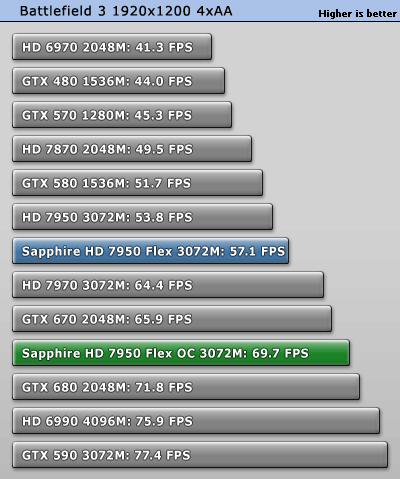
A lot of people don't understand what the 7950 is. It still retains full 32 ROP and 384-bit bus of the 7970. There is a 5% penalty in games at 1080P/1200P due to lower shader and TMU count of the 7950 @ similar clocks to the 7970. That means once it's overclocked to 1100mhz, it'll be already as fast as an HD7970 GE 1050mhz, which is already faster than a GTX680. This is why the 7950 is such a bargain - the chip itself is essentially a 5-6% slower chip than 7970 is in games but has been underclocked from the factory.
Last edited:
TRENDING THREADS
-
 Discussion Zen 5 Speculation (EPYC Turin and Strix Point/Granite Ridge - Ryzen 9000)
- Started by DisEnchantment
- Replies: 25K
-
Discussion Intel Meteor, Arrow, Lunar & Panther Lakes + WCL Discussion Threads
- Started by Tigerick
- Replies: 25K
-
 Discussion Intel current and future Lakes & Rapids thread
- Started by TheF34RChannel
- Replies: 24K
-

-
