• We’re currently investigating an issue related to the forum theme and styling that is impacting page layout and visual formatting. The problem has been identified, and we are actively working on a resolution. There is no impact to user data or functionality, this is strictly a front-end display issue. We’ll post an update once the fix has been deployed. Thanks for your patience while we get this sorted.

Best thermal paste for an AMD processor

Page 2 - Seeking answers? Join the AnandTech community: where nearly half-a-million members share solutions and discuss the latest tech.
Prolimatech PK-1.

^ the best unless u want to go single application style like Indigo Extreme..

This was done by 2 friends of mine. Vapor, and Skinnee:

http://skinneelabs.com/2011-tim-results/3/
tims.jpg
 
Last edited:
I like MX-2. It's cheap, very effective, and very easy to apply and clean. Hell, according to Aigo's chart it's the 7th most effective TIM out of ~30 tested. Not bad.
 
And because it's electrical conductive and usually costs more per gram (compared to MX-2).
Arctic Silver must be lying to its customers then when it says it is not conductive but capacitive in nature.

I don't really know the difference but I also don't know any people who have had problems with silver TIM. When I apply TIM, I try not to get it on electrical components. :hmm:
 
AS5 says its thermal compound is absolutely stable and will not separate/bleed. Diamond is also good. But Noctua NT-H1 can only be 'used for several years without any problems'

Should the long curing time of AS5 be an issue? Its performance is already good at the beginning of the curing process. For those 2 reasons I'll finish up the leftover AS5 I've got.
 
I subscribe to the notion that most TIMs are vastly similar and that surface preparation and correct mounting of a decent heatsink is more important.

Diamond, silver, copper, aluminum, carbon, whatever, it all performs close enough. Although with diamond pastes, you have to watch for abrasion of the CPU.
 
I like MX-2. It's cheap, very effective, and very easy to apply and clean. Hell, according to Aigo's chart it's the 7th most effective TIM out of ~30 tested. Not bad.

Thumbs up for MX-2, good cost to benefit ratio and hard to screw up applying. I salute some of you wanting that last degree or two and willing to put in the extra effort in application.
 
I subscribe to the notion that most TIMs are vastly similar and that surface preparation and correct mounting of a decent heatsink is more important.

This.

Just going by the Skinneelabs tests, the greatest temperature variation between best and worst is only about 4C. If you're splitting hairs about such a minor difference, then you should be concentrating on the other factors that affect your cooling (heatsink, fans, OC/voltage settings, etc.) instead. Pick a TIM that spreads well and be done with it.
 
That's because a thermal compound is supposed to fill the air-gaps between the heatsink and CPU surfaces to promote the conduction of heat. Air is an pretty good insulator.

A bad thermal compound (properly applied) will still be better than conduction by air provided that only the gap spaces have compound between them (realistically impossible).

This is why there is only a few degrees C difference between "bad" and "good" TIMs. Reducing the volume of the air gaps to begin with and selecting a good heatsink with proper airflow/cooling does more to reduce CPU temperatures.

The perfect heatsink would ideally mate perfectly with the CPU, no thermal compound needed at all. We can't have this :'( so we use TIMs to substitute.
 
I'm surprised nobody mentioned Tuniq TX4.
I did mention the TX-2 and how competitive it was. I assume the TX-3 and TX-4 only improve on it, but I can't be sure as it is not available in my place. But if my favorite shop started carrying the TX-4, that would be what I'd be using now, seeing as to how positive my TX-2 experience was.

I get you though, I'm surprised nobody else seems to be using any Tuniq at all.
 
I subscribe to the notion that most TIMs are vastly similar and that surface preparation and correct mounting of a decent heatsink is more important.

From product MSDS, except for the exotics like Indigo Extreme and IC Diamond, most TIMS are formulated from aluminum, aluminum oxide, zinc oxide, carbon black, and either a silicone or polyester oil. Arctic Silver 5 contains silver (amount unknown), aluminum oxide, zinc oxide, and boron nitride in a polyester oil.

The higher viscosity TIMS probably have higher solids concentrations which may make them perform better but are harder to work with.

http://en.wikipedia.org/wiki/List_of_thermal_conductivities
 
From product MSDS, except for the exotics like Indigo Extreme and IC Diamond, most TIMS are formulated from aluminum, aluminum oxide, zinc oxide, carbon black, and either a silicone or polyester oil. Arctic Silver 5 contains silver (amount unknown), aluminum oxide, zinc oxide, and boron nitride in a polyester oil.

The higher viscosity TIMS probably have higher solids concentrations which may make them perform better but are harder to work with.

http://en.wikipedia.org/wiki/List_of_thermal_conductivities
I meant similar performance, not composition, although that seems to be the case as well.

Higher viscosity TIMs are not necessarily better. They are better for heatsinks that have larger pits and groves as they can fill the gaps better. Lower viscosity TIMs are better for flatter surfaces, not for large gaps as the more-fluid like material will flow out of the gaps.

Remember, the TIM's role is to conduct heat better by replacing insulating air in gaps. If CPU surface touches heatsink surface directly and perfectly, that is the ideal situation and no TIM would be needed.
 
guys if u trust my accuracy... go by skinnee labs.

As i said.. 2 of my friends run the reviews for that site, and there about dead accurate u can get.

Go read the methodology section, and how they went about the test, and you'll see for yourself.. they missed no corners.

And yes My friend Vapor had no life doing all these tests.. lol.. everytime i went to PM him on AIM and hear him rant...


One more note... there is no special tim for intel and AMD.... anyone that tells u there is, well that is BS.

the only time where there is a special TIM for Intel or AMD is Indigo Extreme... and that is because of the surface area on the IHS.

Other then that... if tim X works great on AMD... 99.999% of the time i will great on Intel and vice versa.
 
Last edited:
Just going by the Skinneelabs tests, the greatest temperature variation between best and worst is only about 4C. If you're splitting hairs about such a minor difference, then you should be concentrating on the other factors that affect your cooling (heatsink, fans, OC/voltage settings, etc.) instead. Pick a TIM that spreads well and be done with it.

This and what the price/performance ratio is. Is it worth ~$10. an application for Indigo Extreme for a few degrees increase in performance.
 
This and what the price/performance ratio is. Is it worth ~$10. an application for Indigo Extreme for a few degrees increase in performance.

it has one of the easiest application.

Look at skinnee labs, you'll see the delta between the bad mount an good mount is almost nil.... this is whats important in TIM's.

APPLICATION!
 
I'd say nothing is wrong with that. Make sure to mix your AS3, old TIMs may separate. Also make sure to try some out on a flat, hard surface before you put more on a heatsink/CPU to test the viscosity and consistency.

For new TIMs, I would have said that you can get any you want, but this new TIM, Indigo Extreme, seems to be interesting. In general, I am wary of phase change metal TIMs as older ones have corroded or chemically bonded with certain heatsink/CPU surfaces.


EDIT: The T-1000, lol.
http://www.overclock.net/hardware-news/574147-frostytech-indigo-xtreme-beats-ic7-6.html
 
Last edited:
To those still using AS5: Once it's used up, don't buy it again. It was depreciated long ago.
You probably meant to say it was deprecated (as in phased-out and replaced by an improved product). Depreciated is an economic term relating to the decline in value of an item over time and use.

According to Artic Silver, AS5 has not been deprecated, but ceramique has been deprecated and replaced by ceramique 2.

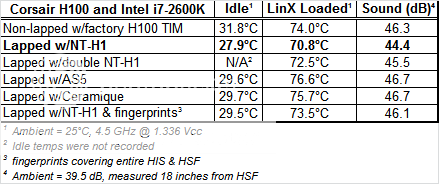
That said, I recently tested NT-H1 vs AS5 vs Ceramique and found the NT-H1 to be notably better by a few degrees. (I have the indigo stuff here too, will test it soon)

The relevance of this, to me, was a notably quieter system because the CPU fans were running slower owing to the lower temps.

H100OCingresults.png


A decrease by a couple of decibels may not seem like much, but the logarithmic scaling means that roughly a change of 3dB means the sound pressure has halved (or doubled).

There was/is a notable sound difference between 46.7dB an 44.4dB.

I should have taken the test one step further, but I didn't think of it at the time, and lowered the fan rpms even more such that the temps became the same (76.6°C in this case) and noted how much more quieter the NH-T1 TIM-enabled system was in that regard.

Suffice to say, after using both, and after having used AS5 for years and years, I won't be using AS5 any longer.
 
Back
Top
