Bay Trail benchmark appears online, crushes fastest Snapdragon ARM SoC

Page 15 - Seeking answers? Join the AnandTech community: where nearly half-a-million members share solutions and discuss the latest tech.
Mar 10, 2006
11,715
2,012
126
You missed krumme's main point that the "piece of poo" looks good if you only judge by Antutu. Which is the same benchmark people are basing their Bay Trail comments on in this thread.

Sure; point well taken. I can't wait for Anand to bench Bay Trail in some real, Windows benchmarks so that we know how good (or bad?) this thing turns out to be. No BS Javascript tests.

Did I mention that I hate the old Atom cores with a passion and hope they burn in silicon hell? Such castrated designs so obviously handicapped. Intel should have done a 32nm "tick"...
 
Last edited:

Erenhardt

Diamond Member
Dec 1, 2012
3,251
105
101
Yeah, what do you expect from an ancient processor core? Clover Trail/Clover Trail+ are merely stopgaps for Bay Trail which will be out this year. It is likely that Intel sold these chips to Samsung at a significant discount just to clear out whatever inventory they had and/or gain some publicity.

The old Atom is a piece of poo, and it's time to put a bullet in this dog's head.

His point was not the performance of old Atom, but the benchmark results! Slow intel chip is suddenly on top of everything else in Antutu!
So if BT is 30% faster in Antutu, then it is 0,33x130%=~40% of Snapdragon 800 in everything else.
 
Mar 10, 2006
11,715
2,012
126
His point was not the performance of old Atom, but the benchmark results! Slow intel chip is suddenly on top of everything else in Antutu!
So if BT is 30% faster in Antutu, then it is 0,33x130%=~40% of Snapdragon 800 in everything else.

That is some seriously convoluted logic. Considering that Silvermont is a new uArch, you have literally no idea how it's going to perform in these traces. Note that the benchmarks in which CT+ gets schooled are FPU intensive benchmarks - and Saltwell was known for having a very seriously weak FPU.

Also, Saltwell's uArch is very sensitive to code being designed just right to reach peak performance, while Silvermont is much more flexible (a lot of that is due to the fact that it's an OoO design, rather than a very limited in-order one).

There's no doubt that the old Atom was a POS, but from both the architectural disclosures and Intel's own performance estimates, I'm still expecting a leadership core from Intel.
 

wlee15

Senior member
Jan 7, 2009
313
31
91
Silvermont is still a lot like the old Saltwell with it's 2 wide decoder and only 2 execution ports. It's only partially out of order, and instruction latencies are not much better than Saltwell.
 

Nothingness

Diamond Member
Jul 3, 2013
3,370
2,466
136
That is some seriously convoluted logic. Considering that Silvermont is a new uArch, you have literally no idea how it's going to perform in these traces. Note that the benchmarks in which CT+ gets schooled are FPU intensive benchmarks - and Saltwell was known for having a very seriously weak FPU.
CT+ stinks even at integer workloads: http://browser.primatelabs.com/geekbench2/compare/2132300/1970892
A S600 is between 10% and 100% faster despite a slightly lower clock.

For the rest I agree we'll have to wait for real devices and independent benchmarks.
 

SiliconWars

Platinum Member
Dec 29, 2012
2,346
0
0
Sure; point well taken. I can't wait for Anand to bench Bay Trail in some real, Windows benchmarks so that we know how good (or bad?) this thing turns out to be. No BS Javascript tests.

Why Windows? If the new Atoms are to be a success they need to perform well on Android. Windows market share is almost irrelevant at this point.

You can see why ARM is saying they are still a generation ahead based on that review and on Intel's projected performance increase.
 

NTMBK

Lifer
Nov 14, 2011
10,522
6,046
136
Why Windows? If the new Atoms are to be a success they need to perform well on Android. Windows market share is almost irrelevant at this point.

Windows market share is irrelevant? What the hell are you smoking? :confused:
 

SiliconWars

Platinum Member
Dec 29, 2012
2,346
0
0
Windows market share is irrelevant? What the hell are you smoking? :confused:

In terms of Atom's main market, Windows market share is almost non-existent. It's nowhere in phones and nowhere in tablets.

Tablets -
slip.jpg


Note that Windows does have more market than shown here but not by much.

Phones -
screen-shot-2013-06-04-at-3-40-58-pm.png


This is common knowledge so I don't know what you are thinking about. Unless you believe Intel spent the past x years developing Atom for low end Windows notebooks?
 
Last edited:
Mar 10, 2006
11,715
2,012
126
In terms of Atom's main market, Windows market share is almost non-existent. It's nowhere in phones and nowhere in tablets.

You do realize that the market is new, right? And that having a bunch of overpriced 1366x768, Clover Trail or Tegra 3 10.1" tablets isn't going to really help.

When we see ~$200 Windows 8 tablets with Bay Trail, I think adoption for Windows tabs will skyrocket.
 
Mar 10, 2006
11,715
2,012
126
Why Windows? If the new Atoms are to be a success they need to perform well on Android. Windows market share is almost irrelevant at this point.

I'm sure they will, but I want to see how a Silvermont compares to a Sandy Bridge or a Haswell so that we know how it performs in more certain terms than JavaScript benchmarks.
 

Mondozei

Golden Member
Jul 7, 2013
1,043
41
86
T4 is on par with the top tier from Qualcomm and Samsung yet it didn't score any major design win. Having a good chip doesn't guarantee you a thing.

T4 is not on par with the top designs from either Samsung or Qualcomm, and certainly not the latter by far.
To quote yourself earlier in the thread: get it already.

Samsung and Apple account for 50% of market share, Qualcomm is likely to sell way cheaper chips than Intel targetting cheaper OEMs. I don't see Amazon trying to make its Kindle the very best out there.

What's left for Intel?

That leaves OEMs willing to draw a wild card like LG, ASUS, ZTE and Huawei or failures as Nokia and BlackBerry.

LG is a wildcard while Nokia is a failure? Last time I checked neither company was doing great but Nokia is still doing way better in the mobile space than LG(which without the Nexus brand is nothing).

You can't even get the basic facts right.


Intel isn't selling in the mobile market because everyone is actively avoiding it.

No, it's because they have not focused on the space until now in a serious manner. Silvermont is their first real attempt in 5 years for Atom. Have you not been paying attention?

It could make its own branding or pay some OEMs to make a device with the "Intel Inside" logo. Nothing, nada. Intel is out of the mobile space.

Actually, they're just now seriously starting to enter it.

None of the top OEMs will go back to chains with Intel

I'm glad that you have a psychic link to all the top minds in the world and can read them and their moves before they do.
No facts, just pure bluster. Well done.

Wasn't he the guy who told us Haswell was an overclockers dream, and that all the previous benchmarks were nothing like what he had seen in his lab?

Btw his ranting seems a bit strange considering that ARM says their current A7's and A15's will beat Silvermont - http://www.techhive.com/article/2040582/arm-claims-processor-superiority-over-intels-silvermont.html

The analyst was probably referring to this image -

id-2040582-armleadership2-100040064-large.jpg


If cherry-picked ICC-biased benchmarks are the best Intel has to show, is it any surprise that ARM doesn't seem worried?

Every company cherrypicks for their marketing. What makes you think that ARM is different? Are you so easy to fool as to blindly trust a single slide from their direct competitor as gospel?

We won't know how things stack up until we get the actual silicon to compare. This goes for both Intel - but also for ARM.

I like your thinking, however you need to apply it to Intel and not ARM.

Intel already knows how the S800 performs and they chose to show biased and cherry-picked benchmarks as a response. That's what the loser usually does.

Apply everything you've seen AMD's marketing do in the past 5 years in response to Intel and you'll quickly realise that Intel has nothing against Qualcomm. Silvermont will be a good chip, but so many people here are going to be very disappointed in the result if they truly believe that this is a knockout blow to ARM.

I agree with you on your last point, but not for the reasons you cite.

ARM is getting a majority of its revenue outside the mobile space. Also, they dominate in the lower segement of the mobile space for emerging markets as well as the upper segment.

Intel is targeting the upper segment, so Qualcomm is the main target there. This is less Intel vs ARM and more Intel vs Qualcomm. Sure, Qualcomm uses ARM architecture but if ARM loses the top segment of the mobile space that will not make a huge impact for them. Qualcomm lives off of the medium to high-end of the mobile space.

Who gets the low end segment? People like Mediatek, not Qualcomm.

Also your statement that "Intel has nothing on Qualcomm" is just pure fanboyism. Then again, as I showed previously, you take one slide from an ARM presentation and treat it as gospel.


The mobile market is locked for Intel and every other player wants it that way.

No market is ever "locked". Samsung would have preferred to have used only their own chips in the S4 but chose a lot of S600's because of issues with their own designs. The best chip tends to win.
And then you have all the other design wins from Qualcomm.

If Intel does better than Qualcomm then nothing is "locked". And we won't know if Intel does better than Qualcomm until we get something to actually compare to.
You're no better than the Intel fanboys who assume blindly that Intel will crush ARM no matter what and it is now "already decided", which is ridicolous. ARM isn't going anywhere and Qualcomm will remain very strong for the very near future, at least and likely beyond that too.


Do you see Samsung killing its custom SoC and foundry business to allow an Intel comeback?

As I mentioned previously, Samsung took in the S600 because it was superior to their own bumbling efforts.
So why would Samsung want to help Qualcomm?

And why are you ranting about "killing it's own business"?


Do you really see any of the other cheap OEMs mounting superexpensive Intel chips?

Protip: maybe we should wait to pass judgement on price before we have even seen a price.
Otherwise we risk looking like shitsprouting fools who have no clue. Again, just a tip.

So what?

Intel is releasing a chip that will beat the A15 cores and the old Krait cores. If you believe these benchmarks I don't really know why you wouldn't trust ARM's claim of A57 cores being 3x faster than A15.

Well if we assume you're right(*shudders*), then a 1.1 Ghz, unoptimized CPU beats a 2.3 Ghz processor by over 43.5%.
Now if that CPU goes up to 2.3% and become optimized, why should it lose to a A-57? And then we add the process node shrinks, further architectual improvements. ARM says we will not see the A-57 for over two years.

But it gets a lot worse than that, actually.

Today, the HTC One's Krait 300 cores, to get to 1.7 Ghz have an operating voltage at full tilt at 1.275 volts.

The Cortex A-15-based Samsung Exynos-5-Octa has is at almost 1.3 volts when it's at full tilt.

Haswell's 3.8 Ghz is at 1.05 voltage, so much more power efficient. To put it bluntly: ARM's architecture as of now simply isn't designed for these high speeds at all, which is why battery life is so awful.

Even if you look at the Cortex A-57, ARM's recommended lower clocks on that architecture is at around 1.7 Ghz, which is exactly where we are now.

Where ARM does indeed crush Intel is at the A-53 architecure, which does what ARM does best: power consumption saving. But for the high end? This battle is far from over.

(Note: I've mostly avoided the "INTEL WILL CRUSH ARM!!!!1" people because their arguments have generally been even weaker than the Intel fanboys/fangirls I've dealt with.
As for my own views on this, as I wrote earlier, Intel's strategy is more aimed at Qualcomm and/or capping ARM at the high end than actually going ARM as a whole since ARM is aimed at so many other segments that Intel more or less ignores as of now. And I'm not going to make blind judgements one way or the other like so many others in this thread.We'll just have to wait and see).

 

SiliconWars

Platinum Member
Dec 29, 2012
2,346
0
0
Every company cherrypicks for their marketing. What makes you think that ARM is different? Are you so easy to fool as to blindly trust a single slide from their direct competitor as gospel?

No but I'm certainly not stupid enough to trust one AnTuTu benchmark like the majority of the Intel crowd were as they scrambled to declare the death the ARM.

That ARM slide is based on Intel's own numbers btw.
 

sushiwarrior

Senior member
Mar 17, 2010
738
0
71
Today, the HTC One's Krait 300 cores, to get to 1.7 Ghz have an operating voltage at full tilt at 1.275 volts.

The Cortex A-15-based Samsung Exynos-5-Octa has is at almost 1.3 volts when it's at full tilt.

Haswell's 3.8 Ghz is at 1.05 voltage, so much more power efficient. To put it bluntly: ARM's architecture as of now simply isn't designed for these high speeds at all, which is why battery life is so awful.

Even if you look at the Cortex A-57, ARM's recommended lower clocks on that architecture is at around 1.7 Ghz, which is exactly where we are now.

Where ARM does indeed crush Intel is at the A-53 architecure, which does what ARM does best: power consumption saving. But for the high end? This battle is far from over.

Again, like was just discussed, power consumption is much less simple than "less volts = more efficient". There are many other factors to consider other than operating voltage, including leakage (die size), process differences, die capacitance, and other factors like that. Saying something as simple as "it uses less volts, it is more efficient" is hopelessly simplistic and absolutely false.
 

Khato

Golden Member
Jul 15, 2001
1,373
480
136
That ARM slide is based on Intel's own numbers btw.

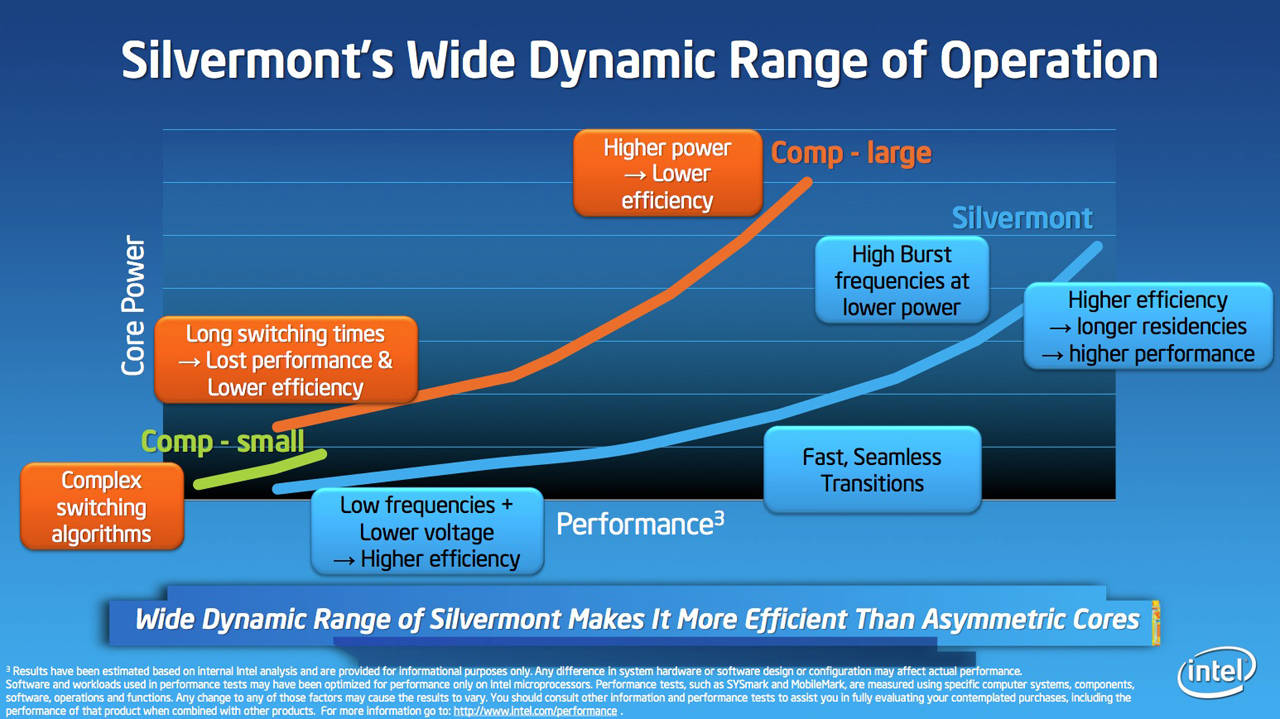
Yes, it does look vaguely similar to Intel's performance versus core power graph for Silvermont. I do wonder how ARM decided what scale Intel was using for it though - they probably just put it where they wanted to in order to claim themselves the victors.

It'd be fun to see where ARM wants to say Haswell is on that chart.

Again, like was just discussed, power consumption is much less simple than "less volts = more efficient". There are many other factors to consider other than operating voltage, including leakage (die size), process differences, die capacitance, and other factors like that. Saying something as simple as "it uses less volts, it is more efficient" is hopelessly simplistic and absolutely false.
Absolutely false? Come now, earlier you fully recognized the fact that it can be true (edit: or at least you stopped attempting to say I was incorrect about the simple fundamental property of dynamic power consumption.) Sure the statement made Mondozi does qualify as a tad bit too simplistic, but it's definitely the major factor in dynamic power consumption... and it requires a marked difference in the activity factor, capacitance, and frequency in order to make up for such large differences in voltage.
 
Last edited:

erunion

Senior member
Jan 20, 2013
765
0
0
In terms of Atom's main market, Windows market share is almost non-existent. It's nowhere in phones and nowhere in tablets.

Tablets -
slip.jpg


Note that Windows does have more market than shown here but not by much.

That isn't showing OS, its showing vendor. Note how it says Microsoft, not Windows. And the Surface RT uses Tegra 3, anyways. Current estimates put Windows Tablet marketshare around 7.5%.

Windows Phone is exclusively Qualcomm for the time being
 

sushiwarrior

Senior member
Mar 17, 2010
738
0
71
Absolutely false? Come now, earlier you fully recognized the fact that it can be true (edit: or at least you stopped attempting to say I was incorrect about the simple fundamental property of dynamic power consumption.) Sure the statement made Mondozi does qualify as a tad bit too simplistic, but it's definitely the major factor in dynamic power consumption... and it requires a marked difference in the activity factor, capacitance, and frequency in order to make up for such large differences in voltage.

No, I recognized that you are quoting a valid equation but absolutely murdering the theory behind it. A die that is more than 10 times the size is not going to magically use the same amount of transistors as one that is a fraction of the size. You are right that P=F*C*V^2, you are absolutely wrong that Haswell's C = A15 or A57's C. Please, don't quote formulas that you do not understand.
 

erunion

Senior member
Jan 20, 2013
765
0
0
That ARM slide is based on Intel's own numbers btw.

The footnote says its based on Intel claims. Which is an odd statement because just a few days before this ARM slide came out, Intel released a slide claiming the opposite. It showed Silvermont ahead of big.little in power and performance.

On what grounds did ARM feel justified in shifting the curves? Did they move their own chips to the right, or did they move Intel to the left? We don't know. Most likely ARM sampled Clovertrail and added 50% performance to the result. Is that guestimation going to be representative of baytrail/valleyview? Probably not.


silvermont_dynamic_range1_large.jpg
 

blackened23

Diamond Member
Jul 26, 2011
8,548
2
0
The footnote says its based on Intel claims. Which is an odd statement because just a few days before this ARM slide came out, Intel released a slide claiming the opposite. It showed Silvermont ahead of big.little in power and performance.

On what grounds did ARM feel justified in shifting the curves? Did they move their own chips to the right, or did they move Intel to the left? We don't know. Most likely ARM sampled Clovertrail and added 50% performance to the result. Is that guestimation going to be representative of baytrail/valleyview? Probably not.

I'm a big fan of letting the final product in a reviewer's hands do the talking. Marketing slides are a questionable source of information at best. :)

The nice thing is, we should get some real numbers for these parts next month. I won't lie, I really want ARM holdings to get extremely uncomfortable because they've shown some incredible arrogance with respect to intel over the prior two years. I want Silvermont to be the chip that sends them back to the drawing board - the intel chip that knocks their socks off and sends them scrambling. And then they'll have to retaliate with a design even better than the A15/57. Competition is a great thing, I certainly hope intel delivers on their claims here. If silvermont is as great as is claimed, that will just force ARMH to create even better product designs/IP.

Curious, how do you guys feel about a company demonstrating extreme hubris? ARMH has made repeating claims about how intel would never, ever catch them in terms of efficiency. That leaves a bad taste for me....and really makes me want to root against them. Maybe silvermont will be the chip that does it, maybe not, but I sure hope that it is.
 
Last edited:

podspi

Golden Member
Jan 11, 2011
1,982
102
106
You do realize that the market is new, right? And that having a bunch of overpriced 1366x768, Clover Trail or Tegra 3 10.1" tablets isn't going to really help.

When we see ~$200 Windows 8 tablets with Bay Trail, I think adoption for Windows tabs will skyrocket.

Yeah, I really can't wait for that to happen. Unfortunately, Microsoft has to get over the fact that people aren't going to pay for consumer OSes anymore. You make money by providing a platform and earning revenue from ads/app sales.

Microsoft's current model is having their cake and eating it too. Charge for the OS, and make money off the top from app sales, etc. Well, if there were any app sales :biggrin:


I do think that Windows tablets are going to be very popular once they become more affordable. My stupid ATIV 500t broke so I had to send it back to Samsung, and I've been stuck using my Kindle Fire and it has really made me appreciate how much I like the 500t (construction quality notwithstanding).
 

blackened23

Diamond Member
Jul 26, 2011
8,548
2
0
Yeah, I really can't wait for that to happen. Unfortunately, Microsoft has to get over the fact that people aren't going to pay for consumer OSes anymore. You make money by providing a platform and earning revenue from ads/app sales.

Microsoft's current model is having their cake and eating it too. Charge for the OS, and make money off the top from app sales, etc. Well, if there were any app sales :biggrin:

Well, there's a double pronged approach to solve this issue. First, MS is lowering the price of Windows licensing for tablet form factor devices beginning with Windows 8.1. I don't recall the specific price, but it will be a lot more competitive. Secondly, intel will be offering Bay Trail parts running android, as well.
 

dealcorn

Senior member
May 28, 2011
247
4
76
Several posts may be premature in criticizing Intel's McAfee purchase. I thought Intel was planning to conquer low power mobile markets when the name McAfee came up. If McAfee eases the acquisition of low power mobile market share, it may be a sterling acquisition even if McAfee revenues go to zero. It is clear that revenues from Intel's acquisition of Infineon may go to zero when Intel may integrate everything Infineon does into the SoC at 14 mn. Intel plays a long game and sometimes it takes time to see benefits. Intel is from perfect but give it some times before jumping to conclusions.
 

Abwx

Lifer
Apr 2, 2011
12,015
4,973
136
Several posts may be premature in criticizing Intel's McAfee purchase. I thought Intel was planning to conquer low power mobile markets when the name McAfee came up. If McAfee eases the acquisition of low power mobile market share, it may be a sterling acquisition even if McAfee revenues go to zero. It is clear that revenues from Intel's acquisition of Infineon may go to zero when Intel may integrate everything Infineon does into the SoC at 14 mn. Intel plays a long game and sometimes it takes time to see benefits. Intel is from perfect but give it some times before jumping to conclusions.

Michael mc afee is himself some kind of big virus seemingly
and all they bought was an infected corpse that is ending
bleeding behind intel doors in what has ended being a 7.68bn
a la madoff funeral ceremony.