• We’re currently investigating an issue related to the forum theme and styling that is impacting page layout and visual formatting. The problem has been identified, and we are actively working on a resolution. There is no impact to user data or functionality, this is strictly a front-end display issue. We’ll post an update once the fix has been deployed. Thanks for your patience while we get this sorted.

[Ashraf] 10nm "Lakefield" SoC with Intel big + little cores

His comment about in relation to Qualcomm seems a bit strange, unless Intel wants to use Lakefield to target Android devices.

-One about CPU being faster doesn't make sense because Icelake core should be faster than whatever QC has then.
-Graphics doesn't make sense unless they want to compare to say, AMD
-Lakefield also seems redundant as a Windows SoC, considering Intel will have alternatives. How does it differentiate from a Icelake-Y or U for example?

I've been thinking due to how the PC ecosystem works, big.little type of chips may be of little benefit, at least for a little while. Having tighter control like Android and iOS is a benefit here.
 
I've been thinking due to how the PC ecosystem works, big.little type of chips may be of little benefit, at least for a little while. Having tighter control like Android and iOS is a benefit here.
I would say the PC wouldn't see much benefit for long while yet with big-little type of CPUs, not with x86 at least anyway.
 
His comment about in relation to Qualcomm seems a bit strange, unless Intel wants to use Lakefield to target Android devices.

Well, as far as I've seen, Windows doesn't/can't support big.LITTLE or anything similar. You have to assume at this point that Lakefield would be targeted at Android and/or ChromeOS. Having competitive idle might be a big enough deal to make it worth it.
 
I would say the PC wouldn't see much benefit for long while yet with big-little type of CPUs, not with x86 at least anyway.

That's true. And while Microsoft can bake the support in with future Windows versions, both the application and the OS has to have its code optimized for it.

In theory, the benefits are great. In a horizontal business model that PC uses, it'll be difficult to achieve.
 
Windows 10 has added a scheduler that can support big.LITTLE for the new Qualcomm laptops.

Indeed, my HP Envy X2 does an excellent job managing the little cores. Even under normal operation Windows has always something to be scheduled on the little cores. When looking at the exceptional battery runtimes i suppose this is working much better than under Android - and this is while using normal Windows Apps.
Under standby there is almost no loss of battery charge per day. I calculate that this device can last 20-30 days in standby - an order of magnitude better than on any other Windows device i ever owned. As comparison my Surface Pro dies after 3-4 days in standby - so i always set it in into hibernate state.

It is absolutely surprising to me how good the Snapdragon is running Windows.
 
Last edited:
On a decent size Fanless Retina Laptop, you LITTLE CPU idle power saving translate to very little benefits. What exactly are there to gain for PC?

For Tablet or Smartphone? Well Intel aren't cost competitive.

For Apple? Sounds like only Apple cares about that extra 5% battery on MacBook, but it is still silly.

I am wondering if it has to do with cost, 2 LITTLE Core + 2 big Core, you still have Quad Core but likely only 3 Core Die Size or less. And 10nm it is expensive, Intel is trying to figure out a way best to capture the profits. So Instead of giving you Quad Core for the same price in 10nm, they will get you 2+2 Quad Core for the same prices, likely the margin is still the same given 10nm yield and price.
 
Indeed, my HP Envy X2 does an excellent job managing the little cores. Even under normal operation Windows has always something to be scheduled on the little cores. When looking at the exceptional battery runtimes i suppose this is working much better than under Android - and this is while using normal Windows Apps.
Under standby there is almost no loss of battery charge per day. I calculate that this device can last 20-30 days in standby - an order of magnitude better than on any other Windows device i ever owned. As comparison my Surface Pro dies after 3-4 days in standby - so i always set it in into hibernate state.

It is absolutely surprising to me how good the Snapdragon is running Windows.


Wait so they already launching it ? But where is the review?
 
Atom should be even more power efficient and needs to perform better in order to show how Intel might defeat the competition.
 
I am wondering if it has to do with cost, 2 LITTLE Core + 2 big Core, you still have Quad Core but likely only 3 Core Die Size or less. And 10nm it is expensive, Intel is trying to figure out a way best to capture the profits. So Instead of giving you Quad Core for the same price in 10nm, they will get you 2+2 Quad Core for the same prices, likely the margin is still the same given 10nm yield and price.

If a person looks at it from the standpoint of replacing Core 4C/8T then yes it could be seen as part for cutting cost.

However, I am seeing it as a part meant for performance replacing the low power (4.5W) 2C/4T. (So increasing costs rather than cutting costs, but obtaining a favorable performance gain in the process)
 
Last edited:
His comment about in relation to Qualcomm seems a bit strange, unless Intel wants to use Lakefield to target Android devices.

-One about CPU being faster doesn't make sense because Icelake core should be faster than whatever QC has then.
-Graphics doesn't make sense unless they want to compare to say, AMD
-Lakefield also seems redundant as a Windows SoC, considering Intel will have alternatives. How does it differentiate from a Icelake-Y or U for example?

I've been thinking due to how the PC ecosystem works, big.little type of chips may be of little benefit, at least for a little while. Having tighter control like Android and iOS is a benefit here.
I don't expect intel to target Android, unless Google really wants that, the thing I don't expect unless Google sees the Intel CPU is so impressive users can't ignore. I expect that, but I think Android has a future with ARM, as alternative computing devices. Intel is combining atom & ice lake as a 5 cores cpu. It will solve battery life problem windows has, because it is only idle problem..
 
Windows 10 has added a scheduler that can support big.LITTLE for the new Qualcomm laptops.

Exactly. I think this is where Intel will fight Qualcomm first. Whether or not Lakefield makes its way into Chromebooks remains to be seen. Qualcomm already has the Snapdragon 850 in Win10 devices now, and I expect them to follow up with the 8180 or whatever it is sometime pretty soon (to compete with A12x/Kirin 980).
 
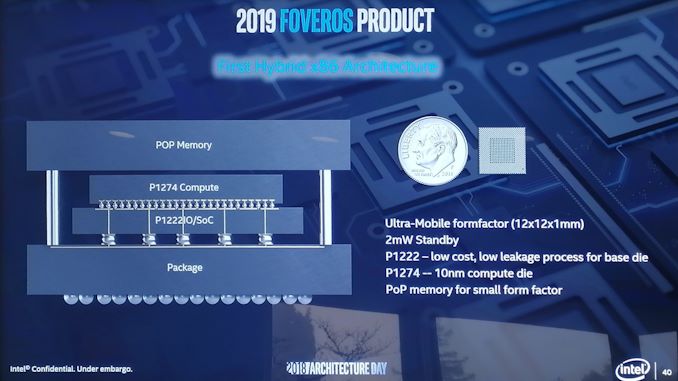
So apparently it is 1 big and 4 small after all. Plus it's using Foveros to have a base die using 22 FFL.

Edit: I wonder who the customer is who wanted it. I doubt it's Apple... 64 EUs is not going to be small.
 
So apparently it is 1 big and 4 small after all. Plus it's using Foveros to have a base die using 22 FFL.

Edit: I wonder who the customer is who wanted it. I doubt it's Apple... 64 EUs is not going to be small.
Package size is 144mm^2, so it isn't massive.

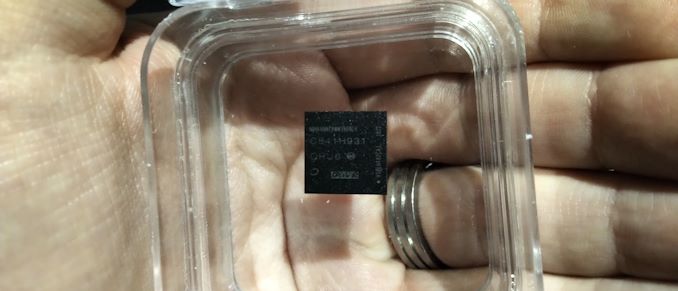
FovChip1_575px.jpg

Foveros%20%281%29_575px.jpg
 
BTW, I thought it a bit and thought that perhaps the customer is Microsoft for a Surface, but probally not. Maybe for an industrial use that would need the GPU for some reason and wants/needs very low idle. So lowish volume but something that would be doable with even super terrible yield.
 
40-50 mm2 is massive for 10 nm.

How would you know the exact size?

They said Gen 11 will be 25% smaller while using 25% less power. That's in the 30-35mm2 range.

Package size is 144mm^2, so it isn't massive.

Yea it should be quite small, possibly in the 70mm2 range.

The demonstration was interesting. The system was smart enough at this point to allocate resources to different cores as required.
 
How would you know the exact size?

They said Gen 11 will be 25% smaller while using 25% less power. That's in the 30-35mm2 range.

Smaller at equivalent node or compared to Gen9.5 on 14 nm?

You would have to include the CPU core too at least, which is probally another 8-10 mm2 although I wonder if the L3 is on the top die or not.
 
Smaller at equivalent node or compared to Gen9.5 on 14 nm?

Update: Techreport says 25% reduction is at the same process.

You would have to include the CPU core too at least, which is probally another 8-10 mm2 although I wonder if the L3 is on the top die or not.

This depends on whether Intel wants to sacrifice L3 latency. Having it on another die will do this. If they want to keep it in a ring bus then it'll all be on the same die.
 
Last edited:
Nice scoop Ashraf 🙂

EDIT: This definitely sounds like a nice product for a portable gaming device- especially with the 64EU GPU, and Adaptive Sync support to help deal with any framerate dips.
 
Last edited:
Back
Top