• We’re currently investigating an issue related to the forum theme and styling that is impacting page layout and visual formatting. The problem has been identified, and we are actively working on a resolution. There is no impact to user data or functionality, this is strictly a front-end display issue. We’ll post an update once the fix has been deployed. Thanks for your patience while we get this sorted.

[Ars Technica] IBM and the 7 nm breakthrough

Page 2 - Seeking answers? Join the AnandTech community: where nearly half-a-million members share solutions and discuss the latest tech.
Just marketing, but suddenly there are tons of articles claiming Intel's process lead is gone -- it really annoys me. Lol. Even EETimes fails to understand that not all 7nm transistors are created equal, and not all TTM dates are equal.

And good luck IBM getting ~80% yields with that quadruple patterning, you also have to do that 😉.
 
Last edited:
It really does doesn't it?
It really annoys you that IBM springs out of the dark with superior tech and 1up's Intel like that. Guess Intel is not the only kid in town with an R&D bidget. Deal with it.

Can you tell me where I can buy chips manufactured with IBM's 10nm tech? I'll even be OK with an example of its 14nm tech.
 
We all know Intel has the process lead but it's examples like this from IBM and the fact that Intel is being oddly quiet about anything below 10nm that has to make you wonder if they are starting to lose the process manufacturing gap.

This is great news as it brings more competition, which let's be honest, we all benefit from. I don't know why anyone would be upset about this.
 
We all know Intel has the process lead but it's examples like this from IBM and the fact that Intel is being oddly quiet about anything below 10nm that has to make you wonder if they are starting to lose the process manufacturing gap.

This is great news as it brings more competition, which let's be honest, we all benefit from. I don't know why anyone would be upset about this.

Its quite obvious why intel is quiet. IDC gave an explanation on the matter. When Intel announced FinFets, so did Samsung and TSMC suddenly.

No need to give the competition more hints than they need.

And from a consumer perspective its pointless. Only us nerds here care about it. The average person just cares about the performance metrics.
 
IBM teamed with GF? Is that wise?

Wise or not, IBM finished sale/delivery of all their fabs and attached process engineers to GF recently. GF is now handling all production of 22nm SOI (POWER8), and will probably handle future implementations of nodes used for IBM products.
 
Its quite obvious why intel is quiet. IDC gave an explanation on the matter. When Intel announced FinFets, so did Samsung and TSMC suddenly.

No need to give the competition more hints than they need.

And from a consumer perspective its pointless. Only us nerds here care about it. The average person just cares about the performance metrics.

Yeah, because Samsung and TSMC are only informed of Intel's movements because of Intel's public statements.


The naiveness in your posts is so dishearting sometimes :\
 
Last edited:
Can you tell me where I can buy chips manufactured with IBM's 10nm tech? I'll even be OK with an example of its 14nm tech.

Sure I2P:IRC#shitthatkicksintelsarse
Anyway, you're not the game I was hunting, seems it has realized its mistake and crawled back into its hole for now.
 
Just marketing, but suddenly there are tons of articles claiming Intel's process lead is gone -- it really annoys me. Lol. Even EETimes fails to understand that not all 7nm transistors are created equal, and not all TTM dates are equal.

And good luck IBM getting ~80% yields with that quadruple patterning, you also have to do that 😉.

Well, according to Ars, they will be using EUV** (wonder if IBM/GLF/SAM were the big buyers of of the recent EUV purchase?) - hence, no need for quad patterning.

The odd thing to me is that is that @ 7nm IBM is sticking with just FinFETs and SiGe. I would expect more significant changes in materials/geometry or both to get high enough drive currents.

**Edit: Hmm, it says SAQR and EUV. Sounds like IBM is really trying to push this out early - otherwise I think it would be all EUV if it were going to be a couple of years later than the press release specifies.
 
Last edited:
Do you interface with the process teams at all?
Not so much, it's usually the PDK and library groups who do that, unless something goes horribly wrong with the PDV deck and/or libraries that necessitates me putting my boot to some patoot 😉
 
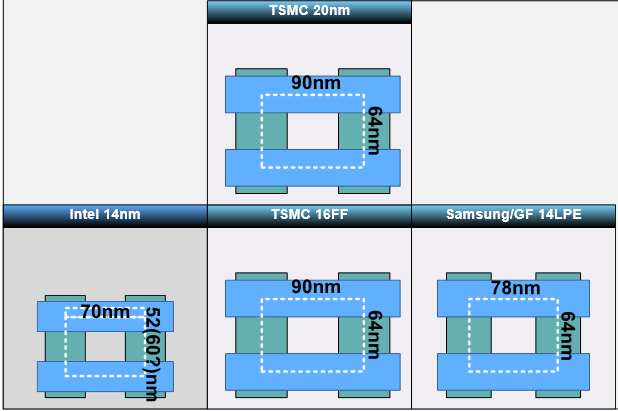
High end cellphone processors are where the money is these days. Apple has been at 20nm since September last year, Samsung's been shipping a 14nm processor for months.

"14nm"

Cell-SizeComparison.png


Samsungs advertising makes me feel dirty for calling it 14nm. It's not comparable. Plus, Intel is the only one using 14 for both front end of line and back end of line.
 
Needing quad with EUV inst impressive at all. Everyone can roughly do that now.

I only just skimmed this thread, so apologies if this has already been discussed, but the quad-patterning w/EUV was a misprint by IBM. It is single-pattern w/EUV but they can get the same results (allegedly) with a more expensive quad-patterning integration using traditional immersion-litho.

In general though, this is an R&D milestone no different than what every other process tech development team is going through all over the planet. What is different here is that IBM elected to showcase their achieving this milestone in such a public fashion.

And IMO the reason why they did so is clear - it is imperative that IBM demonstrate to their shareholders that the decision to gift $1.5B, 2 fabs, and 16,000 patents to GloFo whilst retaining their R&D labs was a decision that does not prevent or undermine IBM's applied research efforts.

But we've seen these sorts of premature "we did it!" press releases from IBM before, 45nm HKMG being one of them. And the management is still the same, so don't expect much more behind this press release than what came from all the others before it.

The good news is that in this day and age one can truthfully say that if IBM can do it then so too can practically everyone else who is in the running to produce a 7nm logic node. And that means good news for us customers of low-cost foundry providers the likes of UMC and SMIC, not to mention TSMC and Samsung who are most assuredly well past this milestone in their own internal 7nm development efforts (but have no need to get the press releases out to sate their shareholders as IBM does).

Not trying to understate the significance or relevance of IBM's integration efforts. Just saying that there isn't really anything revolutionary or groundbreaking here. Everyone is doing the same thing in R&D, but as we saw with Intel's 14nm the deal-killer is ramping these nodes to yield entitlement.

If you don't get the yield then you don't get the chips into the market, at which point it didn't make a difference when you accomplished xyz in R&D. So I will reserve my excitement for the press release detailing something about yield results or something akin to a solid production timeline. If I want to see super-cool transistor results from R&D labs then the IBM press release definitely meets that, but I'd rather see a chip I can buy that uses said super-cool transistors.

 
The good news is that in this day and age one can truthfully say that if IBM can do it then so too can practically everyone else who is in the running to produce a 7nm logic node. And that means good news for us customers of low-cost foundry providers the likes of UMC and SMIC, not to mention TSMC and Samsung who are most assuredly well past this milestone in their own internal 7nm development efforts (but have no need to get the press releases out to sate their shareholders as IBM does).

Very interesting insight on this topic. Thanks!

I'm not that familiar with IBM's position in the semiconductor industry, but from earlier posts I got the impression that IBM usually does a lot of early research and then sells patents to other players in the industry. If so, doesn't that mean that they have to stay ahead of the competition research-wise, at least at this stage of the research? I mean if TSMC/GF/Samsung/Intel already have come as far as IBM in their 7 nm research, don't they already hold the necessary solutions and thus patents?

Maybe I'm misinterpreting something here, but I'm just trying to form a picture of how all of this fits together.
 
Everyone in the industry - or any other major industry - cross licenses their patents. Otherwise nobody would be able to build modern chips.

As IDC said, the IBM deal includes 16,000 patents. That means their competitors would have to come up with a different way of doing those 16,000 things if IBM didn't cross license them. Similarly IBM would have to come up with a different way doing everything else every other chip designer/manufacturer has a patent for. And so would Intel, TSMC, Samsung, etc.

It would be way too costly, the industry would grind to a halt.
 
Back
Top