• We’re currently investigating an issue related to the forum theme and styling that is impacting page layout and visual formatting. The problem has been identified, and we are actively working on a resolution. There is no impact to user data or functionality, this is strictly a front-end display issue. We’ll post an update once the fix has been deployed. Thanks for your patience while we get this sorted.

Discussion Apple Silicon SoC thread

Page 487 - Seeking answers? Join the AnandTech community: where nearly half-a-million members share solutions and discuss the latest tech.

Eug

Lifer
M1
5 nm
Unified memory architecture - LP-DDR4
16 billion transistors

8-core CPU

4 high-performance cores
192 KB instruction cache
128 KB data cache
Shared 12 MB L2 cache

4 high-efficiency cores
128 KB instruction cache
64 KB data cache
Shared 4 MB L2 cache
(Apple claims the 4 high-effiency cores alone perform like a dual-core Intel MacBook Air)

8-core iGPU (but there is a 7-core variant, likely with one inactive core)
128 execution units
Up to 24576 concurrent threads
2.6 Teraflops
82 Gigatexels/s
41 gigapixels/s

16-core neural engine
Secure Enclave
USB 4

Products:
$999 ($899 edu) 13" MacBook Air (fanless) - 18 hour video playback battery life
$699 Mac mini (with fan)
$1299 ($1199 edu) 13" MacBook Pro (with fan) - 20 hour video playback battery life

Memory options 8 GB and 16 GB. No 32 GB option (unless you go Intel).

It should be noted that the M1 chip in these three Macs is the same (aside from GPU core number). Basically, Apple is taking the same approach which these chips as they do the iPhones and iPads. Just one SKU (excluding the X variants), which is the same across all iDevices (aside from maybe slight clock speed differences occasionally).

EDIT:

Screen-Shot-2021-10-18-at-1.20.47-PM.jpg

M1 Pro 8-core CPU (6+2), 14-core GPU
M1 Pro 10-core CPU (8+2), 14-core GPU
M1 Pro 10-core CPU (8+2), 16-core GPU
M1 Max 10-core CPU (8+2), 24-core GPU
M1 Max 10-core CPU (8+2), 32-core GPU

M1 Pro and M1 Max discussion here:


M1 Ultra discussion here:


M2 discussion here:


Second Generation 5 nm
Unified memory architecture - LPDDR5, up to 24 GB and 100 GB/s
20 billion transistors

8-core CPU

4 high-performance cores
192 KB instruction cache
128 KB data cache
Shared 16 MB L2 cache

4 high-efficiency cores
128 KB instruction cache
64 KB data cache
Shared 4 MB L2 cache

10-core iGPU (but there is an 8-core variant)
3.6 Teraflops

16-core neural engine
Secure Enclave
USB 4

Hardware acceleration for 8K h.264, h.264, ProRes

M3 Family discussion here:


M4 Family discussion here:


M5 Family discussion here:

 
Last edited:
I definitely think Apple is best positioned to thrive in this memory constrained markets. They will start to sell out all computers priced until say 4k or so. Unless they can up the supply. Mac revenue will show huge growth for sure.
 
It almost feels like they want to cap the sales of Neo to not impact MBA sales. I think they can double the output and will sell out all of them.
Generally Apple doesn't care about cannibalization. That's one of Jobs' residual values in the culture - better to cannibalize your own stuff than have someone else do it. And Apple normally maintains fairly uniform margins across their products to help with this.

That's also supported by the lack of internal P&L. Apple doesn't care which vector brings the money in. So if Apple sells 50% more Neos at the expense of Airs, then in terms of revenue and income on those they probably come out the same, and they might even boost services with more AppleCare, AppleTV, etc. due to having more users. This is why Apple running AppleTV at a potential loss isn't a big problem for them - just as the iTMS ran break even or below for years, as did the App Store. Those were value-add to the hardware business and didn't need their own P&L.

They are very holistic about this stuff. If the cannibalization is a real problem then they'd adjust the value since they design to price point and add/remove value. So they might add value to the Air next time (which could be as simple as colors - colors carry more value than you realize.)
 
From my little slice of the industry, there were a LOT of purchases made in 2025 related to the end of support for Windows 10 that were brought forward. We've had very little purchasing this year.
That makes sense. Still leaves Apple up, but in terms of share there's an underlying shift that needs to be viewed over a longer period.

I'll be surprised if this isn't durable though. I'm seeing a LOT of Windows people picking up their first Mac and saying 'hey, this is really nice'. Microsoft may not get them back.
 
Apple is claimed to "buying up all the DRAM to prevent their competition from getting any" but what is probably happening is that Apple's long term contracts for DRAM only guarantee a certain amount and because they are seeing higher demand they need to find more wherever they can.
Yes, my understanding of the typical prepurchase agreement by Apple is just that. They are buying a fixed amount of capacity and have first refusal on everything produced until that contract is complete (in time or dollars). They tend to overbuy since they can refuse, but they may not have anticipated this kind of increase, and they may have figured that there would be some market availability that they could buy if they came up short, which may now not exist.

The flipside with Apple is you don't want to get on their bad side, because they are a lot of money and they put a lot of it guaranteed up front. They are the bank in a lot of cases. Given how few memory suppliers there are and how big the other players like Nvidia are, that may not be the advantage it once was, but there is still a politics of who you find capacity for. In 5 years time Apple will still be writing checks that big, but will Nvidia? Because Apple will remember who came through for them.
 
There are projections that Apple is going to grow volume significantly from 21 million units to 28 million units with the Macbook NEO while others are projected to decline ~5%. They will be firm #3 vendor after this.

The fact that it has only 8GB or not is not a hindrance. 8GB is perfectly fine for web browsing, powerpoint, video watching, or even lighting editing applications. Heck I was at 8GB for the longest time, *until* I started playing a game again. Most enthusiasts fail to recognize this.

The NEO is going to add pain to already a very strained market due to high prices driven by AI datacenter push. They are going to have to cut and cut and cut to reach $499/599 prices NEO will be at.
 
There are projections that Apple is going to grow volume significantly from 21 million units to 28 million units with the Macbook NEO while others are projected to decline ~5%. They will be firm #3 vendor after this.

The fact that it has only 8GB or not is not a hindrance. 8GB is perfectly fine for web browsing, powerpoint, video watching, or even lighting editing applications. Heck I was at 8GB for the longest time, *until* I started playing a game again. Most enthusiasts fail to recognize this.

The NEO is going to add pain to already a very strained market due to high prices driven by AI datacenter push. They are going to have to cut and cut and cut to reach $499/599 prices NEO will be at.
The Neo is fine for basic use but lags a bit right out of the box. It will move to 12 GB at its next iteration, and I would not be surprised if the 12 GB Neo comes with a price increase.
 
An excerpt from an article disassembling the latest five laptop models, including the M5 Pro/Max MBP.


Disassembling 5 latest laptop models: what are the internal differences between the new and old MacBook Pro?
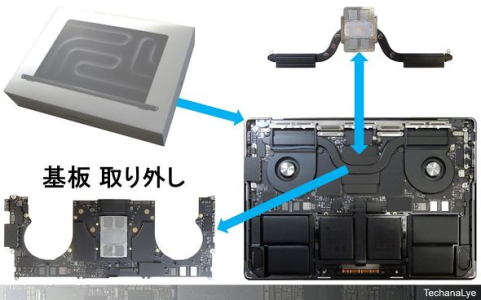
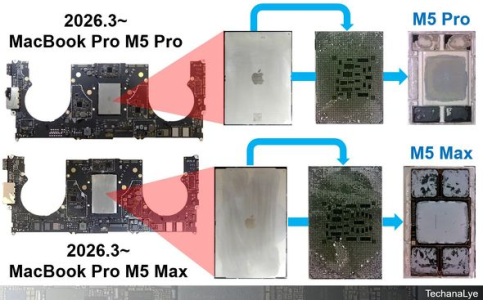
Figure 1 shows the “MacBook Pro M5 Max,” released by Apple on March 11, 2026. On the same day, the “MacBook Pro M5 Pro” was also released. The hardware configuration is almost identical for both the M5 Max and M5 Pro versions. The cooling fan, battery, and display are exactly the same. The differences between the M5 Max and M5 Pro versions are limited to the processor in the center of the motherboard (bottom left of Figure 1) being different, and the shape of the heatsink used to cool the processor (top right of Figure 1).
1777313565760.png
In terms of the chip, the only differences lie in the processor at the center of the motherboard and the power ICs arranged around it. On the left and right sides of the board are Thunderbolt 5 and HDMI ports, as well as a memory card slot, but these are exactly the same in both the M5 Max and M5 Pro versions. A large portion of the components is shared.

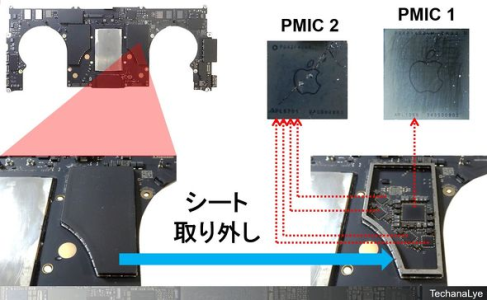
Figure 2 shows the disassembly of the power IC section of the MacBook Pro M5 Max. The power control components are arranged to surround the processor on all sides—left, right, top, and bottom. They are separated by a metal shielding frame, with a heat-dissipation sheet attached on top. In the M5 Max version, four types of power ICs are placed around the processor, handling power management functions such as dynamic voltage and frequency scaling (DVFS). All of these power ICs have Apple’s proprietary chip designation “APLXXXX” printed on their packages, along with the Apple logo. For Apple, power design aimed at maximizing performance is just as important as the processor itself.

1777313635341.png

Across all Apple products—such as the iPhone, Apple Watch, and AirPods—Apple consistently pairs its own processors with Apple-designed power ICs. In 2018, Apple acquired part of the power IC business of Dialog Semiconductor (later acquired by Renesas Electronics in 2021), which had previously supplied power ICs for many of its products. Since then, Apple has shifted to in-house development of power ICs, and today most of them are Apple-made (although some components from Texas Instruments and Dialog are still used in certain cases).

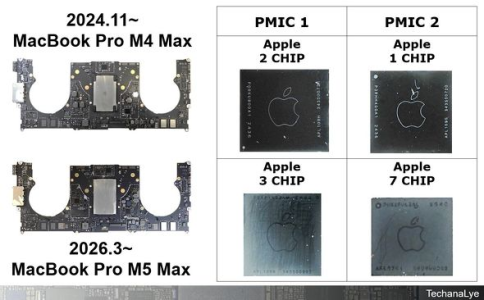
Table 1 shows the “MacBook Pro M4 Max,” released in November 2024, on the top, and the latest M5 Max version on the bottom. The motherboard size, port positions, and overall shape are exactly the same. The differences are limited to the processor and the power ICs (with some minor variations in details). While the M5 Pro and M5 Max versions share many common elements in their boards, the M4 Max and M5 Max versions are also nearly identical. In other words, Apple builds its lineup by keeping a consistent base design and swapping out the processor and power ICs.

1777313715634.png

Due to space limitations, this time the details are omitted, but from the 2021 “MacBook Pro M1 Max” to the 2026 M5 Max version, the fundamental internal architecture has remained the same. While there have been advancements such as processor evolution, increased memory capacity, faster interface standards (from Thunderbolt 4 to Thunderbolt 5), and updated Wi-Fi versions, the core design has been maintained.

However, the power ICs have changed significantly. The M4 Max version used three power ICs to control the processor, whereas the M5 Max version is equipped with more than three times as many—ten power ICs.
This is because miniaturization has increased the number of functions and cores, requiring more granular and finely tuned power control. The processor is completely surrounded by power ICs (as well as passive components for electrical characteristics). The role and number of power ICs have grown dramatically. The same trend can be seen in NVIDIA’s latest GPU boards, automotive-focused Thor, and DGX Spark. Manufacturers specializing in power management ICs are also experiencing remarkable growth in the AI sector (details omitted here).

Figure 3 shows the back side of the package and the chip with the metal lid removed: the top image is the M5 Pro version, and the bottom image is the M5 Max version. The back side of the package is densely populated with silicon capacitors for power stabilization. Once the metal lid is removed, the internal processor and Unified Memory become visible. The processor is a chiplet composed of multiple silicon dies, including filler. Further details will be covered in a separate chip teardown section. In both the M5 Pro and M5 Max versions, the CPU-side silicon is the same. Memory has also been analyzed separately, and between the M5 Pro and M5 Max versions, capacity, bandwidth, and bit width are fully scalable (in integer multiples).

1777313793714.png


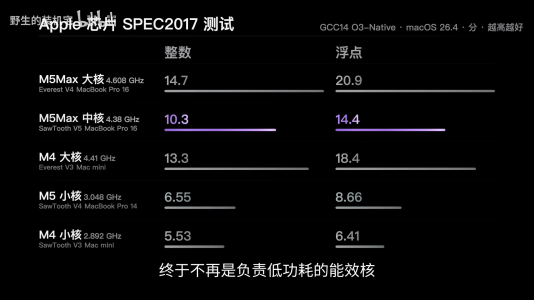
Haven't seen any rumors about this so it is pure speculation but now that Apple has a "middle" core, and the Neo, I wonder if they might change the makeup of their iPhone SoCs to include it.

It doesn't NEED it, but if they went to a 2/2/2 (or whatever) with A20P that would further differentiate with the SoC used in the base models, and that would give a boost to Neo in a year or two when it starts shipping with A20P.

It would bump to MT performance and while I've long been on the record as saying that peak MT is a stupid benchmark for phones because there are no use cases where you max out all cores in any sort of sustained way, it isn't a stupid benchmark for PCs like the Neo.
 
It doesn't NEED it, but if they went to a 2/2/2 (or whatever) with A20P that would further differentiate with the SoC used in the base models, and that would give a boost to Neo in a year or two when it starts shipping with A20P.

It would bump to MT performance and while I've long been on the record as saying that peak MT is a stupid benchmark for phones because there are no use cases where you max out all cores in any sort of sustained way, it isn't a stupid benchmark for PCs like the Neo.

They might finally go up to 8? 2+2+4
Honestly 2/2/2 or even 1/2/3 is the way. No one is running cinememe on their phone.
 
Honestly 2/2/2 or even 1/2/3 is the way. No one is running cinememe on their phone.
Unless, the new core is significantly larger than the e core, I still say the e core is done. If that earlier power curve is anywhere close to accurate.

The new core has only slightly less performance per watt than the e core at low frequencies. My vote for A20 2 + 4 new core, a significant nT bump.
 
It would bump to MT performance and while I've long been on the record as saying that peak MT is a stupid benchmark for phones because there are no use cases where you max out all cores in any sort of sustained way, it isn't a stupid benchmark for PCs like the Neo

Some games might exercise multiple cores quite heavily. Not as well as production workloads, but enough to make the performance important.

For what most people will use a Neo for, MT performance isn't all that important either. The RAM limitations would keep additional cores starved in a lot of the situations where they might otherwise shine.

Having a third core is a good idea, but what does it do best or what is its reason to exist? The problem they face is that they can be hard to justify. It's too easy to imagine not having them to save on area or substituting them for a larger number of smaller or more efficient cores.
 
They might finally go up to 8? 2+2+4
What's the point of mid cores on a device that has only a single foreground process and a bunch of background ones? How many users on these devices (other than the M series iPad Pros) are using processes that scale well with cores? No, these are devices that are effectively quarantining processes to their own cores - 1 for the OS and it's APIs, plus background user processes, 1 for the foreground process, and E cores for the gazillion background processes.

The use cases for phones isn't changing. And the nature of the apps being used by users isn't changing either. They are almost exclusively big single thread dominated apps that scale poorly with additional cores and almost all of them are I/O constrained to the degree that the user gets frustrated.
 
Some games might exercise multiple cores quite heavily. Not as well as production workloads, but enough to make the performance important.

For what most people will use a Neo for, MT performance isn't all that important either. The RAM limitations would keep additional cores starved in a lot of the situations where they might otherwise shine.

Having a third core is a good idea, but what does it do best or what is its reason to exist? The problem they face is that they can be hard to justify. It's too easy to imagine not having them to save on area or substituting them for a larger number of smaller or more efficient cores.
Performance games are maybe a thing on Android in China, but even there they aren't a big market (iPhone growing share in China). The mobile games market is as big as it is because they run fine on $50 phones and 6 year old phones. Even the big gashapon games aren't leaving those markets behind.
 
The use cases for phones isn't changing
High QoS background services if it is indeed more energy efficient
Low QoS but foreground dispatch queue
iOS is flexible enough for it to work. Though not necessarily desirable.
But like Doug was saying, A SoC isn't only for iOS anymore.
 
Haven't seen any rumors about this so it is pure speculation but now that Apple has a "middle" core, and the Neo, I wonder if they might change the makeup of their iPhone SoCs to include it.

It doesn't NEED it, but if they went to a 2/2/2 (or whatever) with A20P that would further differentiate with the SoC used in the base models, and that would give a boost to Neo in a year or two when it starts shipping with A20P.

It would bump to MT performance and while I've long been on the record as saying that peak MT is a stupid benchmark for phones because there are no use cases where you max out all cores in any sort of sustained way, it isn't a stupid benchmark for PCs like the Neo.

My personal suggestion is that Apple will drop the E-core and announce a new HE-core.
E-cores were (handwaving) 1/3 the performance at 1/3 the energy to perform a given task (relative to S core).
The HE (HIGH Efficiency) core can be 1/10 the performance at 1/10 the energy to perform a given task. You could achieve this (and maybe better) by starting with an in-order 3-wide core and throwing a large suite of very carefully chosen optimizations at it.

What's the point of a core so slow? Your phone (and your watch) do a lot of stuff behind the scenes, eg handling notifications, tracking reminders, checking for email. An E-core is way overkill for this.
My feeling is a combo of 2S+4P+2HE could be very nice in terms of feeling faster than the current A19 while also having a much longer "idle" life.

One element to this which I have no feel for is how much more difficult each additional variation makes the OS scheduler.
On other hand, a pair of HE cores is so small that, in a sense, who cares? Just treat them as dedicated hardware that's only used for various specific scenarios (most importantly when the screen is "dark") and don't even bother about trying to get use from them outside that scenario?
 
Back
Top