• We’re currently investigating an issue related to the forum theme and styling that is impacting page layout and visual formatting. The problem has been identified, and we are actively working on a resolution. There is no impact to user data or functionality, this is strictly a front-end display issue. We’ll post an update once the fix has been deployed. Thanks for your patience while we get this sorted.

Discussion Apple Silicon SoC thread

Page 473 - Seeking answers? Join the AnandTech community: where nearly half-a-million members share solutions and discuss the latest tech.

Eug

Lifer
M1
5 nm
Unified memory architecture - LP-DDR4
16 billion transistors

8-core CPU

4 high-performance cores
192 KB instruction cache
128 KB data cache
Shared 12 MB L2 cache

4 high-efficiency cores
128 KB instruction cache
64 KB data cache
Shared 4 MB L2 cache
(Apple claims the 4 high-effiency cores alone perform like a dual-core Intel MacBook Air)

8-core iGPU (but there is a 7-core variant, likely with one inactive core)
128 execution units
Up to 24576 concurrent threads
2.6 Teraflops
82 Gigatexels/s
41 gigapixels/s

16-core neural engine
Secure Enclave
USB 4

Products:
$999 ($899 edu) 13" MacBook Air (fanless) - 18 hour video playback battery life
$699 Mac mini (with fan)
$1299 ($1199 edu) 13" MacBook Pro (with fan) - 20 hour video playback battery life

Memory options 8 GB and 16 GB. No 32 GB option (unless you go Intel).

It should be noted that the M1 chip in these three Macs is the same (aside from GPU core number). Basically, Apple is taking the same approach which these chips as they do the iPhones and iPads. Just one SKU (excluding the X variants), which is the same across all iDevices (aside from maybe slight clock speed differences occasionally).

EDIT:

Screen-Shot-2021-10-18-at-1.20.47-PM.jpg

M1 Pro 8-core CPU (6+2), 14-core GPU
M1 Pro 10-core CPU (8+2), 14-core GPU
M1 Pro 10-core CPU (8+2), 16-core GPU
M1 Max 10-core CPU (8+2), 24-core GPU
M1 Max 10-core CPU (8+2), 32-core GPU

M1 Pro and M1 Max discussion here:


M1 Ultra discussion here:


M2 discussion here:


Second Generation 5 nm
Unified memory architecture - LPDDR5, up to 24 GB and 100 GB/s
20 billion transistors

8-core CPU

4 high-performance cores
192 KB instruction cache
128 KB data cache
Shared 16 MB L2 cache

4 high-efficiency cores
128 KB instruction cache
64 KB data cache
Shared 4 MB L2 cache

10-core iGPU (but there is an 8-core variant)
3.6 Teraflops

16-core neural engine
Secure Enclave
USB 4

Hardware acceleration for 8K h.264, h.264, ProRes

M3 Family discussion here:


M4 Family discussion here:


M5 Family discussion here:

 
Last edited:
Apple is coming from a consumer perspective that is different for your perspective. The build almost 300 million consumer ‘computers’ a year between iPhones and iPads. They integrated the SSD controller into the CPU and soldered the NAND onto the motherboard for these devices It saves energy, money, improves security and the only thing abnormal is they don’t buy third party NAND controllers. Are there smartphones where the DRAM or NAND are upgradeable? The Mac is about 1/10 the market size and smaller than the iPad market where the integrated SSD controller makes sense.

Rescuing data from a dead motherboard should never be an issue. There is a much higher probability that an SSD will die versus a motherboard. Good back up practices are essential for preventing loss of data for any type of failure.

This forum represents a user population biased to modifying and ‘updating’ traditional PCs. I think the bulk of the market, smartphone and even corporate users live with whatever they bought until they replace tham. With the current speeds available through USB and Thunderbolt the external drive market handles most of the needs for external memory.

I used to buy Apple hardware with minimum DRAM and hard drive and upgrade them myself because of the premium Apple charged. Apple since the original 128K Mac has always flipped between user upgradeable and locked down. I think the world is shifting increasingly to ‘appliance’ computing for consumers serving over 5 billion users. I use an iPad for a lot of my computing needs and have to spring for the size of SSD I think I will need.
I will add that as devices get cheaper, the fractional cost of warranty service goes up. An awful lot of the 'simplification' decisions that Apple makes are due to warranty service realities. There was a point in time that Apple Stores could not keep up with in store warranty demand (one of the nicer benefits of owning Apple devices) and they needed to find ways to balance that out. Losing the headphone jack was one of the ways of doing that since dropping your phone and catching it via the wired headphones broke a lot of the solders to the connector and required warranty service.

Apples (and everyone else's) actuaries will tell them that the ideal product from a warranty perspective (which is also annoyance to the user because their device broke perspective) is a solid aluminum slab with an embedded, sealed glass screen, with no mechanical controls or mechanical connectors inside or out, which is pretty damn close to what Apple has delivered at various points. But that's the gravity well that Apple is always being pulled toward, for good or bad. Maintaining a supply chain for replacement parts isn't free, and I think tech people lose sight of the deflationary price of tech relative to the inflationary cost of repair labor, supply chain, and so on and get annoyed that repair keeps coming off the table when it's pretty clear that warranty is inflationary relative to device construction cost and you have a choice of either raising prices to cover your future warranty liability or cutting warranty costs by eliminating potential points for repair.

When I set up the university's student laptop program we would only recommend laptops that had at least 2 years of local warranty support - on site, or a location where a student could reasonably take it. Mail in warranties would leave the student without a machine they might need for an assignment for too long. When you looked at the cheap Costco laptops, pulling them up to a decent warranty nearly doubled their price and closed a lot of the gap to something like a MBA with AppleCare. And that was across all vendors - HP, Lenovo, Asus, etc. Everyone knows what these cost are, and what incurs them. Apple by all indications has the lowest warranty liability of anyone in the industry, and a lot of those vendors are calculating that they won't need to pay that liability because if the laptop is cheap enough, the user will just bin it rather than seek a repair.
 
This forum represents a user population biased to modifying and ‘updating’ traditional PCs. I think the bulk of the market, smartphone and even corporate users live with whatever they bought until they replace tham.

Yes I've posted here many times that back in 2015 it was reported fewer than 10% of PCs were EVER opened up. So not only not people doing stuff like CPU upgrades, repairing broken fans or whatever but not even upgrading RAM or storage. The typical consumer just does not do that, ever.

Safe to say that number is even lower in 2026. Apple is not losing many customers by not making Macs upgradeable post sale, especially since the types of people most likely to crack open their PC case are hardcore gamers who have never been a target market for the Mac.

It would be "nice to have" but isn't costing Apple much other the ire of people like @Jan Olšan who would likely never considering buying Apple products no matter what changes they made.
 
to use regular NVMe drives like.
Apple Sillicon can’t use standard NVMe drives from the shelf because they have a controller which cannot be trusted by Apple's security model but instead can ONLY use RAW NAND modules as the primary boot drive from the factory and if you actually read documentation written by Asahi Linux and others as to why that is, it would make sense to you. You can however add extra storage later via PCIe or USB/Thunderbolt but the boot process ALWAYS happens from the Apple SoC.

That is why I always say for Apple to make the SSD prices upgrade cheaper and to add modular NAND modules like they do on Mac mini, Studio and Pro for their laptops too.
Because you are wrong, the security aspect doesn't rule them out at all. Encryption scheme where the keys always stay in the SoC and the encryption is solely implemented and controlled by the SoC and only encrypted data are ever stored to the actual SSD is perfectly possible with regular SSD too. Actually, Intel with Microsoft are now rolling exactly that with the Panther Lake SoCs.
> the encryption is solely implemented and controlled by the SoC

This is false. Intel and Microsoft's implemenation is not controlled by the SoC only but by Windows. Panther Lake does not have a feature like Apple's Secure Enclave and is far from Apple's implemenation of encryption.

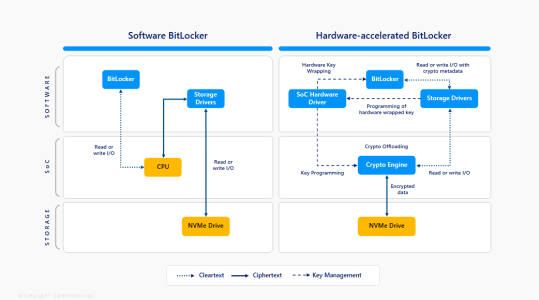
The diagram that Microsoft provided in the hardware-accelerated Bitlocker announcement proves it.

Screenshot 2025-12-18 131458.png

On PC, the SoC only handles the key unwrapping using its hardware defined key and performs bulk AES operations. Everything else such as deciding when to encrypt, programming the key into Crypto Engine and access policy is managed by Windows and its drivers.

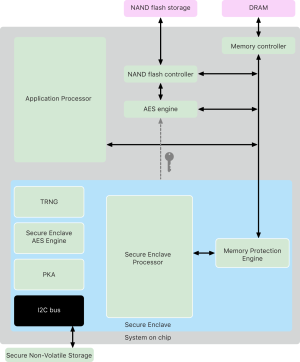
On the Apple side, the Secure Enclave i.e the SoC decides everything letting macOS only to send operation requests such as entering your passcode.


1773019086236.png

1773019111414.png


Apple's keys arrive in the AES Engine via a private hardware wire from the Secure Enclave at boot on every ARM Mac, macOS never touches them. On PC this key arrives in the Crypto Engine because a Windows driver said so.

> where the keys always stay in the SoC

This is impossble how can you store keys in a SoC when its powered off, its volatile!
Keys are only in the SoC during operation for both Apple and Intel.

Where it differs is when its powered off, Apple's key lives in a dedicated non-volatile storage physically wired only to the Secure Enclave, outside the SoC.
On PC this key lives on the NVMe drive managed by Windows storage drivers outside the SoC and fully within Windows' reach.

1773017402508.png
Next time research before commenting and saying others are wrong.
Apple's approch is VERY different and does a whole lot more and is much more autonomous than Microsoft/Intels way and makes it impossible to actually add standard NVMe drives to Apple's boot model.
 
Last edited:
Apple Sillicon can’t use standard NVMe drives from the shelf because they have a controller which cannot be trusted by Apple's security model but instead can ONLY use RAW NAND modules as the primary boot drive from the factory and if you actually read documentation written by Asahi Linux and others as to why that is, it would make sense to you. You can however add extra storage later via PCIe or USB/Thunderbolt but the boot process ALWAYS happens from the Apple SoC.

That is why I always say for Apple to make the SSD prices upgrade cheaper and to add modular NAND modules like they do on Mac mini, Studio and Pro for their laptops too.

> the encryption is solely implemented and controlled by the SoC

This is false. Intel and Microsoft's implemenation is not controlled by the SoC only but by Windows. Panther Lake does not have a feature like Apple's Secure Enclave and is far from Apple's implemenation of encryption.

The diagram that Microsoft provided in the hardware-accelerated Bitlocker announcement proves it.

View attachment 139558

On PC, the SoC only handles the key unwrapping using its hardware defined key and performs bulk AES operations. Everything else such as deciding when to encrypt, programming the key into Crypto Engine and access policy is managed by Windows and its drivers.

On the Apple side, the Secure Enclave i.e the SoC decides everything letting macOS only to send operation requests such as entering your passcode.


View attachment 139565

View attachment 139566


Apple's keys arrive in the AES Engine via a private hardware wire from the Secure Enclave at boot on every ARM Mac, macOS never touches them. On PC this key arrives in the Crypto Engine because a Windows driver said so.

> where the keys always stay in the SoC

This is impossble how can you store keys in a SoC when its powered off, its volatile!
No...

Keys are only in the SoC during operation for both Apple and Intel.

Where it differs is when its powered off, Apple's key lives in a dedicated non-volatile storage physically wired only to the Secure Enclave, outside the SoC.
On PC this key lives on the NVMe drive managed by Windows storage drivers outside the SoC and fully within Windows' reach.
That's not what the new bitlocker architecture does. Of course, it's a new feature so almost nothing uses it yet. But it shows in-SoC encryption is possible with plain NVMe drives (which was my claim).
View attachment 139563
Next time research before commenting and saying others are wrong.
Apple's approch is VERY different and does a whole lot more and is much more autonomous than Microsoft/Intels way and makes it impossible to actually add standard NVMe drives to Apple's boot model.
 
Last edited:
Interesting. MT not as strong as I would have thought swapping the M cores for the Es, and Cinebench GPU quite a bit stronger.
The score is also seemed to be on the low low and from what I’ve seen. His ST Geekbench score was 4246, the median like 4310 as of right now.

Interestingly, though the Cinebench 2024 score for multithread isn’t even more than the M4 Max which is very surprising, it’s also not even really anything more than the M5 in single thread either.
CNETs review had the M5 Max scoring 8879 in CB26.
That’s more like it.
—————
Unfortunately we didn’t get any Cinebench power draw data from the notebook check review. That would’ve been nice and will probably get added later I imagine.
 
Last edited:
Ars has some interesting new benchmarks up, particularly looking at sustained clocks on the various cores.

So I'll float here as well - the change up with the E/M cores doesn't show the payoff in these benchmarks, IMO. Just rough math they are performing about as well as I would have expected a straight extension of the old P/E core approach. So there's no downside, but also no apparent upside yet. That suggests to me either that the payoff comes in the Ultra, or it comes in specific applications that aren't getting tested.

A long complaint was that LogicPro refused to use E cores under any circumstance (in fact, the only instance I can find where you can't force use of an E core) and the M cores might solve that problem. But that's a big change for only one app. Or is this merely the inflection point where there's no cost to the new architecture and the payoff will be in the M6 or later?
 
Definitely was expecting:
at least 750 in CB 2026 ST,
205 in CB 2024 ST
just because of additional cooling.

The CB 2026 MT score makes sense.
The CB 2024 one is perplexing.

If there is a reduction in power draw, I’ll be less disappointed.
 
Definitely was expecting:
at least 750 in CB 2026 ST,
205 in CB 2024 ST
just because of additional cooling.

The CB 2026 MT score makes sense.
The CB 2024 one is perplexing.

If there is a reduction in power draw, I’ll be less disappointed.
It’s the same clocks for ST.
 
Definitely was expecting:
at least 750 in CB 2026 ST,
205 in CB 2024 ST
just because of additional cooling.

The CB 2026 MT score makes sense.
The CB 2024 one is perplexing.

If there is a reduction in power draw, I’ll be less disappointed.
Considering that it's almost the same node, it looks very good. I'm waiting for a detailed analysis from Geekerwan.
 
Definitely was expecting:
at least 750 in CB 2026 ST,
205 in CB 2024 ST
just because of additional cooling.

The CB 2026 MT score makes sense.
The CB 2024 one is perplexing.

If there is a reduction in power draw, I’ll be less disappointed.

looks like NBC is reporting the wrong MT scores for M5 Max. Ars and PCMag got higher scores in Cinebench 2024.
NBC score: 2073
Ars score: 2301
PC Mag: 2444
 

looks like NBC is reporting the wrong MT scores for M5 Max. Ars and PCMag got higher scores in Cinebench 2024.
NBC score: 2073
Ars score: 2301
PC Mag: 2444
Ah indeed. Very odd. Maybe it was 2370. Would make more sense. But even the M5 Pro they tested should be around that.

The numbers just seem weird there. The M5 Pro 18-core has a higher multicore power draw than the M5 Max? With the same core config?

Also, the M5 Pro and Max have significantly higher single core power draw than just a M5. What is it doing with all that extra power draw?
 
Last edited:
Ah indeed. Very odd. Maybe it was 2370. Would make more sense. But even the M5 Pro they tested should be around that.

The numbers just seem weird there. The M5 Pro 18-core has a higher multicore power draw than the M5 Max? With the same core config?
Very strange I'm waiting for chinese reviews to confirm.

So re the M5 max scores, NBC compared the M5 Max in a 14" chassis to a M4 Max in a 16" chassis...
 
Back
Top