• We’re currently investigating an issue related to the forum theme and styling that is impacting page layout and visual formatting. The problem has been identified, and we are actively working on a resolution. There is no impact to user data or functionality, this is strictly a front-end display issue. We’ll post an update once the fix has been deployed. Thanks for your patience while we get this sorted.

Discussion Apple Silicon SoC thread

Page 469 - Seeking answers? Join the AnandTech community: where nearly half-a-million members share solutions and discuss the latest tech.

Eug

Lifer
M1
5 nm
Unified memory architecture - LP-DDR4
16 billion transistors

8-core CPU

4 high-performance cores
192 KB instruction cache
128 KB data cache
Shared 12 MB L2 cache

4 high-efficiency cores
128 KB instruction cache
64 KB data cache
Shared 4 MB L2 cache
(Apple claims the 4 high-effiency cores alone perform like a dual-core Intel MacBook Air)

8-core iGPU (but there is a 7-core variant, likely with one inactive core)
128 execution units
Up to 24576 concurrent threads
2.6 Teraflops
82 Gigatexels/s
41 gigapixels/s

16-core neural engine
Secure Enclave
USB 4

Products:
$999 ($899 edu) 13" MacBook Air (fanless) - 18 hour video playback battery life
$699 Mac mini (with fan)
$1299 ($1199 edu) 13" MacBook Pro (with fan) - 20 hour video playback battery life

Memory options 8 GB and 16 GB. No 32 GB option (unless you go Intel).

It should be noted that the M1 chip in these three Macs is the same (aside from GPU core number). Basically, Apple is taking the same approach which these chips as they do the iPhones and iPads. Just one SKU (excluding the X variants), which is the same across all iDevices (aside from maybe slight clock speed differences occasionally).

EDIT:

Screen-Shot-2021-10-18-at-1.20.47-PM.jpg

M1 Pro 8-core CPU (6+2), 14-core GPU
M1 Pro 10-core CPU (8+2), 14-core GPU
M1 Pro 10-core CPU (8+2), 16-core GPU
M1 Max 10-core CPU (8+2), 24-core GPU
M1 Max 10-core CPU (8+2), 32-core GPU

M1 Pro and M1 Max discussion here:


M1 Ultra discussion here:


M2 discussion here:


Second Generation 5 nm
Unified memory architecture - LPDDR5, up to 24 GB and 100 GB/s
20 billion transistors

8-core CPU

4 high-performance cores
192 KB instruction cache
128 KB data cache
Shared 16 MB L2 cache

4 high-efficiency cores
128 KB instruction cache
64 KB data cache
Shared 4 MB L2 cache

10-core iGPU (but there is an 8-core variant)
3.6 Teraflops

16-core neural engine
Secure Enclave
USB 4

Hardware acceleration for 8K h.264, h.264, ProRes

M3 Family discussion here:


M4 Family discussion here:


M5 Family discussion here:

 
Last edited:
i just watched the MKBHD video and he had a good point which is that if you're watching a video about this thing on the day it's announced, it's probably not for you. if you know or care what lag is, it's not for you.

the neo is for people who don't know or care about computers at all, and just want something they don't need to think about. my dad still pays over $100 a month for verizon because he likes being able to go to a store and talk to someone when he has an issue with his phone. if you're the IT guy for your family, tell them to get these laptops and applecare and you wont hear from them for 5 years
Yeah, I was wondering about that. IIRC, MKBHD didn't outright say it felt slow, but he certainly implied that, whereas Mrwhosetheboss just flatly stated there were 1-2 s pauses.

I mentioned earlier that my wife previously never complained about speed on her iPad 9 with 3 GB (15 GB/s bandwidth), but noticed it on the iPad after getting the M4 MacBook Air. My wife is antithesis of a tech geek.

Oh that 64-bit bus is getting choked with macOS. this laptop is just waiting for A20 Pro which is rumoured to be 96-bit.
I'd be curious to know what kind of swap file there was. I noticed with my M1 with 16 GB (68 GB/s bandwidth), with light usage, after a period of time I'd get a swap file that wouldn't go away completely. And once that swap file got to say 1-2 GB in size, I'd occasionally notice some lag. I never notice lag on my M4 with 24 GB (120 GB/s bandwidth). However, with my usage and multitasking on that M4, I never have a swap file, even after days of usage.
 
Last edited:
If there is any perceptible "lag" related to memory it isn't from lacking membw (it isn't), it's probably from paging.

The SoC performance, bandwidth should be totally fine for 2026. MacOS 26 + 8GB, on the other hand...
 
Last edited:
FYI A18 Pro has more memory bandwidth than M1
M1 is 68GB/s, A18 Pro is 60GB/s
If there is any perceptible "lag" related to memory it isn't from lacking membw (it probably isn't), it's probably from paging.

The SoC performance, bandwidth should be totally fine for 2026. MacOS 26 + 8GB, on the other hand.
a18 pro is single channel which also effects performance.
 
I really doubt memory bandwidth is a problem. Capacity issue probably.

Hmm... I bought 8GB/256GB latop with great 2560x1600 screen for 625 € (VAT inclusive) in 2020, and the fixed memory capacity is the worst thing about it, should have gotten the slightly more expensive 16GB version (I could get a cheap upgrade motherboard it seems, these days, though it's from these fishy chinese markets).
I did swap a 1TB Samsung 970 Evo in there though. I guess if not for that, the storage would be a huge problem. 256 GB really stinks. I guess if the storage is fixed, It's different and it's worse than 8GB RAM.

(I also bought a notebook with 320GB HDD for equivalent of 530 € today in 2011... lesser storage capacity today is the vendors literally treating us as their "bitches").
 
Something I did not see mentioned (might have missed it): despite its shortcomings, the Neo might appeal to iPhone users who can not afford a MacBook but are ready to spend some more dollars than a Chromebook/Windows laptop; this will give better/easier sharing capabilities between their phone and their computer.
 
Actually, there's another possible culprit for the lagginess, the storage. Barring macOS sucking a lot in this regard, memory capacity should not really matter if you are freshly booted and just launch a single app, most likely you aren't going to hit the cap that fast with regular simple software.

The SoC is used in Phones, it probably doesn't have PC class storage performance of today's NVMe SSDs (and the complicated thing Apple uses in M SoCs for their petty reasons). Various latencies and IOPS limits likely add up when running a heavy OS.
 
M1 is 68GB/s, A18 Pro is 60GB/s
I stand corrected.
a18 pro is single channel which also effects performance.
Technically it's 4 LPDDR channels. But why does the number of channels matter? What matters is the bandwidth at the end, right? Not the means used to achieve it.

As an example:

Performance of 64 bit LPDDR5X-8533 should be equal to 128 bit LPDDR4X-4266, all else being equal.
 
Actually, there's another possible culprit for the lagginess, the storage. Barring macOS sucking a lot in this regard, memory capacity should not really matter if you are freshly booted and just launch a single app, most likely you aren't going to hit the cap that fast with regular simple software.

The SoC is used in Phones, it probably doesn't have PC class storage performance of today's NVMe SSDs (and the complicated thing Apple uses in M SoCs for their petty reasons). Various latencies and IOPS limits likely add up when running a heavy OS.
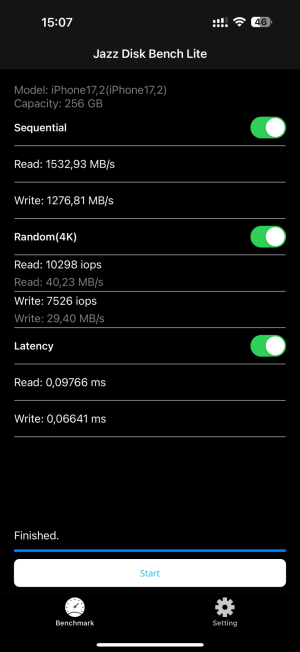
I think you maybe onto something with the storage. this is the disk speed test on a 256GB A18 Pro iPhone.
1772696021530.png

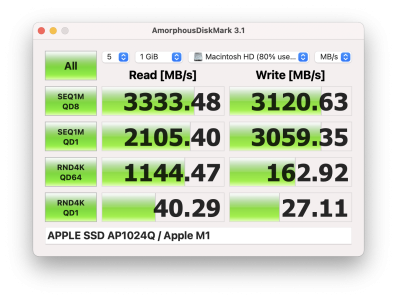
M1 IOPS:
Rnd4K QD64 (R/W): 262991/23166
Rnd4K QD1 (R/W): 16088/9868

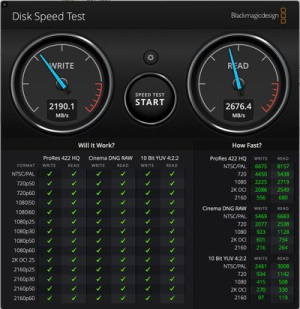
M1 Disk speed test:
1772696764572.png

the ssd maybe thottling when you open multiple apps. These iPhone chips were designed for iOS where you don't open more than one app at a time.

This could also be the reason as to why the A20 Pro is rumoured to get a major memory bandwitdh update cause the iPhone Fold would need to run multiple apps at the same time.
 

Attachments

  • 1772696564388.png
    1772696564388.png
    797.7 KB · Views: 14
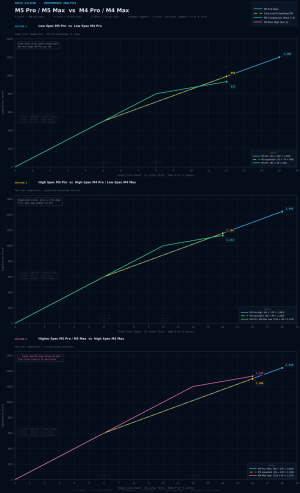
Following up on my post earlier. Here are the relative performance/core count curve comparisons between the new core config vs the old (M4s).

Maybe they came to the conclusion that most workloads require less than 6 tier-1 threads/cores?
It’s an interesting trade-off once you get past 6 threads. Must be that they can save a bit of power but get similar performance with more parallelized workloads.
1772696612160.png
 
Technically it's 4 LPDDR channels. But why does the number of channels matter? What matters is the bandwidth at the end, right? Not the means used to achieve it.
The number of channels can matter a bit since it can also help with effective latency, but that's not something that can affect app loading and switching. As long as latency numbers are comparable (not necessarily equal), bandwidth is what matters.

The SoC is used in Phones, it probably doesn't have PC class storage performance of today's NVMe SSDs (and the complicated thing Apple uses in M SoCs for their petty reasons). Various latencies and IOPS limits likely add up when running a heavy OS.
You know how modern software compensates for slow storage speeds. It caches to RAM, for some scenarios it even does that in advance. You just need RAM to cache to.

However, if what you say is true and storage is slow enough to affect app loading, this will get painfully worse when the OS starts paging.

8GB is fine, because it's a $599 Apple product. I can both be an enthusiast and still understand 8GB is fine for vast majority of people. Also until very recently my brother was gaming on the Sandy Bridge i3 with 8GB RAM.
Was that on an iGPU or an dGPU? When you have a single memory pool, your RAM is also your VRAM, and VRAM matters now even when you browse the web or open Chromium based apps.

I'm not speaking as an enthusiast here, I'm speaking as a value buyer who is often asked by friends and relatives to help them buy (relatively cheap) devices that stand the test of time. My parents are both still using Haswell laptops, and they both have RAM upgrades.

If you have an old CPU then your computer takes 2x more time to do it's job. If you have less than enough RAM it can take 10x more time once the paging starts.
 
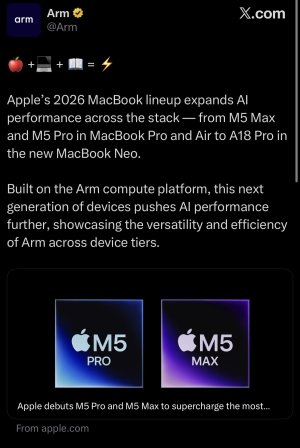
Offical ARM account is hyping up the new chips. I don’t think they did this before. Seems like ARM and Apple have a good relationship.

From ARM's perspective it makes zero difference whether x86 Windows market share is stolen by Qualcomm Windows ARM PCs or Macs. They will just be happy to see "their side" winning a few percent more of the overall PC marketshare.
 
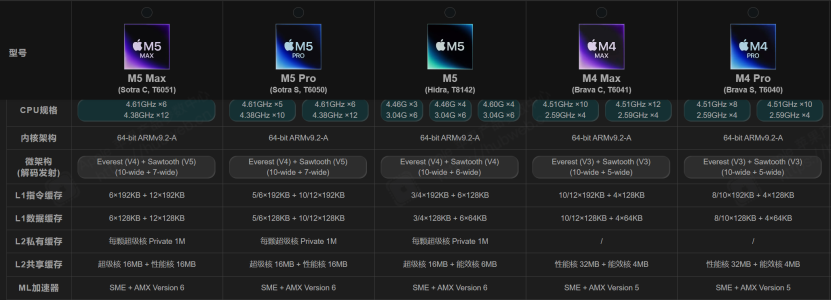
looks like @adroc_thurston is right about new private cache in M5 series.
1772700354717.png
 
Interesting that the new mid core is Sawtooth V5. Looking forward to seeing the IPC in isolation compared to V4. They got that thing clocking higher that’s for sure.
 
Interesting that the new mid core is Sawtooth V5. Looking forward to seeing the IPC in isolation compared to V4. They got that thing clocking higher that’s for sure.
It's not Sawtooth. I'm surprised that the tech community continues to refer to all cores by their old A16 names. Instead, Apple has simply stopped giving code names to its CPU architectures.
 
It's not Sawtooth. I'm surprised that the tech community continues to refer to all cores by their old A16 names. Instead, Apple has simply stopped giving code names to its CPU architectures.
I mean sure, but it can be a point of reference. Regardless, we’ll likely find out if the mid-core is indeed a different microarchitecture as depicted in that image. Seems plausible since it’s narrower but clocked so highly.
 
What I find odd is that it took that long for people playing with M5 to realise that. Reverse engineering is not what it used to be 🙂
I’m not convinced the M5 has private L2. I believe it has the same version the A19s have, which would have been seen in the die shots and shown up in latency graphs.

I also still believe the new cache hierarchy is for the chiplets, why use unnecessary space on monolithic M5. I think the chart isn’t accounting for core differences in the same generation.
 
looks like @adroc_thurston is right about new private cache in M5 series.
View attachment 139296
Did they reverse engineer it, or are they also going off rumours?
 
I’m not convinced the M5 has private L2. I believe it has the same version the A19s have, which would have been seen in the die shots and shown up in latency graphs.
Are there dieshots of base M5 ?
I also still believe the new cache hierarchy is for the chiplets, why use unnecessary space on monolithic M5. I think the chart isn’t accounting for core differences in the same generation.
The wording in the Apple article is a bit vague;

"The industry-leading super core was first introduced as performance cores in M5, which also adopts the super core name for all M5-based products — MacBook Air, the 14-inch MacBook Pro, iPad Pro, and Apple Vision Pro. This core is the highest-performance core design with the world’s fastest single-threaded performance, driven in part by increased front-end bandwidth, a new cache hierarchy, and enhanced branch prediction."
 
Back
Top