Discussion Apple Silicon SoC thread

Page 444 - Seeking answers? Join the AnandTech community: where nearly half-a-million members share solutions and discuss the latest tech.

Eug

Lifer
Mar 11, 2000
24,167
1,812
126
M1
5 nm
Unified memory architecture - LP-DDR4
16 billion transistors

8-core CPU

4 high-performance cores
192 KB instruction cache
128 KB data cache
Shared 12 MB L2 cache

4 high-efficiency cores
128 KB instruction cache
64 KB data cache
Shared 4 MB L2 cache
(Apple claims the 4 high-effiency cores alone perform like a dual-core Intel MacBook Air)

8-core iGPU (but there is a 7-core variant, likely with one inactive core)
128 execution units
Up to 24576 concurrent threads
2.6 Teraflops
82 Gigatexels/s
41 gigapixels/s

16-core neural engine
Secure Enclave
USB 4

Products:
$999 ($899 edu) 13" MacBook Air (fanless) - 18 hour video playback battery life
$699 Mac mini (with fan)
$1299 ($1199 edu) 13" MacBook Pro (with fan) - 20 hour video playback battery life

Memory options 8 GB and 16 GB. No 32 GB option (unless you go Intel).

It should be noted that the M1 chip in these three Macs is the same (aside from GPU core number). Basically, Apple is taking the same approach which these chips as they do the iPhones and iPads. Just one SKU (excluding the X variants), which is the same across all iDevices (aside from maybe slight clock speed differences occasionally).

EDIT:
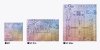
Screen-Shot-2021-10-18-at-1.20.47-PM.jpg

M1 Pro 8-core CPU (6+2), 14-core GPU
M1 Pro 10-core CPU (8+2), 14-core GPU
M1 Pro 10-core CPU (8+2), 16-core GPU
M1 Max 10-core CPU (8+2), 24-core GPU
M1 Max 10-core CPU (8+2), 32-core GPU

M1 Pro and M1 Max discussion here:


M1 Ultra discussion here:


M2 discussion here:


Second Generation 5 nm
Unified memory architecture - LPDDR5, up to 24 GB and 100 GB/s
20 billion transistors

8-core CPU

4 high-performance cores
192 KB instruction cache
128 KB data cache
Shared 16 MB L2 cache

4 high-efficiency cores
128 KB instruction cache
64 KB data cache
Shared 4 MB L2 cache

10-core iGPU (but there is an 8-core variant)
3.6 Teraflops

16-core neural engine
Secure Enclave
USB 4

Hardware acceleration for 8K h.264, h.264, ProRes

M3 Family discussion here:


M4 Family discussion here:


M5 Family discussion here:

 
Last edited:

Covfefe

Member
Jul 23, 2025
86
147
66
I’m pretty sure Notebookcheck, and ComputerBase run their power draw test via a meter. If I’m wrong someone correct me.
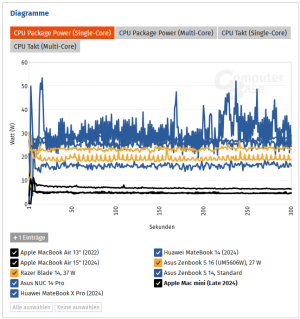
I think ComputerBase uses Power Metrics. Their chart says CPU Package Power in their M4 Pro Mac Mini review. It could vary from review to review though.

1765547072049.png

Looking at Notebookcheck's testing methodology, they measure at the outlet for their power consumption charts. However, I noticed that the power consumption in the CPU performance section of their Macbook Pro M4 review is lower so I think they're using Power Metrics for that section. "In the multi-core tests, the new M4 in the MBP 14 consumed a maximum of 24 watts" compared to 37.8 watts average and 43.7 watts max for Cinebench R23 in the power consumption charts.
 

name99

Senior member
Sep 11, 2010
680
570
136
Anyone ever seen any figures or even hints what Apple TV's installed base is? I love mine but I've never once thought "man I would like to game on this" because it isn't designed for that and would need some sort of controller since the remote isn't exactly useful beyond a narrow category of games.

If the market isn't very large, and it would require the purchase of a 3rd party gaming controller which pushes you into an even smaller niche, I can see why developers ignore it. If Apple wanted gaming to be a thing they'd promote it for that, incentivize developers, offer a controller for it etc. It would still be a drop in ocean compared to the revenue they make from mobile gaming - and would suffer in comparisons with real game consoles.
 

poke01

Diamond Member
Mar 8, 2022
4,604
5,915
106
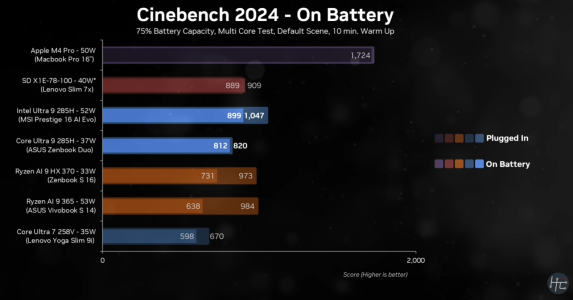
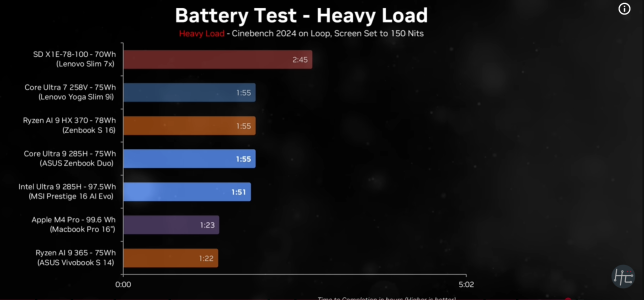
Looks accurate to me. Another issue is a lot of reviewers don’t measure power under a worst case scenario. Instead they will do things like simulate web browsing, watch a video, etc. These are areas where the M-series excels. However, when the chip is fully loaded, efficiency tends to fall.
This is because Apple laptops do not change to a different power profile automatically when unplugged, leading to worse battery life when fully loaded. If you want even better battery life, then you can change the macbook to low power mode.

We see this in countless reviews.
1765572502554.png

1765572556384.png


johnsonwax

Senior member
Jun 27, 2024
461
670
96
Anyone ever seen any figures or even hints what Apple TV's installed base is? I love mine but I've never once thought "man I would like to game on this" because it isn't designed for that and would need some sort of controller since the remote isn't exactly useful beyond a narrow category of games.

If the market isn't very large, and it would require the purchase of a 3rd party gaming controller which pushes you into an even smaller niche, I can see why developers ignore it. If Apple wanted gaming to be a thing they'd promote it for that, incentivize developers, offer a controller for it etc. It would still be a drop in ocean compared to the revenue they make from mobile gaming - and would suffer in comparisons with real game consoles.
Games aren't relevant to the market. But Apple's AI plans are - if they want AI powered Siri on AppleTV, they're going to need the RAM/NPU of their more current SOCs.
 

poke01

Diamond Member
Mar 8, 2022
4,604
5,915
106
"Apple Mac True Power Consumption: power meter vs powermetrics"


The youtuber says the "telemetric" data that most people trust to show Apple Silicon power consumption, can be understating the actual power consumption significantly. Or at least in his results...
Powermetrics command never showed total system power consumption.

It’s shows CPU/GPU/NPU package power, that’s it. Anandtech mentioned this in 2021.
 

Jan Olšan

Senior member
Jan 12, 2017
601
1,177
136
Powermetrics command never showed total system power consumption.

It’s shows CPU/GPU/NPU package power, that’s it. Anandtech mentioned this in 2021.
That's obvious and not what the video is about, the measurements if legit show a huge discrepance that can hardly be explained by powermetrics being accurate and rest of the system taking the excess power.
 

Nothingness

Diamond Member
Jul 3, 2013
3,354
2,438
136
That's obvious and not what the video is about, the measurements if legit show a huge discrepance that can hardly be explained by powermetrics being accurate and rest of the system taking the excess power.
How do reviewers measure power consumption on x86 machines? I agree that the better way seems to use a wattmeter at the wall. Comparisons should only be made at that level on all systems under review.
 

Covfefe

Member
Jul 23, 2025
86
147
66
I decided to dig a little deeper into notebookcheck's power consumption numbers. I used the max power draw mentioned in the CPU part of the review and compared it to the max from the power consumption chart. The Macbooks' outlet measurements are 70-82% higher than their software readings. On the x86 side, the outlet measurements are only 32-40% higher.

This is all very messy. The power consumption wasn't measured at the same time, and the benchmarks used might vary from review to review. Nevertheless there's a clear pattern of the Apple's software readings understating the actual power draw.

software reading​
outlet reading​
discrepancy​
24 watts​
43.7 watts​
82.1%​
46 watts​
84.4 watts​
83.5%​
30.5 watts​
52 watts​
70.5%​
37 watts​
51.8 watts​
40.0%​
46 watts​
61 watts​
32.6%​
 

poke01

Diamond Member
Mar 8, 2022
4,604
5,915
106
I decided to dig a little deeper into notebookcheck's power consumption numbers. I used the max power draw mentioned in the CPU part of the review and compared it to the max from the power consumption chart. The Macbooks' outlet measurements are 70-82% higher than their software readings. On the x86 side, the outlet measurements are only 32-40% higher.

This is all very messy. The power consumption wasn't measured at the same time, and the benchmarks used might vary from review to review. Nevertheless there's a clear pattern of the Apple's software readings understating the actual power draw.

software reading​
outlet reading​
discrepancy​
24 watts​
43.7 watts​
82.1%​
46 watts​
84.4 watts​
83.5%​
30.5 watts​
52 watts​
70.5%​
37 watts​
51.8 watts​
40.0%​
46 watts​
61 watts​
32.6%​
That software reading is only for the total CPU core package (it doesn't include the cache, uncore etc) for the Macbooks.

There are Mac sensor apps like Mactop and Stats that show near total system power consumption unlike powermetrics.
 

poke01

Diamond Member
Mar 8, 2022
4,604
5,915
106
I did some testing. Watch it till end. Pretty much confirms that the standard powermetrics command is only reporting total CPU cores power consumption.

I used a Tapo smart plug and Stats for software sensor software. Its pretty accurate.


Nothingness

Diamond Member
Jul 3, 2013
3,354
2,438
136
I decided to dig a little deeper into notebookcheck's power consumption numbers. I used the max power draw mentioned in the CPU part of the review and compared it to the max from the power consumption chart. The Macbooks' outlet measurements are 70-82% higher than their software readings. On the x86 side, the outlet measurements are only 32-40% higher.

This is all very messy. The power consumption wasn't measured at the same time, and the benchmarks used might vary from review to review. Nevertheless there's a clear pattern of the Apple's software readings understating the actual power draw.

software reading​
outlet reading​
discrepancy​
24 watts​
43.7 watts​
82.1%​
46 watts​
84.4 watts​
83.5%​
30.5 watts​
52 watts​
70.5%​
37 watts​
51.8 watts​
40.0%​
46 watts​
61 watts​
32.6%​
IMHO comparing laptops leads to more differences due to other components (screen and its settings in particular). It'd be more interesting to measure this on desktops. That's why I found the measurements on the Apple Studio in the video relevant.
 

name99

Senior member
Sep 11, 2010
680
570
136
I decided to dig a little deeper into notebookcheck's power consumption numbers. I used the max power draw mentioned in the CPU part of the review and compared it to the max from the power consumption chart. The Macbooks' outlet measurements are 70-82% higher than their software readings. On the x86 side, the outlet measurements are only 32-40% higher.

This is all very messy. The power consumption wasn't measured at the same time, and the benchmarks used might vary from review to review. Nevertheless there's a clear pattern of the Apple's software readings understating the actual power draw.

software reading​
outlet reading​
discrepancy​
24 watts​
43.7 watts​
82.1%​
46 watts​
84.4 watts​
83.5%​
30.5 watts​
52 watts​
70.5%​
37 watts​
51.8 watts​
40.0%​
46 watts​
61 watts​
32.6%​
Do the people creating these sorts of charts have a clue what they are ACTUALLY measuring?
For example let's suppose (I have no idea if this is true) that
- Apple's wall power draw varies extremely rapidly (goes up and down multiple times per second) because, eg, it operates on a principle of filling up some capacitors as rapidly as possible, then draining them while throttling the AC draw
- the power meter is designed to capture the *maximum* draw over some longish period (say a second or two)

Then an Apple internal value reporting essentially a "genuine" average will look very different from a HW meter reporting essentially a "maximum over one second" value.

This could be resolved very easily by using a scheme that measures ENERGY not power. Either a meter that's designed (and designed WELL...) to measure energy, or by driving the mac off a battery with a trustworthy "capacity" measurement.

But I've concluded that the amateur internet world is simply uninterested in actually thinking about this issue [energy vs power] like an adult; they've being making idiotic statements on the issue since the M2, so I'll bow out now and leave the rest of you to fight about this in blissful ignorance.
 

poke01

Diamond Member
Mar 8, 2022
4,604
5,915
106
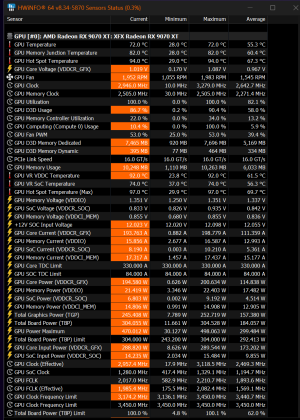
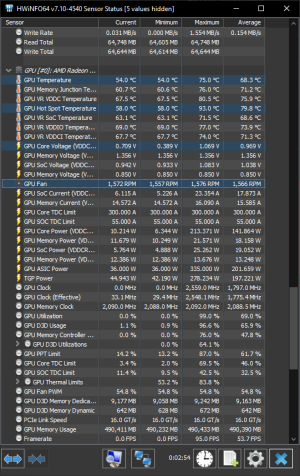
AMD used to also report ONLY the GPU cores power consumption pre-RDNA3.
Meaning the TBP was off by 100watts in some GPUs like RX 6800 XT

This isn’t unique to Apple silicon. Any software measurement is inaccurate, period.
 

adroc_thurston

Diamond Member
Jul 2, 2023
7,882
10,598
106
It doesn’t include memory or VRM on cards prior rdna3. The software doesn’t read the full TBP.
yeah it does.

Software is inaccurate.
that's a factory OC mememodel in furmark crasher bios mode.