
-
We’re currently investigating an issue related to the forum theme and styling that is impacting page layout and visual formatting. The problem has been identified, and we are actively working on a resolution. There is no impact to user data or functionality, this is strictly a front-end display issue. We’ll post an update once the fix has been deployed. Thanks for your patience while we get this sorted.
You are using an out of date browser. It may not display this or other websites correctly.
You should upgrade or use an alternative browser.
You should upgrade or use an alternative browser.
Apple A7 is now 64-bit
Page 7 - Seeking answers? Join the AnandTech community: where nearly half-a-million members share solutions and discuss the latest tech.
For those of you who care about this sort of stuff, here is Linpack (multithread) on the 5S:
http://reviews.cnet.com/iphone-5s/
iPhone 5S - 1634.4
HTC One - 648.7
Galaxy S4 - 636.5
iPhone 5C - 583.9
Moto X - 293.8
IOW, the GS4 scores < 40% of what the iPhone 5S does.
Does Apple have a boost mode for running benchmarks as Samsung does with the S4?

Eug
Lifer
You'll have to ask Apple, but I suspect not.
Perhaps their Java is much better optimized in general though. (I assume it's Java. Not sure though.)
Plus, Anand likes to repeat he thinks higher clocked dual-core in phones is probably usually better than quad-core in phones because of thermal contraints.
Perhaps their Java is much better optimized in general though. (I assume it's Java. Not sure though.)
Plus, Anand likes to repeat he thinks higher clocked dual-core in phones is probably usually better than quad-core in phones because of thermal contraints.
So, are we sure now that the fab is Samsung? Anand seems to think it is.
I don't know. Reading the 'tea leaves' isn't exactly a science : http://blogs.barrons.com/techtrader...-ponders-odd-signals-from-samsung-austin-fab/
I'd imagine its native versus Java, I don't think iOS has a Java run-time.You'll have to ask Apple, but I suspect not.
Perhaps their Java is much better optimized in general though. (I assume it's Java. Not sure though.)

StinkyPinky
Diamond Member
No denying it, those cpu's are monsters. Massive gains.
For those of you who care about this sort of stuff, here is Linpack (multithread) on the 5S:
http://reviews.cnet.com/iphone-5s/
iPhone 5S - 1634.4
HTC One - 648.7
Galaxy S4 - 636.5
iPhone 5C - 583.9
Moto X - 293.8
IOW, the GS4 scores < 40% of what the iPhone 5S does.
Doesn't really mean anything.
Apple seems to always do well in synthetic tests (GL bench fill tests for example the iphone 5 lead by a major margin to collapse in the T-rex test). Likewise the iphone 5 tied or beat the gs4 in linpack but was/is behind in almost every test.
http://www.notebookcheck.net/Review-Samsung-Galaxy-S4-GT-I9505-Smartphone.92829.0.html
slackerinabox
Lifer
Does Apple have a boost mode for running benchmarks as Samsung does with the S4?
Why would they? They rarely market based on specs (and their audience indifferent in general). But they do have a good track record of great performing socs
Eug
Lifer
Doesn't really mean anything.
Apple seems to always do well in synthetic tests (GL bench fill tests for example the iphone 5 lead by a major margin to collapse in the T-rex test). Likewise the iphone 5 tied or beat the gs4 in linpack but was/is behind in almost every test.
http://www.notebookcheck.net/Review-Samsung-Galaxy-S4-GT-I9505-Smartphone.92829.0.html
Makes sense, but I don't understand that link. It has Linpack for Android but then lists the iPhone 5 under that heading.
The iPhone 5S does very well in T-Rex though.
I'm surprised no one noticed this: >1B transistors for 102mm². That's denser than 22nm Ivy Bridge with it 1.4B transistors and 160mm².
Most of the chip is GPU which is far denser than CPU logic.
Makes sense, but I don't understand that link. It has Linpack for Android but then lists the iPhone 5 under that heading.
The iPhone 5S does very well in T-Rex though.
Meant the 5. 5s doesn't show this discrepancy as much though. AMD kabini did the same thing.
Apple doesn't have a jvm for iOS and originally didn't allow third party jvms. So I'd imagine tests are in Objective-C. Apple has changed it's tune and Oracle produced some Open Source jvms and now there are third party tools for writing java based iOS apps: http://www.javaworld.com/javaworld/jw-03-2013/130327-open-source-java-iphone-tools-compared.htmlI'd imagine its native versus Java, I don't think iOS has a Java run-time.
I haven't tried any myself.
Last edited:
Does Apple have a boost mode for running benchmarks as Samsung does with the S4?
The A7 chip is a nice improvement over the A6 but some of the people saying that it's in the same league as the Intel i series chip or even BayTrail in CPU power is pretty delusional. The tests that Apple does well in are as much software tests as they are hardware tests. They are browser based tests where the scores are influenced by how fast the javascript engine is. While these tests are valid for comparing absolute CPU performance on the same platform and same browser it's not valid when comparing results from a different platform and different browser. While you can definitively say that the A7 chip is faster then the A6 chip (because we have results from the same platform and browser) you can't necessarily say it's faster then BT-T or S800.
If we look at the browser based benchmarks (sunspider, octane, kraken, etc) we know that the Apple platform does very well and beats even BT-T. Android is severely handicapped in theses tests because they don't run native code but rely on DVM and the browsers are different. Tests have shown that on the SAME hardware depending on what browser or OS you are using the results can differ by over 300%. Even Anand's review of iOS 7 compared to iOS6 says this:
This is not to say that the A7 isn't a good chip because it looks like it was designed very well for what it was intended to do, it just means that we would never know if an S800 or BT-T would perform even better if Apple used those CPU for the iPhone 5s. You just can't make any conclusion about hardware when the software affects the result so much.Theres a 15 percent difference in sunspider and browsermark, and a larger one closer to 50 percent in kraken and google octane, webxprt sees a 30 percent jump.
Now to explain the Linpack score, Eug explained part of it. The Java engine efficiency plays a huge part in the score that's one of the reasons why Apple does very well. If you remember in the Froyo days on Android Linpack scores jumped hugely on Android devices when JIT was added to Dalvik. The other reason why the A7 chip does really well in Linpack is because it's a floating point test and the A7 chip has 128bit FP compared to 64bit on the A6 and android phones. Without any other optimizations that would put the A7 around a score of 1150 compared to the A6's 584. Given that Apple has said the A7 is about 30% faster then the A6 (IPC) + 128bit FPU the Linpack score would be around 1600 like what the results show.

Arachnotronic
Lifer
The A7 chip is a nice improvement over the A6 but some of the people saying that it's in the same league as the Intel i series chip or even BayTrail in CPU power is pretty delusional.
I don't think the Geekbench results (native benchmark) really agree with this sentiment.
Bay Trail is a great merchant chip, but it really does look outclassed unless Geekbench 3 is a BS benchmark.
Eug
Lifer
It turns out it's not Java on iOS. Somebody in another thread said it's native on iOS, and Java on Android.Now to explain the Linpack score, Eug explained part of it. The Java engine efficiency plays a huge part in the score that's one of the reasons why Apple does very well.
Eug
Lifer
Chipworks Provides First Apple A7 Die Shot

Yellow: ? dual CPU cores
Blue: ? quad GPU clusters
Chipworks hasn't annotated the chip die image yet.
Yellow: ? dual CPU cores
Blue: ? quad GPU clusters
Chipworks hasn't annotated the chip die image yet.


Hans de Vries
Senior member
Interesting to compare the size of the "Cyclone" cores with
those of the A15 and A7 in the same Samsung 28 nm process.
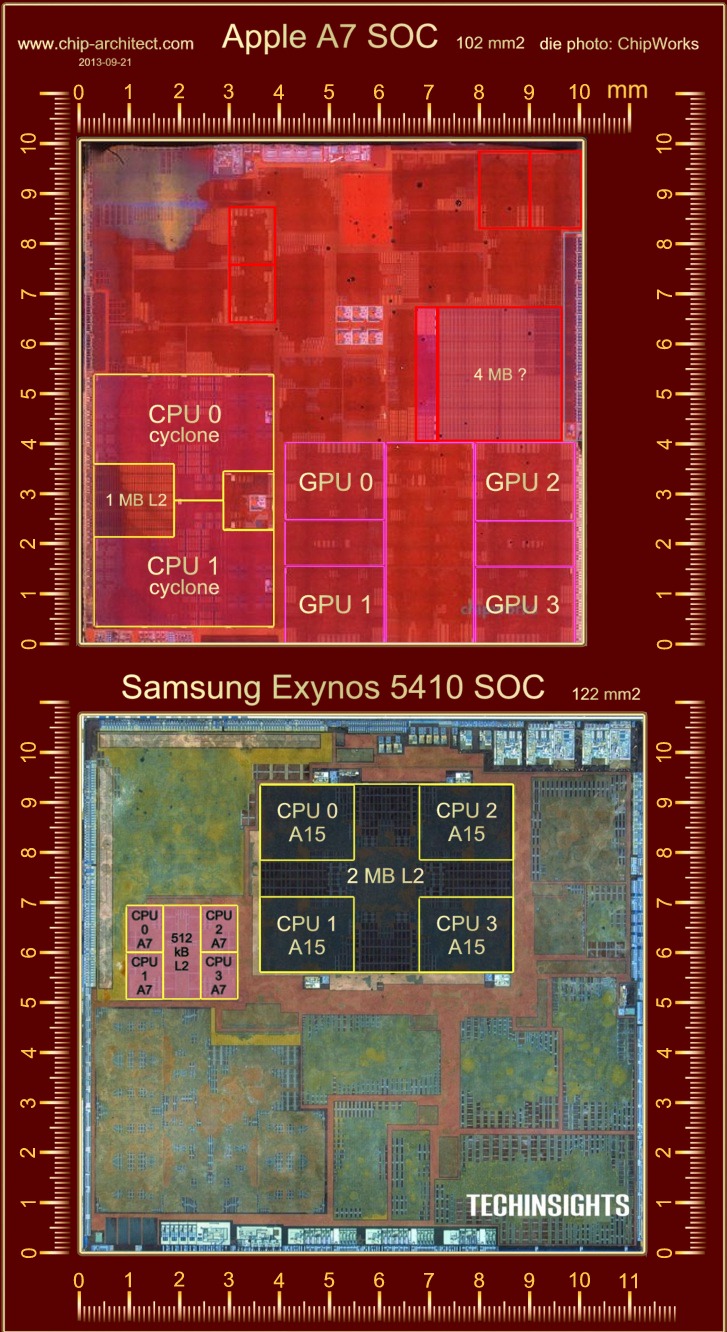
Hans.
those of the A15 and A7 in the same Samsung 28 nm process.
Hans.
Last edited:
Nothingness
Diamond Member
Nice comparison, thanks! So we can say that a Cyclone core is about twice as large as an A15.
If I computed correctly a dual core Cyclone + 1 MB L2 is ~22 mm². According to Hiroshige Goto a 22nm dual core Silvermont + 1 MB L2 is ~8.x mm².
Ref: http://pc.watch.impress.co.jp/img/pcw/docs/615/261/html/14.jpg.html
If I computed correctly a dual core Cyclone + 1 MB L2 is ~22 mm². According to Hiroshige Goto a 22nm dual core Silvermont + 1 MB L2 is ~8.x mm².
Ref: http://pc.watch.impress.co.jp/img/pcw/docs/615/261/html/14.jpg.html
Hans de Vries
Senior member
Nice comparison, thanks! So we can say that a Cyclone core is about twice as large as an A15.
If I computed correctly a dual core Cyclone + 1 MB L2 is ~22 mm². According to Hiroshige Goto a 22nm dual core Silvermont + 1 MB L2 is ~8.x mm².
Ref: http://pc.watch.impress.co.jp/img/pcw/docs/615/261/html/14.jpg.html
Dual core Cyclone + 1 MB LB is 5.0 x 3.6 = 18 mm2
That's probably bigger than anybody expected.
Just like the performance 😛
I wonder how the A57 will end up.
Hans.
Last edited:
I don't think the Geekbench results (native benchmark) really agree with this sentiment.
Bay Trail is a great merchant chip, but it really does look outclassed unless Geekbench 3 is a BS benchmark.
I found some benchmarks on PCMag:
http://www.pcmag.com/article2/0,2817,2424668,00.asp
iPhone 3gs geekbench score of 2557
http://www.pcmag.com/article2/0,2817,2424262,00.asp
Z3770 geekbench score of 2935
Dual core Cyclone + 1 MB LB is 5.0 x 3.6 = 18 mm2
That's probably bigger then anybody expected.
Just like the performance 😛
I wonder how the A57 will end up.
Hans.
We should find out within the next 6 months. Though, some designs are 20nm, so they may not be in shipping products for a few months after that. Is AMD producing it's A57 design @ TSMC or GF? If GF then it will be 28nm and would be better for comparison.
Thanks Hans, as usual, for the die shots! You always show up at just the right moment :thumbsup:
We should find out within the next 6 months. Though, some designs are 20nm, so they may not be in shipping products for a few months after that. Is AMD producing it's A57 design @ TSMC or GF? If GF then it will be 28nm and would be better for comparison.
Agreed, it's quite possible that one of the initial designs will be at least demonstrated at MWC next year similar to TI's OMAP 5. However that was little more than a teaser. I wouldn't be surprised if we don't get a good review for another year based on the timelines for both A9 and A15. (A15 was announced in early September of 2010 with first product in November of 2012, A9 was announced in early October of 2007 with first product in February of 2010 I believe it was?)
Which actually makes me wonder whether the first non-Apple ARMv8 core will be ARM's A57/A53 or Qualcomm's next design? I somewhat suspect that Qualcomm may well beat ARM, otherwise what 64-bit SoC could Samsung use for next year's Galaxy smartphone refresh in the April/May time frame? Since they've pretty clearly implied that they already have a 64-bit capable SoC lined up for it 😉
Agreed, it's quite possible that one of the initial designs will be at least demonstrated at MWC next year similar to TI's OMAP 5. However that was little more than a teaser. I wouldn't be surprised if we don't get a good review for another year based on the timelines for both A9 and A15. (A15 was announced in early September of 2010 with first product in November of 2012, A9 was announced in early October of 2007 with first product in February of 2010 I believe it was?)
And Cortex-A7 was revealed October 2011 and the first products were out early 2013. The gap of time between announcement and first product has been shrinking for ARM - and this isn't just because A7 is a simpler chip, it's the successor to A5 which took forever to show up in anything. Cortex-A57 was revealed October 2012. Early to mid-2014 wouldn't be too strange for first products.
Like you said, Samsung says their next big SoC would be 64-bit. That doesn't sound like they're talking about an SoC from Qualcomm and I don't think they're going to suddenly come out with their own custom CPU.
TRENDING THREADS
-
 Discussion Zen 5 Speculation (EPYC Turin and Strix Point/Granite Ridge - Ryzen 9000)
- Started by DisEnchantment
- Replies: 25K
-
Discussion Intel Meteor, Arrow, Lunar & Panther Lakes + WCL Discussion Threads
- Started by Tigerick
- Replies: 25K
-

-

-
