• We’re currently investigating an issue related to the forum theme and styling that is impacting page layout and visual formatting. The problem has been identified, and we are actively working on a resolution. There is no impact to user data or functionality, this is strictly a front-end display issue. We’ll post an update once the fix has been deployed. Thanks for your patience while we get this sorted.

Question Anyone successfully deodorised a power supply? (SOLVED)

I want to re-use an ATX power supply that's only about 3 years old but it came from a computer that was in a car-related workshop. Does anyone here have any experience of getting rid of a smell from a PSU?

 
Opening it up and putting it in the path of lots of direct sunlight with a fan blowing over it could help the aromatic compounds disperse, provided you place it somewhere you know where there's not much chance of something bad getting inside it.

One other possible option is hot hairdryer but obviously not hot enough to melt something inside.
 
I (a long time ago) bought a Windows home server box on eBay.
It was fine but the home it had been in was obviously full of chain smokers as the inside was full of dust stuck to nicotine and tar.
I used A LOT of isopropyl cleaning that.
 
I want to re-use an ATX power supply that's only about 3 years old but it came from a computer that was in a car-related workshop. Does anyone here have any experience of getting rid of a smell from a PSU?
What does a car related workshop PSU smell like? Oil, exhaust, or tears from those that came in to get a cheap repair that didn't work out that way?

Besides just putting it in an area were you don't smell it and pointing a fan at it for a while (better still if it's running to power that fan... DOUBLE FAN!! lol, you'd need to determine the type of contaminant to use the least aggressive solvent possible to remove that.

Often when I want to clean a part exposed to oil or tobacco tar, I use a mild ammonia solution or Mr Clean with ammonia already in it, but it should not be used on anything aluminum, which your PSU probably has as heatsinks in it. Granted the issue there is stripping off the anodization, so it's only cosmetic, but it could be alarming if you exposed black anodized heatsinks to ammonia and they ended up looking half bald. It's a mild effect so if you worked quickly, it shouldn't be too bad, just get a cup of cleaner and a paint brush and brush the solution onto the PSU, area by area, rinsing an area at a time.

You'd need to be certain that after the last rinse, there was no water pooling up on the PCB that causes any water soluble flux residue to form acidic pools. This can also be solved by scrubbing on the PCB ehough, but a rinse agent or drop of detergent added to a final rinse bath should solve that, or add some rubbing alcohol to the final rinse, breaking the surface tension of the water so it doesn't pool up.

I would at least remove the fan first, don't want to chance anything getting into the bearings, and it could take a long time to dry out any moisture that gets inside of any switches, days of having a fan pointed at it after shaking out all the water you can.

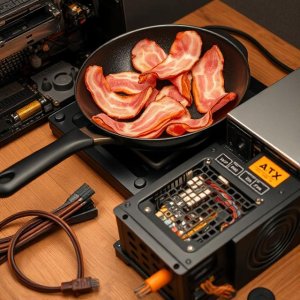
It would be a lot easier to just live with the smell for a while - you'll get used to it and it will dissipate over time, and put an air cleaner and/or scent making widget in the room to alter the scent. The scent making widget could be an electric skillet cooking bacon, that could distract almost anyone.
n3otwlAb.jpg
 
Last edited:
I want to re-use an ATX power supply that's only about 3 years old but it came from a computer that was in a car-related workshop. Does anyone here have any experience of getting rid of a smell from a PSU?
Get some dessicant like food grade silica and fill it leave for 24 - 48 hrs
I want to re-use an ATX power supply that's only about 3 years old but it came from a computer that was in a car-related workshop. Does anyone here have any experience of getting rid of a smell from a PSU?
 
Well, you can always get it cleaned using an ultrasonic bath. I would remove any fan(s) it may have, but the rest of it could be submerged in the same solutions they use for cleaning PCBs and other electronics. The fan(s) would typically have ball bearings in it which would not fair well with cleaning (well, they would fair fine, but you would need to re-pack them with proper grease/lubrication which you probably do not have and would be as, if not more, expensive than replacing the fan to purchase the correct lubricants and tools). You may want to simply replace the fan(s) if you can as cleaning them will be tough if it is airborne grease/oil particles that have stuck to the fan blades and surfaces...

There are some places that provide this as a service, and there are some places that also rent the ultrasonic cleaners. You would have to look around online to see if you can have it done. I suggest a spray down of or dunk in isopropyl after removing from the bath (most ultrasonic baths use a combination of distilled water and solvents/degreasers (they don't use isopropyl because the agitation generates heat and causes it to evaporate faster, creating lots of flammable vapors) so the water would need to be completely removed and preferably displaced by a dipping in isopropyl afterwards).
 
As I tend to be pretty hands-off with regard to the insides of power supplies, I've shied away from those kind of suggestions. My wife suggested putting it in a box with a load of coffee granules for a few days. Now my computer room smells strongly of coffee 🙂

I probably should have tried the silica gel in a box instead!
 
^ If the PSU warranty has ended, it's not a big deal to open one, dust it out, assess remaining fan lifespan, then do whatever... but ultimately unless some solvent is involved, it's going to take putting a lot of air through it to get a half life of decay of the smell and so on, decreasing with each additional hour that smell migrates from inside the PSU to outside.

There was a time when some of the cheap nasty generic PSU might not be trusted to have a bleeder circuit to drain off dangerous voltage, but that shouldn't apply to anything worth using, let alone reusing, today. In any case you could always wear insulative gloves.

Silica gel would mostly just absorb moisture while the fumes from the automotive shop are more likely other pollutants. Moisture would be driven off right away by just running the PSU, it warms up and pulls air through, fairly quickly equalizing to the ambient humidity level or by contrast, if you managed to get almost all moisture removed with silica gel, rice, or another desiccant, then as soon as it's running again, will then pick up ambient moisture and be at same state as if never dehumidified, which doesn't do much unless it had a fungus in it and the dry air killed that. I'd be more concerned about fungus getting into the room than smell, though a PSU would have to be sitting in a very damp environment unpowered, likely with a large contributing accumulation of dust inside, for fungus to build up. It's pretty rare, at least in my climate.
 
Back
Top