Anybody Remember Conroe?

Page 2 - Seeking answers? Join the AnandTech community: where nearly half-a-million members share solutions and discuss the latest tech.
Aug 11, 2008
10,451
642
126
I love and despise Intel. I think their engineers are ridiculously talented and have immense respect for that part of the company. What I don't like is the non technical side of the company. The same side that are prepared to make their products worse for the slimmest reductions in cost.

I get that companies are interested in maximizing profit. What I don't enjoy is companies pursuing profit so aggressively they are prepared to completely ignore a small but enthusiastic part of their customer base. Do you really think Intel soldering the IHS to the die for their 'k' CPUs would have had any real impact on their bottom line?

But what annoys me even more is when people defend these decisions. You reference the fact some people are fans of other companies and your disdain (I get that). People call out AMD fanboys all the time. And yet these same people will turn around and brush aside the deliberate crippling of Intel's products and cite the marginal performance increases we've observed for the last two generations. These are the people Intel couldn't give [a hoot] about. And they have the hide to mock people who defend AMD.

Sound wrong perhaps, but I just choose the company that produces the best product for what I want to use it for. Within reason, I don't really care about the business practices of Intel or AMD. I just want the best product for my use. Even if I did want to base my buying decision on the "ethics" of a company, I dont have enough information about what goes on inside Intel or AMD to make a knowledgeable choice. If intel's market segmentation (which I agree is pretty arbitrary) makes their product not the best choice for someone, they are free to purchase from AMD. What I guess I dont agree with is that Intel is some evil empire while AMD is the knight riding in on the white horse. AMD was certainly not above charging very high premiums for their cpus back in the day when they had the performance lead.
 
Last edited by a moderator:

jvroig

Platinum Member
Nov 4, 2009
2,394
1
81
Personally, from that "Bay Trail crushes ARM" thread and this thread that seems to be a direct consequence of that, I have no strong feelings either way - I won't be surprised if the new Atom outperforms any ARM competitor, but I can't say I'm exactly hoping or counting on it either. I'm just purely wait-and-see, no expectations either way.

My only real opinion on the matter is that whether Bay Trail outperforms ARM or not, AnTuTu is, without a doubt in my mind, not the benchmark to indicate it. AnTuTu is neither reliable nor consistent, and can be gamed. Its technical flaws prevent it from being any sort of bell-weather. And that's the crux of the issue. Had there been multiple benchmarks made public - Kraken, Octane, Browsermark, 3DMark, Sunspider, anything at all aside from AnTuTu, then that would be a more solid base upon which to shout "Woohoo, Intel finally beat ARM! My company is number 1 and I am somehow a better person for it! Take that, you ARM fanboys!".

So the real issue at heart here (for me) isn't whether people believe or don't believe that Intel can catch/overtake ARM. (Everything is just a matter of money in engineering - how much one party decides to throw at the problem - so anything is possible*, and I believe Intel should in fact allocate as much resources as they need in order to succeed here, even to the detriment of their desktop line.) The real issue at heart is that only one benchmark has been "leaked", and it is the worst possible benchmark, and yet some decidedly pro-Intel parties take it as irrefutable evidence already. And then, when it is pointed out to them that AnTuTu is a terri-bad benchmark, so hold off on the proclamation until we get more reliable and consistent benchmarks, these same pro-Intel parties brand their opponents "AMD fans", "ARM fans", "Qualcomm fans", or just generic "Intel haters". I find that rather disturbing. You, OP, do not wish to be branded an Intel fanboy (even going so far as to explain the nickname with a completely harmless origin story), yet you seem to have no qualms about branding the people who disagree with your conclusions and/or interpretations to be Intel haters. It is very disconcerting, and I seriously hope you can begin discussions in the future without unnecessary rhetoric like that. You essentially invited a fanboy flamewar to happen when you opened your thread like that. If that truly wasn't your intent, then you may be well served by exercising better judgment in your future opening posts.

TL;DR: I've no doubt in my mind that if Intel actually spent several billions in the design of Bay Trail with the express intent of overthrowing ARM, it is very probable to overtake ARM in performance and efficiency. However, the question of whether they have now accomplished it completely, partially, or not at all, is not something that the AnTuTu benchmark can determine.


*Engineering results scale pretty well with money. If Apple, for example, handed AMD $50B to build the necessary fab and tools and design a chip to embarrass the highest-end Intel products, it would happen (that's a lot of money). But if Google would then hand Intel a bigger amount of money to one-up that resulting Apple/AMD product, then it would also happen. It really all comes down to money, hence the more successful a company becomes, the more muscle they have to flex since engineering issues are mostly caused by - and also mitigated/cured by - money.
 
Last edited:

piesquared

Golden Member
Oct 16, 2006
1,651
473
136
I sincerely hope that this isn't coming off as a "troll" post...I'm honestly just interested in understanding why there's so much hate/doubt on the Intel side of things. I know there are some totally rational posters on this forum who take the opposite view that I do, and I really look forward to reading what they have to say.

If the moderators think it's a troll post, I will be happy to modify it to their wishes.

Hate is a pretty strong verb, personally it's disgust because intel has succeeded thus far through every dirty and abusive trick in the book. As well as breaking anti competition laws.
And in many cases with inferior tech - MUCH inferior. Maybe people are getting tired of it.
 

Ancalagon44

Diamond Member
Feb 17, 2010
3,274
202
106
I do think, even if we ignore the AnTuTu benchmark, that Silvermont is going to be seriously good. Intel is not one to hype unnecessarily.

My predictions are that, clock for clock, Silvermont will be about as fast as Jaguar, but that it will use less power and clock power. I expect a 2.1Ghz Silvermont to use as much power as a 1.5 Ghz Jaguar. Plus it will probably have better idle power usage. And it will hopefully even have turbo, which most Jaguar SKUs do not have.

My guess is that we will start seeing wider availability of Jaguar based laptops starting in August, and about a year from then, AMD will refresh Jaguar, probably increasing clockspeed and adding turbo to most SKUs.

I'm still waiting for the opportunity to buy a Jaguar laptop actually. I want an A4-5000 in an 11.6 inch chassis.
 

Cerb

Elite Member
Aug 26, 2000
17,484
33
86
Silvermont may yet be slower than Jaguar. But, it could still be quite successful, even if it is. Jaguar has decent power draw, but tablets, FI, could stand to have further reduced CPU/GPU power consumption, even if at the cost of some performance. Int OoOE and cache improvement should be enough for it to not have the sluggishness that gives current Atoms a bad rap (deservedly, at that). Also, ditching PowerVR GPUs once and for all will be a blessing, and that should happen any time, now.
 

NTMBK

Lifer
Nov 14, 2011
10,522
6,046
136
My (completely finger-in-the-air) guess- Silvermont will be faster than Jaguar in integer workloads, but weaker in floating point.
 

Idontcare

Elite Member
Oct 10, 1999
21,110
64
91
Personally, from that "Bay Trail crushes ARM" thread and this thread that seems to be a direct consequence of that, I have no strong feelings either way - I won't be surprised if the new Atom outperforms any ARM competitor, but I can't say I'm exactly hoping or counting on it either. I'm just purely wait-and-see, no expectations either way.

My only real opinion on the matter is that whether Bay Trail outperforms ARM or not, AnTuTu is, without a doubt in my mind, not the benchmark to indicate it. AnTuTu is neither reliable nor consistent, and can be gamed. Its technical flaws prevent it from being any sort of bell-weather. And that's the crux of the issue. Had there been multiple benchmarks made public - Kraken, Octane, Browsermark, 3DMark, Sunspider, anything at all aside from AnTuTu, then that would be a more solid base upon which to shout "Woohoo, Intel finally beat ARM! My company is number 1 and I am somehow a better person for it! Take that, you ARM fanboys!".

So the real issue at heart here (for me) isn't whether people believe or don't believe that Intel can catch/overtake ARM. (Everything is just a matter of money in engineering - how much one party decides to throw at the problem - so anything is possible*, and I believe Intel should in fact allocate as much resources as they need in order to succeed here, even to the detriment of their desktop line.) The real issue at heart is that only one benchmark has been "leaked", and it is the worst possible benchmark, and yet some decidedly pro-Intel parties take it as irrefutable evidence already. And then, when it is pointed out to them that AnTuTu is a terri-bad benchmark, so hold off on the proclamation until we get more reliable and consistent benchmarks, these same pro-Intel parties brand their opponents "AMD fans", "ARM fans", "Qualcomm fans", or just generic "Intel haters". I find that rather disturbing. You, OP, do not wish to be branded an Intel fanboy (even going so far as to explain the nickname with a completely harmless origin story), yet you seem to have no qualms about branding the people who disagree with your conclusions and/or interpretations to be Intel haters. It is very disconcerting, and I seriously hope you can begin discussions in the future without unnecessary rhetoric like that. You essentially invited a fanboy flamewar to happen when you opened your thread like that. If that truly wasn't your intent, then you may be well served by exercising better judgment in your future opening posts.

TL;DR: I've no doubt in my mind that if Intel actually spent several billions in the design of Bay Trail with the express intent of overthrowing ARM, it is very probably to overtake ARM in performance and efficiency. However, the question of whether they have now accomplished it completely, partially, or not at all, is not something that the AnTuTu benchmark can determine.


*Engineering results scale pretty well with money. If Apple, for example, handed AMD $50B to build the necessary fab and tools and design a chip to embarrass the highest-end Intel products, it would happen (that's a lot of money). But if Google would then hand Intel a bigger amount of money to one-up that resulting Apple/AMD product, then it would also happen. It really all comes down to money, hence the more successful a company becomes, the more muscle they have to flex since engineering issues are mostly caused by - and also mitigated/cured by - money.

All good points, but I feel the especially great points are the one's touching on the fact that building great processors is hardly a matter of magic and hope combined, it is simply a judicious combination of money and competence.

Take away the competence and yes you can spend money and get crap in return, but you can add all the competence in the world that you can muster and without the cash you won't get very far.

Or as they say - you won't necessarily get what you paid for, but you definitely won't get what you didn't pay for ;)
 

TidusZ

Golden Member
Nov 13, 2007
1,765
2
81
And on top of all that, when Intel actually responds to what the market wants with Haswell (battery life, battery life, and battery life)

Yes I need more battery life to play Planetary Annihilation 20 v 20 at acceptable framerates on my desktop.
 
Mar 10, 2006
11,715
2,012
126
Yes I need more battery life to play Planetary Annihilation 20 v 20 at acceptable framerates on my desktop.

Desktop users weren't the target market (initially, anyway) for Haswell. Intel is happy to sell you some of those upcoming IVB-E chips, though if you need brute performance.

If the desktop (not AIO desktop) were booming, we'd be getting more products sooner. But it's not booming...we are a dying breed, unfortunately.
 

Abwx

Lifer
Apr 2, 2011
12,011
4,973
136
The OP comparison lacks substance once we look at the numbers..

Conroe at the time not only was 65nm while Athlon X2 was 90nm
but it has also double the transistor budget , and that was without
integrated memory controller , all this for what after all was a marginal improvement over the competition , though compared to their own previous offering....

Anyway , hardly a technical prowess...
 

SlimFan

Member
Jul 5, 2013
92
14
71
Most of the problem here stems from the fact that mobile benchmarking is, to put it as kindly as I can, in the dark ages. This is especially true if you're trying to figure out how the CPU performs (as opposed to graphics). At least with graphics benchmarks, a real image is produced for the run. For most of the CPU benchmarks, it's a random snippet of code compiled in an undocumented way that produces an unknown result. That result is then turned into a score and published.

There are so many different mobile CPU architectures (A7, A8, A9, A15, Krait2, Krait3, Swift, etc) that run at so many different claimed frequencies, yet sit on so many different form factors that produce different throttling behaviors that it's almost impossible to do an apples to apples comparison. Then you have things like different OS types (Android, IOS, Win8) with so many different versions... it's all a mess.

Something like Geekbench tries to close that gap, but again, that's another closed source benchmark with an unknown workload with unknown compiler settings. Has anybody like Exophase done a breakdown to see what instructions are used? For example, do the FP components use SSE and NEON across architectures and OS versions?

Then there are the browser benchmarks (Sunspider, Octane, Kraken, etc). Nobody ever believes these are right. There are always claims of browser cheats or unfair optimization. Other people say that the benchmarks "don't run long enough" and that if they were longer, this would lead to more throttling.

Does anybody here have a mobile benchmark that they think is a reasonable indication of CPU performance? Is there any "one" benchmark that could leak that people would actually believe? I don't think there is, and honestly, there shouldn't be.

Until someone steps up and produces a better mobile benchmark, I'm afraid that the screams and yells of the forum posters will continue unabated.
 

SiliconWars

Platinum Member
Dec 29, 2012
2,346
0
0
- That benchmark doesn't count [EDIT: In the case of AnTuTu, which really is the only benchmark we have right now, Exophase makes a very compelling case for why it really doesn't count which is well worth reading below ]

Add David Kanter and Francois Piednoel to that and the case is closed. There is no debate, AnTuTu is a bad benchmark, period.

- ARM has something better coming at 20nm, you just wait and see
This is exactly the same argument that you and others are using right now.

- Intel's graphics suck!
55636.png


Yes, they really do. See the comparable Atom SoC at the bottom of the table, then the Snapdragon 10x faster? Based on Intel's own best case numbers, the new Atom will likely come in somewhere near the middle of the two. Let's call it "sucking less".

It just seems to me the same kind of denial that happened when Intel introduced Conroe ("Oh, Barcelona will be better"), and then Kentsfield ("It's not true quad core!"), and then Nehalem, and then Sandy Bridge ("BULLDOZER WILL DESTROY IT!"), etc.
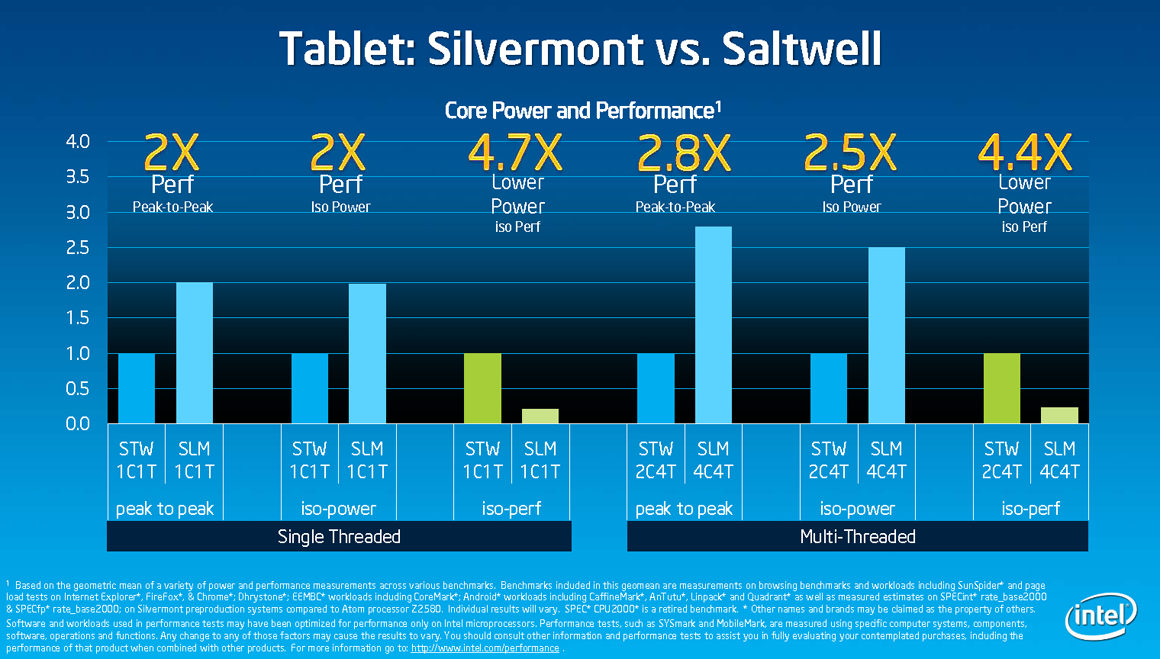
silvermont_tech20_1160-100036212-orig.png


The only denial is the denial of what the facts tell us so far. Intel has said it will be 50-60% faster than Clover Trail. Best case single thread, it is 2x peak vs the current Z2680. That means twice as fast at 2.4 GHz turbo vs 2.0 GHz, best case. 2.8x is given as best case for multithread.

Look at the AT review of the A4-5000

Now add 10% to that Z2760 and double it for single thread and multiply by 2.8x for multithread. Look at how close they are, by Intels own numbers which we can take for a fact as being best case.

So there you have it quite clearly. Intels fastest Silvermont will perform very closely to AMD's 2nd or 3rd fastest Jaguar. "What about perf/Watt?" you say, well given that Intel has...

1) A process advantage
2) 6 months to 1 year extra development
3) Much less legacy and I/O on the Silvermont SoC
3) God knows how much more money to throw at it

I'd be really, really disappointed in Intel if they couldn't come up with something that had better perf/Watt.

Thing is, Silvermont will be up against Jaguar with the legacy and I/O removed before very long, so the perf/Watt difference won't be that much in the end either.

I don't know...I just don't get all this hatred for Intel around here. Qualcomm is gigantic and yet whenever a leaked benchmark of a Snapdragon shows up, everyone's cheering, but if Intel looks like it's going to do well, it's excuses city. I notice similar hatred for Nvidia, too.
Of course you do, you only notice hatred for Intel and Nvidia. Clearly there is no hatred for AMD or anyone else. Obviously we didn't see a huge amount of cheering and BS in the other thread before the AnTuTu benchmark was shown to be a false dawn and then even dismissed by two people who normally have a heavy Intel bias (Piednoel and Kanter).

Thoughts?
[redacted]

You were doing well until the end, then it became a mean spirited personal attack
-ViRGE
 
Last edited by a moderator:

mrmt

Diamond Member
Aug 18, 2012
3,974
0
76
Add David Kanter and Francois Piednoel to that and the case is closed. There is no debate, AnTuTu is a bad benchmark, period.

If you are to take Francois' word for AnTuTu, why don't you take his word for Bay Trail performance? Because he is *very* bullish about both raw performance and performance/watt. He is saying that Bay Trail will be better than anything has or will have in the short term.
 

SiliconWars

Platinum Member
Dec 29, 2012
2,346
0
0
If you are to take Francois' word for AnTuTu, why don't you take his word for Bay Trail performance? Because he is *very* bullish about both raw performance and performance/watt. He is saying that Bay Trail will be better than anything has or will have in the short term.

Because Francois has a habit of overstating Intel performance.

The fact that he is downplaying the AnTuTu results is quite telling. He knows it's a complete fantasy and that when the real results come out people are going to be hung out to dry when they realise that Silvermont is in fact "just" a good match for 6-month old SoC's. The people proclaiming the end of ARM are going to be very embarrassed.
 
Last edited:

podspi

Golden Member
Jan 11, 2011
1,982
102
106
I am pretty excited for Baytrail, and since Windows x86 compatibility is important to me, I can't wait for these to become more commonplace.

But I don't think Baytrail will Conroe the mobile market, because I do not expect the GPU to be good enough to do so. Given what Intel has released so far, I do expect the CPU performance to exceed that of its ARM competitors, though. Whether most people care (and whether that performance is enough to make up for the loss of compatibility with some apps) is another question entirely.
 
Mar 10, 2006
11,715
2,012
126
SiliconWars,

This is exactly the same argument that you and others are using right now.
You do know that Bay Trail is coming in September, meaning that in tablets it will be going right up against Tegra 4 and Snapdragon 800...right?

index.php


1) A process advantage
2) 6 months to 1 year extra development
3) Much less legacy and I/O on the Silvermont SoC
3) God knows how much more money to throw at it

I'd be really, really disappointed in Intel if they couldn't come up with something that had better perf/Watt.

Thing is, Silvermont will be up against Jaguar with the legacy and I/O removed before very long, so the perf/Watt difference won't be that much in the end either.

Bay Trail M has all of the legacy I/O that you speak of, clocks far higher than Kabini, all in a much lower power envelope. You literally cannot fight this process advantage with micro-architecture unless the guy with the process advantage really, really screws up. I think Silvermont will be a very good CPU core, and the 4 EU Bay Trail, while not likely to win raw performance metrics, is also likely to do very well considering its power envelope.

34e.jpg


Yes, they really do. See the comparable Atom SoC at the bottom of the table, then the Snapdragon 10x faster? Based on Intel's own best case numbers, the new Atom will likely come in somewhere near the middle of the two. Let's call it "sucking less".

At what power consumption level? Has anybody measured power draw for the Snapdragon 800 in a full graphics load? And certainly a 15W Kabini isn't exactly the best thing to be comparing a 3W tablet Bay Trail against.

Also, remember what devices were used to benchmark the S800...

A bulky-as-hell 720p display toting smartphone reference design...

Snap800MDPhoneSide_689.jpg


and a bulky 11.6" reference tablet...

Snapdragon-800-MSM8974-Reference-device.jpg


[redacted]
 
Last edited by a moderator:

NTMBK

Lifer
Nov 14, 2011
10,522
6,046
136
Silvermont and Conroe are fundamentally different for business reasons. With Conroe, Intel was retaking the crown in a market that Intel built for itself, in which it has a very strong history and a massive install base. With Silvermont it needs to break into the mobile phone space, which has almost non-existant x86 install and entrenched ARM competitors. Intel need Silvermont to be better than Conroe, in all honesty. (Not in terms of overall performance, obviously. Just in terms of improvement/lead over competitors.)

Tablets are a different kettle of fish of course. I think Win8.1 plus Silvermont/Jaguar will be a very potent combination.
 

Rio Rebel

Administrator Emeritus<br>Elite Member
Oct 9, 1999
5,194
0
0
I thought this was going to be a thread about how Conroe is still a very viable processor, despite being three sockets and several "generations" behind the current Haswell architecture.

And if that had been the topic, I would agree. :)

As to the speculation that Intel is about to revolutionize the industry and everyone is hating on them, I don't have much to add on that score.
 

Abwx

Lifer
Apr 2, 2011
12,011
4,973
136
SiliconWars,


You do know that Bay Trail is coming in September, meaning that in tablets it will be going right up against Tegra 4 and Snapdragon 800...right?

index.php


Bay Trail M has all of the legacy I/O that you speak of, clocks far higher than Kabini, all in a much lower power envelope. You literally cannot fight this process advantage with micro-architecture unless the guy with the process advantage really, really screws up. I think Silvermont will be a very good CPU core, and the 4 EU Bay Trail, while not likely to win raw performance metrics, is also likely to do very well considering its power envelope.

34e.jpg


At what power consumption level? Has anybody measured power draw for the Snapdragon 800 in a full graphics load? And certainly a 15W Kabini isn't exactly the best thing to be comparing a 3W tablet Bay Trail against.

Your slides are outdated , yet you keep using them as if the info
written is holy grail..

From the forum :
http://wenku.baidu.com/view/678a3a36dd36a32d73758148.html

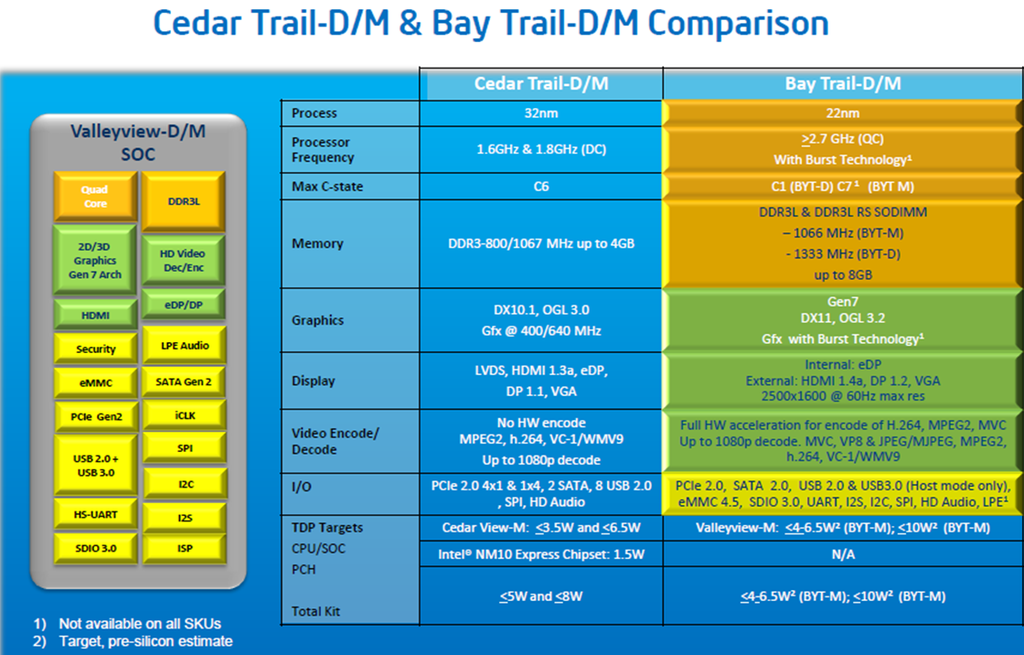
4.5W is the minimum , at 1.46ghz and for a 2C.
 

mrmt

Diamond Member
Aug 18, 2012
3,974
0
76
Because Francois has a habit of overstating Intel performance.

Mind give any examples?

The fact that he is downplaying the AnTuTu results is quite telling. He knows it's a complete fantasy and that when the real results come out people are going to be hung out to dry when they realise that Silvermont is in fact "just" a good match for 6-month old SoC's. The people proclaiming the end of ARM are going to be very embarrassed.

Francois just said that AnTuTu isn't the best benchmark over there, which is rather obvious, and Kanter said this:

"Silvermont will be good, but remember that AnTuTu is a useless stupid benchmark. It'll take more than 1.1GHz to beat Snapdragon".

Followed by

"Almost all mobile benchmarks are bullshit and twisted one way or another. But I don't know because they aren't profiled".

Francois agreeded with this but didn't back off from his comments that Silvermont will beat anything ARM out there.

Given the following comments, I don't think they are expecting Silvermont to be just a good match for Snapdragon. Your hope on this is as unfounded as the hopes of those you are criticizing here.
 

ViRGE

Elite Member, Moderator Emeritus
Oct 9, 1999
31,516
167
106
I've handed out over half a dozen infractions/warnings now, and whisked off another half-dozen posts to the great beyond, where no one else will have to suffer through them.

Quite frankly this thread is marginal at best, but there are just enough good posts amidst the drivel that it's worth leaving open for now. However I don't want to see any more complaints about thread-crapping or other meta-commentary in this thread. This is what reported posts and the Mod Discussion forum is for. And while we're at it, try to ditch the hostility and mean spirited posting.

-ViRGE
 

SiliconWars

Platinum Member
Dec 29, 2012
2,346
0
0
SiliconWars,


You do know that Bay Trail is coming in September, meaning that in tablets it will be going right up against Tegra 4 and Snapdragon 800...right?

I'll believe it when I see it.

Bay Trail M has all of the legacy I/O that you speak of, clocks far higher than Kabini, all in a much lower power envelope.
That also remains to be seen. We're talking about Tablets however.

You literally cannot fight this process advantage with micro-architecture unless the guy with the process advantage really, really screws up. I think Silvermont will be a very good CPU core, and the 4 EU Bay Trail, while not likely to win raw performance metrics, is also likely to do very well considering its power envelope.
Of course you can. Intel "only" gained about 30% power reduction from 32 to 22nm. That can easily be made up by going wide. Notice how Intels chips are so much higher clocked? they mean to use their process advantage for density purposes because that's the only way they can compete in price. All the power savings are used in density and Intel will simply be competing closely to the S800 on perf/W, probably losing slightly in cpu and heavily in gpu. That's the payoff. TSMC's 28nm is an exceptionally good node.

At what power consumption level? Has anybody measured power draw for the Snapdragon 800 in a full graphics load?
I'm glad you asked! http://www.androidauthority.com/snapdragon-800-battery-benchmark-galaxy-s4-lte-a-237448/

Impressed yet? Or just plain worried?

And certainly a 15W Kabini isn't exactly the best thing to be comparing a 3W tablet Bay Trail against.
First of all, Kabini appears to just have an arbitrary 15W catch-all TDP thrown at it. Anand found it to consume much less.

Kabini has all the I/O that Bay Trail-T doesn't have. Kabini has almost double the gpu performance and will likely have better cpu performance as well (not by as much, it'll be close though).

Kabini is not yet ready for tablets, that's a marketing decision AMD made based on their desire to get it into notebooks. But make no mistake, it will be ready before long and it will have similar per/W improvements from Brazos to Hondo.

You are however correct, the best comparison is against the S800.
 
Last edited:

bryanW1995

Lifer
May 22, 2007
11,144
32
91
The problem is the race to the bottom and ultimately technical superority is not necessarily an indication of 100% guaranteed success. There are many other factors at play like cost or IP licensing terms for example. The problem is people are trying to take experience with desktops,etc and extrapolate from that.

People have forgotten how ARM was written off decades ago too for use in personal computing,and never were expected to be ANY competition in the personal computing field to big companies like Intel. People are also forgetting the financial resources companies like Qualcomm,Apple,Samsung have which are far more than what AMD could ever muster even at their height and probably can challenge or exceed what Intel has. They can probably even afford to make mistakes along the way(unlike AMD). That is who Intel are fighting,meaning everyone from a small Chinese developer with razor thin margins to giants like Qualcomm.

If those companies pull their full weight behind developing ARM CPUs,it will be just an all out fight,and they are not going to keel over and say meh.

Then there are the Chinese developing their own chips too using the MIPS instruction set as a national product with government backing,which might end up starting to penetrate more markets.

So whether Intel wins,Qualcomm wins,or everyone wins is all uncertain IMHO.

In the end I only care that I get better final products at a reasonable price. Hopefully a good old fight between these giant tech firms will ensure this.

Insightful post. Intel kicked a$$ with conroe (and subsequent releases) b/c they just continued developing/improving their existing mobile technology, and their single competitor was ridiculous outclassed. In mobile, they have a lot more competition, and the competition has a head start.

And speaking of conroe, my IT guy is headed over to my mom's house to replace her 36gb raptor with a wd6400aaks. What, you might ask, is her cpu? Q6600 overclocked to 3.4 of course. :)
 
Last edited: