• We’re currently investigating an issue related to the forum theme and styling that is impacting page layout and visual formatting. The problem has been identified, and we are actively working on a resolution. There is no impact to user data or functionality, this is strictly a front-end display issue. We’ll post an update once the fix has been deployed. Thanks for your patience while we get this sorted.

AMD Ryzen (Summit Ridge) Benchmarks Thread (use new thread)

Page 106 - Seeking answers? Join the AnandTech community: where nearly half-a-million members share solutions and discuss the latest tech.
Status
Not open for further replies.
The leaks are saying it has auto-overclocking with no predefined "top" boost based on cooling capacity, LN2 was mentioned so it appears it can go balls to the wall on its own without user intervention.
Yup, that part is really intriguing to me. It's as if, keeping it cool is all you have to do to OC. Surely though there would have to be at least a power slider, like on GPUs.
 
Sounds like a terrible way to overclock. I don't want to overclock my CPU like my GPU, plz AMD, no.

Sent from my Nexus 5X using Tapatalk
 
I'd probably want to disable the auto overclocking to keep power consumption in check.

Also, note the rumoured selling prices. If true, its a good indication of how competitive they are.
 
I'd probably want to disable the auto overclocking to keep power consumption in check.

Also, note the rumoured selling prices. If true, its a good indication of how competitive they are.
I would imagine it would be just the opposite. From the sounds of it.. auto overclocking gives just the right voltage boost for each small 25Mhz increment when it's auto OCing. Which is better granularity than you can achieve by manually overclocking. If that's how it works I dig it.

Bulldozer was overpriced for what it was at the launch.. so I wouldn't read much into the price. It also depends on how disruptive AMD wants to be. They could really throw a wrench and cause a price war if they had a good product.
 
I would imagine it would be just the opposite. From the sounds of it.. auto overclocking gives just the right voltage boost for each small 25Mhz increment when it's auto OCing. Which is better granularity than you can achieve by manually overclocking. If that's how it works I dig it.

You're not getting my point. Even if it can OC better than I can, I don't want it to OC at all. Power consumption is more important to me.

Sadly I'd probably only be able to afford the quad core version.
 
Also, note the rumoured selling prices. If true, its a good indication of how competitive they are.

Even with these slides, there is no mention of anything but an 8 core CPU. I highly doubt the rumors are true. AMD wants to sell high end parts at first to bring in needed cash. Cheaper parts will have to wait.
 
You're not getting my point. Even if it can OC better than I can, I don't want it to OC at all. Power consumption is more important to me.

Sadly I'd probably only be able to afford the quad core version.
My point is that this thing could auto OC and still maintain power consumption low. A task finishing sooner means a CPU spends more time being idle consuming very little power. Of course hopefully they make it optional for people who like to undervolt/underclock.
 
There will be some limit, but ultimatly it's saying there will be an extra dimension to the binning process, that being Core temp. My guess some sort of Lookup table based on process behavior on top of standard binning technique. Because of that I'd also guess it would be pretty conservative.


No, You'll have a Base, a Max precision Boost, and then the Temperature based XFR.

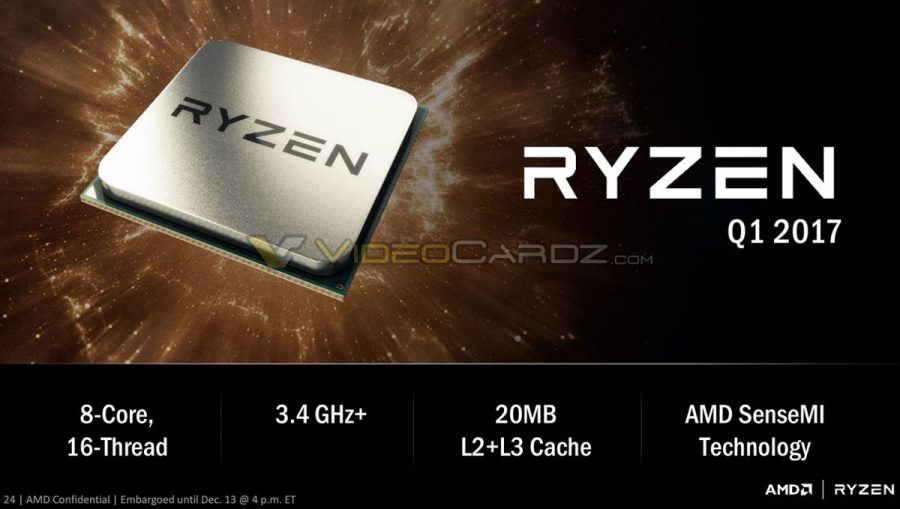
"3.4Ghz+" could however mean 3.4 boost + XFR which would be a bit disappointing.
That is not what I read. There was no mention of a Max precision boost, and then a temperature boost. I'm not saying that won't happen, only that is now what I read.
 
So, given we have already seen evidence of 3.2 GHz base, 3.5 GHz turbo, and bearing AMD's historical track record in mind....

I think its fair to say that the 3.4 GHz+ refers to turbo conditions.

In fact, its almost 100% certain to be such; the + obviously meaning exact figures cannot be tied down. Unfortunately, as with Barcelona, it looks like the release is a step backward from some of the ES in terms of clocks.
 
So, given we have already seen evidence of 3.2 GHz base, 3.5 GHz turbo, and bearing AMD's historical track record in mind....

I think its fair to say that the 3.4 GHz+ refers to turbo conditions.

In fact, its almost 100% certain to be such; the + obviously meaning exact figures cannot be tied down. Unfortunately, as with Barcelona, it looks like the release is a step backward from some of the ES in terms of clocks.

With 40% higher IPC and reduced power consumption, that may not be too important.

I don't care about clockspeed - I care about the performance per watt and performance per dollar ratios. If those are good, I'm happy.
 
With 40% higher IPC and reduced power consumption, that may not be too important.

I don't care about clockspeed - I care about the performance per watt and performance per dollar ratios. If those are good, I'm happy.

Yep. Same boat.

I do want to temper some unreasonable expectations that exist before release! (Including allowing my own to become unreasonable.)


So I also want to initiate that argument - if someone has evidence that the base is 3.4+, then I'm gonna be delighted to see it, but right now I'm not aware of anything supporting that.
 
When is the official presentation going to happen today? And whats up with the terrible names...Ryzen, that sounds like something from Samsung.
 
As far as I've "understood" it, the "XFR" operates within models specific limits meaning it won't be ramping up the clocks and voltages infinitely (obviously). For example a model might have 3.2GHz maximum all core boost (MACB), 3.5GHz maximum single core boost (MSCB) and 3.6GHz precision boost max limit.

Since Kaveri AMD hasn't had any guaranteed "base clocks" for the CPUs, so the advertized figures might neither be exactly what your will get or be limited to as the CPU adjusts it's frequency based on the available power budget.
 
No idea. There are definitely temperature coefficients, but I don't think they are the critical ones (to frequency) as long as the compared temperatures are not too far apart (e.g. 10°C tDie delta between the two cooling methods). No doubt the difference is larger than on previous designs due the process characteristics, however vast improvements should still only be seen only when the temperature difference is large enough to significantly reduce the leakage. On 32nm parts lowering the tDie by 180°C reduced the total power draw of the CPU roughly by one third, to give you some idea.
 
Since Kaveri AMD hasn't had any guaranteed "base clocks" for the CPUs, so the advertized figures might neither be exactly what your will get or be limited to as the CPU adjusts it's frequency based on the available power budget.

Kaveri is an APU with a GPU that share the power budget with a CPU, so you re just preventively badmouthing Zen using a fallacious, and irrelevant anyway, exemple..
 
Kaveri is an APU with a GPU that share the power budget with a CPU, so you re just preventively badmouthing Zen using a fallacious, and irrelevant anyway, exemple..
Cool down. Why does it matter it shares gpu. Its same principle as i can see?
 
Cool down. Why does it matter it shares gpu. Its same principle as i can see?

No, in the case of an APU the GPU will have a big TDP footprints in the total power comsumption, if it s not used then there s no way that the CPU cant work at its stock frequency even with Prime 95 as load, this is demonstrated by all reviews, so the Stilt "exemple" was just thrown out without even thinking that Summit Ridge is a stand alone CPU, a relevant exemple and comparison would had been a FX8350 or eventually a GPU less Kaveri like the 860-880K.
 
Last edited:
No, in the case of an APU the GPU will have a big TDP footprints in the total power comsumption,
And in the case of ZEN SMT will have a TDP footprint,that we have no idea of how big it could be,can you be a 100% absolutely sure that base clock is not for 8 threads?
 
Kaveri is an APU with a GPU that share the power budget with a CPU, so you re just preventively badmouthing Zen using a fallacious, and irrelevant anyway, exemple..

I cannot quite see how talking about the working priciples of the dynamic clocking is bad mouthing? 😵
Kaveri is a broken design, but the fact is that since Kaveri (or it's time frame) there hasn't been a product with a fixed base frequency.
The same exact behavior (clocks being dynamically adjusted based on available power budget) happens on all AMD APUs and GPUs released after 2013. It is a feature of the SMU and has nothing to do with the domains sharing the power (since there are no domain specific power budgets). Zeppelin uses similar SMU as Excavator parts do, only more advanced and with some additional blocks. Regardless this isn't anything new exactly, since the same feature is implemented in Orochi through Apm. Ultimately the clocks depend on how tight the TDP limit is in relation to the actual unconstrained Pmax.

Dynamic clocking is a much anticipated feature, since it adjusts the performance based on actual operating parameters. Because of that the product might not always reach it advertized frequencies but it can also in some cases exceed them (i.e when the power budget allows), as I previously said.

This is no different how recent Intel CPUs operate.
 
Because of that the product might not always reach it advertized frequencies but it can also in some cases exceed them (i.e when the power budget allows), as I previously said.
.

This happen only when the integrated GPU is loaded concurrently with the CPU, wich by the definition cant happen with Summit Ridge, or even with Kaveri provided the GPU is not significantly loaded.

As for SRidge AMD gave a lot of infos from wich we can safely assume that in regular softwares it should be capable of 3.5GHz within its 95W TDP since it consume the same as an XV based CPU, and that this latter use 46W in a 4C and with Cinebench, a SRidge should be at 92W assuming that anything else than the cores didnt see its perf/Watt improved, wich is unlikely, so the estimation is quite reasonable.
 
And in the case of ZEN SMT will have a TDP footprint,that we have no idea of how big it could be,can you be a 100% absolutely sure that base clock is not for 8 threads?

It is written 8 cores/16 threads, 3.4GHz+.

RYZEN-8C-16T-900x509.jpg
 
Status
Not open for further replies.
Back
Top