• We’re currently investigating an issue related to the forum theme and styling that is impacting page layout and visual formatting. The problem has been identified, and we are actively working on a resolution. There is no impact to user data or functionality, this is strictly a front-end display issue. We’ll post an update once the fix has been deployed. Thanks for your patience while we get this sorted.

AMD Ryzen (Summit Ridge) Benchmarks Thread (use new thread)

Page 204 - Seeking answers? Join the AnandTech community: where nearly half-a-million members share solutions and discuss the latest tech.
Status
Not open for further replies.
lolfail9001 said:
Do note, however, that in this particular bench XV is only 20% behind Skylake per clock, making is **even more likely** that Passmark is Con-core biased, and as such using it to draw conclusions on Ryzen via AMD's statement would be at best weird.

Yes of course, it could be the case that passmark is not a good representative of improvements Zen brings (when directly compared to XV core). Ryzen could have ran that benchmark at 3.8Ghz which makes it around ~7% slower than Haswell, still tremendous result.
 
I stand corrected about physics then 🙂

Do we know if ST performance in passmark is IPC or indeed single thread performance?

Never mind my silly question... Although I don't know how indicative IPC (or single thread performance) is when SMT is involved.
 
Last edited:
Look at the physics score. That is what is going to condemn it to gaming mediocrity. The memory score is also a grave concern, if it is cache bandwidth that is pulling it down.
I don't see strong correlations there. As dfk7677 wrote, physics is mostly a task of the GPUs. And the mem score isn't fully correlated with cache bandwidth, if at all. And with slow settings, there is room for improvement running mem at typical settings.

BIOS etc. not discussed here - no data.
 
Interesting...

AMD-Ryzen-Sisoft-benchmark-1000x1551.png


sandra-multi.jpg

Source

That's a great score for the same sample. Still don't know if turbo is enabled or not.
 
Because that i3 is 3 years old? If you take an objective perspective, you might recall that bulldozer also looked pretty decent compared to 3 year old intels chips at the time.
I was being sarcastic dude...

BTW after watching other benchmarks which compares Ryzen with i7 6950x showing Ryzen scoring slightly higher 2046 vs 2022 for the Intel chip im pretty sure Ryzen was running at 3.8ghz...

If it turns out that it was running 3.4ghz then we can say it has higher IPC then broadwell since the stock i7 6950x runs at 3.5ghz for ST tests..
 
I was wondering if you could tell if XFR was enabled.

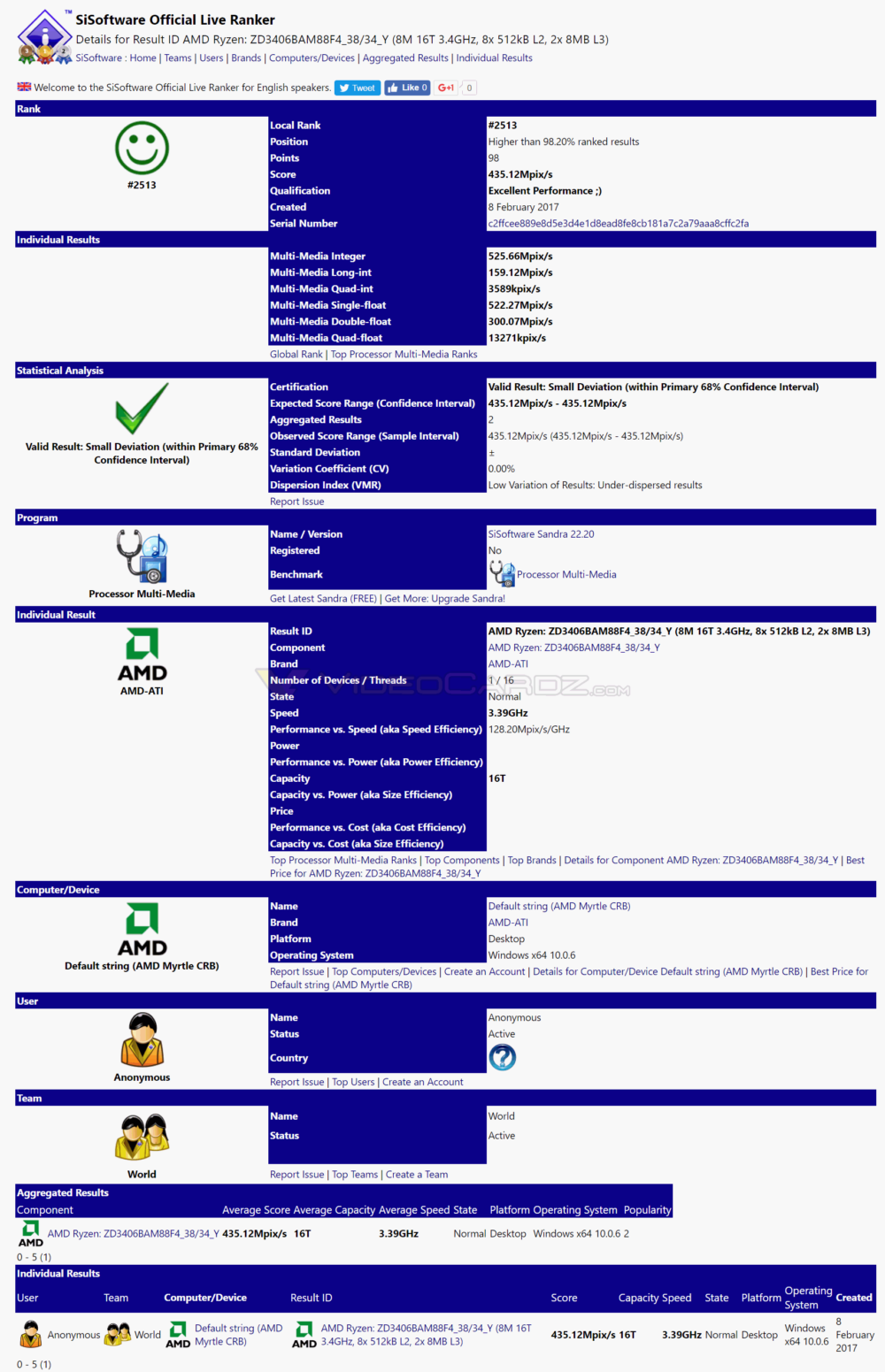
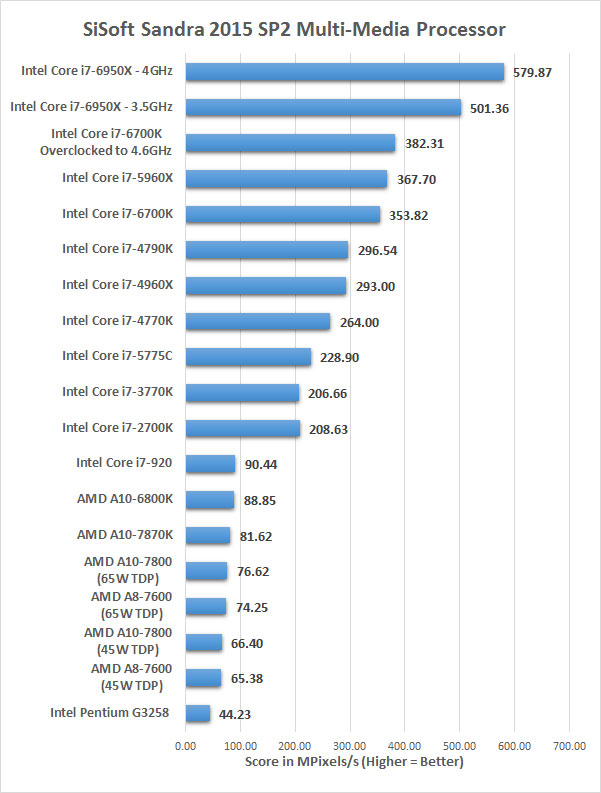
I looked at the Sandra result and compared it to a random 6900K score that seemed like it had turbo disabled (3.2 ghz):

MM Integer: 718 vs 525 for the Ryzen "38_34"
MM Long Int: 211 vs 159
MM Quad Int: 3299 vs 3589
MM Single Float: 654 vs 522
MM Double Float: 374 vs 300
MM Quad Float: 13352 vs 13271

Not sure what to make of it beyond perhaps some have AVX(2) optimizations and some don't.

several posts before, someone mentioned that this was on an x300? board--one of the barebones that that locks OC (so, XFR). So, just buy knowing the board in the test (which is known), you can know that this was locked at reported test clocks.
 
I doubt that board will just lock ST Turbo clock, in that case AMD's advertised clock of 3.8Ghz would never be reached(see the problem?). I think the board does clearly support the Turbo functionality but whether it was enabled or not is unclear.
 
several posts before, someone mentioned that this was on an x300? board--one of the barebones that that locks OC (so, XFR). So, just buy knowing the board in the test (which is known), you can know that this was locked at reported test clocks.

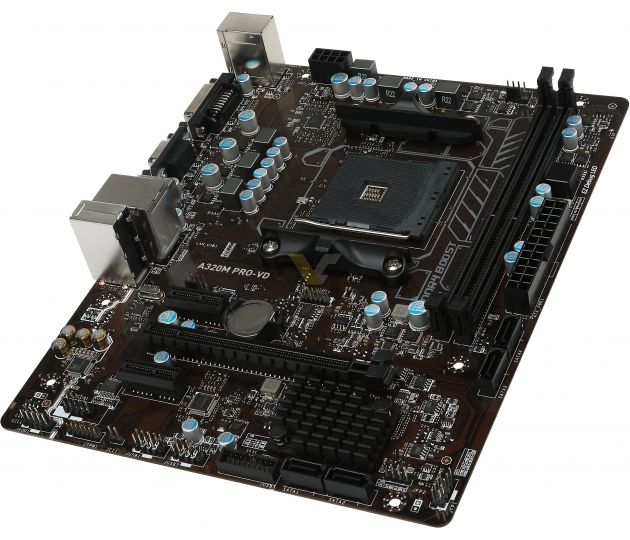
Sample is running on this potato quality motherboard.

MSI A320M PRO-VD

35319cc91d56e8e3e87c02bb4a651b59-630x540.jpg


Overclocking chipsets
B350
X300
X370

Non overclocking chipsets
A320
A300


No XFR, which is auto overclocking. Turbo should work if enabled.
 
Because that i3 is 3 years old? If you take an objective perspective, you might recall that bulldozer also looked pretty decent compared to 3 year old intels chips at the time.
Bulldozer really didn't, maybe Piledriver looked okay. Plus, current Sky/Kaby Lake designs are only 10-15% faster per clock, with Broadwell-E being less. Like I said, you aren't fooling anyone with this 3 year-old spin.
 
I know that it does not work so. I was only supposing that with XFR the binning can also be done this way. Could you say that this is impossible?
It's possible, yes. IMO.

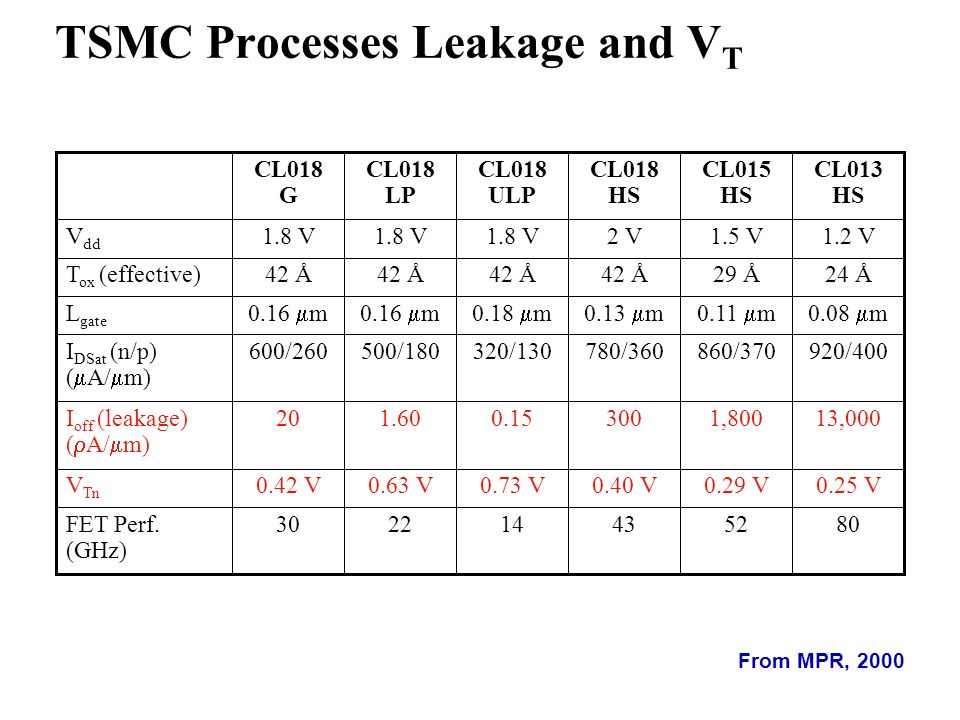
But Vt 'binning' is never done. Those chips consumers see as 'high leakage', they are way too hot on current to validate on most MBs.

If you mean intentional Vt variation among transistors, that's a different topic altogether and not what is referred to as 'high/low leakage chip'.

That is also what I said, but you keep forgotting and mocking me. I said that maybe 4GHz will not be reached at launch but after some months.
I don't mock you. I mocked your repetitive assertions because they were adrift of reality.

You were claiming 4-4.5GHz for launch under 95W, and theorizing more is possible due to the Neon FPU on 14nm test vehicle. Then you extrapolated that to EXC max clock and added the gains on top. Plus the >BDe level IPC and better than BDe power.

I have those posts saved

Clocks after some tuning is when I said that it is surely possible but certainly not for launch under 95W. You always hit a knee-jerk reaction on this, until now.

It's been shown that Samsung's process is inferior on every metric to Intels original nontuned 14nm in 2014. Just imagine Intels process right now in 2017, but you still kept promoting without data how AMD will easily beat those IPC x Clocks@Power. I kept trying to explain to you it's a seesaw, but then gave up after you would ignore answering pertinent questions, providing data or discussing actual historical trends and data.

Walls of texts on repeat doesn't reinforce an erroneous point.

Neither does playing tag team.

TI_Leakage_Delay2_C1A.jpg

slide_21.jpg

LVT transistors have high leakage than RVT and HVT transistors, so your statement is incorrect. LVt means low Vt and so on.
The problem is that you can't guarantee exact Vt and so leakage for a given transistor.

That linked is about transistor level not chip level.

These trannys are used in different areas depending on if it is in the critical speed path or power critical, they pose different benefits. HVT allows lower power but slower delay. LVT allows the converse. I don't disagree with any of that. If you search back I explained these same points months ago on here.


Zen is looking better than all initial indications (I predicted 3-3.4GHz all core max, SNB-HSW level average) but it is still not a known if it performs IVB level in average, worse, better, or IVB-KBL level. It is also an unknown if those TDP figures mean anything close to power draw under full load.

IF today benchmarks start leaking Ryzen to be SNB-HSW level then its still a major engineering achievement to catch up on the +60% deficit. Might not be competitive past the mid-range, but doesn't mean it's anywhere close to Bulldozer.

As for Passmark, I really wouldn't go off it too much. It has too many variables able to cause variations which skew comparisons.


But I will say, I dislike anyone trying to save face backtracking\euphemisming on lengthy claims after they realize how incorrectly exaggerated they were for months, now that reality is hitting home.

It's intellectual dishonesty and I expect you to not take this route.

It's better to live and learn, but take a measured approach for the future processor releases.

Sent from HTC 10
(Opinions are own)

 
Last edited:
^ You should directly quote whatever you are responding to. The discussion is moving so fast that it is difficult to keep up with the changing topics.
 
Sample is running on this potato quality motherboard.

MSI A320M PRO-VD

35319cc91d56e8e3e87c02bb4a651b59-630x540.jpg


Overclocking chipsets
B350
X300
X370

Non overclocking chipsets
A320
A300


No XFR, which is auto overclocking. Turbo should work if enabled.

OIC--I'm a nube, so was just assuming that any OC disabled meant that both the new auto-OC feature for AMD wouldn't work, as well as turbo. I don't know anything about these turbo frequency things (which I guess have been around far longer than I have appreated). I just plug the CPU in and push the buttons. 😀
 
The real question is if the processor is really running at 3.4 GHz or if it's running at a boost clock that the benchmarking program can't properly defect. For all we know, it might have some exotic liquid cooling system that lets it hit 5 GHz.

I'd still wait for official benchmarks before placing a pre-order.
 
The real question is if the processor is really running at 3.4 GHz or if it's running at a boost clock that the benchmarking program can't properly defect. For all we know, it might have some exotic liquid cooling system that lets it hit 5 GHz.

I'd still wait for official benchmarks before placing a pre-order.

From a person I know that tests motherboards and has privy to Ryzen says that motherboards are not good at the moment. Turbo doesn't work and firmware is not yet available to run turbo stable. The chip is likely on an older firmware and clearly it is flat base clock. Turbo would not arbitrarily not detect unless it is turned off. either way points to turbo off.
 
Yep, that is why Lisa Su said that they will cover 85% of the server market with Zen. The missing 15% is HPC. Zen+ should address that I guess.

HPC is going to be the domain of GPGPU wherever possible. My assumption is that they're going to sell Snowy Owl and/or RTG products to that market.

At least the more recent versions do.
AVX, AVX2 and FMA.

Bullet is part of my test suite because of that.
Cache size and latency has a huge effect too.

Bullet Physics kicked Carrizo/Bristol Ridge's ass thanks to that half-sized l2 cache.

From a person I know that tests motherboards and has privy to Ryzen says that motherboards are not good at the moment. Turbo doesn't work and firmware is not yet available to run turbo stable. The chip is likely on an older firmware and clearly it is flat base clock. Turbo would not arbitrarily not detect unless it is turned off. either way points to turbo off.

You aren't the first person to say that. Allegedly board problems pushed back the Ryzen launch. Hell we didn't even see Asus boards at all until recently.
 
Status
Not open for further replies.
Back
Top