
III-V
Senior member
I don't really see why they couldn't be the budget alternative again.Its quite obvious that Zen and K12 will be another idiotic attempt for AMD to come back to servers. Yet again dragging the rest of the company down with it.

I don't really see why they couldn't be the budget alternative again.Its quite obvious that Zen and K12 will be another idiotic attempt for AMD to come back to servers. Yet again dragging the rest of the company down with it.

After all these years with the mining craze, I can't understand how amd's market share has plummet so much? There was a serious shortage on amd cards for so long that I cannot fathom where all those cards went?Steam's HW Survery GPU Makeup:-
44.0% nVidia
22.0% AMD
19.8% Intel
13.8% Other
http://store.steampowered.com/hwsurvey/videocard/
Out of AMD's 22% GFX market share, Kaveri's are included under the 0.55% user base "AMD Radeon R7 200 Series" shared with desktop dGPU's like R7 240/250/260/260X, etc. Remove those dGPU's, and Kaveri users basically make up nearer 0.20-0.25% (1 in 400-500) of the gaming market. Not exactly sure how that results in dGPU's being made "fringe" for gaming or AMD APU's being "mainstream" (either for gaming OR compute)?
There seems to be a constant "split" between the assumption of "20% of Steam users use Intel iGPU's therefore AMD's APU must be selling well" or "everyone's interested primarily in APU compute performance" vs what 99.5% of the market is actually doing to the contrary in observable reality...
AMD's been losing out on OEM wins big time since Maxwell released nearly a year ago.After all these years with the mining craze, I can't understand how amd's market share has plummet so much? There was a serious shortage on amd cards for so long that I cannot fathom where all those cards went?
To the thrash? Or doesn't miners play games and because of that steam HW survey isn't very reliable place to get definitive numbers?

It would be very foolish from AMD's part if they decided to burn half the die of their products for the sake of a nonexistent feature like compute


After all these years with the mining craze, I can't understand how amd's market share has plummet so much? There was a serious shortage on amd cards for so long that I cannot fathom where all those cards went?
To the thrash? Or doesn't miners play games and because of that steam HW survey isn't very reliable place to get definitive numbers?
After all these years with the mining craze, I can't understand how amd's market share has plummet so much? There was a serious shortage on amd cards for so long that I cannot fathom where all those cards went?
To the thrash? Or doesn't miners play games and because of that steam HW survey isn't very reliable place to get definitive numbers?

After all these years with the mining craze, I can't understand how amd's market share has plummet so much? There was a serious shortage on amd cards for so long that I cannot fathom where all those cards went?
To the thrash? Or doesn't miners play games and because of that steam HW survey isn't very reliable place to get definitive numbers?
Because the mining craze was massively overhyped. AMD had a component shortage. Not a massive sale.
Once again you can't imagine something not right in your face exists. GPU mining is still growing. The pay to play is getting bigger though.
So tell me why this crazy mining didnt show up on AMDs financials.
It did. It enabled them to start charging higher when retailers found the demand was much higher than expected. The negative side is that marketshare for gamers was reduced by people being priced out.
A company and all of their partners selling all of their products from MSRP to up to 70% higher is a positive thing, no matter the spin you could put on it. With all the time you spend on this forum, are you willfully oblivious of what's going on around you?
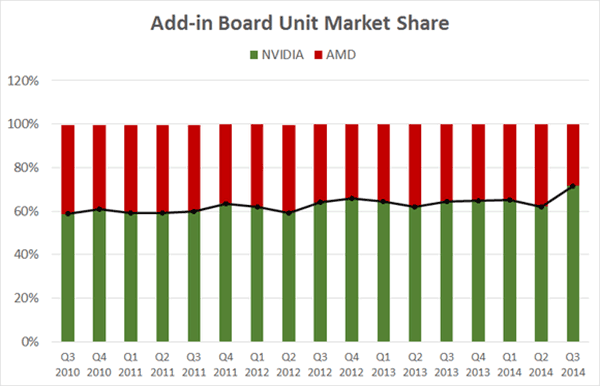
No, your link doesnt concern AMDs financials. And also you forgot in how much of the world the cards costed the same all the time.
Those that made money on this is companies like Newegg.
AMD showed no benefit in their financials from this.
No, your link doesnt concern AMDs financials. And also you forgot in how much of the world the cards costed the same all the time.
Those that made money on this is companies like Newegg, retailers.
AMD showed no benefit in their financials from this.
And in terms of marketshare:
Do you know how many R9 280/X and R9 290/X were sold at that time (Q4 2013) ???
Just asking
Also, at Q4 2013 Graphics and Visual Solutions had its highest Revenue and Income since today. Granted it combines both GPUs and Console chips but non the less they had 865M of Net Revenue and 121M of Operating Income.
That means they increased their Net Revenue by ~29% but increased Operating Income by 53% from Q3 2013. I wouldnt count the consoles for this 😉
http://phx.corporate-ir.net/External.File?item=UGFyZW50SUQ9MjY3MjMyfENoaWxkSUQ9LTF8VHlwZT0z&t=1
Selling all of your products produced is never a bad thing. It's clear you've never worked in the middle of a supply chain. Once high demand is established, the price to retailers is variable. It is never static. Bolded is completely wrong.
And even it what you said was true, the logic behind it being negative or that it didn't help them financially is baffling. It is a horrible thing to sell all of your products then to have a stockpile of hardware waiting to be sold at a lower pricepoint. Yep, that makes sense!
Edit: Posting market share numbers? Talk about a red herring. Because AMD had high demand, that doesn't mean nVidia didn't either. Cryptocoin is a new market that nVidia didn't have the hardware to compete it. It doesn't mean they didn't sell a ton of video cards to gamers and professionals. Also, that market share graph is incredibly misleading as it doesn't account for APU graphic cards, as they are around the same power as most discrete cards sold. Again, more red herrings to support your flawed logic.
So you know the number is useless, yet you post it?
So what made the Revenue to increase by 29% and the Income by 53% from Q3 2013 to Q4 2013 ???
He'll just dodge the question again with red herrings.
http://phx.corporate-ir.net/External.File?item=UGFyZW50SUQ9MjE3Nzc5fENoaWxkSUQ9LTF8VHlwZT0z&t=1
• GVS segment revenue was up 29% sequentially, primarily due to sales of semi-custom SoCs to Sony and Microsoft for their next-generation game console offerings.
• Graphics Processing Unit (GPU) revenue increased sequentially, driven by sales of our next-generation AMD RadeonTM R7 and R9 series GPUs.
There was some impact from the mining drill but by no means close to 29% increased revenue:
And since you have said sooooo many times how low margins those Consoles have, it is only logical that the higher Income (53%) came from the High end GPUs.
To quote mrmt
" the console APUs have ridiculously low margins."

What you write about is pretty interesting, but Iris Pro and Haswell-E are at the highest end of the market (where volume is really low).
In contrast, even most people in this enthusiast forum only use a Core i5 (of some type) that they may have been holding onto for quite some time because they haven't found the need any extra CPU performance.
As much as GPGPU will play a bigger role in the future, neither AMD nor Intel sell a CPU today to offer a benefit years down the road
It will be rather curious if they launch an Excavator die by the time they should have their next wonderchip, designed by the hands of an EE God, rolling out on the market.
It will be cheaper and easier for AMD to modify Carrizo to make Bristol Ridge than it will be for them to make an APU out of Zen. Zen APUs come later.
If so, why bother? AMD had a 1.2 billion/quarter CPU business three years ago, now it is a sub-300MM business and if they don't change the product mix it will keep shrinking. By the time this Bristol Ridge arrives I don't think there will be volumes for the chip to pay itself back.


