• We’re currently investigating an issue related to the forum theme and styling that is impacting page layout and visual formatting. The problem has been identified, and we are actively working on a resolution. There is no impact to user data or functionality, this is strictly a front-end display issue. We’ll post an update once the fix has been deployed. Thanks for your patience while we get this sorted.

[AMD Processors] The future CPUs

Page 7 - Seeking answers? Join the AnandTech community: where nearly half-a-million members share solutions and discuss the latest tech.
If it means anything to you guys, The Stilt did in fact unlock the cTDP restrictions on his 8800P system (to the point that he can now overwhelm the power brick under certain circumstances). I'm trying to get him to run a few fp-heavy benches at a fixed clockspeed (2 GHz or so) on that thing to provide a frame of reference against Kaveri.

Then maybe we can have some idea of what we can expect from Zen.
 
Construction APUs are supposed to continue in life for a while, maybe it'll finally see a die shrink
 
My bet is on at least one SKU of Zen with a fat iGPU using HBM2 like Intel uses eDRAM -- as an L4 cache for the processor but also as the primary memory for graphics tasks.

Broadwell still wins versus Skylake and 4790k in some benches due to how much uplift they get out of that 128mb eDRAM. I wonder how much a 2GB HBM2 stack L4 cache would uplift performance. Does it make more sense as a total DRAM replacement (e.g. SOC style)?
 
So... Bristol Ridge ended to be 14 nm Bulldozer after all?

Wouldn't be surprised if AMD started work on a 14 nm constructor chip but cancelled it.

My bet is on at least one SKU of Zen with a fat iGPU using HBM2 like Intel uses eDRAM -- as an L4 cache for the processor but also as the primary memory for graphics tasks.

Good luck getting OEMs to use it.
 
That would be really exciting to actually be interested in an AMD platform again, however, if SB IPC is what it ends up having, then...well, I've already had that since 2011. Skylake-E it will be.
 
That would be really exciting to actually be interested in an AMD platform again, however, if SB IPC is what it ends up having, then...well, I've already had that since 2011. Skylake-E it will be.

You never thought that said 40% could be an average..?.

Think about it, an Excavator FPU has as much throughput than a HW core, a single Excavator core is not enough to max out this FPU, two cores are necessary for this purpose.

Using Cinebench 11.5 as metric, wich cant be considered as favouring AMD, an EXV module should score 1.94 at 3.5GHz, FTR a HW core score 1.52 in ST and 1.90 with 1C/2T.

A single Zen core using this FPU, and in case it can saturate it, would have the same FP throughput as an Excavator module, and would largely match HW.
 
You never thought that said 40% could be an average..?.

Think about it, an Excavator FPU has as much throughput than a HW core, a single Excavator core is not enough to max out this FPU, two cores are necessary for this purpose.

Using Cinebench 11.5 as metric, wich cant be considered as favouring AMD, an EXV module should score 1.94 at 3.5GHz, FTR a HW core score 1.52 in ST and 1.90 with 1C/2T.

A single Zen core using this FPU, and in case it can saturate it, would have the same FP throughput as an Excavator module, and would largely match HW.

Its not my intention to argue, but Haswell is available right now and has been out for a long time already. I could have upgraded to a haswell-E platform but didn't feel it was worth my money. I upgraded other stuff instead. A 6-8 core Skylake would barely be enough of an upgrade for me, and that is largely dependent on how well they OC.
So if Zen is even as fast as Haswell, i'm afraid I won't be interested in saving a few bucks and buying one. I'd rather have the best, but that's just me and we have to wait and see anyways.
 
Its not my intention to argue, but Haswell is available right now and has been out for a long time already. I could have upgraded to a haswell-E platform but didn't feel it was worth my money. I upgraded other stuff instead. A 6-8 core Skylake would barely be enough of an upgrade for me, and that is largely dependent on how well they OC.
So if Zen is even as fast as Haswell, i'm afraid I won't be interested in saving a few bucks and buying one. I'd rather have the best, but that's just me and we have to wait and see anyways.

FX Zen will be 95W with 8C/16T, given that it will use a generic and low cost plateform it shouldnt be expensive overall, and i dont think that a 8C SKL will fit in a 95W TDP..

It will be indeed interesting to read the opinion of all people that are currently slicing a few watts, and a handfull of $, as argument when dealing with the current FXs...

That said i hope that they ll keep devellopping the Excavator cores, at 14nm this uarch would be more efficient than the usual designs and it would be a mistake to ditch it now that Mthreading is a concern for all software editors, including games develloppers..
 
Broadwell still wins versus Skylake and 4790k in some benches due to how much uplift they get out of that 128mb eDRAM. I wonder how much a 2GB HBM2 stack L4 cache would uplift performance. Does it make more sense as a total DRAM replacement (e.g. SOC style)?

To use it as a cache, you need tag memory, which is a rather large 2MB on 128MB for Crystalwell. 2GB would be prohibitive.
 
Well lets see. If AMD wants to compete against Skylake/Kaby GT4e (Quad Core 8x Threads die size of 200mm2+) then they would need a 200mm2+ die as well.

With 14nm FF they will be able to install 2x the iGPU of Kaveri/Carrizo at close to 200-220mm2. That means close to R9 270 performance if they will use HBM2. That APU will be close to the PS4 GPU performance but at lower power and smaller die.

Heh forget about 200mm2 14nm APUs from AMD if Kaveri is faster than GT3e Broadwell.

A 120mm2 8x CU GCN 1.2 with DDR-4 3200MHz APU next year could be faster than Skylake GT4e.

http://www.sweclockers.com/test/20908-intel-core-i7-5775c-och-i5-5675c-broadwell/1#content

10416


10445


10436

10424


10407
 
The Stilt came through on a few Carrizo benchmarks at locked clockspeeds:

http://www.overclock.net/t/1560230/jagatreview-hands-on-amd-fx-8800p-carrizo/400_100#post_24310470

You can see my comparison of Carrizo and Kaveri below in the same thread:

http://www.overclock.net/t/1560230/jagatreview-hands-on-amd-fx-8800p-carrizo/400_100#post_24312595

So 11% faster, 20% faster, 11% faster, and 5% faster in those four benchmarks. I have a feeling that a lot of older software and/or software that is simply not terribly well-optimized for anything, we'll see more results like those of Cinebench, but still when you consider what is possible, it becomes clear that Carrizo has some serious power under the hood.

Now, make Zen 40% faster than that.

Here's one example of how things could work out. First, consider an i7-4770k @ stock running Cinebench R10:

http://www.anandtech.com/show/7003/the-haswell-review-intel-core-i74770k-i54560k-tested/7

The 4c/8t 4770k scores 28623. A 4c/8t Zen @ 3.4 GHz should score 36809 since:

2m/4t Carrizo scores 13146 @ 3.4 GHz. 4m/8t Carrizo, given the same utilization %, should score 26292 @ 3.4 GHz. 26292 * 1.4 = 36809.

The oft-cited 95W 8c/16t should score 73618 @ 3.4 GHz assuming it doesn't hit one of R10's thread limits (it can max out beyond a certain number of threads). Is 3.4 GHz doable with that many cores in that power envelope? I don't know. 3 GHz may be more realistic. It would still be a fireball at that speed.

Sandy Bridge like performance? I don't think so.
 
Last edited:
Nice job at handpicking AtenRa. My turn:

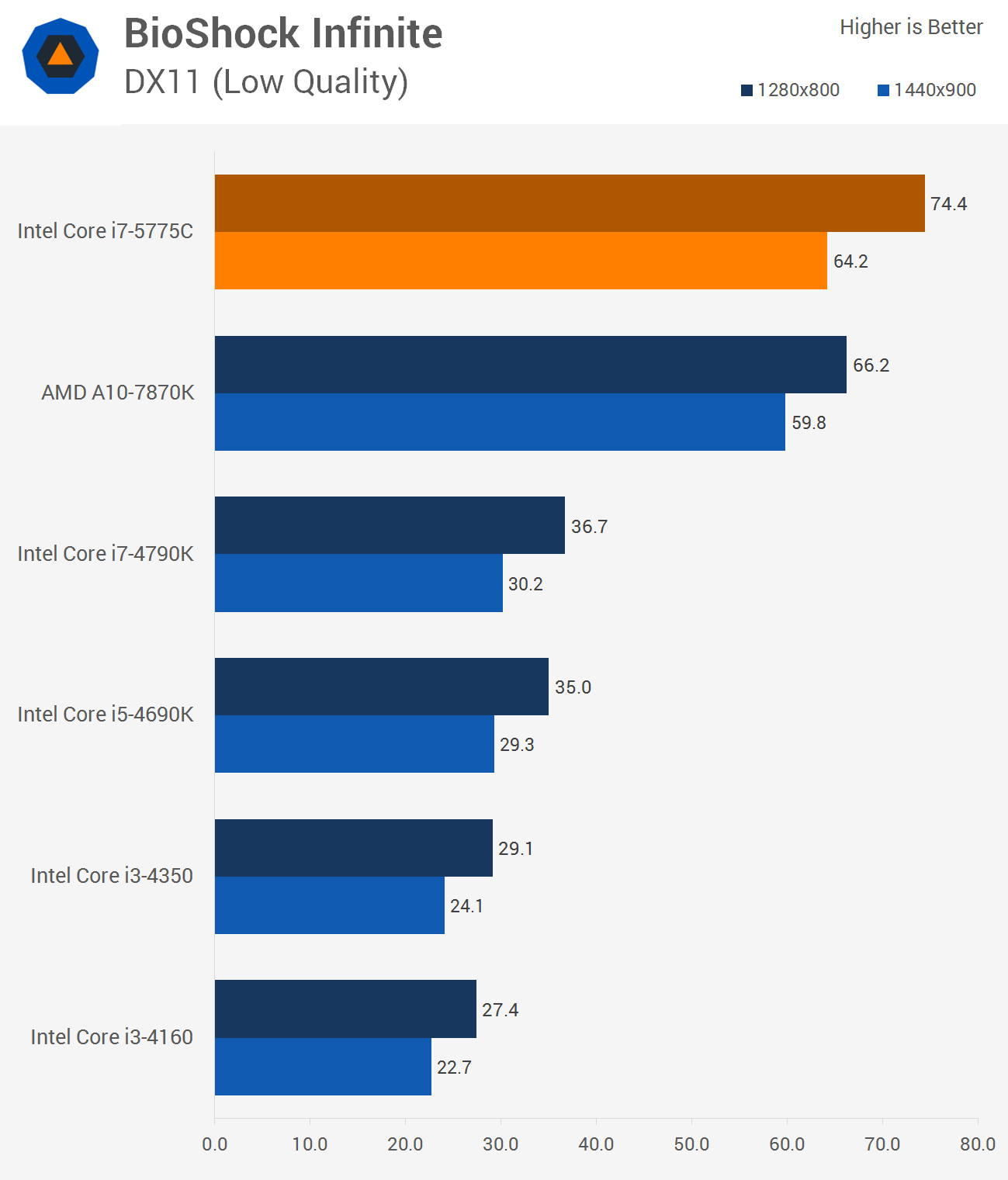
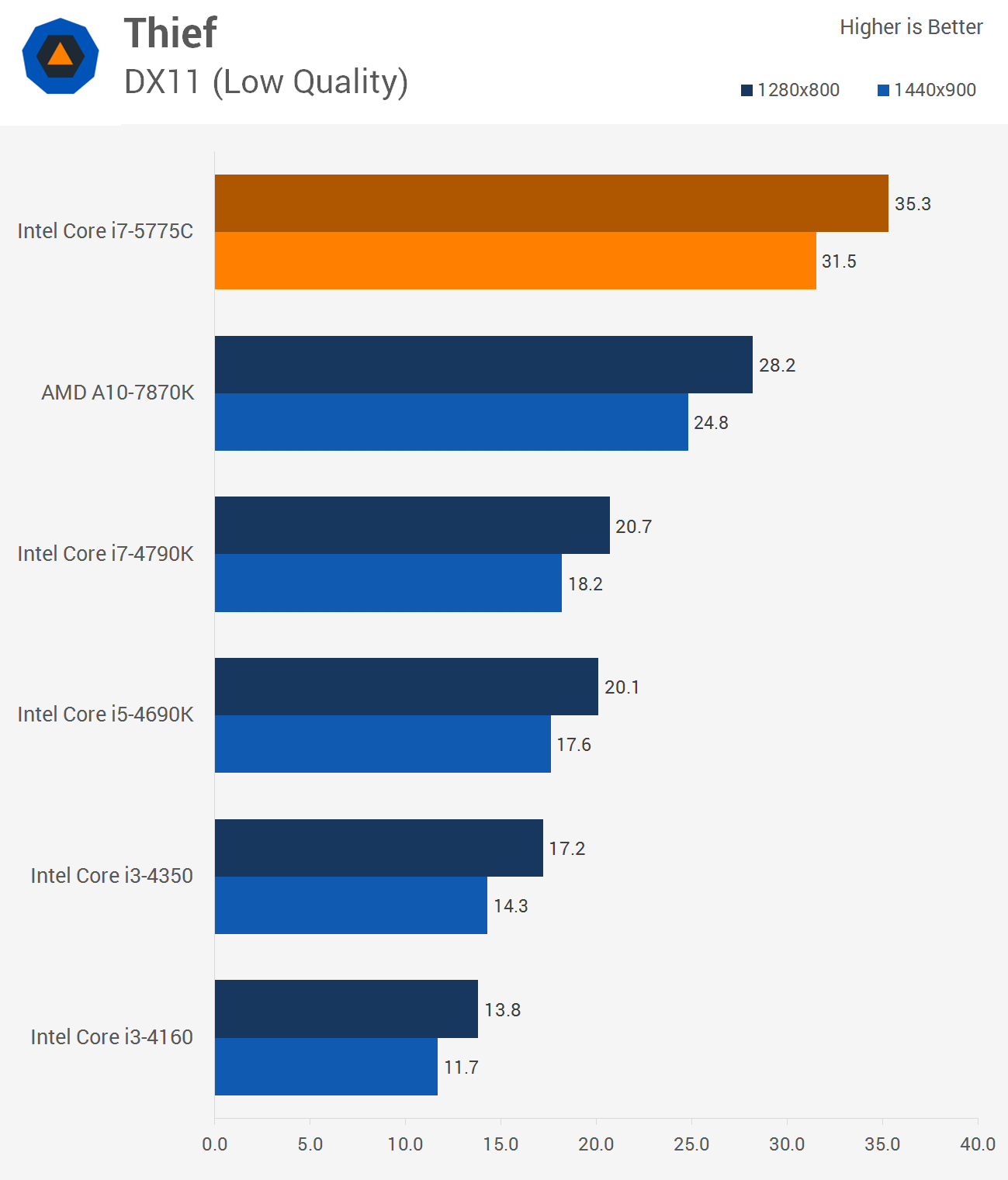
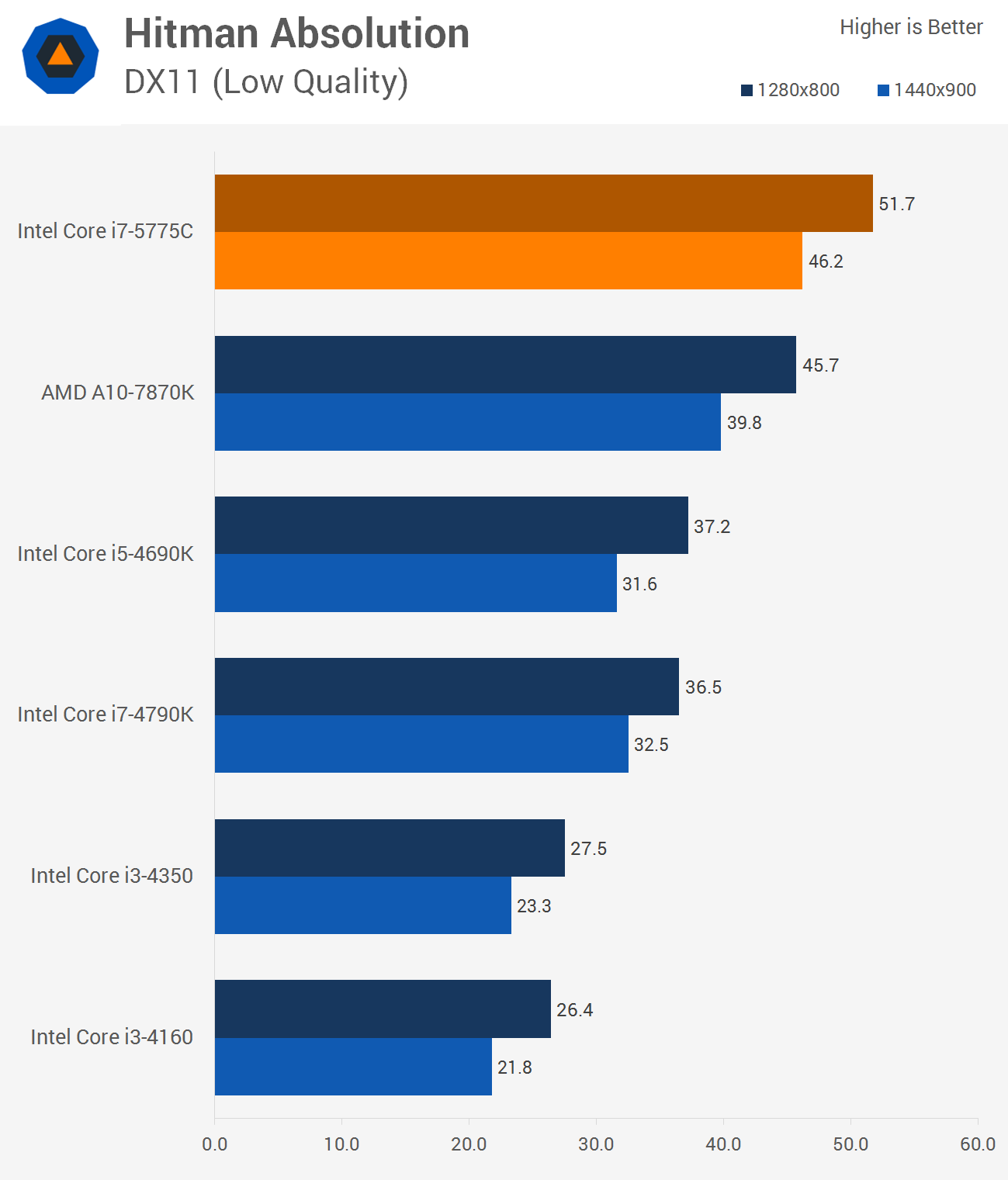
Majority of benchmarks put Broadwell GT3e ahead of AMD's APUs.

iGaming_01.png


iGaming_05.png


iGaming_03.png


iGaming_02.png


219574.png


219575.png


219579.png


219582.png


Bristol Ridge will get smoked by Skylake GT4e and Kabylake GT4e next year, only hope for AMD now is the 2017 Raven Ridge APU and there's not a single leaked slide talking about HBM yet.
 
Nice job at handpicking AtenRa. My turn:

Majority of benchmarks put Broadwell GT3e ahead of AMD's APUs.

Bristol Ridge will get smoked by Skylake GT4e and Kabylake GT4e next year, only hope for AMD now is the 2017 Raven Ridge APU and there's not a single leaked slide talking about HBM yet.
Is there an inverse correlation between render quality and a Broadwell advantage?
 
Is there an inverse correlation between render quality and a Broadwell advantage?

Considering the framerates are barely playable as is, why would you want to turn them up? These are the settings you're actually going to be running these games at.
 
Considering the framerates are barely playable as is, why would you want to turn them up? These are the settings you're actually going to be running these games at.

I asked because this would shift power requirements from shaders to CPU cores or GPU geometry engines.
 
Nice job at handpicking AtenRa. My turn:

Majority of benchmarks put Broadwell GT3e ahead of AMD's APUs.

Bristol Ridge will get smoked by Skylake GT4e and Kabylake GT4e next year, only hope for AMD now is the 2017 Raven Ridge APU and there's not a single leaked slide talking about HBM yet.

A $324 part better damn well outperform a $139 part.
 
An addendum to my price agnostic bias theory:
Looking at Sweepr's sig it seems, that while driving a 10 year old car, he's comparing Bugatti Veyrons to Corvettes. 😉

Now I'm waiting for someone explaining me why those car's don't match the chip companies ^^.
 
Last edited:
Broadwell gives hugely better cpu performance than kaveri, so to compare price/performance based on igpu performance alone is only looking at part of the picture. As a purchaser, i also dont consider "price agnostic" to be biased. Some purchasers simply want the best no matter what, that does not necessarily indicate bias.
 
Back
Top