

"AMD Moves Away From PCs Amid Steep Losses"
Page 2 - Seeking answers? Join the AnandTech community: where nearly half-a-million members share solutions and discuss the latest tech.
You are using an out of date browser. It may not display this or other websites correctly.
You should upgrade or use an alternative browser.
You should upgrade or use an alternative browser.
Beat me to it, the rumours seem to be they have the Xbox and Playstation GPU contracts under their belt, they could make some serious cash there if they play it right, part of the PC decline is mobile but a large part of that is cheap consoles.
Cheap consoles have close to a zero effect, in fact it's close enough to zero to not even consider it. Most console gamers are console gamers because that's what they know, that's what they want. Something simple that just works. Very few are console gamers because PC gaming is too expensive.

NTMBK
Lifer
- Nov 14, 2011
- 10,526
- 6,051
- 136
But AMD is not selling GPUs they are selling IP. They got $1 or $2 per console. That's nothing if your overall GPU business is going down.
Not just GPUs- the rumours are a whole AMD APU, with x86 cores.
nemesismk2
Diamond Member

Yeah that sucks because I have always used AMD cpu going back to the amd 386 dx 40mhz some years ago


CHADBOGA
Platinum Member
- Mar 31, 2009
- 2,135
- 833
- 136
You will get the chance to explore new things.Yeah that sucks because I have always used AMD cpu going back to the amd 386 dx 40mhz some years ago

AtenRa
Lifer
- Feb 2, 2009
- 14,003
- 3,362
- 136
You will get the chance to explore new things.
Yeap, the AMD APUs(you included :biggrin

ViRGE
Elite Member, Moderator Emeritus
- Oct 9, 1999
- 31,516
- 167
- 106
It doesn't really matter. Getting into a console is about bragging rights, not profit. The console's owner will drive your margins into the ground, in large part because they control the IP (MS having learned that one the hard way after Xbox 1). It's consistent revenue (and that's a very good thing), but it's not the kind of big money needed to sustain high-end GPU development, which is part of the reason why everyone is using PC GPU variants in the first place.Not just GPUs- the rumours are a whole AMD APU, with x86 cores.
AMD should have done what nVidia is doing.
Which bit of what NV are doing? Improving compute performance on GPUs in order to get into the HPC market?
Aiming for the low power/tablet market?
Being a fabless design company?
Which thing that NV is doing should AMD also be doing that they are not already doing? Unless you mean going ARM.


Olikan
Platinum Member
- Sep 23, 2011
- 2,023
- 275
- 126
It doesn't really matter. Getting into a console is about bragging rights, not profit. The console's owner will drive your margins into the ground, in large part because they control the IP (MS having learned that one the hard way after Xbox 1). It's consistent revenue (and that's a very good thing), but it's not the kind of big money needed to sustain high-end GPU development, which is part of the reason why everyone is using PC GPU variants in the first place.
yes, what is good about consoles (money wise), is that the other company pays your R&D costs...
the other benefit is been close to game developers...that gives a good idea about the future, and help the company to avoid bad products...like p4 and bulldozer
Which bit of what NV are doing? Improving compute performance on GPUs in order to get into the HPC market?
Aiming for the low power/tablet market?
Being a fabless design company?
Which thing that NV is doing should AMD also be doing that they are not already doing? Unless you mean going ARM.
Being innovative:
nVidia's first real GPGPU product was G80 (November 2006). AMD first real product was Cypress (Septemer 2009).
nVidia's product for the Netbook/Atom-market was ION (February 2009), AMD released Brazos end of 2010.
Optimus in February 2010 vs. <i have no clue> 1 1/2 years later and then renamed to Enduro this year or so.
nVidia went big into the low power market with Tegra 2 (CES 2010, first product out in August 2010). AMD has no product for this market...
AMD is to slow to survive. They are always a step behind their competition. And there is no excuse why they can't hang on with nVidia...
nemesismk2
Diamond Member
You will get the chance to explore new things.
I guess i will be using my amd athlon ii x3 455 3.3ghz for a bit longer then lol

mikeymikec
Lifer
- May 19, 2011
- 21,619
- 16,895
- 136
So this might mean no more gpu's either?
AMD GPUs are credible products in today's marketplace so I doubt that they're going to disappear or be put on the backburner. If AMD stopped fuelling GPU R&D the way they are at the moment then they may as well hand over that market to NVIDIA as well as the possible future possibilities for next-gen consoles.
AMD GPUs may not be a big earner for AMD but at least they're doing OK. Also, their push in the APU direction relies on having solid graphics performance in 2D and 3D, so I think AMD GPU R&D will remain reasonably consistent (maybe some cutbacks in the short term though).
So this might mean no more gpu's either?
that's one of their main strengths, I think GPUs and other parts with IGPs (APUs) are only going to be more important....
AMD won't do ARM soc's - there's little money in it and AMD don't have the skills. AMD know how to make cpu's and gpu's, not everything else that goes on the soc. For ARM you can already buy a perfectly good ARM cpu for peanuts so AMD can't make money there, for gpu's they may not be able to compete due to clauses in the sale of their mobile division. If you look at nvidia they spent years getting all the bits of a soc - they bought the original ipod audio company, they bought someone who can do the mobile phone standards, they invested a lot in software so they could get their chips working better faster. AMD are too late to do this.
Imo seamicro is the best indication of future direction. Instead of just building cpu's they'll focus on niche areas that can use their skills, in particular I think they want to get away from directly competing with Intel cause they'll only loose so it wouldn't surprise me if they stop making cpu's in a few years. This makes sense - at least they aren't just continuing to fight the same loosing battle, at least they have the potential to win. That said its bad for us in the pc market as there will be less competition.
They might continue building gpu's because that's a market they at least compete as an equal in, although if they run out of money which is looking pretty likely selling Ati is the obvious next step.
Imo seamicro is the best indication of future direction. Instead of just building cpu's they'll focus on niche areas that can use their skills, in particular I think they want to get away from directly competing with Intel cause they'll only loose so it wouldn't surprise me if they stop making cpu's in a few years. This makes sense - at least they aren't just continuing to fight the same loosing battle, at least they have the potential to win. That said its bad for us in the pc market as there will be less competition.
They might continue building gpu's because that's a market they at least compete as an equal in, although if they run out of money which is looking pretty likely selling Ati is the obvious next step.
Last edited:
AMD won't do ARM soc's - there's little money in it and AMD don't have the skills. AMD know how to make cpu's and gpu's, not everything else that goes on the soc. For ARM you can already buy a perfectly good ARM cpu for peanuts so AMD can't make money there, for gpu's they may not be able to compete due to clauses in the sale of their mobile division. If you look at nvidia they spent years getting all the bits of a soc - they bought the original ipod audio company, they bought someone who can do the mobile phone standards, they invested a lot in software so they could get their chips working better faster. AMD are too late to do this.
Imo seamicro is the best indication of future direction. Instead of just building cpu's they'll focus on niche areas that can use their skills, in particular I think they want to get away from directly competing with Intel cause they'll only loose so it wouldn't surprise me if they stop making cpu's in a few years. This makes sense - at least they aren't just continuing to fight the same loosing battle, at least they have the potential to win. That said its bad for us in the pc market as there will be less competition.
They might continue building gpu's because that's a market they at least compete as an equal in, although if they run out of money which is looking pretty likely selling Ati is the obvious next step.
This is the AMD slide that is included in Ryan's article on AMD's Q3 results:

First concern is anytime you are talking niche and specialty you are talking low-volume.
The problem with low-volume is that it is a very expensive proposition to design chips for low-volume applications. The irony here is deep when one considers why Intel developed x86 in the first place back in the 70's.
A bigger concern is mixing low-volume niche with aspirations of high-dollar data center markets. The 90's is littered with the corpses of businesses that thought they could recede from the incoming wave of x86 products by climbing into higher dollar, lower volume, niche products.
It is a strategy that literally doesn't work, for anyone, in the semiconductor industry.
The myth of the niche market is born from the same recycled thinking that the grass is greener on the other side of the fence. If niche markets were so profitable then everyone would be scrambling to do niche designs.
It is very telling that the only time you hear of a company pining for niche market business is when they are losing gobs of money and restructuring to avoid bankruptcy.
Second thing, referring to AMD's slide - I read that to mean they are going to prioritize Jaguar and its successors. I.e. they really are downsizing themselves to compete with Via.
Third thing, it is interesting to note that even AMD admits it is dealing with a process technology gap, something that some folks here in these forums passionately argue does not exist. They should tell AMD.
Fourth thing, AMD is doing that "focus across the board" thing. Everything is being focused on except the desktop PC. When you focus on nearly everything you are focusing on nearly nothing.
I'm curious what they think "agile and flexible" SOC methodology means to them
To the shareholders it means $100m write-down for overpriced Llanos. It means a cancelled 28n bobcat successor.
Olikan
Platinum Member
- Sep 23, 2011
- 2,023
- 275
- 126
i just read the finance meeting, it doesn't look that bad...
i mean, it's bad, but not that bad!
-it seems that trinity got market share (in notebooks) and gpu desktop share too...
-the embedded market got some big design wins...
-kabini is to lunch in 1H of 2013
really, really bad part:
no talk about kaveri and steamroller
http://seekingalpha.com/article/934...-results-earnings-call-transcript?part=single
i mean, it's bad, but not that bad!
-it seems that trinity got market share (in notebooks) and gpu desktop share too...
-the embedded market got some big design wins...
-kabini is to lunch in 1H of 2013
really, really bad part:
no talk about kaveri and steamroller
http://seekingalpha.com/article/934...-results-earnings-call-transcript?part=single
AtenRa
Lifer
- Feb 2, 2009
- 14,003
- 3,362
- 136
Second thing, referring to AMD's slide - I read that to mean they are going to prioritize Jaguar and its successors. I.e. they really are downsizing themselves to compete with Via.
Jaguar is the replacement of Bobcat, it is a high performance(Out of Order) low power quad core APU that will compete against Intel's ATOM and lower performance Core CPUs. It is manufactured at 28nm process and it will be available for low-end Desktop, Mobile, Tablets and more.
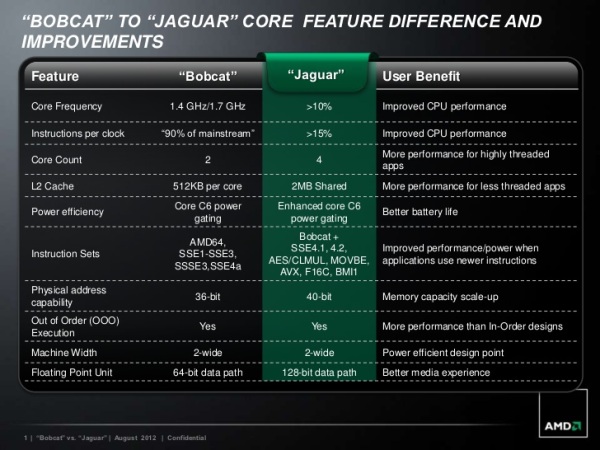
Fourth thing, AMD is doing that "focus across the board" thing. Everything is being focused on except the desktop PC. When you focus on nearly everything you are focusing on nearly nothing.
AMD will focus on APUs for the desktop, they have already said they will not compete against Intel in the high end Desktop arena. They will not stop designing and producing APUs for Desktop.
I'm curious what they think "agile and flexible" SOC methodology means to them
Jaguar is the 28nm Bobcat successor and it is not cancelled. Llano is not a SOC as you may know, this write-off has nothing to do with future SoCs plans.

happysmiles
Senior member
- May 1, 2012
- 340
- 0
- 0
AtenRa
Lifer
- Feb 2, 2009
- 14,003
- 3,362
- 136
really, really bad part:
no talk about kaveri and steamroller
They have talked about SteamRoller in HotChips 2012 and they have just released Desktop Trinity, i dont think they wanted to say anything about Kaveri as of yet.
They have talked about SteamRoller in HotChips 2012 and they have just released Desktop Trinity, i dont think they wanted to say anything about Kaveri as of yet.
So they are stopping desktop releases at Piledriver? Will they just clearance these chips out at this point with limited support?
AtenRa
Lifer
- Feb 2, 2009
- 14,003
- 3,362
- 136
So they are stopping desktop releases at Piledriver? Will they just clearance these chips out at this point with limited support?
Nobody have said they will stop at PileDriver, they are not going to compete against Intel's HighEnd Desktop (Core i7).
Jaguar is the 28nm Bobcat successor and it is not cancelled.
Jaguar is the successor to bobcat because they cancelled the 28nm Krishna and Wichita (28nm bobcat shrink) that were supposed to come out before Jaguar. Tick tock.
TRENDING THREADS
-
 Discussion Zen 5 Speculation (EPYC Turin and Strix Point/Granite Ridge - Ryzen 9000)
- Started by DisEnchantment
- Replies: 25K
-
Discussion Intel Meteor, Arrow, Lunar & Panther Lakes + WCL Discussion Threads
- Started by Tigerick
- Replies: 24K
-
 Discussion Intel current and future Lakes & Rapids thread
- Started by TheF34RChannel
- Replies: 23K
-

-


AnandTech is part of Future plc, an international media group and leading digital publisher. Visit our corporate site.
© Future Publishing Limited Quay House, The Ambury, Bath BA1 1UA. All rights reserved. England and Wales company registration number 2008885.
 Facebook
 Twitter