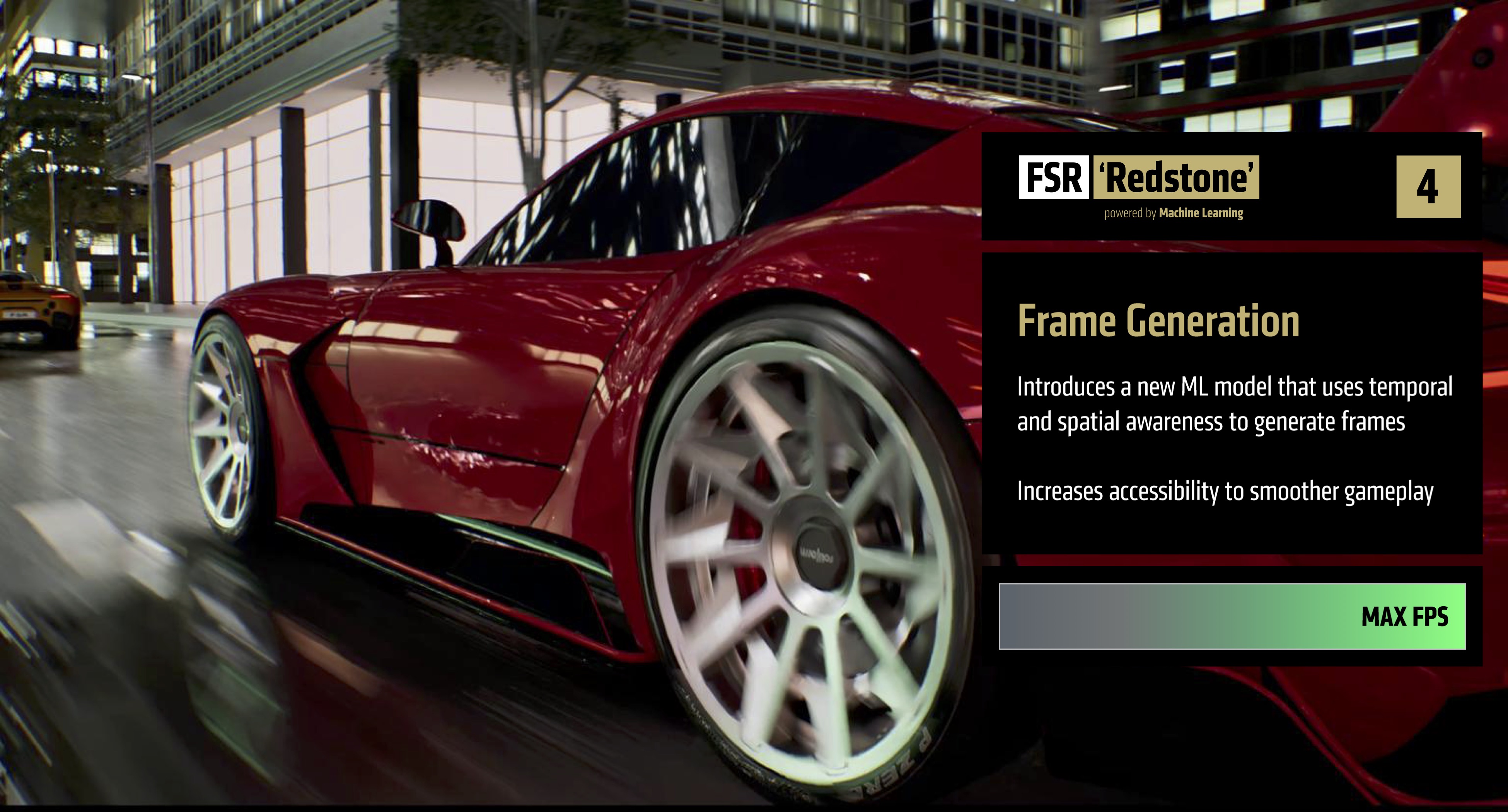
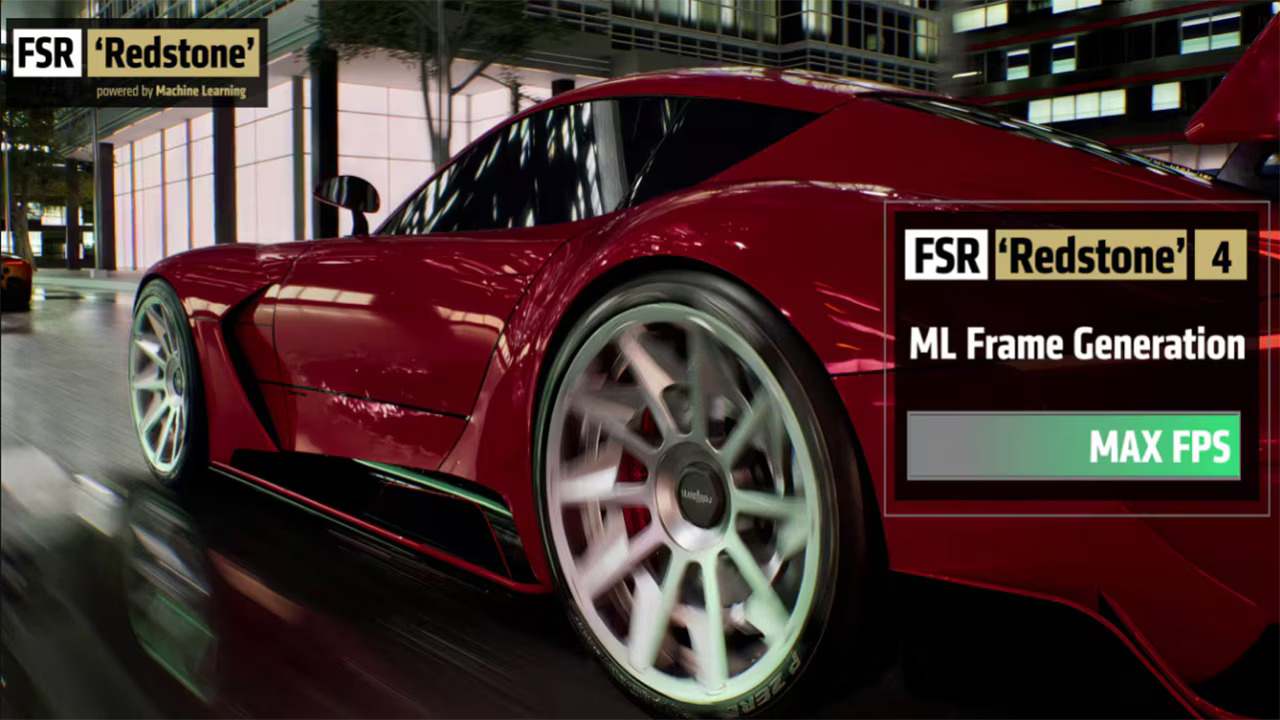
News AMD FSR 4 Redstone path tracing software uses ML2CODE framework to run on any GPU

marees

Platinum Member
Apr 28, 2024
2,091
2,702
96
A Japanese tech journalist came to USA & interviewed Chris Hall AMD's software head on ROCm & FSR 4 Redstone

It appears Redstone path tracing software can run on any GPU since it is compiled to shader code using ML2CODE framework


Screenshot_20250913-130704_Opera.jpg
ML2CODE is included in AMD's GPU computing (GPGPU) platform, ROCm 6.1 and later.

Rather than executing trained AI cores at runtime, it optimizes them as existing Compute Shader code and enables native execution.

 
Last edited:

Quintessa

Member
Jun 23, 2025
125
94
61
This is interesting and mostly plausible, but with caveats. ML2CODE converting model inference into generic compute shaders is a strong way to boost compatibility and avoid being locked to specific "AI core" hardware. But "any GPU" often means any GPU with sufficient shader performance and feature support which is not universal.
 

marees

Platinum Member
Apr 28, 2024
2,091
2,702
96
Last edited:
  • Like
Reactions: Kaluan

basix

Senior member
Oct 4, 2024
287
571
96
I think we are closing in on a release:
- HPG Talk about GATE (Neural Radiance Caching and Neural Ambient Occlusion): https://gpuopen.com/download/GATE.pdf
- FSR 3.1.4 Release in early August 2025, which brings some additional API compatibility with upcoming FSR Redstone
- FSR 4 "quasi-release" with FidelityFX SDK 2.0.0 in second half of August 2025
- Driver release with extended FSR 4 drop-in capabilities in early September 2025

So there seems to be some preparation work on-going. A release of FSR Redstone before the Holiday Season would make sense to me. So I somewhat expect something in the next 4-6 weeks.
 
Last edited:

marees

Platinum Member
Apr 28, 2024
2,091
2,702
96

marees

Platinum Member
Apr 28, 2024
2,091
2,702
96
.more reddit comments on ml2code


Some people are claiming they got the INT8 version of FSR4 working, which was accidentally leaked last month by AMD on Github.


It works even on nvidia GPUs lmao. On 7800 XT it takes 2ms to upscale 1440p balanced, not bad. And it works on windows unlike the emulated Linux method.

Edit: Theyre also claiming it should work well on RDNA2 as the performance shown here is without WMMA acceleration, which means this performance should be identical to something like a 6800 XT. That would be great for RDNA2 users if true.
 

marees

Platinum Member
Apr 28, 2024
2,091
2,702
96
Seems to me that AMD has a working solution here

Probably just a matter of scaling up by investing in more software engineers

As a side note: nvidia has more software engineers than hardware engineers


"FSR4 on RDNA3 is just clearly superior over FSR3.
Yea it's a performance hit but the resultant image quality is just much better."

 
Last edited:

soresu

Diamond Member
Dec 19, 2014
4,209
3,687
136
- HPG Talk about GATE (Neural Radiance Caching and Neural Ambient Occlusion): https://gpuopen.com/download/GATE.pdf
Highly likely this was already part of Redstone before the paper was published.

That being said you seem to have misread something.

GATE has nothing to do with NRC or NAO specifically, it's just a better system for working ML based gfx techniques in 3D scenes vs previous approaches (hash grids I think).

NRC and NAO were only used as examples in the paper and presentation to demonstrate GATE's efficacy vs said previous works.
 

basix

Senior member
Oct 4, 2024
287
571
96
Clear, NRC was probably worked on since some time (many months). But I assume GATE is part or groundwork of their NRC solution. Not that it actually is NRC ;)
To me, GATE is simply an indication that progress and solutions are there and in a quite well shape already (because you hear more and more about it). AMD has teasered their Ray Regeneration technique a while ago as well.

GATE seems to be more efficient than Hash-Grids, which could make stuff like NRC (via FSR Redstone) better and faster on more GPUs compared to Nvidias solution (SHarC is much faster than NRC, see RTXDI on github). And if the rumors are true that FSR Redstone will run on any GPU (e.g. with help of ML2CODE from ROCm) that could be an win for all gamers (Nvidia, Intel and maybe even console users included).
 
Last edited:
  • Like
Reactions: MrMPFR

marees

Platinum Member
Apr 28, 2024
2,091
2,702
96
Jack Hyunh comments from May

Redstone is the development code name and is likely to be a different name when it is officially announced. However, he also said, ''I still can't decide whether it will be FSR 5 or 4.1 or 4.5.''

Moreover, he said, ''I can't say for sure, but it would be possible to port it to another company's GPU.''.


basix

Senior member
Oct 4, 2024
287
571
96
FSR 5 would only make sense, if FSR Redstone invloves a clear quality upgrade of the Super Resolution algorithm. And surpasses DLSS4 as well. FSR 4.5 would make more sense, when they "just" add RR and ML-FG.

But maybe it turns out to be more of a marketing thing to indicate their leadership: AMD would be the first to go to "5", before DLSS reaches version 5 ;)
 

marees

Platinum Member
Apr 28, 2024
2,091
2,702
96
Contrast between ML2CODE approach vs DirectX approach

ML2CODE
it doesn't require AI or matrix math cores, just as Nvidia's DLSS technology requires Tensor cores. It can run on conventional GPU shaders. "ML2CODE-based frameworks, such as FSR Redstone, can be seamlessly integrated directly into DirectX or Vulkan graphics pipelines with minimal latency. We believe that the ML2CODE solution is the best way, at least for now, to integrate and deploy 3D graphics and AI technologies." Hall says.


DIRECTX
However, Hall does foresee future AMD graphics architectures that will have dedicated AI cores that are compatible with Microsoft's DirectX Cooperative Vector technology. "Cooperative Vector is a DirectX programming model. It's a framework that provides a way for programmable shader units to perform calculations using other accelerators. In other words, it's a framework that allows shader programs to utilize AI accelerators within the GPU. This is an excellent approach for implementing various AI styles.


"However, currently, significant delays can occur unless the GPU has an architecture specialized for DirectX Cooperative Vector technology. It's true that we're actively working on supporting Cooperative Vector," Hall says.


https://www.pcgamer.com/hardware/gr...one-ai-upscaling-tech-can-run-on-nvidia-gpus/
 

Thunder 57

Diamond Member
Aug 19, 2007
4,216
7,003
136
Jack Hyunh comments from May

Redstone is the development code name and is likely to be a different name when it is officially announced. However, he also said, ''I still can't decide whether it will be FSR 5 or 4.1 or 4.5.''

Moreover, he said, ''I can't say for sure, but it would be possible to port it to another company's GPU.''.


And I like it. It reminds me of the Redstone rocket that launched Alan Shepard and Gus Grissom into space. Maybe they will continue with Atlas, Titan, and Saturn :p .
 

marees

Platinum Member
Apr 28, 2024
2,091
2,702
96

Why this matters now: DLSS lock-in, XeSS, and consoles​

DLSS has been Nvidia’s stickiest moat: it’s good, and the best parts (frame gen) are limited to newer RTX parts. Intel’s XeSS already demonstrated that AI upscaling can fall back to shaders (DP4a) and still look decent, but adoption lags DLSS. AMD going all-in on a shader-based neural pipeline feels like a second attempt at the “works everywhere” promise—only now with ML-driven components beyond upscaling, including neural radiance cache that could make global illumination and RT more viable on mid-range hardware.

The console angle is massive. PS5 and Xbox Series systems run AMD silicon without dedicated AI blocks exposed for games. If Redstone’s compute path delivers stable image quality and sensible performance on those boxes, developers get a unified feature set across PC and console. That could accelerate adoption more than any PC-only tech ever could—and it would undercut the notion that you need Tensor cores to ship modern reconstruction and frame gen.

https://finalboss.io/amds-redstone-fsr-aims-to-run-on-any

On a beefy card with unused compute, fine. On older GPUs already compute-bound, adding neural upscaling plus frame gen could be a zero-sum trade: a higher “fps” number but more hitching or reduced RT quality because you had to drop effects to pay the shader bill. AMD will need to prove this works across the Steam hardware survey’s middle class—think GTX 1660/RTX 2060 up through RX 5700 and console-class RDNA 2/3—without turning every game’s settings menu into a compromise simulator.
 

soresu

Diamond Member
Dec 19, 2014
4,209
3,687
136
DLSS has been Nvidia’s stickiest moat
In gaming/gfx yes, but it's relatively recent and low impact compared to CUDA which is the real meat of nVidia's income, and the thing AMD most need to compete with in the long term.
 
  • Like
Reactions: Tlh97

basix

Senior member
Oct 4, 2024
287
571
96
Did anybody notice, that AMD has updated their Neural Supersampling blog post from September 2024? AMD held a presentation about their solution in May 2025, here the link to the corresponding paper (no public access): https://dl.acm.org/doi/abs/10.1145/3728297

Blogpost on gpuopen:
- Some example pictures
- Example video

It does not look perfect yet and worse than DLSS 4 Ray Reconstruction:
- Wobbly and blotchy light / shadows in case of fast movements
- Fine details are a bit blurred

According to the paper they are using a multi-faceted U-Net and no transformer. I wonder, if the final RR release contains a transformer element as well. Akin to FSR4, which uses parts of both CNN and Transformer models.
 

marees

Platinum Member
Apr 28, 2024
2,091
2,702
96
Did anybody notice, that AMD has updated their Neural Supersampling blog post from September 2024? AMD held a presentation about their solution in May 2025, here the link to the corresponding paper (no public access): https://dl.acm.org/doi/abs/10.1145/3728297

Blogpost on gpuopen:
- Some example pictures
- Example video

It does not look perfect yet and worse than DLSS 4 Ray Reconstruction:
- Wobbly and blotchy light / shadows in case of fast movements
- Fine details are a bit blurred

According to the paper they are using a multi-faceted U-Net and no transformer. I wonder, if the final RR release contains a transformer element as well. Akin to FSR4, which uses parts of both CNN and Transformer models.
My bet is they first release Redstone for PS5 pro & only after that for RDNA 4
 

Vikv1918

Member
Mar 12, 2025
71
194
66
It does not look perfect yet and worse than DLSS 4 Ray Reconstruction:
- Wobbly and blotchy light / shadows in case of fast movements
- Fine details are a bit blurred
1758567996683.png

1758568469802.png

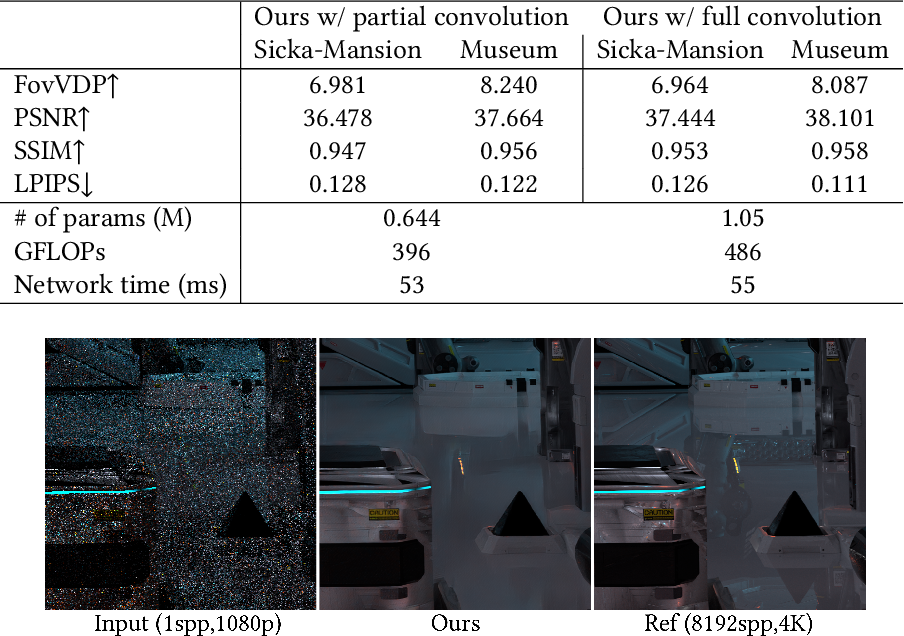
I get what you're saying, but considering the reference is 8000 samples per pixel and native 4K, compared to 1spp and 1080p for the top left image, its pretty close. It'd be great to have access to the paper to see if they provide any estimate on the performance for these.
 
Last edited:

basix

Senior member
Oct 4, 2024
287
571
96
It is a good step, sure. But as I am familiar with what DLSS4 RR produces, AMDs solution is not there yet.

I do not expect that AMD reaches that with their first RR solution. But some of the blotchy and unstable illumination is very distracting. AMD needs to fix that.
Little bit blurriness or lack of detail is less of an issue (altough I am a friend of crisp images). But especially glossy surfaces with reflections are missing details. Maybe their solution does not yet use multiple bounces for reflections. That could explain some of the missing features.

Here some numbers (execution time is on a MI210 with an unoptimized Pytorch implementation):
- 50...250ms just for the DNN is quite heavy
- DLSS4 RR has roughly ~2ms of Tensor Core utilization on a RTX4090 (4K DLSS-P with RR).
- 50% of peak FP8 throughput would yield in ~2ms on 9070XT as well (396 GFLOPS / ~390 TFLOPS * 50%). That should be realistic for an optimized implementation
13-Table3-1.png

15-Figure8-1.png
 
Last edited:

soresu

Diamond Member
Dec 19, 2014
4,209
3,687
136
Did anybody notice, that AMD has updated their Neural Supersampling blog post from September 2024? AMD held a presentation about their solution in May 2025, here the link to the corresponding paper (no public access): https://dl.acm.org/doi/abs/10.1145/3728297

Blogpost on gpuopen:
- Some example pictures
- Example video

It does not look perfect yet and worse than DLSS 4 Ray Reconstruction:
- Wobbly and blotchy light / shadows in case of fast movements
- Fine details are a bit blurred

According to the paper they are using a multi-faceted U-Net and no transformer. I wonder, if the final RR release contains a transformer element as well. Akin to FSR4, which uses parts of both CNN and Transformer models.
That was originally posted in October last year for the academic publication, and updated in late June for what I would assume to be the initial/early software results.

Given we are already roughly 3 months on you can expect some significant further tuning to have occurred since.