Fjodor2001
Diamond Member
- Feb 6, 2010
- 4,505
- 711
- 126


I agree. There will be a point where the LLM running with home hardware will be nearly as good as enterprise GPUs. Not for a while though. Maybe 10-15 years.True, but at the same time there is going to be diminishing returns for a lot of workloads. The current quality of cloud AI is already good enough for millions of customers as is. I don't think the cloud providers will ever vanish in the AI market, but their monopoly will go away as more memory and bandwidth becomes available to end users.

Yes, I'm doing the same. I've been 100% invested in semis since ChatGPT came out 3 years ago.I have, first by selling down my holdings of Nvidia and a few other high flyers (still hold some but not as much as I did) and quite recently via leveraged ETF "bear" funds against the semi industry. All the recent circle jerks with Nvidia investing in companies to buy more of their products was for me a leading indicator that we're in the terminal stages of the bubble.
I didn't short Nvidia because as Buffett says the market can remain irrational longer than you can remain solvent, so actual shorting is IMHO way too risky for any typical individual investor. Buying puts is a safer way to short but if you jump in too early (or choose a time horizon too far out) the theta will kill you.
If you believe AI growth is going to continue through the rest of the decade are you buying all the AI related stocks you can on margin? Are you loading up on far out of the money calls so you can cash in when they continue to grow and blow past your strike price? You want others to put their money where their mouth is, are you doing the same?
Keep in mind that it is 27% of x86 client market share. AMD is winning at the expense of Intel only. In other words, AMD is getting a bigger piece of the shrinking x86 pie.Here are some reference points for Client revenue: AMD vs. Intel
2022 Q3: $1.0 vs $8.1
2023 Q3: $1.5 vs $7.9
2024 Q3: $1.9 vs $7.3
2025 Q3: $2.8 vs $8.5 *
* The $8.5 billion is not apples to apples. It contains ~$900m to $1 billion of NEX division, so real number is probably ~7.3 - ~7.4 billion. Intel called it flat YoY, so that matches.
So, client $ market share of AMD went from:
2022 Q3: 10%
2025 Q3: 27%
Keep in mind that it is 27% of x86 client market share. AMD is winning at the expense of Intel only. In other words, AMD is getting a bigger piece of the shrinking x86 pie.
We know that similar to Crypto boom in "gaming", there is an AI boom in "gaming".
We will never find out from Jensen what percentage of "gaming" was Crypto. Similarly, we will never find out from Jensen what percentage of "gaming" now is AI. All we can do is estimate.
Gaming, in aggregate, has not gone up by 1/3 in last 4 quarters as NVidia reporting shows. Does not seem real to me.
Some people think the opposite, that gaming is in fact going down.
x86 has been steadily losing marketshare to Arm laptops over the past 5 years. I expect this to accelerate drastically as Qualcomm and Nvidia enter the market in big ways and Windows on Arm gets better quietly.Maybe shrinking slightly in inflation adjusted total, but in fixed dollars, kind of hovering around $10 billion total (per quarter) between Intel and AMD and likely sowing some growth in both 2025 and 2026.
Nothing remotely close to growth of the AI GPU market, but for AMD, with steadily growing Client Revenue and Market Share, it is a good, growing business.
Some people project that in ~3-5 years, material percentage of AI will shift from Cloud to Client, which could result in some AI fueled growth in client as well.
GAAP figures aren’t “useless”. They’re the legally required accounting standard that ensures comparability and auditability across companies. Non GAAP metrics can highlight operational trends but they also exclude real expenses like stock based compensation and amortization.
Analysts and investors who understand a business look at both. Ignoring GAAP entirely isn’t sophistication. It’s cherrypicking the numbers that make a company look better.
I'm aware of Xilinx amortization.In case of AMD, it is not just some cherry picking, but a big elephant in the room, in form of Xilinx acquisition. IIRC, the biggest acquisition in semiconductor industry.
Cost of the acquisition has then been gradually written off as depreciation of Good Will, which truly made AMD GAAP results useless especially for any company to company comparisons.
I'm aware of Xilinx amortization.
Regardless, don't be so attached to AMD. Had you invested in Nvidia/TSMC/Broadcom instead of AMD, you would have done far better over the last few years.
AMD is the darling amongst tech enthusiast crowd, which happens to be the Anandtech crowd. I get the bias favoring AMD here. I totally do. 90% of posters here are probably AMD fans because they own Ryzen CPUs. They feel like AMD saved them from Intel 4-core 14nm years.
A rising boat (AI boom) lifts all boats. But AMD isn't the boat I'm riding on.
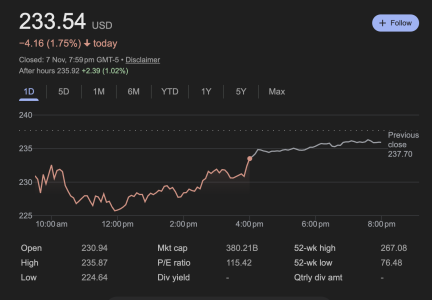
AMD's valuation $380.21B hinges on its ability to grab AI market share. That's why Wallstreet doesn't care about anything other AI in AMD's earnings.That's summary of my point. The point of disagreement waw when you said that in case of AI collapse, AMD would do worse than NVidia, which is something I disagreed with.
x86 has been steadily losing marketshare to Arm laptops over the past 5 years. I expect this to accelerate drastically as Qualcomm and Nvidia enter the market in big ways and Windows on Arm gets better quietly.
Furthermore, Arm owns the highend laptop market which is where most of the profit is. It wouldn't surprise me if Apple owns the lion's share of total laptop profits already.
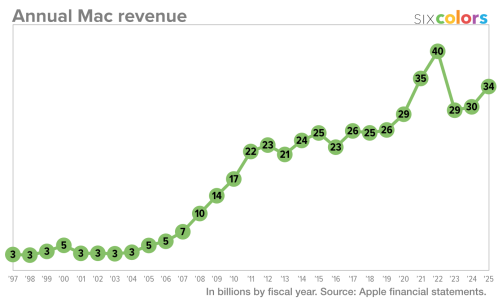
That's some of wildest copium I've seen yet here.Mac has reached a multiyear plateau and is now has correlation of ~1 to x86 shipments.
The ChromeBooks, one area of Arm penetration - they are now kaput.
Snapdragon had a good potential to make inroads, but has fizzled out even during the height of the hype cycle. May have shipped 720k units (but it is unknown from where to where it was shipped). Not necessarily to consumers.
Qualcomm projection of reaching 5% market share by the end of 2025 is now a very sad joke, may not reach 1%.
Apple in comparison ships ~ 6 million units per quarter
NVidia could make some inroads, we will see.
Apple does, not Arm. As Apple did when Apple used x86.
Snapdragon is being dumped at cheap prices, big discounts.

Idk WoA is every bit as stillborn as it ever was.It's not going to look pretty in the Windows on ARM world for x86 very soon.
It's a non problem now for most people.Idk WoA is every bit as stillborn as it ever was.
Yeah it is which is why QC is sub-1% PC share.It's a non problem now for most people.
Ah cool
Already responded to this point above.Ah cool
So you're taking the GAAP profitability which is depressed because of the way the xilinx deal is taken to the P&L to save tax. It's a much lower number of you take that out.
That's some of wildest copium I've seen yet here.
Apple has dominated high end laptops where most of the profits are. Since Apple Silicon, they're growing and it seems to be accelerating (minus Covid boom). Now that Apple is readying an inexpensive Macbook, growth should be robust from now on. Soon, a $599-$699 Macbook will have 15% faster ST speed than AMD's very best laptop chip.
View attachment 133509
Qualcomm's latest phone chip has faster ST speed than AMD's best laptop chip. It's not going to look pretty in the Windows on ARM world for x86 very soon.
I understand the feeling and I also use extensively LLMs to code (bioinfo research/ML), but all of this doesn't disprove in any way that current AI economics is a bubble.Yes, I'm doing the same. I've been 100% invested in semis since ChatGPT came out 3 years ago.
Not only that, in my profession (software engineering in a major Silicon Valley company), I've gone from using Stackoverflow via Google to asking ChatGPT via copy/pasting code, to now having agents write 95% of the code I ship. This all happened within 3 years.
Every single engineer on my team has gone through the same journey. And before anyone asks, no, our software quality did not drop. It increased significantly because LLMs can be leveraged for testing as well.
In my mind, there is no way the AI boom is done. We've only begun. There will be dips here and there but the market size in 2030 will be several times bigger than 2025. That's what I'm betting on. That's the majority wall street opinion as well.

The Internet was a Bubble 25 years ago.There were dozens of railroad bubbles yet we still have railroads.
The utility of an investment category does not preclude or limit the possibility of investor delirium. Often it seems to invite the most idiotic build outs that have no possibility of profit.
Ultimately I find it very hard to believe the current level of spending (causing shortages in many supply sectors, even as fundamental as turbines and electricity) cannot be the result of a bubble. It seems the most likely explanation. It does not seem like a new baseline of activity. It is eagerness to be the one who captures the market.
I don't think this will happen any time soon. The only way that could be true is if we hit a cap on the effective size of a model, but since they are still so much smaller than the human brain, I think that any way a model gets cheaper will not just be used to fit what we already have into consumer hardware but also to make frontier models bigger.I agree. There will be a point where the LLM running with home hardware will be nearly as good as enterprise GPUs. Not for a while though. Maybe 10-15 years.




 Facebook
 Twitter