• We’re currently investigating an issue related to the forum theme and styling that is impacting page layout and visual formatting. The problem has been identified, and we are actively working on a resolution. There is no impact to user data or functionality, this is strictly a front-end display issue. We’ll post an update once the fix has been deployed. Thanks for your patience while we get this sorted.

Discussion AMD Cezanne/Zen 3 APU Speculation and Discussion

Page 21 - Seeking answers? Join the AnandTech community: where nearly half-a-million members share solutions and discuss the latest tech.

dr1337

Senior member
Fresh leak out today, not much is known but at least 8cu's is confirmed. Probably an engineering sample, core count is unknown and clocks may not be final.

This is very interesting to me because cezanne is seemingly 8cu only, and it seems unlikely to me that AMD could squeeze any more performance out of vega. A cpu only upgrade of renoir may be lackluster compared to tigerlake's quite large GPU.

What do you guys think? Will zen 3 be a large enough improvement in APU form? Will it have full cache? Are there more than 8cus? Has AMD truly evolved vega yet again or is it more like rdna?
 
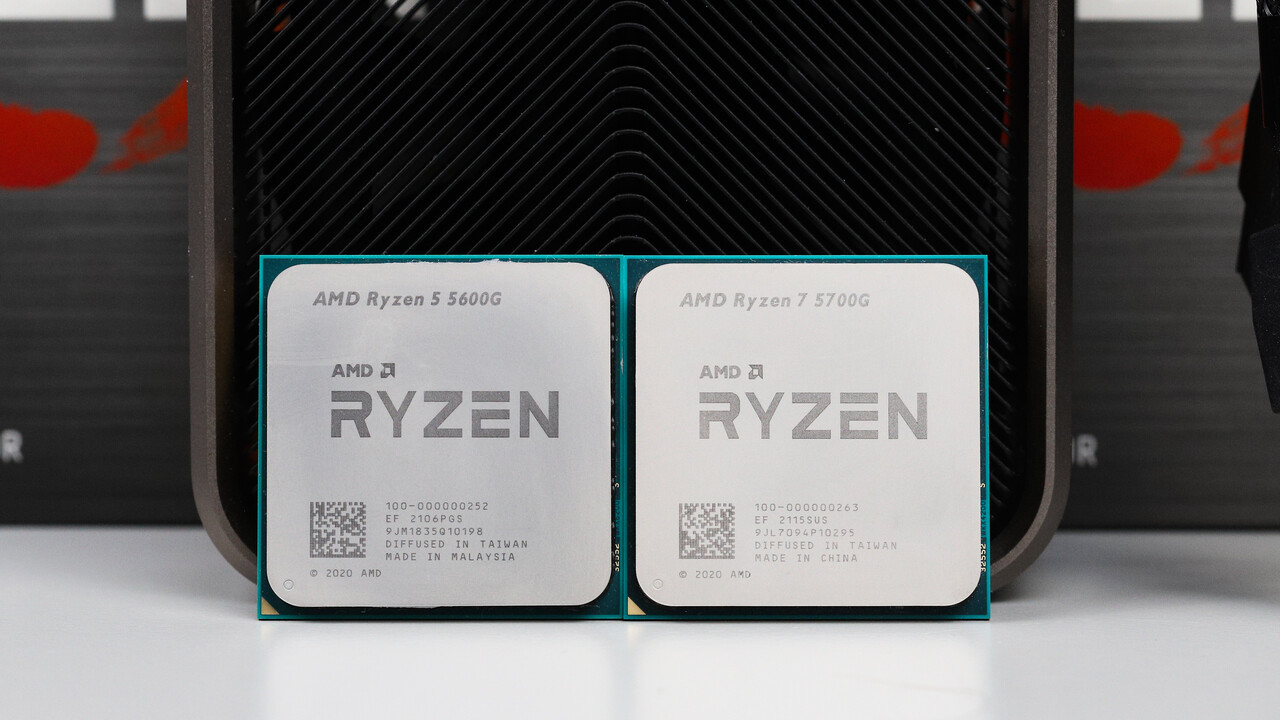
5700G die is 180 mm2, not sure what need to be shrinked
To reach the low budget "niche" market AMD would need to shrink the profit margin which they'll try to avoid doing as long as the products sell perfectly fine at the current prices and margins. 😉

Once supply beats demand (whenever that may be) lower margin products will reappear.
 
To reach the low budget "niche" market AMD would need to shrink the profit margin which they'll try to avoid doing as long as the products sell perfectly fine at the current prices and margins. 😉

Once supply beats demand (whenever that may be) lower margin products will reappear.

Also, the "shrinking need" need for N7/N6 will be because they've moved tons of products to N5 but there is wafer capacity available on the previous Node.

AMD in growth mode needs to be smart about growing their market share with the wafers they can get, not the wafers they necessarily want.
 
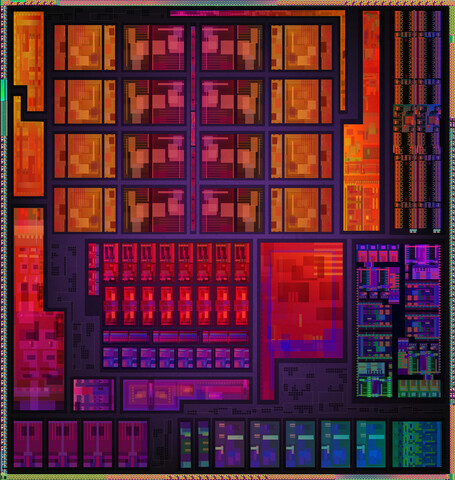
5700G die is 180 mm2, not sure what need to be shrinked since they can get something like 320 functional dies out of a waffer, dunno the exact waffer cost but seems that it got below 8000$ when Vermeer was released.

11-630.c1597b03.jpg


For comparisson, Renoir R7 Pro 4750G has 156mm2 die size.

 
5700G die is 180 mm2, not sure what need to be shrinked since they can get something like 320 functional dies out of a waffer, dunno the exact waffer cost but seems that it got below 8000$ when Vermeer was released.

11-630.c1597b03.jpg


I though earlier estimates had it at 175mm², but I guess that 180mm² is "rund 180 mm² große Chip".

Anyway, plugging the SqrtRt of 180 (13.4mm) into this:
wafer yield calculator with a defect rate of 0.09 per cm² gives us this (TSMC gave that defect rate a good while back so it should hopefully be a lot better now):
UUDnY9r.png

Your 320 figure was assuming no defects.
The calculator expects 269 good dies per wafer although not all the 47 'defect' dies would be waste as with some of them they could disable a CU or core, etc.
On the other hand, not all good dies will bin at the kind of clocks or voltages they want, but since Cezanne isn't a single SKU console those should be useable somewhere.
$8000 is a bit optimistic, 7nm wafer are meant to be more like $12000+.
Anyway while wafers are scares, I guess the comparison for AMD is how many CCDS could they make instead?
 
5700G die is 180 mm2, not sure what need to be shrinked since they can get something like 320 functional dies out of a waffer, dunno the exact waffer cost but seems that it got below 8000$ when Vermeer was released.

I think you misunderstand what I was saying. Someday they're gonna move all their high-profit stuff off N7/N6. That's what I meant by "shrinking family of products". I did not imply that anything in particular needed a die shrink.
 
To reach the low budget "niche" market AMD would need to shrink the profit margin which they'll try to avoid doing as long as the products sell perfectly fine at the current prices and margins. 😉

Once supply beats demand (whenever that may be) lower margin products will reappear.

APUs prices are somewhat unrealistic these days given that they are supposed to cover the low cost segment.

Hope thIs will filled either with Renoir, wich would allow for a 8C, but that s doubtfull since it would eat on the 7nm budget, or more likely with Van Gogh.
I though earlier estimates had it at 175mm², but I guess that 180mm² is "rund 180 mm² große Chip".

Anyway, plugging the SqrtRt of 180 (13.4mm) into this:
wafer yield calculator with a defect rate of 0.09 per cm² gives us this (TSMC gave that defect rate a good while back so it should hopefully be a lot better now):
UUDnY9r.png

Your 320 figure was assuming no defects.
The calculator expects 269 good dies per wafer although not all the 47 'defect' dies would be waste as with some of them they could disable a CU or core, etc.
On the other hand, not all good dies will bin at the kind of clocks or voltages they want, but since Cezanne isn't a single SKU console those should be useable somewhere.
$8000 is a bit optimistic, 7nm wafer are meant to be more like $12000+.
Anyway while wafers are scares, I guess the comparison for AMD is how many CCDS could they make instead?

Actually i did put the recoverable dies at 90%, and when i said functional dies this include the 6C/7CU parts where either a core or a CU has been disabled due to a defect in the silicon.

FI if the GPU is 40% of the area then 40% of the defects will be concentrated in the GPU, wich can be neutered by disabling a CU, and so on with defects that are on a core out of 8.

As for the waffer price it was stated by some exec (Lisa Su or some TSMC head) as shifting below 8k from the 12k or so when Zen 2 was released.
 
I though earlier estimates had it at 175mm², but I guess that 180mm² is "rund 180 mm² große Chip".
"rund 180 mm²" translates to "around 180 mm²" which means it's a fuzzy rounded number, 175 mm² may still be more correct.

APUs prices are somewhat unrealistic these days given that they are supposed to cover the low cost segment.
That's your expectation. These APUs are clearly not part of the low cost segment though. Why would they? Honestly it's insane enough that people expect a bigger monolithic chip with iGPU to be cheaper than a similar featured MCM chip without iGPU. The only reason this still makes somewhat sense for these particular chips is the significantly cut L3$ and lack of PCIe 4, and they are cheaper than the X-counterparts as a result.
 
That's your expectation. These APUs are clearly not part of the low cost segment though. Why would they? Honestly it's insane enough that people expect a bigger monolithic chip with iGPU to be cheaper than a similar featured MCM chip without iGPU. The only reason this still makes somewhat sense for these particular chips is the significantly cut L3$ and lack of PCIe 4, and they are cheaper than the X-counterparts as a result.

And they probably cost more to make.
These are, some do forget, first and foremost a mobile product which has a use on desktop too but still a mobile product. Less interesting dies will be sold as desktop parts. Just recycling.
 
Also, the "shrinking need" need for N7/N6 will be because they've moved tons of products to N5 but there is wafer capacity available on the previous Node.

AMD in growth mode needs to be smart about growing their market share with the wafers they can get, not the wafers they necessarily want.

They will continue to crank out 7nm console APUs for years to come, eating up a big chunk of their wafers. And no doubt they will also want to move their IODs from 12/14nm onto a smaller process at some point.
 
And they probably cost more to make.
These are, some do forget, first and foremost a mobile product which has a use on desktop too but still a mobile product. Less interesting dies will be sold as desktop parts. Just recycling.
Indeed, and the mobile market clearly is the focus. That very likely ate up supply for the low cost desktop segment to begin with. Like supply of the Dali-based 3000G disappeared right at the point AMD announced the Dali-based Chromebooks. Guess those are selling well. (Supply of 3000G actually has improved in Germany lately, but still far above the price from a year ago.)
 
Keep in mind, there's no need for their N7 parts to dip too low in the market. AMD has a quad core Zen2 based APU on 12LP coming from GF real soon now. No idea on the GPU side of it, but, it would be real gracious of them to include an at least 8CU VEGA section on it. The 48EU version of Xe in the low end Tiger Lake parts is notably better than the Vega 3 iGPU in Dali/Raven2.
 
AMD has a quad core Zen2 based APU on 12LP coming from GF real soon now. No idea on the GPU side of it, but, it would be real gracious of them to include an at least 8CU VEGA section on it.

I'd be really happy if they include an AV1 capable HW decoder (VCN 3.0) too. That'd be the perfect HTPC chip. But it's perhaps too much to ask for, given the segment.
 
Supposedly RDNA2 based iGPU right? So there is some hope...
Imo RDNA2 including VCN3/AV1 is more likely than a high amount of CUs. It's still a low budget part. Modern hardware acceleration is a selling point there, whereas comparably low CPU and GPU performance is to be expected.

I don't think this will directly compare to Tiger Lake considering the use of 12nm instead something more modern rather points to a budget even below that.
 
The Tigerlake Celeron 6305, which is decidedly low end, still has a 48EU Xe iGPU that will run circles around VEGA3 and includes all of the most recent CODECS. If they are trying to be competitive at the low end, and releasing something this year, it HAS to be better than Vega 3 in Dali. Just doing 4 RDNA2 CUs would be a dramatic improvement and likely just be competitive...
 
I bring some bad news, it seems for some reason RMB lacks AV1 decode.

I don't get why. Van Gogh has the full RDNA2 media block, but RMB has a trimmed one.

 
I bring some bad news, it seems for some reason RMB lacks AV1 decode.

I don't get why. Van Gogh has the full RDNA2 media block, but RMB has a trimmed one.

Relevant table:
1628105620846.png

If true that's just stupid...
 
I bring some bad news, it seems for some reason RMB lacks AV1 decode.

I don't get why. Van Gogh has the full RDNA2 media block, but RMB has a trimmed one.

Yeah, that's just retarded, if true. Even 14nm Rocket Lake has it!
 
phttps://www.anandtech.com/show/16824/amd-ryzen-7-5700g-and-ryzen-5-5600g-apu-review/12

Isn't Ian IGP tests nonsensical?
Very low resolutions, even 360p all lowest quality. Who plays like that? Won't "real people" not use a mix of settings to get maximum quality possible at playable framerates? Aren't these new IGPs enough to 720p-900p medium?
Them he tests 1080p and even 4K at high and ultra. Why? We already know that it's possible with these IGPs, what the public wants to know is what sort of experience they can actually get with these APUs, but these tests don't answer this question, they mean nothing.
 
phttps://www.anandtech.com/show/16824/amd-ryzen-7-5700g-and-ryzen-5-5600g-apu-review/12

Isn't Ian IGP tests nonsensical?
Very low resolutions, even 360p all lowest quality. Who plays like that? Won't "real people" not use a mix of settings to get maximum quality possible at playable framerates? Aren't these new IGPs enough to 720p-900p medium?
Them he tests 1080p and even 4K at high and ultra. Why? We already know that it's possible with these IGPs, what the public wants to know is what sort of experience they can actually get with these APUs, but these tests don't answer this question, they mean nothing.

I expect they will be exhaustively reviewed right after they finish the Ampere and RDNA2 GPU family reviews.

😉
 
As for these reviews, I think it's really nonsensical for the iGPU reviews as well.

Additionally I really think the important point to be evaluated is what can the end-user expect with minimal customization.

My 5600X has DDR4-4000 RAM with IF at 2000 and PBO +200 and literally, just enabled XMP and set PBO to +200 MHz. My Geekbench 5 score is 1720, which beats all the chips in the review.

What I think most users want to know is how does that compare on the 5700G, 5600G, and how does it compare with simple Intel overclocking.

The average end-user and corporate IT purchaser might be interested in what Dr Cutress tests, but anyone reading Anandtech is going to be FAR more interested in at least basic overclocking.
 
If i learned something from testing these APUs is that making a review is hard, tech sites stick to quality presets and quality presets is bad for these APUs. I did not post my results yet because while i was dumping the data to excel i realised there is something off with dynamic VRAM ON, so im investigating a little more.
 
Yeah i knew something was off, the miner is far better to detect the inefficiency of dynamic vram, i did notice this by looking at the graphs of origins and shadow of the tomb raider, dynamic vram affects the minimums and causes more shuttering. While static vram gives more smooth experience, but this is not reflected on the avg fps. Take that HU.

This is the 5700G
512MB+Dynamic
M5MmzcD.png

8GB static
P7N6RxK.png


Also, dynamic vram in the 5700G is 6GB, im petty sure the 5600G was unable to start the miner on only dynamic, i need to check the 5600G again.
 
Back
Top