• We’re currently investigating an issue related to the forum theme and styling that is impacting page layout and visual formatting. The problem has been identified, and we are actively working on a resolution. There is no impact to user data or functionality, this is strictly a front-end display issue. We’ll post an update once the fix has been deployed. Thanks for your patience while we get this sorted.

Question AIO over Air cooled?

terpsy

Platinum Member
I have seen the new Montech, Arctic, and Thermalright AIO offerings and their aggressive pricing that is enticing.

I have always been shy to pull the trigger on an AIO, fearing that adding more failure points into the system risks larger potential loss.

the common failure point of both setups is the fans, which are replaceable quickly.

I am afraid of a pump failure I may be unaware about at first, or leaks! (rare from what I have seen, but possible)

Does the manufacturer of the AIO cover the loss from leaks during their warranty period? How can you prove it was strictly a defect, and they won't say you did something wrong, and you eat the replacement costs?

I know a quality AIR cooler can keep pace with an AIO, but the AIO should be better at load temperature controlling, and longer sustained cooling (if I am reading that right?)

I would love to hear your experiences and thoughts.

Danke!
 
I've never installed an AIO but I don't understand why the fans would be a common point of failure, surely they'll be approximately as likely to fail as any other cooling fan?

In my line of work (computer repair), I wouldn't regard fans as a common failure point. I would say as the tech has improved, fans in general run at lower rotational speeds and that's the reason why I'm seeing fans fail less often than I used to. Maybe I replace one a year these days?
 
I'm sure what OP meant by "common failure point" is not that fans fail often. He meant just that fans are used in both systems, so there is no difference there.

I do not use AIO. I agree that a good fan system can do the job for most users, with the exception of VERY high workload systems using high-power CPU's heavily. For CPU's of less-than-high power, GOOD air-cooled fan units can keep them cool for long sustained work.

Failure of AIO systems can come about in many ways. Pump failure is the most drastic because that means little or NO movement of heat from CPU to rad, so NO CPU cooling. Complete pump failure, or dramatically reduced pump capacity, is often very clear in high CPU temps, throttling and shutdowns. If this happens early it may be covered under a warranty. But most people would expect such failure after about 5 years, maybe longer. A related type of failure is clogging of the liquid loop by corrosion or biological debris, causing very slow fluid flow even though the pump is working properly. A third phenomenon can be corrosion and loss of part of the pump impeller leading to poor fluid flow rate, which is hard to recognize but also NOT common.

One common failure mode is loss of coolant fluid leading to air bubbles in the system and poor flow rate. This can happen by big leaks, but that is not common. Such a large leak might be covered under warranty. MUCH more commonly the fluid leaks VERY slowly out of the system, so it builds an air bubble in one spot that expands slowly. That is why the installation instructions advise how to arrange the pump, rad and hoses to isolate the air bubble at a safe location. Eventually this process will slow down fluid flow and reduce cooling capacity, but that is NOT covered under a warranty.

AIO systems generally are supplied fully assembled and with no provision for servicing or for re-filling the fluid level. There ARE some such systems on the market that DO have a filling port with a replaceable plug. To do that you need to get the right fluid, but that can be done with advice from the system maker. Those are not the common design. Unless you have that refillable type, there is NO way for you to do such a repair, and your only option is to replace the entire system.
 
I've been using AIOs for awhile.
I like my computers really quite and I find that an AIO with low rpm fans can cool a couple very well with little noise.
Also partly I switched over from air cooling when air coolers got ludicrously heavy. Once you've got the radiator installed it's way easier to work around an AIO cooler than the mahoosive air coolers that way a Kg or so and block access to most of the motherboard.
I suppose that pump failure is a thing but I've not had it happen to me in the several years I've been running AIOs plus even if the pump did fail all that's going to happen is the CPU is going to throttle and I'll get some temp warnings, nothings going to be permanently damaged.

Now I guess a water leak is genuine issue if it happens but I've never met anyone that's actually had that problem so it's not something I'm going to worry about. It's not like AIOs are pressurised system!

Honestly they are great at cooling, very quiet, look nice (if that's your thing) and easy to work with. There's not a lot not to like!
 
I've been using AIOs for awhile.
I like my computers really quite and I find that an AIO with low rpm fans can cool a couple very well with little noise.
Also partly I switched over from air cooling when air coolers got ludicrously heavy. Once you've got the radiator installed it's way easier to work around an AIO cooler than the mahoosive air coolers that way a Kg or so and block access to most of the motherboard.
I suppose that pump failure is a thing but I've not had it happen to me in the several years I've been running AIOs plus even if the pump did fail all that's going to happen is the CPU is going to throttle and I'll get some temp warnings, nothings going to be permanently damaged.

Now I guess a water leak is genuine issue if it happens but I've never met anyone that's actually had that problem so it's not something I'm going to worry about. It's not like AIOs are pressurised system!

Honestly they are great at cooling, very quiet, look nice (if that's your thing) and easy to work with. There's not a lot not to like!
Admittedly the physical size of higher-end air coolers has been getting on my nerves. My NH-D15S cooling my 7800X3D absolutely dominates the top half of my board, obscuring access to the first M.2 slot as well as the securing clip for the graphics card.

I'm firmly in "if it ain't broke don't fix it" territory now though; my computer runs quietly enough at idle that I have to listen carefully to hear noise from it (once the HDD has powered down). It's not silent on load but I rarely care about that. I'd like to try installing an AIO but I'm not going to experiment on my main PC and I would need to invest sufficiently in high-enough-end hardware to properly test it out. Maybe if I max out the CPU with AM5's final gen 16c CPU? It would be handy for Handbrake work.
 
Admittedly the physical size of higher-end air coolers has been getting on my nerves. My NH-D15S cooling my 7800X3D absolutely dominates the top half of my board, obscuring access to the first M.2 slot as well as the securing clip for the graphics card.

I'm firmly in "if it ain't broke don't fix it" territory now though; my computer runs quietly enough at idle that I have to listen carefully to hear noise from it (once the HDD has powered down). It's not silent on load but I rarely care about that. I'd like to try installing an AIO but I'm not going to experiment on my main PC and I would need to invest sufficiently in high-enough-end hardware to properly test it out. Maybe if I max out the CPU with AM5's final gen 16c CPU? It would be handy for Handbrake work.
That's why I pursued the story I told in the Ocypus thread. There are good Air-cooling heatpipe coolers out there -- several. The NH-D15S is great, but probably the most unwieldy of the current options. Then, there's the ThermalRight Phantom Spirit, TR Royal PRetor 130 -- both edging close to AIO water-cooling performance. And so my story has me finding a stray, brand-new ThermalRight Le Grand Macho RT, which I explain in that thread.

But -- suit yourselves. Some, like WelshBloke, are comfortable with AIOs. I can't ignore NASA's pronouncement of the MTBF estimate for heatpipe coolers -- a million years.

While I cannot overclock the latest processors quite as well as I might with water-cooling, it just isn't necessary. WelshBloke may have mentioned the weight of standard heatpipe cooler configurations, but I've been able to reduce the weight. I duct the rear case-fan -- something like a Noctua iPPC 3000 120mm fan -- to the rear/output side of the cooler. The Macho which I mentioned actually has TR accessory silicon-rubber accordion ducts you can buy, or you can build a duct with black foam art-board. For the Macho, you might still have a single fan pushing from the front, or you could simply rely on the rear-exhaust case-fan to do the job. But it's the fans which add to the weight -- translated into torque to stress the motherboard. It's not likely a serious problem, though.
 
I've never installed an AIO
Was not expecting that from you. How come not a single one of your customers has ever wanted an AIO cooler? That's just plain weird. The main thing that's attractive to me about AIO coolers is that the baseplate/pump portion is much easier to install and the RAM clearance is a big plus since I love to tinker with different RAM sticks. With a huge heatsink, that immediately becomes a no-no. I've so far tried only 240mm AIOs. The radiator is big enough that I shudder to think how much harder installing a 360 or 420mm one is going to be. In my two installations so far, I have NOT been able to get the radiator installed on top without issues. There just isn't enough space above the mobo to do that in the cheap cases I opt for.

In fact, one of my cases has the radiator installed on top with just two screws because the whole radiator is tilted and one screw is sticking out on top of the case! Trust me, I tried my best to push that radiator into place as much as I could but there just wasn't any space.

The second case is even funnier! The radiator is installed in front and the whole case is turned on the side so the radiator appears on the top to benefit from gravity!
 
I am in the water and computer don't mix camp. I just upgraded my 3700X to 5950x and a Thermalright PS120SE. I like how the fans are clipped on and easy to adjust for ram height or replace the fan. Supposed to be good up to 200W and the cpu is capped at 142W max.

Thing is I have never had a dead fan, ever.
 
Last edited:
I've done the AIO thing. It was fun when it was the new thing in 2014. After my 4790K system died of a leak in the AIO. FML. So, when I built my rig in my sig, I went back with air cooling. It's rather large NH-D15. It cools my 16-core 5950X and is nearly silent. My case is large enough to handle it. I easily adjusted the first fan to allow clearance for the ram modules. I don't really need to play with anything as I overbuilt it. Here's a video I made in 2021 when I put it together. It has 2 x 2TB m.2, 3 x 2TB HGST enterprise drives (HDD) and my old 72GB Raptor from 2005!

 
Last edited:
It's rather large NH-D15. It cools my 16-core 5950X and is nearly silent.
Well, TBH even your cat is silent so something is wrong. J/K!

I'm not sure if 5950X is a good candidate for showcasing the power of a cooling solution coz AMD CPUs generally don't run crazy hot. Now if that were a 14900K or even a 14700K, that would be impressive. But yeah, silent fans are awesome. Everyone needs them. The ones on my two AIOs are ridiculously loud. I think the only nearly silent fans I have are on my Arctic Freezer cooler for my Epyc.

The only time I have found fan noise to be "useful" is when being time constrained at work, working on a large Excel sheet and some formula pegs all cores at 100%. I switch to browsing and wait until the fan noise dies down because that tells me the calculation is done.

By the way, you have a REALLY nice voice! You should be a narrator or something.
 
I am in the water and computer don't mix camp. I just upgraded my 3700X to 5950x and a Thermalright PS120SE. I like how the fans are clipped on and easy to adjust for ram height or replace the fan. Supposed to be good up to 200W and the cpu is capped at 142W max.

Thing is I have never had a dead fan, ever.
I suppose even if non-conductive liquid was used in the AIO, it would still probably damage stuff. My first thought was seeing a PCB bloat with liquid absorption but plastic probably doesn't do that 🙂

I replaced a 12cm chassis fan in my Haswell build after about ten years of use IIRC. It didn't outright fail, it made annoying squeaky type sounds because (presumably) the lubrication of the bearings failed. Since my AM3 build in 2010, I don't think I stayed with a CPU fan realistically long enough for it to fail; I switched from a stock cooler to a better one a few years in, then re-used that cooler on my Haswell upgrade for a few years then switched to a BQ Pure Rock Slim, then on to AM5/NH-D15S in 2023. Realistically I can't see myself changing CPU or HSF for many years so this Noctua fan is going to see a good bit of long-term use.
 
I spent a fair bit of time in server rooms. Fan noise at home don't bother me.

I think the fact that I've been self-employed for over twenty years in a quiet job has something to do with my intolerance for unnecessary background noise. That and a touch of tinnitus.
 
I think the fact that I've been self-employed for over twenty years in a quiet job has something to do with my intolerance for unnecessary background noise. That and a touch of tinnitus.
I always carry ear plugs if I need to go to server room xd

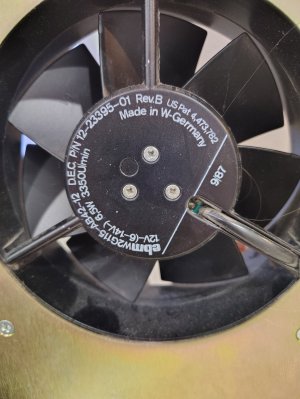
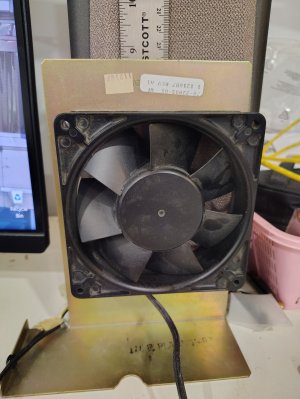
I still have a fan from a DEC VAX that is all metal. Works fine.
 
Last edited:
You know it's old when it says "Made in W. Germany" 😀

<cue stereotypical German WW2-era music when the fan is powered up>
 
You know it's old when it says "Made in W. Germany" 😀

<cue stereotypical German WW2-era music when the fan is powered up>
Sept 1987 according to the marking. The only suitable music would be "The Ride of the Valkyries". Says Made in W Germany but the speed marking is in German U/min. as opposed to RPM.

 
Last edited:
Well, TBH even your cat is silent so something is wrong. J/K!

I'm not sure if 5950X is a good candidate for showcasing the power of a cooling solution coz AMD CPUs generally don't run crazy hot. Now if that were a 14900K or even a 14700K, that would be impressive. But yeah, silent fans are awesome. Everyone needs them. The ones on my two AIOs are ridiculously loud. I think the only nearly silent fans I have are on my Arctic Freezer cooler for my Epyc.

The only time I have found fan noise to be "useful" is when being time constrained at work, working on a large Excel sheet and some formula pegs all cores at 100%. I switch to browsing and wait until the fan noise dies down because that tells me the calculation is done.

By the way, you have a REALLY nice voice! You should be a narrator or something.
Under load, the 5950X can reach 90°+ and that's normal. If you don't have adequate cooling, it will throttle. AMD recommends an AIO.
 
Back
Top